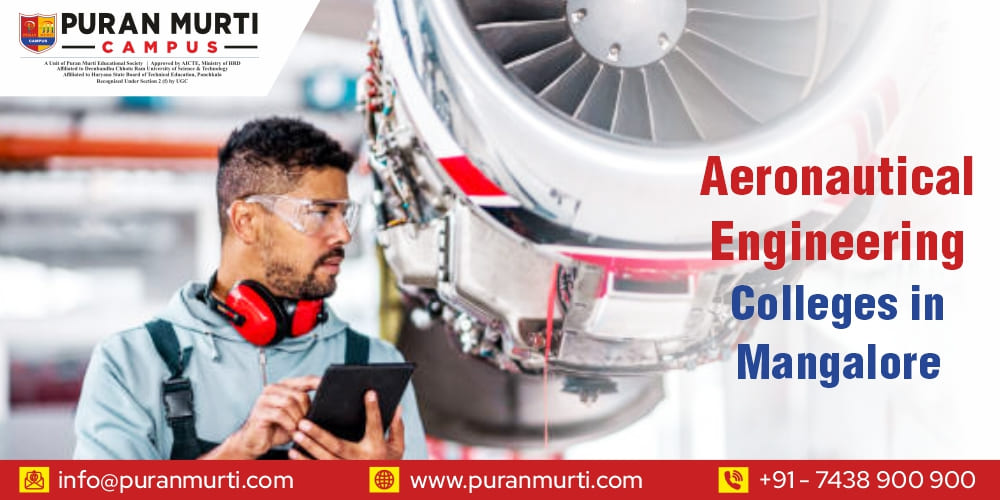
Aeronautical Engineering Colleges in Mangalore
Posted on : 9 February, 2026 2:13 pm
The biggest choice for students arises when they must pick their career path after completing their 12th-grade education. If you are fascinated by aircraft, helicopters, drones, space technology, and aviation systems, then Aeronautical Engineering can be the perfect career path for you. Here is the Aeronautical Engineering Colleges in Mangalore
The increasing growth of the aviation and aerospace industries in India has led students from Mangalore Karnataka and nearby coastal regions to search for “Aeronautical Engineering colleges near me.”
The blog provides detailed information about all Aeronautical Engineering Colleges located in Mangalore by evaluating their academic structure and campus facilities and their methods of preparing students for professional careers which follow the educational standards of Puran Murti Vidyapeeth that specializes in technical education for professional development and practical industry training. Apply Now
What Is Aeronautical Engineering?
Aeronautical Engineering exists as an engineering branch which focuses on design development and testing and operation and maintenance of aircraft that people use to fly throughout the Earth’s atmosphere. Apply Now
This field focuses on:
-
Aircraft structure and materials
-
Aerodynamics (airflow and flight mechanics)
-
Aircraft propulsion (engines)
-
Flight control systems
-
Avionics and navigation systems
The students who select this program learn to handle work related to airplanes and helicopters and drones and military aircraft.
Why Study Aeronautical Engineering in Mangalore?
Mangalore has developed into a coastal Karnataka educational center which provides students with excellent engineering programs and a tranquil environment and lower living expenses than metropolitan areas.
Key advantages for students:
-
Good engineering colleges and technical institutes
-
Strong science education background
-
Close to aviation hubs like Bengaluru
-
Suitable for focused academic life
-
Lower hostel and living expenses
The Mangalore area has few Aeronautical Engineering colleges but their popularity continues to grow because of rising interest in aviation professions. Apply Now
Aeronautical Engineering Colleges in Mangalore (Overview)
Currently, very few colleges in Mangalore offer Aeronautical Engineering directly, but students can still pursue this course through:
-
Aerospace-related engineering branches
-
Higher studies after diploma or UG
Institutions in Mangalore follow AICTE/University-approved curriculum, similar in structure to reputed campuses like Puran Murti Vidyapeeth, which focuses on strong fundamentals and industry exposure. Apply Now
Course Structure – What Students Study
The Aeronautical Engineering syllabus has been designed to develop both technical skills and practical abilities.
Semester first:
- ENGLISH LANGUAGE SKILL
- MATHEMATICS – I
- PHYSICS
- BASIC ELECTRICAL ENGINEERING
- ENGINEERING GRAPHICS & DESIGN
PRACTICAL
- ENGLISH LANGUAGE LAB
- PHYSICS LAB
- BASIC ELECTRICAL ENGINEERING LAB
- INDUCTION PROGRAM
Second Semester
- MATHEMATICS-II
- CHEMISTRY
- PROGRAMMING FOR PROBLEM SOLVING
- WORKSHOP/ MANUFACTURING PRACTICES
PRACTICAL
- CHEMISTRYLAB
- PROGRAMMING FOR PROBLEM SOLVING LAB
- IN-HOUSE PRACTICALTRAINING
Third Semester Apply Now
- Engineering Economics
- Mathematics – III (PDE, Probability & Statistics)
- BIOLOGY FOR ENGINEERS
- Basic Electronics Engineering
- Elements of Aerodynamics
- THERMODYNAMICS
- Constitution of India
PRACTICAL
- Elements of Aerodynamics Lab

Fourth Semester
- Aircraft Material & Processes
- Aircraft Performance
- Aircraft System & Instrumentation
- Aircraft Propulsion
- Aircraft structure
- Environmental Studies
PRACTICAL
- Aircraft Propulsion lab
- Aircraft Structure Lab
Fifth Semester
- Aero Engine Design
- Aircraft Structure Analysis & Design
- Aircraft Stability & Control
- Compressible & Finite Wing Aerodynamics
- Theory of Machines
PRACTICAL
- Aircraft Structure Analysis & Design Lab
- Compressible & Finite Wing Aerodynamics Lab
- Professional Training (Level II)
Sixth Semester
- Vibration & Aero Elasticity
- Computational fluid Dynamics
- (PROFESSIONAL ELECTIVE)
- Space Dynamics
- Helicopter Dynamics
- Wind Turbines
- Experimental Aerodynamics
- Robotics and Automation
- (OPEN-ELECTIVE)
- Professional Communication for Engineers
- Soft Skills and Inter-personal Communication
- Human Resource Management
- Values, Ethics and IPR
- Introduction to German Language
- Introduction to French language
PRACTICAL
- Computational fluid Dynamics Lab
- In-house Project
Seven Semester
- Airplane Design
- Avionics
- (PROFESSIONAL ELECTIVE)
- Viscous Flow Theory
- Wind Tunnel Techniques
- Missile Technology
- Gas Dynamics
- Advanced Aerodynamics
- (OPEN-ELECTIVE)
- Computer Network
- Cyber Security
- Industrial Safety
- Disaster Management
- Consumer Electronics
PRACTICAL
- Avionics Lab
- Professional Training (Level III)
- Minor Project
Eight Semester
- (Professional Elective-III)
- Aircraft Quality control, Quality Assurance and Certification
- Maintenance of airframe and systems
- Aircraft Maintenance and Air worthiness
- (Professional Elective -IV)
- Ergonomics in Aerospace
- Introduction to Automatic Flight Control
- Air Transportation and Operations
- Aircraft Modeling and Simulation
- (Professional Elective – V)
- Fuels and Propellant Technology
- Maintenance of Power plant and systems
- Rocket Propulsion
- (Open Elective-III)
- Artificial Intelligence & Expert Systems
- Electrical and Hybrid Vehicles
- Entrepreneurship
- Fundamentals of Sustainable Manufacturing
- Nano Science and Nano-Technology
- Smart Grid
PRACTICAL
- Major Project OR Internship
- General Fitness for the Profession Apply Now
The structure maintains high similarity with the professional course model that Puran Murti Vidyapeeth adheres to because it emphasizes both practical learning and career readiness development.
Course Duration
-
B.E / B.Tech Aeronautical Engineering: 4 Years (8 Semesters)
-
Includes theory + lab work + projects + internship Apply Now
Eligibility Criteria
To take admission in Aeronautical Engineering colleges in Mangalore, students must fulfill:
The B.Tech / B.E program requires students to complete these basic requirements:
- Passed 10+2 (Science)
- Physics, Chemistry, Mathematics (PCM) compulsory
- Minimum 50–60% marks (varies by college)
- Entrance exam qualification (CET / college-level test)
Puran Murti Vidyapeeth admission guidance highlights that students with strong PCM fundamentals perform best. Apply Now
Admission Process (Step-by-Step)
- Complete 10+2 with PCM
- Apply through
- State entrance exam (KCET)
- College-level counseling
- Merit list & seat allotment
- Document verification
- Fee payment & enrollment
Tip: When students submit their applications early, they improve their chances to secure their seats. Apply Now
Course Fees
Aeronautical Engineering Fees
-
Government / aided colleges: ₹20,000 – ₹40,000 per year
-
Private colleges: ₹70,000 – ₹1,50,000 per year
Additional Costs
- Hostel & mess
- Study materials
- Projects & workshops
The fee structure of Puran Murti campus matches other campus locations which provide students with superior infrastructure and technical laboratories. Apply Now
Campus Facilities Students Should Look For
A good Aeronautical Engineering college must offer:
-
Advanced laboratories
-
Aircraft models and tools
-
Computer simulation labs
-
Library with technical books
-
Hostel facilities
-
Sports & recreation
-
Seminar halls & workshops
-
Industry interaction programs
Institutions inspired by Puran Murti Vidyapeeth model focus on:
- Discipline
- Infrastructure
- Practical exposure
- Student support systems Apply Now
Skills Developed During the Course
Aeronautical Engineering students develop:
-
Analytical and problem-solving skills
-
Design and simulation skills
-
Technical drawing and modeling
-
Teamwork and communication
-
Safety and quality awareness
-
Research and innovation mindset
These skills are valuable not only in aviation but also in automobile, defense, robotics, and space industries. Apply Now
Career Opportunities After Aeronautical Engineering
After completing the course, students can work as:
- Aeronautical Engineer
- Aircraft Design Engineer
- Aerospace Engineer
- Maintenance Engineer
- Avionics Engineer
- Quality Control Engineer
- Defense & Research Engineer Apply Now
Top Hiring Sectors
-
Aviation companies
-
Defense organizations
-
Aircraft manufacturing units
-
Research & development centers
-
Government aerospace agencies
Top Recruiters
-
HAL (Hindustan Aeronautics Limited)
-
ISRO
-
DRDO
-
Boeing
-
Airbus
-
Indigo, Air India (technical divisions)
-
Aviation MRO companies
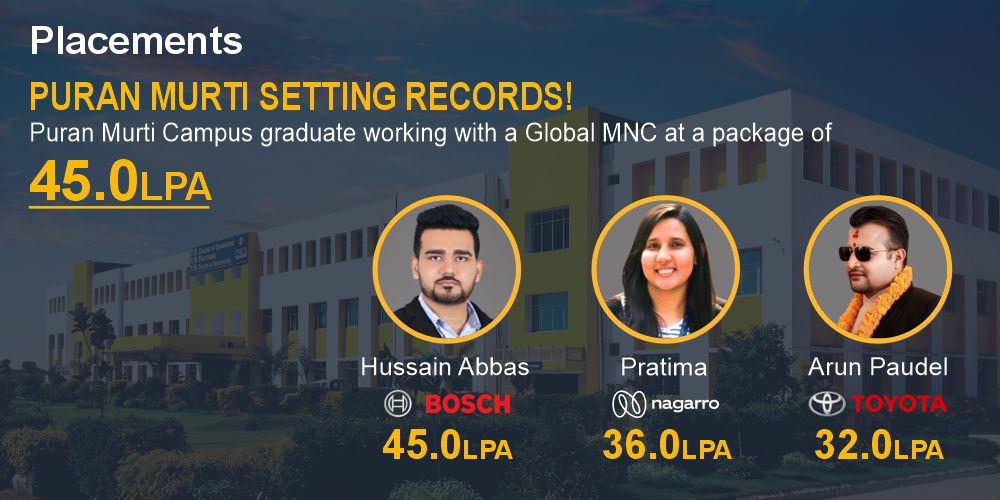
Graduates from well-structured campuses like Puran Murti Vidyapeeth are trained to meet these industry standards — a model many students look for while choosing colleges. Apply Now
Salary After Aeronautical Engineering
Starting Salary:
-
₹3 LPA – ₹6 LPA (freshers)
With Experience:
-
₹8 LPA – ₹15+ LPA
International opportunities can offer even higher packages with proper certification and experience. Apply Now
Higher Studies Options
Students can continue education through:
-
MBA in Aviation Management
-
Research & PhD
-
Specialized certification programs
Higher studies greatly increase career growth and salary potential.
Why Parents Trust This Career Path
Parents prefer Aeronautical Engineering because:
-
Stable and high-value profession
-
Growing aviation demand in India
-
Opportunities in government & defense
-
Global career scope
Institutions like Puran Murti Vidyapeeth have shown how structured technical education builds long-term careers, which is why students often use it as a reference model. Apply Now
Final Words: Is Aeronautical Engineering in Mangalore a Good Choice?
Yes — if you choose carefully.
While Mangalore has limited Aeronautical Engineering colleges, students who are serious, disciplined, and goal-oriented can build a strong future by selecting the right institute, focusing on fundamentals, and gaining practical exposure.
If aviation is your dream, don’t stop at location — focus on quality education, campus facilities, and career support, just like the structured approach followed by Puran Murti Vidyapeeth.