
Top Private Law College in Haryana
Posted on : 19 January, 2026 7:28 pm
Top Private Law College in Haryana: A Complete Student Guide
Top Private Law College in Haryana is a frequent search among students aiming for a legal career. Law remains one of India’s most stable and respected professions, but it is not a shortcut. It rewards patience, skill, and exposure, and the choice of college plays a decisive role in shaping all three.
Haryana has emerged as a strong destination for private legal education. Its proximity to Delhi, courts, and corporate hubs offers a clear advantage. Private colleges in the state increasingly provide structured academics and meaningful practical exposure. Apply Now
This article presents a clear, neutral, and student-focused overview. It explains why Haryana matters, how to evaluate private law colleges objectively, and what students should realistically expect from legal education. Apply Now

Why Haryana Is Emerging as a Law Education Hub
Haryana’s growth in legal education is not accidental. Several structural factors support this rise.
Key Reasons Students Prefer Haryana
- Close access to Delhi High Court and Supreme Court
- Growing number of district and sessions courts
- Affordable education compared to metro cities
- Strong road and rail connectivity
- Increasing demand for corporate and compliance lawyers
Moreover, Haryana hosts multiple industrial corridors. This creates demand for legal professionals in contracts, labor law, and compliance. Beyond location, Haryana’s industrial and corporate growth has expanded demand for legal professionals. Manufacturing hubs, logistics corridors, real estate development, and corporate offices require lawyers for contracts, compliance, labor law, and dispute resolution. Legal education aligned with these realities becomes more relevant. Apply Now
What Defines a Top Private Law College in Haryana
Not every private college qualifies as “top.” Marketing claims often exaggerate reality, so serious law aspirants must rely on evidence, not brochures. A strong private law college is defined by outcomes, not assertions. While private institutions can adapt faster than public universities, quality varies widely. Some invest in academics and student development, while others focus mainly on enrolment. This makes careful evaluation essential. A top private law college in Haryana is ultimately judged by academic discipline, faculty strength, practical exposure, and graduate outcomes. Apply Now
Key Criteria That Define a Top Private Law College in Haryana
-
Regulatory Approval and Affiliation
Any serious law college must be approved by the Bar Council of India (BCI). This is non-negotiable. Without BCI approval, graduates cannot practice law in India. Apply Now
Non-negotiable requirements include:
- Approval from Bar Council of India (BCI)
- University affiliation recognized under UGC norms
- Compliance with NAAC-linked academic standards
In addition, university affiliation, examination discipline, and transparent academic calendars reflect institutional seriousness. These are basic checks, yet many students skip them. Apply Now
-
Program Structure and Academic Depth
Law is taught by people, not buildings. Faculty quality directly affects how students think, argue, and write. Apply Now
Strong law colleges employ faculty with:
- Formal legal education from reputed institutions
- Experience in litigation, corporate law, or research
- Ability to connect legal theory with real cases
When students are trained by teachers who understand courts and clients, learning becomes practical and grounded.
Leading colleges offer:
- LLB (3-year) for graduates
- BA LLB (5-year) for school leavers
- LLM for specialization and research
What separates strong institutions is curriculum execution, not syllabus printing. Apply Now
-
Curriculum That Reflects Real Legal Practice
A modern law curriculum must go beyond statutes and case laws. It should integrate drafting, research, negotiation, and ethics.
Top private law colleges continuously update syllabi to reflect changes in:
- Commercial laws
- Technology and data protection
- Arbitration and mediation
- Regulatory and compliance frameworks
Static curricula create outdated graduates. Apply Now
-
Faculty Quality
Students do not learn law from buildings. They learn law from people. Apply Now
Strong law colleges maintain:
- Faculty with litigation, judiciary, and academic experience
- Exposure to constitutional law, criminal law, corporate law, and jurisprudence
- Mentorship beyond classroom teaching
-
Practical Legal Exposure
Theory without application fails in court. Top colleges institutionalize:
- Moot court competitions
- Legal aid clinics
- Drafting workshops
- Court visits and internships
These are not optional activities. They are core training tools. Apply Now
-
Infrastructure That Supports Legal Training
Law education requires:
- Dedicated moot court halls
- Updated law libraries
- Digital legal research access
- Seminar halls for case discussions
Facilities must serve learning, not marketing. Apply Now

-
Career and Placement Support
Law placements differ from engineering placements. Outcomes include:
- Law firms
- Corporate legal departments
- Litigation chambers
- Judiciary preparation
- Higher education pathways
Colleges that acknowledge this reality perform better. Apply Now
Law Courses Offered by Puran Murti Law College in Haryana
Most reputed private institutions in Haryana offer standard law programs. However, execution quality varies.
Law Programs Offered:
| Course | Duration | Suitable For |
| BA LLB (Hons) | 5 Years | Students after Class 12 |
| BBA LLB | 5 Years | Corporate law aspirants |
| LLB | 3 Years | Graduates from any stream |
| LLM | 1–2 Years | Specialization seekers |
Integrated programs like BA LLB and BBA LLB are increasingly preferred. They combine legal education with social sciences or business foundations, producing well-rounded graduates. Apply Now
Academic Philosophy
The law curriculum emphasizes:
- Conceptual clarity
- Case law interpretation
- Legal writing and drafting
- Constitutional and statutory analysis
Teaching is designed to move beyond rote learning. Apply Now
Faculty and Mentorship
Infrastructure attracts students. Faculty quality retains them. Puran Murti college invest in experienced educators. Many faculty members combine teaching with legal practice. Apply Now
What Strong Faculty Brings
- Academic specialization
- Practical courtroom insights
- Real case discussions
- Mentorship beyond textbooks
- Research and publication guidance
This directly impacts confidence and competence.
Students receive guidance for:
- Courtroom preparation
- Moot participation
- Research papers
- Competitive examinations
This mentorship-based approach is a differentiator. Apply Now
Moot Courts and Legal Training
Legal education without practice produces theoretical graduates. Courts and law firms expect readiness, not rote learning.
Puran Murti colleges in Haryana integrate practical exposure throughout the program, not as an afterthought. Moot courts are treated as structured learning platforms. Apply Now
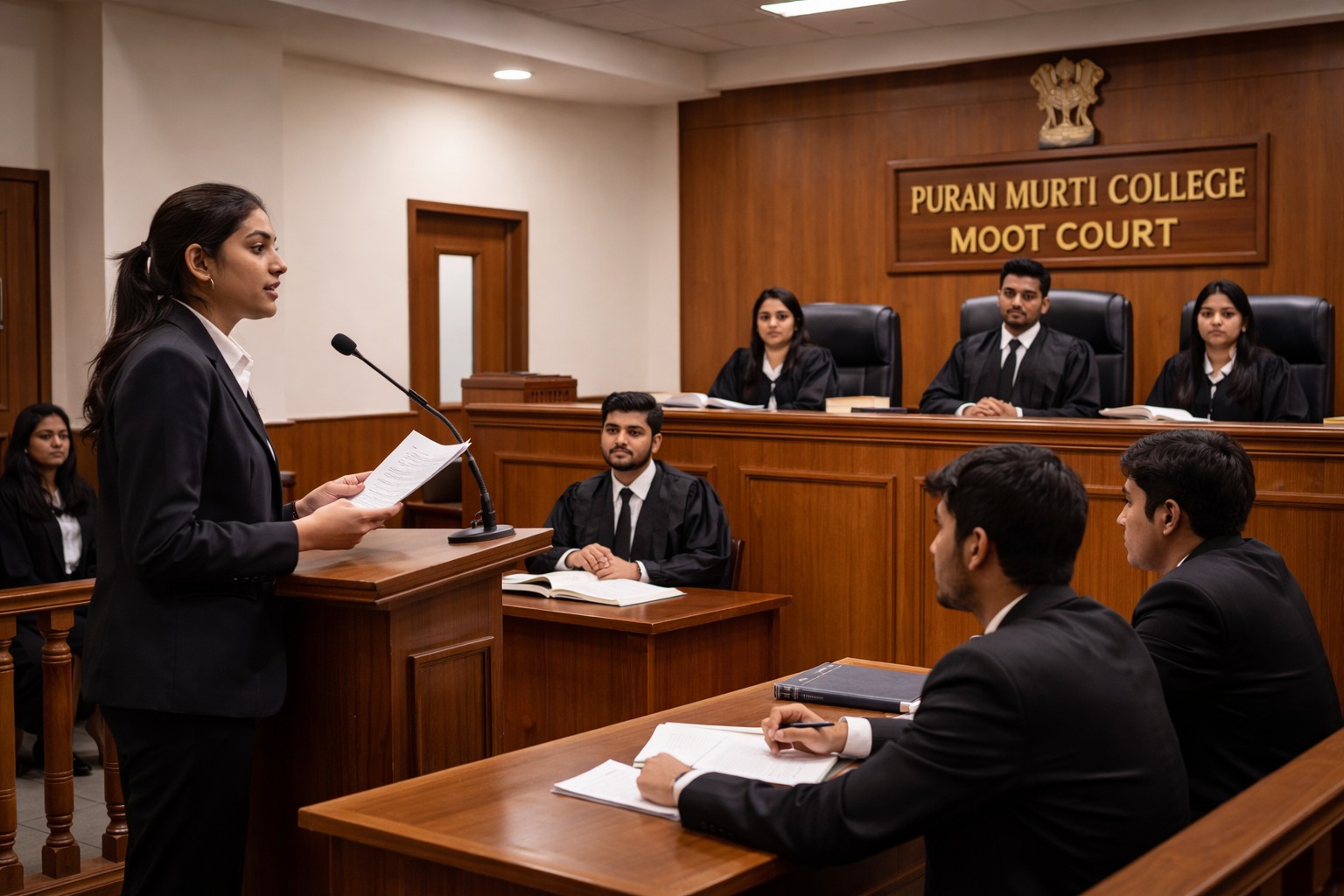
Effective Practical Components Include
- Regular moot court exercises
- Legal drafting and pleading workshops
- Client interviewing simulations
- Court visits and case analysis
These activities build confidence and professional competence early. Apply Now
Students participate in:
- In-house moot competitions
- Inter-college events
- Drafting and argument sessions
This develops confidence, articulation, and legal reasoning. Apply Now
Internships and Court Exposure
Internships are the backbone of legal training. They expose students to courtroom realities, deadlines, client expectations, and ethical dilemmas. Apply Now
Puran Murti College facilitates internships with:
- Advocates and law chambers
- Corporate legal departments
- Trial court internships
- District court exposure
- NGO and legal aid placements
These experiences help students understand procedural law early. Students who intern consistently outperform peers who rely only on classroom learning. Apply Now
Legal Aid and Social Responsibility
Legal education carries social responsibility.
Students engage in:
- Legal awareness programs
- Community legal aid initiatives
- Public interest exposure
This builds ethical grounding. Apply Now
Infrastructure Support
The campus provides:
- Law-specific libraries
- Moot courtrooms
- Seminar halls
- Digital research support
Facilities are aligned with professional training needs. Apply Now
Admission Process and Eligibility
Private law colleges follow straightforward transparent admission norms. Most align with BCI and university guidelines.
General Eligibility Standards
- BA LLB / BBA LLB: 10+2 from a recognized board
- LLB: Graduation in any discipline
- LLM: LLB degree from a recognized institution
Some colleges consider national or institutional entrance tests. Others admit students based on academic merit. Neither approach is inherently superior. What matters is academic rigor after admission. Apply Now
Always verify:
- BCI approval
- University affiliation
- Academic calendar discipline
Career Scope After Studying Law in Haryana
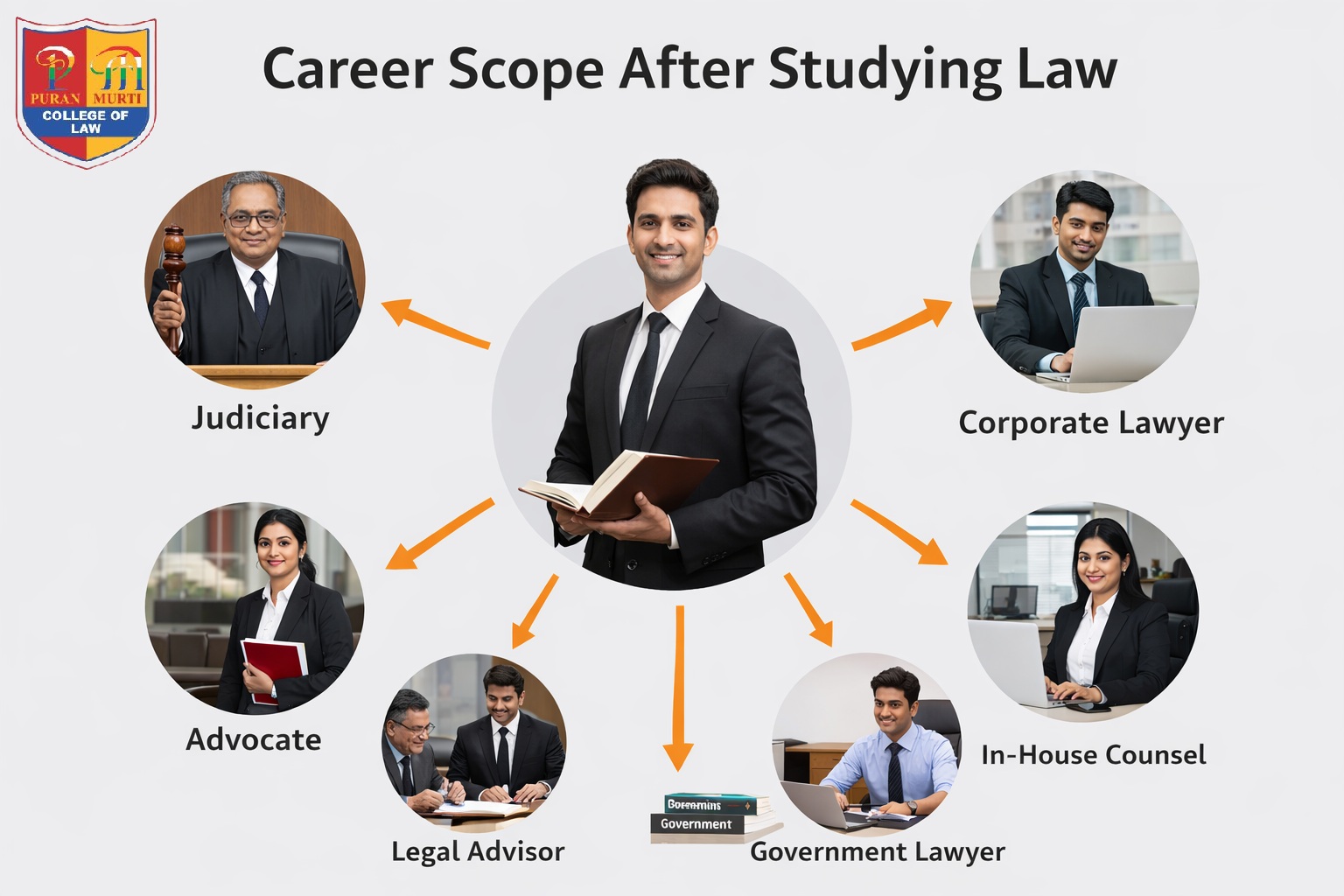
Law graduates from Haryana pursue diverse career paths. The degree itself is flexible. Outcomes depend on skill, exposure, and clarity. Apply Now
Career Opportunities
- Litigation under practicing advocates
- Corporate legal roles in companies
- Judiciary and public service examinations
- Compliance and regulatory advisory
- Legal research, academia, and policy work
Haryana’s proximity to Delhi expands access to national-level opportunities without the cost burden of metro education. Graduates also pursue higher studies in India or abroad. Apply Now
Role of Private Law Colleges in Career Readiness
Modern private institutions increasingly focus on employability rather than mere degrees. This shift is healthy.
Career readiness depends on:
- Drafting and argument proficiency skills
- Professional ethics training
- Research capability
- Oral advocacy skills
- Internship depth
Colleges that structure programs around these outcomes produce stronger graduates. Apply Now
Where Puran Murti College Fits In Haryana’s Academic Ecosystem
Puran Murti College functions within Haryana’s private education ecosystem with a focus on structured academics, faculty-led learning, and core professional skills in law. Students should judge such institutions by curriculum quality, teaching engagement, and practical exposure rather than branding. Independent evaluation is essential. Apply Now
Students should independently evaluate:
- Course design
- Faculty interaction
- Practical exposure
Informed decisions matter more than brand names. Apply Now
Who Should Consider This College
Ideal for students who:
- Want courtroom exposure early
- Value mentorship over hype
- Seek a regulated, compliant legal degree
- Plan careers in litigation, compliance, or public service
Not ideal for students expecting corporate law firm placements without individual effort. Apply Now
Comparison Snapshot
| Factor | Average Private Law College | Puran Murti College |
| BCI Approval | Varies | Yes |
| Moot Courts | Limited | Structured |
| Faculty Access | Moderate | High |
| Internship Support | Informal | Guided |
| Campus Resources | Basic | Comprehensive |
How to Choose the Right Private Law College in Haryana
Choosing a law college is a long-term decision. It should be approached strategically, not emotionally. Do not rely on rankings alone. Use a checklist. Apply Now
A Practical Evaluation Checklist
- Is the college BCI approved
- Review moot court and internship structure
- Assess faculty profiles and experience
- Speak with current students
- Understand academic discipline and assessment rigor
Campus visits, when possible, provide insights no brochure can. Apply Now
Common Mistakes Law Aspirants Should Avoid
Many students make avoidable errors that affect their careers.
These include:
- Choosing college based only on fees
- Ignoring faculty background
- Overlooking internship culture
- Assuming all private colleges offer equal value
Law is a profession of preparation. Shortcuts rarely work. Apply Now
The Future of Legal Education in Haryana
Legal education is evolving rapidly. Technology, arbitration, compliance, and alternative dispute resolution are reshaping legal careers.
Colleges that adapt to these changes will lead. Those that remain theory-heavy will struggle.
Students should choose institutions aligned with the future, not the past Apply Now
Conclusion
A top private law college in Haryana is defined by discipline, academic depth, and delivery—not advertising. Haryana’s location advantage and growing academic maturity make it a credible choice for legal education, but outcomes depend on institutional rigor.
Within this context, Puran Murti College aligns with core legal education standards through structured programs, faculty engagement, practical exposure, and regulatory compliance. Students should evaluate academics, exposure, and outcomes together. A law degree is a long-term investment. Choose wisely. Apply Now
FAQs
Is Haryana a good state for studying law
Yes. Proximity to Delhi courts and legal hubs provides strong practical exposure.
Are private law colleges in Haryana approved by the Bar Council of India
Many are. Always verify BCI approval before admission.
Which law course is better: BA LLB or LLB
BA LLB suits students after Class 12. LLB suits graduates seeking specialization.
Do private law colleges in Haryana offer internships
Reputed colleges do. Internship quality and depth vary, so confirmation is essential.
Is law a stable career in India
Yes. Legal professionals are required across litigation, corporate, regulatory, and governance roles.
Is Puran Murti College approved by the Bar Council of India
Yes. Its law programs comply with BCI requirements.
Does Puran Murti College offer a five-year law program
Yes. The BA LLB (Hons) program is available.
Are moot courts mandatory in the law program
Yes. Moot courts are a core component of practical legal training.
What career paths do graduates typically follow
Graduates pursue litigation, corporate compliance, higher studies, and judiciary preparation.
Is the college suitable for judiciary aspirants
Yes. The curriculum supports strong foundational preparation.