
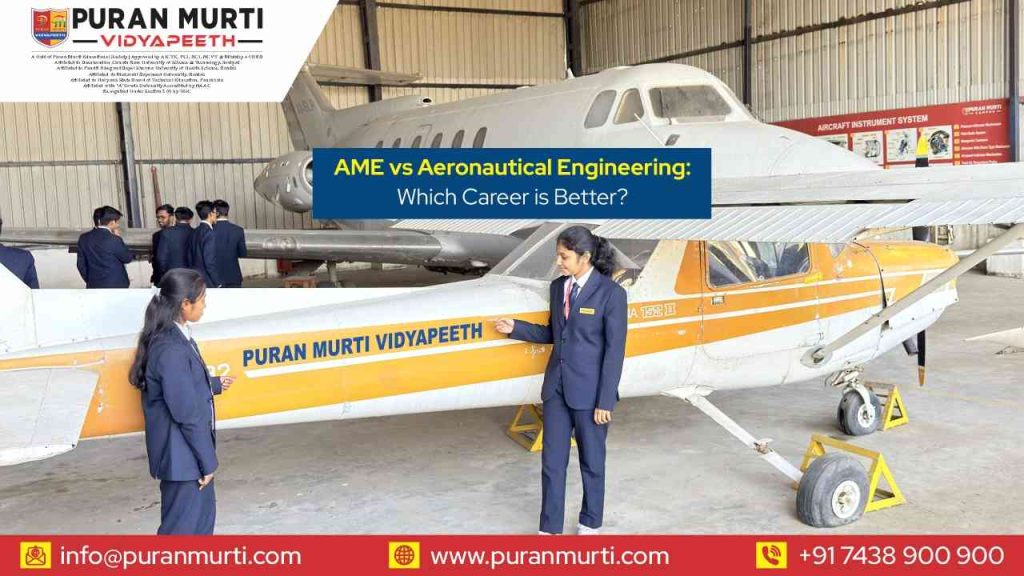
AME vs Aeronautical Engineering: Which Career Is Better?
Posted on : 23 September, 2026 5:09 pm
The aviation and aerospace industry attracts students who dream of working with aircraft, advanced technology and the science behind flying. After Class 12, two popular career options students often consider are Aircraft Maintenance Engineering (AME) and Aeronautical Engineering. Although both fields are connected to aircraft, their roles, education pathways and career responsibilities are quite different. So, if you are confused about AME vs Aeronautical Engineering, understanding these differences can help you choose a course according to your interests and career goals.
we will compare AME vs Aeronautical Engineering: Which Career Is Better? based on course duration, eligibility, subjects, career opportunities, work profile, skills, salary and future scope. We will also discuss how an institution such as Puran Murti Vidyapeeth can be considered while exploring aviation and engineering education options. Apply Now
What Is Aircraft Maintenance Engineering (AME)?
Aircraft Maintenance Engineering (AME) is a specialized aviation field focused mainly on the maintenance, inspection and airworthiness of aircraft. An AME professional works to ensure that aircraft and their components are maintained according to applicable aviation safety and regulatory requirements. Their work can involve inspecting aircraft systems, identifying technical issues, carrying out approved maintenance tasks and maintaining technical records.
AME is suitable for students who enjoy practical and technical work and are interested in aircraft maintenance rather than designing aircraft.
What Does an AME Professional Do?
Depending on the specialization and applicable licence requirements, AME-related work may involve:
- Inspecting aircraft components and systems
- Supporting aircraft maintenance activities
- Identifying technical problems
- Checking aircraft systems after maintenance
- Following aviation safety procedures
- Maintaining technical documentation
- Working with maintenance teams
- Helping ensure aircraft remain airworthy
AME is therefore closely connected with aircraft safety and maintenance. Apply Now
What Is Aeronautical Engineering?
Aeronautical Engineering is a branch of engineering that focuses on the design, development, testing and maintenance-related aspects of aircraft and aerospace systems, particularly those operating within Earth’s atmosphere. Students studying aeronautical engineering learn engineering principles related to aircraft structures, propulsion, aerodynamics, materials, electronics and flight systems.
Aeronautical engineering can be a good option for students who are interested in the engineering and technology behind aircraft.
What Does an Aeronautical Engineer Do?
Aeronautical engineers can work in areas such as: Apply Now
- Aircraft design and development
- Aerodynamics
- Aircraft structures
- Propulsion systems
- Aircraft testing
- Manufacturing
- Research and development
- Maintenance-related engineering functions
- Aviation and aerospace technology
AME vs Aeronautical Engineering
| Feature | AME | Aeronautical Engineering |
|---|---|---|
| Full Form | Aircraft Maintenance Engineering | Aeronautical Engineering |
| Main Focus | Aircraft maintenance and airworthiness | Aircraft engineering and technology |
| Nature of Work | Practical and maintenance-oriented | Engineering, design, development and technical |
| Main Area | Aircraft maintenance | Aircraft and aviation engineering |
| Work Environment | Airports, MROs, maintenance facilities | Manufacturing, R&D, aviation and aerospace organizations |
| Career Type | Specialized aviation maintenance | Broader engineering career |
| Suitable For | Students interested in aircraft maintenance | Students interested in aircraft engineering |
| Key Skills | Technical skills, accuracy, safety awareness | Mathematics, engineering, design and problem-solving |
AME vs Aeronautical Engineering Eligibility
- For many aeronautical engineering degree programmes, students generally need to complete Class 12 with Physics and Mathematics, along with the required subjects and minimum marks specified by the institution or applicable admission rules.
- For AME programmes, eligibility depends on the specific programme, institute and applicable aviation regulations.
Students should always check the latest eligibility requirements before applying because admission and licensing conditions can vary.
AME vs Aeronautical Engineering Subjects
The subjects in both fields involve aircraft technology, but the approach is different. Apply Now
- Aircraft maintenance practices
- Aircraft structures
- Aircraft systems
- Aviation safety
- Aircraft materials
- Aircraft engines
- Electrical systems
- Avionics
- Maintenance procedures
- Technical documentation
Aeronautical Engineering Subjects
A degree programme may include:
- Engineering Mathematics
- Engineering Physics
- Engineering Mechanics
- Fluid Mechanics
- Thermodynamics
- Aerodynamics
- Aircraft Structures
- Propulsion
- Flight Mechanics
- Aircraft Materials
- Avionics
- Aircraft Design
- Manufacturing Processes
Aeronautical engineering generally provides a wider engineering curriculum, while AME has a stronger focus on maintenance and aircraft serviceability. Apply Now

Career Opportunities After AME
After completing the required education, training and applicable licensing requirements, AME professionals can explore opportunities in areas such as:
- Airlines
- Maintenance, Repair and Overhaul (MRO) organizations
- Aircraft maintenance facilities
- Aviation companies
- Ground maintenance operations
- Aircraft component maintenance
- Technical services
Possible job titles and responsibilities vary according to licence category, experience and employer requirements. Apply Now
Career Opportunities After Aeronautical Engineering
Aeronautical engineering graduates can explore careers across aviation, aerospace and engineering industries.
- Aeronautical Engineer
- Aircraft Design Engineer
- Aerospace Engineer
- Aerodynamics Engineer
- Aircraft Manufacturing Engineer
- Propulsion Engineer
- Structural Engineer
- Avionics Engineer
- Research and Development Engineer
- Production Engineer
- Quality Engineer
Which Is More Practical AME or Aeronautical Engineering?
Both programmes can include practical learning, but their practical focus is different.
- AME is strongly connected with hands-on aircraft maintenance. Students who enjoy inspecting systems, understanding aircraft components and working with maintenance procedures may find this field interesting.
- Aeronautical Engineering combines theoretical engineering knowledge with laboratory, design and technical applications. Students may work on aircraft structures, aerodynamics, propulsion and other engineering problems.
So, the better fit depends on your interests. Apply Now
Puran Murti Vidyapeeth for Engineering
Students exploring engineering and aviation-related careers can also consider institutions such as Puran Murti Vidyapeeth when researching their higher-education options.
- Course curriculum
- Faculty
- Laboratories and practical facilities
- Workshops and technical infrastructure
- Industry exposure
- Internship opportunities
- Placement support
- Campus facilities
- Accreditation and approvals applicable to the programme
- Eligibility and admission requirements
For aviation-related education in particular, students should carefully verify whether the selected programme has the specific approvals, affiliations or regulatory recognition required for the career pathway they intend to follow. Apply Now
AME vs Aeronautical Engineering Which Should You Choose?
- There is no single choice that is right for every student. Apply Now
Choose AME if you are particularly interested in:
- Aircraft maintenance
- Hands-on technical work
- Aircraft inspections
- Aviation safety
- Maintenance procedures
- Working around operational aircraft
Choose Aeronautical Engineering if you are interested in:
- Aircraft design
- Aerodynamics
- Propulsion
- Aircraft structures
- Engineering research
- Manufacturing
- Product development
- Broader engineering career options
In simple words, AME is more focused on maintaining aircraft and supporting their airworthiness, while Aeronautical Engineering is a broader engineering field connected with aircraft design, development, testing and technology.
AME vs Aeronautical Engineering
| Factor | AME | Aeronautical Engineering |
|---|---|---|
| Primary Focus | Aircraft maintenance | Aircraft engineering |
| Work Style | Hands-on and maintenance-focused | Engineering and technical |
| Degree Path | Specialized aviation training/licensing pathway | B.Tech/B.E. degree pathway |
| Design Work | Limited compared with engineering | Important area |
| Maintenance | Core area | One possible engineering area |
| Career Scope | Aviation maintenance | Aviation, aerospace and engineering |
| Best For | Aircraft maintenance enthusiasts | Engineering and aircraft technology enthusiasts |
Final Thoughts
- The choice between AME vs Aeronautical Engineering should depend on what kind of aviation career you imagine for yourself.
- If your interest is mainly in aircraft maintenance, inspection and practical aviation work, AME may align more closely with your interests.
If you are more interested in engineering, aircraft design, aerodynamics, propulsion, manufacturing or research, Aeronautical Engineering may offer a pathway that better matches those interests. Before taking admission, compare the curriculum, eligibility, practical facilities, approvals, career pathway and long-term opportunities. Students considering engineering education can also explore options such as Puran Murti Vidyapeeth and compare programmes according to their individual career goals. Apply Now
FAQs
1. Is AME the same as Aeronautical Engineering?
No. AME primarily focuses on aircraft maintenance and airworthiness, while Aeronautical Engineering is a broader engineering discipline involving aircraft technology, design, development and related engineering functions.
2. Which course is better after 12th?
The suitable option depends on your career interest. Students interested in aircraft maintenance may explore AME, while students interested in aircraft engineering and design may consider Aeronautical Engineering.
3. Is Aeronautical Engineering a degree course?
B.Tech and B.E. Aeronautical Engineering programmes are undergraduate engineering degree programmes, generally lasting four years.
4. Does AME involve practical training?
Yes. AME education and training are closely connected with practical aircraft maintenance activities, subject to the requirements of the specific programme and applicable aviation regulations.
5. Can Aeronautical Engineers work in the aviation industry?
Yes. Aeronautical engineering graduates can explore opportunities in aircraft manufacturing, aviation, aerospace, engineering services, research and development and related sectors. Apply Now
6. Can AME professionals work at airports?
AME-related professionals can work in aircraft maintenance and technical operations at airports, airlines and maintenance organizations, subject to the required qualifications and authorizations.
7. Which field has more career options?
Aeronautical Engineering provides a broader engineering pathway, while AME is more specialized toward aircraft maintenance. Career opportunities depend on qualification, skills, experience and industry requirements.
8. What should I check before choosing an AME course?
Check the institute’s applicable approvals, affiliations, training facilities, curriculum, practical exposure, licensing pathway and current eligibility requirements.
9. What skills are useful for Aeronautical Engineering?
Mathematics, physics, problem-solving, analytical thinking, technical knowledge, computer skills and an interest in aircraft technology are useful. Apply Now