
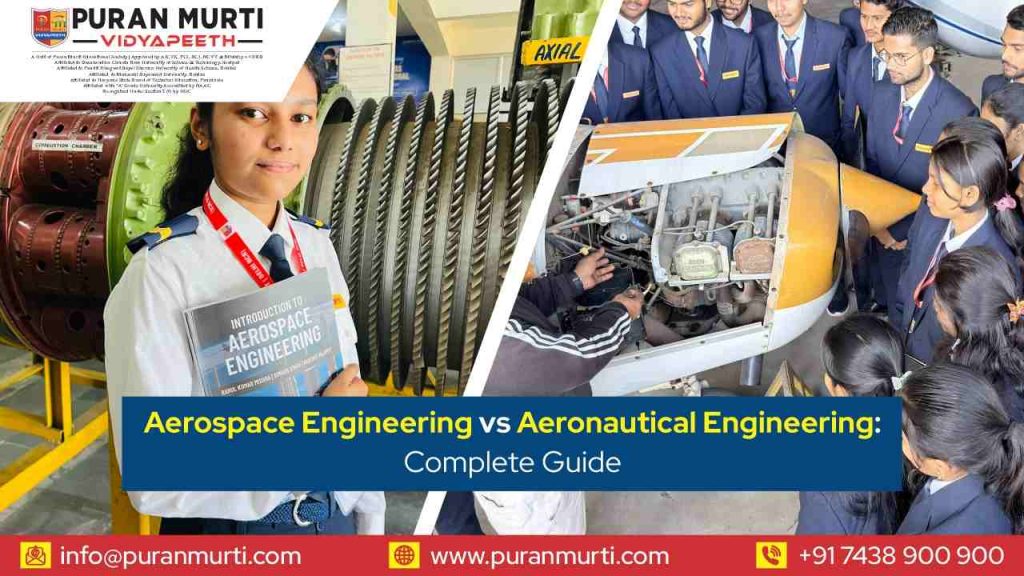
Aerospace Engineering vs Aeronautical Engineering: Complete Guide
Posted on : 16 October, 2026 10:18 pm
Choosing the best engineering course after class 12th, is a tough decision especially when similar courses pique one’s interest. Aerospace engineering and Aeronautical engineering are two such popular courses among students who have a keen interest in Aircrafts, rockets, satellites, and advanced technologies of aviation. Although both courses offer bright career opportunities, their eligibility criteria and curriculum vary significantly. Here is the Aerospace Engineering vs Aeronautical Engineering: Complete Guide
Therefore, for students who are eligible for B.Tech programs after completing class 12th with Physics, Chemistry, and Mathematics (PCM) we are here to discuss aerospace engineering vs aeronautical engineering differences and other important factors that will help in making the right choice. Apply Now
What is Aerospace Engineering?
Aerospace engineering deals with the construction, development, launching, and maintenance of vehicles meant for flying within or outside the atmosphere of the earth.
It is a broad discipline comprising of aeronautical engineering and astronautical engineering. It refers to aircraft and spacecraft, missiles, and commercial planes. Aerospace Engineering can be studied both at B.Tech and M.Tech levels. Apply Now
Some of the Important Topics Covered in Aerospace Engineering are:
- Aircraft and spacecraft
- Rocket and Jet Propulsion
- Satellite
- Aerodynamics and flight mechanics
What is Aeronautical Engineering?
Aeronautical engineering deals with the designing, development, and maintenance of aeroplanes, helicopters, and aircrafts. Aeronautical engineers ensure that aircrafts are reliable, durable, safe, and precise for smooth flight. The specialization of aeronautical engineering lies in the fields of aeroplane design and development, aircraft engines, and other aviation equipments. The Aeronautical engineering course has been designed on the basis of the educational needs and emerging trends in the aviation industry. It comprises of theoretical and practical subjects and is offered at both the graduate and post-graduate levels.
Some of the Important Topics Covered in Aeronautical Engineering are: Apply Now
- Airplane design
- Airplane engines
- Aerodynamics
- Aeroplane structures
Aerospace Engineering vs Aeronautical Engineering
| Parameters | Aerospace Engineering | Aeronautical Engineering |
| Definition | Deals with the design and development of aircraft and spacecraft. | Deals with the design and development of aircraft. |
| Duration | Usually 4 years for B.Tech. | Usually 4 years for B.Tech. |
| Core Subjects | Aerodynamics, propulsion, spacecraft systems, and orbital mechanics. | Aerodynamics, aircraft structures, propulsion, and flight mechanics. |
| Career Scope | Aviation, aerospace, satellites, and space systems. | Aviation, aircraft manufacturing, and aircraft testing. |
| Job Opportunities | Aircraft, spacecraft, launch vehicles, and related systems. | Aircraft design, development, testing, and related systems. |
| Ideal For | Aviation and space technology interested students | students Aircraft and flight technology interested students |
Aerospace Engineering vs Aeronautical: Eligibility Criteria
Eligibility criteria for both courses are similar, and students need to fulfill the basic requirements needed for engineering courses in general. Candidates who have secured PCM in their 12th class from a recognized board are eligible to pursue this course. Apply Now
- Educational Qualification: 10+2 or equivalent qualification from a recognized board
- Subjects Required: Physics and Mathematics along with other relevant subjects
- Minimum Percentage of Marks: As specified by the institution like 50 – 60 %
- Entrance Examinations: Conducted by concerned university/college
- Diploma Holders: Lateral entry is allowed if applicable
Candidates are advised to review the eligibility criteria and other requirements issued by the institutions offering these courses.

Career Opportunities After Aerospace Engineering
There is a wide range of aerospace jobs for freshers and experienced professionals. Aerospace engineering offers a variety of career opportunities in aviation and space-related industries. Here is a list of job options available for aerospace engineering graduates.
- Aerospace Engineer: Involved in aircraft and spacecraft
- Spacecraft Design Engineer: Designs spacecraft and its components
- Propulsion Engineer: Propulsion system and its development
- Satellite Systems Engineer: Designs satellite systems
- Aerodynamics Engineer: Analyses aerodynamics
- Aerospace Design Engineer: Designs and improves engineering components
- Research and Development Engineer: Research and development of new technology
Career Opportunities After Aeronautical Engineering
Aeronautical engineering opens up a range of career opportunities, especially related to aircraft and aviation.
- Aeronautical Engineer: Concerned with aircraft and aircraft parts
- Aircraft Design Engineer: Designs various component of aircraft
- Aerodynamics Engineer: Analyses aerodynamics
- Aircraft Structures Engineer: Analyses aircraft structures
- Flight Test Engineer: Concerned with aircraft testing
- Propulsion Engineer: Concerned with aircraft propulsion
- Avionics Engineer: Concerned with aircraft avionics
Career Opportunities after aeronautical engineering mainly lies in aircraft manufacturing and defense sectors. One can also explore drone related careers and aeroplane design and development. Apply Now
Aerospace Engineering vs Aeronautical Engineering Salary in India
- Freshers Approximately: 2.5–5 LPA
- 1-3 Years Approximately: 4–7 LPA
- 3-5 Years Approximately: 5–9 LPA
- 5-10 Years Approximately: 8–15 LPA
- Experts Above: 12-20 LPA
Which Course Has Better Scope in India?
Scope of both the specializations depends upon the area of interest. Let’s take a look at the job trends to understand which specialization has a better scope in India.
Aeronautical Engineering Scope
Aeronautical engineering scope is ideal for those who wish to develop a career in aircraft manufacturing, and aviation industry. This course can also support research in aircraft design and development, and drone technology.
Aerospace Engineering Scope
Aerospace engineering scope is ideal for those who want to develop a career in aviation industry, aircraft manufacturing, and space research. A career in Aerospace engineering opens up opportunities in space rocket manufacturing, defense research, and space technology.
Both specializations offer good career scope in India as well as abroad. However, expertise and skills determine the scope and job profile. Higher education and specializations help one to climb up the ladder in their desired field. Apply Now
Why Consider Puran Murti Vidyapeeth for Engineering?
When considering the options of colleges, students might find their options narrowed down to Puran Murti Vidyapeeth due to its promising facilities in the field of aviation. However, there are several other factors that one should take into account before pursuing their B.Tech in Aerospace or Aeronautical Engineering from a particular institution.
Before taking any decision, here are some of the major points that students should keep in mind while short-listing the colleges offering aerospace and aeronautical engineering
- Course curriculum
- Laboratories and workshops
- Faculty members and academic staff
- Exposure
- Placements
- Affiliation and other relevant approvals
Students interested in aerospace engineering and aeronautical engineering should confirm the courses they are interested in, and the programs currently being offered by Puran Murti Vidyapeeth, and also review the eligibility criteria, course fees, and admission process before taking any decisions.
The right college/education helps students to achieve their goals and make a difference in their desired fields. It is up to the students to choose the right platform for building their careers. Apply Now
Frequently Asked Questions (FAQs)
1. What is the main difference between Aerospace and Aeronautical Engineering?
Aerospace engineering deals with the construction of aircraft and spacecraft, while aeronautical engineering is concerned with the construction of aeroplanes.
2. Which is better, Aerospace or aeronautical engineering?
Both the courses have different specializations and offer different career opportunities. Aerospace engineering offers a wider range of specializations, whereas aeronautical engineering is more aircraft oriented.
3. Can I study these courses after class 12th?
Yes, students who have completed their class 12th with PCM and other relevant subjects are eligible to take up these courses at graduation levels.
4. What is the duration of the program?
Generally, the program duration is 4 years for both the specializations. Apply Now
5. Which course has more job opportunities?
Aerospace Engineering offers a wide range of job opportunities, whereas Aeronautical Engineering offers specific job roles related to aeroplane designing, development, and manufacturing.
6. Can Aeronautical engineers work in the space industry?
Certain skills of Aeronautical engineers can be applied to space industry but certain specific roles might require additional expertise
7. What is the salary after Aerospace or Aeronautical Engineering?
The salary depends upon the designation, company, location, and experience. Candidates should research and analyze the job market before choosing their specialization.
8. Is Mathematics important for both the courses?
Yes, math is important for understanding aerodynamics, propulsion, flight mechanics, and other engineering principles.
9. Can I pursue higher studies after either of the specializations?
Yes, candidates can go for higher education after completing their graduation. Masters, research studies, and doctoral programs are some of the options that one can consider. Apply Now
Conclusion
Making the right decision between aerospace engineering vs aeronautical engineering might be a difficult task, especially when students are not aware of their specializations and area of interest. Aeronautical engineering focuses on aircrafts, whereas aerospace engineering focuses on aircrafts along with spacecrafts. Therefore, it is important for students to identify the area of interest and then decide the course according to it. In case students are interested in designing aeroplanes and helicopters, they should choose aeronautical engineering. Whereas for those students who have an interest in the space industry, aerospace engineering would be a better option.
Students should compare the specializations and important topics covered in both the courses, and review the eligibility criteria, career opportunities, and college facilities before making the decision. Students can also consider Puran Murti Vidyapeeth for their engineering courses and review the programs on offer. Apply Now
Polytechnic Courses After 10th: Eligibility, Fees and Career Scope