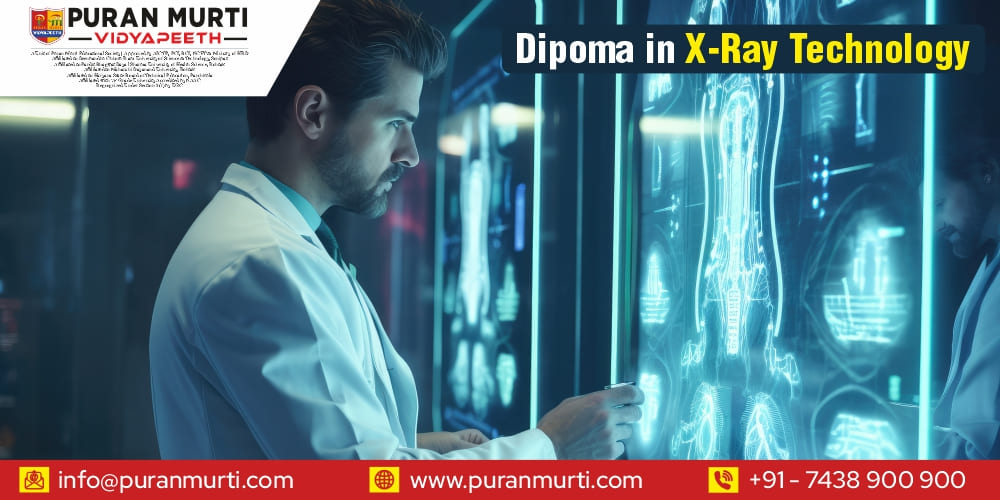
Dipoma in X-Ray Technology
Posted on : 18 February, 2026 12:54 am
Introduction
A X-Ray Technology Course is a specialised educational program designed to train students in the science and practice of diagnostic radiography. The primary goal of the course is to equip learners with the technical knowledge and clinical skills needed to operate X-ray equipment, produce quality diagnostic images, ensure patient safety, and assist physicians in diagnosing illnesses and injuries.
Students will learn about human anatomy, physics of X-rays, radiation safety, imaging procedures, patient care and clinical practice. Graduates can work in hospitals, imaging centres, clinics, and diagnostic laboratories.
What Is an X-Ray Technician?
An X-Ray Technician, also known as a Radiologic Technologist, is a healthcare professional who specializes in capturing medical images using X-ray machines. These images help doctors examine bones, organs, and tissues to diagnose injuries, infections, fractures, and diseases.
They work closely with patients, radiologists (physicians who interpret imaging), and other healthcare staff. The job involves technical skills, patient interaction, safety protocols, and precise imaging techniques. Apply Now
Why Pursue a Technician X-Ray Course?
Students choose this career for many reasons, including:
- Strong demand for imaging professionals
- Opportunity to work in healthcare without becoming a physician
- Stable employment and good salaries
- Meaningful work that helps patient care
- Variety of imaging modalities and specializations
What is Diploma in X-Ray Technology?
A Diploma in X-Ray Technology is a 2-year paramedical diploma course that trains students to operate X-ray machines and other diagnostic imaging equipment. The course focuses on:
- Radiographic positioning techniques
- Human anatomy and physiology
- Radiation physics
- Patient care and safety
- X-ray film processing and digital imaging
The main goal of this diploma is to prepare students to work as professional X-Ray technicians in hospitals, diagnostic centers, trauma units, and imaging labs. Apply Now
Healthcare has become one of the fastest-growing industries in India. With the rise in accidents, diseases, and medical diagnostics, radiology services are now essential in every hospital. That is why a Diploma in X-Ray Technology has become one of the most searched paramedical courses today.
Course Highlights
| Course Name | Diploma in X-Ray Technology |
|---|---|
| Course Level | Diploma |
| Duration | 3 Years |
| Eligibility | 10th |
| Admission Process | Merit-Based / Entrance Exam |
| Average Fees | Rs 40,000 – Rs 1,20,000 per year |
| Job Roles | X-Ray Technician, Radiology Assistant |
| Average Salary | Rs 2.5 – 5 LPA |
Why Choose Diploma in X-Ray Technology?
Here are the top reasons why students prefer this course:
1. High Demand in Healthcare Sector
Every hospital — private or government — requires trained X-Ray technicians. Diagnostic imaging is an important part of treatment planning.
2. Short Duration Course
Unlike medical degrees that take 5–6 years, a Diploma in X-Ray Technology is completed in just 3 years after 10th and in 2 years after 12th PCM/PCB
3. Affordable Course Fees
Compared to MBBS or BDS, this diploma is affordable and provides quick returns in terms of job opportunities.
4. Early Job Opportunities
Students can start earning right after completing the diploma.
5. Career Growth in Radiology
After a Diploma in X-Ray Technology, students can pursue higher education like B.Sc. Radiology or specialized imaging courses.
Comparison Table of Technician X-Ray Course Types
| Course Type | Duration | Level | Career Level |
|---|---|---|---|
| Certificate | 6–12 months | Entry | Basic |
| Diploma | 1–2 years | Intermediate | Professional |
| Bachelor Degree | 3 years | Advanced | Senior |
| Postgraduate Diploma | 1–2 years | Advanced | Specialist |
| Specialization Course | 6–12 months | Expert | Specialized |
Practical Training & Internship
The program requires students to complete a clinical exposure component. Most courses include: Apply Now
- Hospital rotations
- Diagnostic imaging labs
- Students participate in hands-on training with actual X-ray and CT and MRI machines.
Entry Requirements
Admission criteria vary by institution, but typical requirements include:
- Completion of higher secondary school
- Science stream preferred, especially Physics, Chemistry, Biology
- Minimum academic marks (varies by college)
- Some institutions may require an entrance exam or interview
Diploma in X-Ray Technology Syllabus
The syllabus of Diploma in X-Ray Technology includes both theoretical and practical training.
First Year Subjects:
- Human Anatomy & Physiology
- Radiation Physics
- Fundamentals of Radiography
- Pathology Basics
- Patient Care Techniques
Second Year Subjects:
- Advanced Radiographic Techniques
- CT Scan Basics
- MRI Introduction
- Ultrasound Fundamentals
- Radiation Protection & Safety
- Practical Clinical Training
Practical training is very important in this diploma course because students learn to handle real X-ray machines under supervision.
Learning Outcomes
By the end of the course, students will be able to:
- Understand human anatomy relevant to imaging
- Operate X-ray equipment safely and effectively
- Produce quality diagnostic images
- Apply radiation safety protocols for patients and staff
- Communicate effectively with patients and healthcare teams
- Adhere to ethics and professional standards
Diploma in X-Ray Technology vs B.Sc. Radiology
| Feature | Diploma | B.Sc. |
|---|---|---|
| Duration | 3 Years after 10th | 3 Years |
| Cost | Affordable | Higher |
| Job Entry | Faster | Slightly better salary |
| Higher Study | Required for advancement | Already a degree |
Skills and Competencies Developed
Technical Skills
- X-ray machine operation
- Image capture and processing
- Anatomy recognition
- Radiation management
Soft Skills
- Communication
- Patient care
- Teamwork
- Critical thinking
Assessment and Certification
Assessment methods vary by program but generally include:
Written Exams
Test theory on:
- Physics
- Anatomy
- Safety protocols
- Terminology
Practical Exams
Students demonstrate:
- Equipment setup
- Patient positioning
- Image quality
Clinical Evaluation
Performance in real settings is assessed by mentors.
Certification
Upon successful completion, students receive a diploma or certificate. Many regions also require professional certification from a recognized board or authority.
Tools and Resources Students Will Use
Textbooks
Standard texts cover:
- Radiologic physics
- Anatomy
- Imaging procedures
- Safety protocols
Imaging Equipment
Students train on:
- X-ray units
- Digital receptors
- Protective gear
Simulation Labs
Help practice before clinical exposure.
Admission Process for Technician X-Ray Course (2026)
1. Check Eligibility Criteria
Before applying, confirm your eligibility. Common eligibility requirements include:
Educational Qualification
- For certificate and diploma courses: Completion of Class 12 (10+2) from any recognized board is usually required; science subjects (Physics, Chemistry, Biology) are preferred in many institutes.
- Some diploma programs may accept Class 10/Matric pass students in certain cases, depending on institute rules.
Age Criteria
- Candidates typically must be at least 17 years old by the end of the calendar year of admission (for example, by December 31st, 2026).
- No strict upper age limit is imposed in most cases.
⇒Tip: Always check the college brochure for exact eligibility, as some institutes require specific pass marks or subject combinations.
2. Admission Notifications and Application Forms
Where to Find Notifications
- Colleges and universities release admission notifications on their official websites.
- Commonly, the admission window for 2026 starts between January and April, but it can vary by institution.
Application Form
You’ll need to fill out an application form, which may be available:
- Online — through the college or university website
- Offline — by physically collecting and submitting the form at the admission office
Institutes like Rajiv Gandhi Cancer Institute,Puran Murti Vidyapeeth, and others allow both online and offline applications.
3. Entrance Test or Merit Selection (Where Applicable)
Merit-based Admission
-
Many colleges like PMV admit students based on their Class 12 marks (merit list). If the number of applicants is high, merit lists are prepared to shortlist candidates. Apply Now
Entrance Exams
- Some universities or autonomous colleges may conduct institution-level entrance exams or include radiography questions; this varies by institution.
- For BSc programs, universities may include online assessments or entrance tests as part of the selection before counseling.
4. Document Submission
Once your application is accepted, you will need to upload or submit verified copies of important documents, typically including:
- Class 10 and Class 12 mark sheets
- Transfer Certificate (TC) / School Leaving Certificate
- Age proof (birth certificate or equivalent)
- Identity proof (Aadhaar, Voter ID, etc.)
- Category/Reservation certificate (if applicable)
Always keep both originals and photocopies ready, as colleges may verify them during counseling or document submission.
5. Merit List / Shortlist Announcement
After applications close:
- Colleges prepare a merit list or shortlist of candidates based on marks or entrance test scores.
- This list is usually published on the institute’s website or notice board.
- Selected candidates are called for counseling/interview and document verification.
6. Counseling and Seat Allotment
For many diploma or degree courses:
- Counseling sessions are held where you confirm your seat.
- You may need to attend in person or online as per institute rules.
During counseling you will:
- Select your preferred course (certificate/diploma/BSc)
- Submit required fees to reserve your seat
- Complete identity and eligibility checks
7. Fee Payment and Admission Confirmation
Once selected:
- Pay the course fees within the deadline to confirm your seat.
- Fee payment may be accepted online or at the institute office.
- After payment, you receive an admission letter or enrollment confirmation.
Typical Timeline for 2026 Admissions
| Stage | Typical Period |
|---|---|
| Admission Notifications Released | January – April 2026 |
| Application Submission | February – June 2026 |
| Entrance Test / Merit Screening | March – July 2026 |
| Merit List / Shortlist | April – August 2026 |
| Counseling Document Verification | May – September 2026 |
| Course Start | June – October 2026 |
Note: The exact timeline varies depending on the college or program type.

Top Colleges Offering Technician X-Ray Course (2026)
1. Puran Murti Vidyapeeth (Delhi NCR)
- Offers B.Voc (Medical Imaging Technology) — a 3-year paramedical degree that covers X-ray, CT, MRI, ultrasound and diagnostic imaging techniques. Admission is generally merit-based or through entrance evaluation.
- Also offers D.Voc in Medical Imaging Technology focusing on diagnostic imaging including X-ray, digital imaging, CT and MRI with practical exposure.
Location: Delhi NCR region (Noida/NCR vicinity)
Course Types: B.Voc, D.Voc (Medical Imaging Technology)
2. Bangalore Medical College and Research Institute (BMCRI), Bangalore
-
Well known for Diploma in X-Ray Technician and allied paramedical courses in radiography and imaging technology.
3. King George’s Medical University (KGMU), Lucknow
-
Offers high-quality paramedical and allied health programs including Diploma in Radiography and X-Ray Technology and other radiology related streams.
4. Santosh Institute of Allied Health Sciences, Ghaziabad (Delhi NCR)
-
Recognized paramedical college with Diploma in X-Ray Technician and other allied health science courses.
5. Christian Medical College (CMC), Vellore
-
Prestigious medical and paramedical institute offering B.Sc in Imaging Technology / Radiography and advanced allied health courses.
6. University College of Medical Sciences (UCMS), New Delhi
-
Offers B.Sc and diploma programs in Radiography / Medical Imaging Technology, suitable for careers in diagnostic imaging.
Checklist Before Applying
- Confirm eligibility based on educational background and age.
- Note the application deadline and publish timeline from the college.
- Prepare scanned copies of marksheets and certificates.
- Decide between online or offline submission based on the institute.
- Plan finances — have fee payment options ready.
X-Ray Technician Jobs and Average Salary in India
| Job Role | Work Setting | Experience Level | Average Monthly Salary | Average Annual Salary |
|---|---|---|---|---|
| X-Ray Technician (Fresher) | Clinic, small hospital | 0–1 year | RS 8,000 – RS 15,000 | RS 96,000 – RS 1,80,000 |
| Junior X-Ray Technician | Diagnostic center, nursing home | 1–2 years | RS 12,000 – RS 18,000 | RS 1,44,000 – RS 2,16,000 |
| X-Ray Technician | Private hospital, imaging lab | 2–5 years | RS 18,000 – RS 30,000 | RS 2,16,000 – RS 3,60,000 |
| Senior X-Ray Technician | Multi-specialty hospital | 5+ years | RS 30,000 – RS 45,000 | RS 3,60,000 – RS 5,40,000 |
| Radiologic Technologist | Corporate hospital | 3–7 years | RS 25,000 – RS 40,000 | RS 3,00,000 – RS 4,80,000 |
| CT / MRI Technician | Advanced diagnostic center | 3+ years with specialization | RS 35,000 – RS 60,000 | RS 4,20,000 – RS 7,20,000 |
| Imaging Department Supervisor | Large hospital | 7+ years | RS 45,000 – RS 70,000 | RS 5,40,000 – RS 8,40,000 |
| Government Hospital X-Ray Technician | Government medical college | As per pay scale | RS 25,000 – RS 50,000 | RS 3,00,000 – RS 6,00,000 |
With specialisation: Rs 50,000+ per month possible
Is Diploma in X-Ray Technology a Good Career in 2026?
Yes, absolutely. In 2026, healthcare careers are among the most stable professions. A Diploma in X-Ray Technology offers:
- Secure employment
- Respectable medical profession
- Opportunities in India and abroad
- Continuous career growth
Who Should Choose Diploma in X-Ray Technology?
This course is ideal for:
- Students who want quick job after 12th
- Students interested in medical field but not MBBS
- Students looking for affordable healthcare course
- Students interested in radiology and imaging
Common Challenges Students Face
Understanding Physics
The physics section can be technical. Focused study and practice help.
Patient Interaction
Some patients are anxious or uncooperative. Strong communication skills are essential.
Quality Control
Producing consistently high-quality images takes practice.
Tips for Success
- Attend all clinical sessions
- Practice positioning techniques
- Review anatomy regularly
- Ask questions in labs and clinical settings
- Stay updated on safety guidelines
Future Trends in Radiography
The field is evolving with:
- Digital imaging advancements
- Artificial intelligence assisting image interpretation
- Remote diagnostics
- Enhanced safety technologies
Staying informed helps career growth.