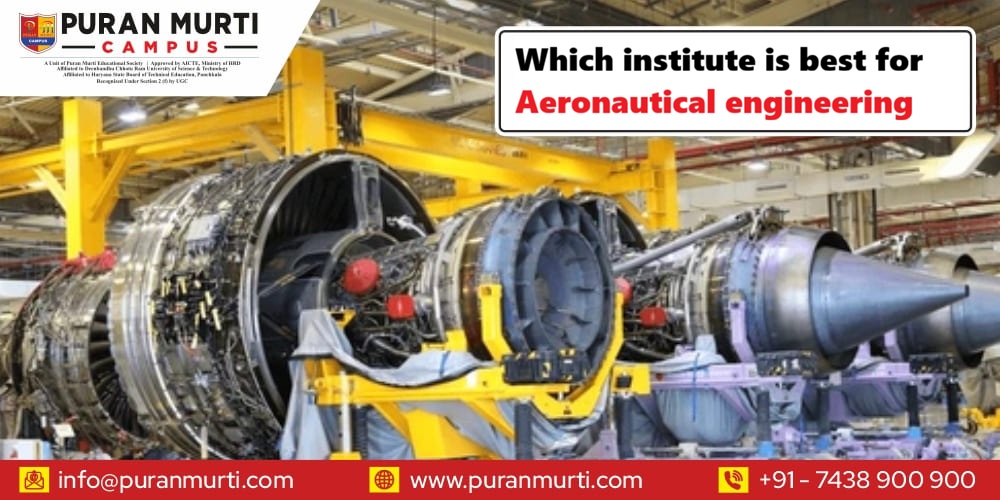
Which institute is best for Aeronautical engineering
Posted on : 3 February, 2026 6:53 pm
Rise of Aeronautical Engineering in India
Aeronautical Engineering focuses on designing, developing, testing, and maintaining aircraft that operate within Earth’s atmosphere. Engineers master aerodynamics, propulsion systems, and avionics. This field blends physics, mathematics, and cutting-edge technology. This blog talks about which institute is best for Aeronautical engineering.
India’s aviation boom fuels demand. The sector requires over 1,000 new aircraft by 2030, creating jobs in airlines, defense, and manufacturing. Graduates earn starting salaries of ₹5-8 LPA, scaling to ₹20-45 LPA with experience. Roles span design engineers, maintenance technicians, and avionics specialists. Apply Now
Moreover, government initiatives like Make in India boost opportunities at HAL, DRDO, and private firms like Tata Advanced Systems. Puran Murti College positions students at this intersection. It emphasizes practical training from semester one, unlike theory-heavy peers. Consequently, alumni thrive globally. Apply Now
Comprehensive Programs at Puran Murti
Puran Murti College offers diverse Aeronautical Engineering pathways. Choose B.Tech (4 years), Integrated B.Tech + AME DGCA, Diploma (3 years), or M.Tech Aerospace. Each aligns with industry needs.
Affiliated to Deenbandhu Chhotu Ram University and AICTE-approved, these programs ensure credibility. Eligibility: 10+2 with PCM (50% minimum) for B.Tech; 10th pass for Diploma. Admissions occur via AIE CET or merit lists. Apply Now
The curriculum evolves with aviation trends. Students tackle real-world projects, from drone assembly to engine overhauls. Integrated AME prepares for DGCA licensing, a rare edge.
| Program | Duration | Highlights | Ideal For |
| B.Tech Aeronautical | 4 years | Aerodynamics, propulsion, live labs, CPL ground classes | Fresh 12th graduates |
| B.Tech + AME DGCA | 4 years | DGCA modules, maintenance training, dual certification | Airline maintenance careers |
| Diploma Aeronautical | 3 years | Quick skills in structures, avionics; job-ready fast | Early workforce entry |
| M.Tech Aerospace | 2 years | Advanced research, AI in aviation, patents | B.Tech holders seeking specialization |
Detailed Curriculum Breakdown
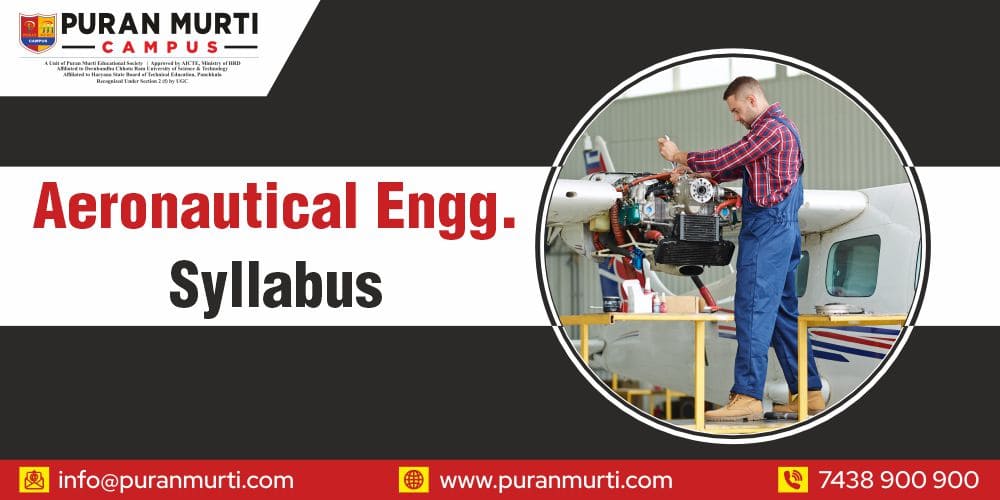
Puran Murti follows a semester-wise structure, approved by AICTE and DGCA where applicable. Semesters build progressively: basics first, advanced applications later. Apply Now
Semester 1-2: Foundations
Mathematics-I/II, Physics/Chemistry Labs, Programming, Basic Electrical Engineering, Workshop Practices. Labs hone problem-solving. For instance, Chemistry Lab tests material durability for aircraft.
Semester 3-4: Core Aero Concepts
Elements of Aerodynamics, Thermodynamics, Aircraft Materials, Propulsion, Structures. Practical: Aerodynamics Lab simulates wind tunnels. Students analyze lift and drag forces firsthand.
Semester 5-6: Advanced Design
Aircraft Stability, Compressible Aerodynamics, Aero Engine Design, Vibration. Labs include Structure Analysis and Propulsion Testing. Professional Training Level II offers industry immersion.
Semester 7-8: Specialization & Projects
Quality Assurance, Airworthiness, Avionics, Electives like Rocket Propulsion or AI in Flight. Culminate in Major Project—build and test prototypes. Open electives cover Cyber Security or Sustainable Manufacturing.
This rigorous path exceeds peers. Puran Murti integrates DGCA modules uniquely, ensuring graduates excel in maintenance roles. Faculty guide capstone projects with real aircraft data. Apply Now
Cutting-Edge Facilities
Spread over 35 acres near Delhi-NCR, Puran Murti boasts futuristic infrastructure. Aeronautical labs house actual aircraft for disassembly and reassembly. Apply Now
Key assets include:
- Live Aircraft Hangar: Hands-on maintenance on retired jets.
- Aerodynamics Wind Tunnel: Tests wing designs.
- Propulsion Lab: Engine disassembly, thrust analysis.
- Avionics Suite: Simulators for flight controls.
Wi-Fi blankets the campus. Separate hostels, cricket academy, gym, and 60K-book library support holistic growth. Dispensary ensures health; sports courts build teamwork.
Industry tie-ups bring simulators from Boeing partners. Students prototype drones and CNG micro-planes, fostering innovation. Apply Now
Expert Faculty and Research Ecosystem
Faculty averages 15-20 years in aviation and research. Dr. Sweety, Dean of Engineering, earned Young Scientist Awards and IEEE accolades. Mr. Sangh Deep, MD, holds Best Researcher honors.
Puran Murti files 94 patents, publishes 1,900 papers. Five research centers target AI aviation and green propulsion. MSME incubator nurtures startups—students access ₹15 crore grants.
Collaborations with Infosys, NASSCOM integrate emerging tech. Consequently, students co-author papers and secure funded projects early. Apply Now
Unmatched Placement Records
Puran Murti guarantees 100% placements. Aviation alumni join IndiGo, Vistara, Air India, Boeing, HAL. Highest package: 45 LPA (Bosch); aeronautical averages ₹9-17 LPA. Apply Now
Training covers soft skills, GDPI prep, and recruiter mocks. Key recruiters:
| Recruiter | Roles Offered | Avg Package |
| IndiGo, SpiceJet | AME, Flight Engineer | ₹9-14 LPA |
| Boeing, Airbus | Design, Avionics | ₹12-20 LPA |
| HAL, DRDO | R&D Engineer | ₹10-15 LPA |
| Siemens, Quest | Systems Specialist | ₹11-18 LPA |
Alumni network spans 2,000 across MNCs in India, US, UK. Lateral placements and global exchanges add value.
Prestigious Rankings and Accolades
Puran Murti tops Haryana engineering rankings (IIRF, Times). NAAC A-grade, ISO 9001/14001 certified. Recognitions: Best Emerging Campus (Times), Top Employability (IIRF). Apply Now
ACU member; Zee Awards for infrastructure. Outperforms in placements, research per Open Magazine.
Vibrant Student Life
Campus pulses with energy. Adventure trips—rafting in Rishikesh, paragliding in Solang—build resilience. Clubs for robotics, aviation quizzes foster skills. Apply Now
Testimonials shine: “Faculty supportive; dynamic environment,” says Ayushi Yadav. Alferd Tongsin: “Miraculous facilities; home-like”. International students from Africa, Nepal integrate seamlessly. Apply Now
2026 Admissions Guide

Apply at puranmurti.com. AIE CET scores or 10+2 merit decide seats. Counseling follows results; scholarships cut fees. Deadlines: March-June 2026.
Visit Kami Road, Sonepat—35 acres await. Apply Now
Eligibility, Entrance Exams and Admission Process
Most Aeronautical Engineering Colleges follow eligibility and admission norms similar to leading institutes like Puran Murti Vidyapeeth. Apply Now
Basic Eligibility
- 10+2 with Physics, Chemistry, and Mathematics from a recognized board.
- Minimum aggregate usually ranges from 45% to 50%, with relaxation for reserved categories as per norms.
- Some colleges also allow B.Sc or diploma holders for lateral entry in higher semesters.
Entrance Exams Commonly Accepted
- JEE Main for national-level engineering admissions.
- State-level engineering entrance exams, where applicable, as per technical education regulations.
- College-level or university-level entrance tests for institutes that conduct their own examinations.
Simple Admission Flow
- Register and appear for the accepted entrance exam
- Participate in counseling and choice locking for branches and colleges
- Attend document verification as per college or counseling authority rules
- Confirm the seat by paying the first installment of fees
In addition, some private colleges offer merit-based or management quota seats for students with strong interest in aviation, similar to the flexibility seen at Puran Murti Vidyapeeth.

Why Puran Murti Outshines Competitors
Compared to IITs or MIT Manipal, Puran Murti offers affordability and aviation-specific labs. IITs demand JEE Advanced; here, AIE CET suffices. Peers lack live aircraft; Puran Murti delivers.
In Haryana, it leads over YMCA Faridabad in placements (100% vs 85%) and facilities. Global exposure matches VIT without relocation costs. Apply Now
How to Choose Which institute is best for Aeronautical engineering
Because multiple institutes may offer engineering with aviation-friendly streams, students should carefully compare their options.
Important points to evaluate
- Approval and affiliation: Check AICTE approval and university affiliation of the engineering program.
- Branch availability: Confirm whether the college offers aeronautical, aerospace, or closely allied branches like mechanical with aviation electives.
- Faculty strength: Look for experienced faculty with a background in aeronautics, aerospace, or related research.
- Laboratory quality: Review labs, workshops, software tools, and simulation facilities during campus visits or online tours.
- Placement record: Check recent placement statistics, top recruiters, and roles offered to engineering graduates.
- Location and hostel: Consider safety, hostel quality, food, and transport to ensure comfort over four years.
Colleges that follow models similar to Puran Murti Vidyapeeth often combine strong academics with placement-driven training, which supports better outcomes for students. Apply Now
Future-Ready Skills
Graduates master CAD, CFD software; DGCA prep ensures licenses. Electives in EVs, Nano-Tech future-proof careers. Entrepreneurship cell incubates ideas like student-built quad-bikes. Apply Now
Specializations in Aeronautical Engineering
Modern aeronautical engineering programs allow students to focus on specialized domains, enhancing expertise and career prospects.
Core Specialization Tracks
| Specialization | Focus Area | Career Path |
| Aerodynamics | Air flow, lift, drag optimization | Design engineer, research scientist |
| Propulsion Systems | Jet engines, rocket propulsion, combustion | Engine design, missile systems |
| Avionics | Navigation, communication, flight instruments | Avionics engineer, systems integrator |
| Aircraft Structures | Material science, structural integrity, stress analysis | Structural analyst, quality engineer |
| Flight Mechanics & Control | Stability, control systems, flight dynamics | Flight test engineer, control systems engineer |
| Computational Fluid Dynamics (CFD) | Simulation, analysis, aerodynamic modeling | CFD analyst, design optimization |
| UAV/Drone Technology | Unmanned aircraft design, autonomous systems | Drone engineer, roboticist |
| Sustainable Aviation | Electric/hybrid propulsion, eco-friendly design | Green technology engineer, innovation lead |
| Space Systems Engineering | Spacecraft, orbital mechanics, satellite systems | Space engineer, mission planner |
Why specialize
Choosing a specialization early allows students to take targeted electives, do focused projects, and gain industry-relevant skills that make them immediately job-ready.
Career Opportunities

Emerging Drone & UAV Career Opportunities
India’s drone industry is expanding rapidly, creating exciting new roles for aeronautical engineers with AI, robotics, and design skills.
Why Drone Careers Are Growing
- Government initiatives like Drone Shakti and Digital Sky Platform encourage commercial drone adoption
- Applications expanding in agriculture, logistics, surveillance, defense, filmmaking, and disaster management
- Hundreds of drone tech startups emerging with venture funding
- Shortage of skilled UAV professionals vs. high market demand
Top Drone Industry Roles for Aeronautical Engineers
| Role | Monthly Salary | Key Skills Required |
| Drone Pilot / UAV Operator | ₹40,000–₹80,000 | DGCA remote pilot certificate, flight operations, route planning |
| UAV Software Engineer | ₹60,000–₹1,20,000 | Programming (Python, C++), flight control systems, AI integration |
| Drone Design Engineer | ₹50,000–₹1,00,000 | Aerodynamics, CAD, propulsion, materials, structural design |
| Drone Data Analyst | ₹50,000–₹90,000 | GIS tools, image processing, data visualization, analysis |
| Drone Maintenance Engineer | ₹35,000–₹70,000 | Electronics, mechanics, firmware, troubleshooting |
| Drone Research Scientist | ₹80,000–₹1,50,000 | Aerodynamics, robotics, AI, R&D methodology |
Industries Hiring Drone Professionals in 2025
- Agriculture: Precision farming, crop health monitoring, pesticide spraying
- Logistics: Drone delivery services, warehouse inventory, remote location supply
- Defense & Government: Surveillance, reconnaissance, border patrol, disaster assessment
- Media & Film: Aerial cinematography, live event coverage, sports broadcasting
- Infrastructure: Smart city planning, mining surveys, utility inspections
- Startups: Innovation in autonomous delivery, AI-driven analytics, environmental monitoring
How Aeronautical Engineers Enter Drone Sector
- Pursue specialization in UAV design during B.Tech final years
- Gain DGCA Remote Pilot Certificate for operational credibility
- Learn complementary skills: GIS tools, Python programming, data analytics
- Intern with drone startups or established aerospace companies
- Consider M.Tech in Aerospace with UAV focus for advanced R&D roles
Government Support
- Drone Policy 2.0 simplifies licensing and operation
- Designated test zones for pilot training and R&D
- Incentives for startups developing indigenous drone technology under Make in India
Internships, Industry Exposure and Practical Training
To succeed in aeronautical engineering, students must gain strong practical experience. Because of that, most good colleges design structured internship and training opportunities in aviation-related domains. Apply Now
Types of exposure students usually get
- Internships with airlines, maintenance organizations, design firms, or research centers, depending on tie-ups.
- Industrial visits to airports, aircraft maintenance facilities, or simulation centers.
- Workshops on drone technology, CAD tools, CFD, avionics, or safety regulations.
- Participation in technical competitions, aeromodelling clubs, and student projects in collaboration with faculty.
Institutes inspired by the Puran Murti Vidyapeeth approach emphasize real-world training so students can easily transition into jobs after graduation. Apply Now
Salary & Earning Potential for Aeronautical Engineers
Aeronautical engineering offers competitive compensation across career stages, reflecting the technical expertise and responsibility involved.
Average Salaries in India (2025)
| Career Stage | Average Annual Salary | Monthly Range |
| Entry-level (0-1 year) | ₹7,50,000 | ₹60,000–₹65,000 |
| Early career (1-4 years) | ₹6,74,074 | ₹55,000–₹58,000 |
| Overall aeronautical engineer | ₹7,22,136 | ₹65,000–₹75,000 |
| Aerospace engineers | ₹7,12,155 | ₹64,000–₹74,000 |
Notably, these figures increase significantly with specialization, location, employer type, and additional certifications like DGCA AME licensing.
Salary drivers
- Employer type (government PSU vs. private vs. defense)
- Location (metros offer 15–20% higher pay)
- Specialization (propulsion, avionics, design pay better)
- Experience and certifications (DGCA AME, GATE, MBA add premiums)
- Company size and international exposure
Engineers working with prestigious organizations like HAL, ISRO, Boeing India, or Airbus India typically command higher packages plus comprehensive benefits including housing, travel allowances, and medical coverage. Apply Now
The DGCA Aircraft Maintenance Engineer Path
Beyond traditional B.Tech aeronautical engineering, a specialized pathway exists to become a DGCA-licensed Aircraft Maintenance Engineer. This certification, issued carries international validity and allows engineers to legally sign aircraft airworthiness certificates before takeoff—a security-critical responsibility.
The AME license comes in categories: Category A for minor maintenance, and Category B1 (Mechanical) and B2 (Avionics) for comprehensive system maintenance. After completing recognized training and clearing DGCA module exams, candidates must complete 18–24 months of on-the-job training at approved aviation organizations. Importantly, many B.Tech graduates pursue dual qualification as both aeronautical engineers and licensed AMEs, significantly enhancing their international marketability and earning potential. Apply Now
India’s Booming Aviation Market
Understanding the industry context underscores why aeronautical engineering remains attractive. India is the 3rd largest civil aviation market globally with projected 25% annual growth. The commercial aviation sector is adding 50+ new aircraft annually, while government initiatives—including airport expansion, defense modernization, and ISRO’s expanding space missions—are driving demand for skilled professionals. Notably, there exists a significant shortage of qualified aeronautical engineers, creating abundant job opportunities across sectors. Apply Now
Global Opportunities and International Prospects
Aeronautical engineering graduates enjoy strong international career prospects. The DGCA AME license is recognized globally under ICAO standards, valid in the USA, UK, Europe, Middle East, Australia, and Singapore. Global aerospace companies like Boeing, Airbus, Lockheed Martin, and Embraer actively hire Indian engineers. Furthermore, pursuing M.Tech followed by PhD from top universities (MIT, Caltech, Stanford) opens research and development roles with substantial salary premiums. Many Indian professionals work internationally in expatriate roles earning 2–3 times their domestic salaries. Apply Now
Scholarships and Financial Aid Opportunities
Multiple scholarship programs help eligible students pursue aeronautical engineering without excessive financial burden. The AICTE Pragati Scholarship supports girl students across engineering colleges. Similarly, DRDO ARDB, HAL, and ISRO offer merit-based scholarships for deserving candidates. Furthermore, the Shaksham Scholarship provides 40–60% fee waivers for eligible students. Beyond national programs, many private colleges offer merit scholarships based on 10+2 marks and entrance exam performance. Additionally, most institutions provide installment-based fee payment options and facilitate education loans through banks at subsidized rates.
Campus Facilities and Learning Environment
Leading Aeronautical Engineering Colleges design their campus facilities on the lines of top engineering institutions, with strong emphasis on labs and practical exposure.
Common facilities you can expect
- Aerodynamics and propulsion labs with experimental setups and basic wind tunnel arrangements.
- Aircraft structure, avionics, and materials labs for hands-on practice on components and systems.
- CAD/CAM and simulation labs for design, modeling, and analysis of aircraft parts and systems.
- Workshops and fabrication areas for machining, fitting, and basic manufacturing processes.
- Digital library, e-resources, and technical journals related to aviation and aerospace.
- Hostel, canteen, transport, sports, and student activity clubs for overall development.
Colleges that mirror the Puran Murti Vidyapeeth model also focus on value-added certifications, personality development, and industry interaction, which help students become job-ready.
Conclusion
Puran Murti College emerges as the premier institute for Aeronautical Engineering in Haryana. It delivers AICTE-approved programs with live aircraft labs and 100% placements. Aspiring engineers and parents prioritize credible choices that fuse rigorous academics, practical exposure, and proven career outcomes.
Apply Now—secure your wings for 2026.
Aeronautical Engineering Colleges in Jharkhand
FAQs
Is Puran Murti AICTE-approved for Aeronautical Engineering?
Yes, fully approved with university affiliation.
What placements do Aeronautical graduates get?
100% with IndiGo, Boeing at ₹9-45 LPA.
Are live aircraft labs available?
Yes, hands-on from semester one.
International students welcome?
Yes, full support provided.
Entrance for B.Tech Aeronautical?
AIE CET or 10+2 PCM merit.
Diploma vs B.Tech—which better?
Diploma for quick jobs; B.Tech for design roles.