

BA LLB Course: Eligibility, Admission, Fees, Syllabus & Career Opportunities
Posted on : 29 June, 2026 1:56 pm
Choosing the right professional course after Class 12 is one of the most important decisions for students planning a successful career. Among the most popular law programs in India, the BA LLB Course: Eligibility, Admission, Fees, Syllabus & Career Opportunities is a preferred choice for students interested in law, justice, public policy, and legal advocacy. Understanding the BA LLB Course: Eligibility, Admission, Fees, Syllabus & Career Opportunities helps students make informed decisions about their education and future. This guide covers every important aspect of the BA LLB Course: Eligibility, Admission, Fees, Syllabus & Career Opportunities, including admission process, eligibility criteria, fee structure, syllabus, career options, salary, and future scope. By exploring the BA LLB Course: Eligibility, Admission, Fees, Syllabus & Career Opportunities, students can confidently choose the right path toward a rewarding legal career.
What is BA LLB?
Apply Now
The course develops legal knowledge along with analytical thinking, communication skills, and problem-solving abilities, preparing students for careers in litigation, corporate law, judiciary, and public administration.
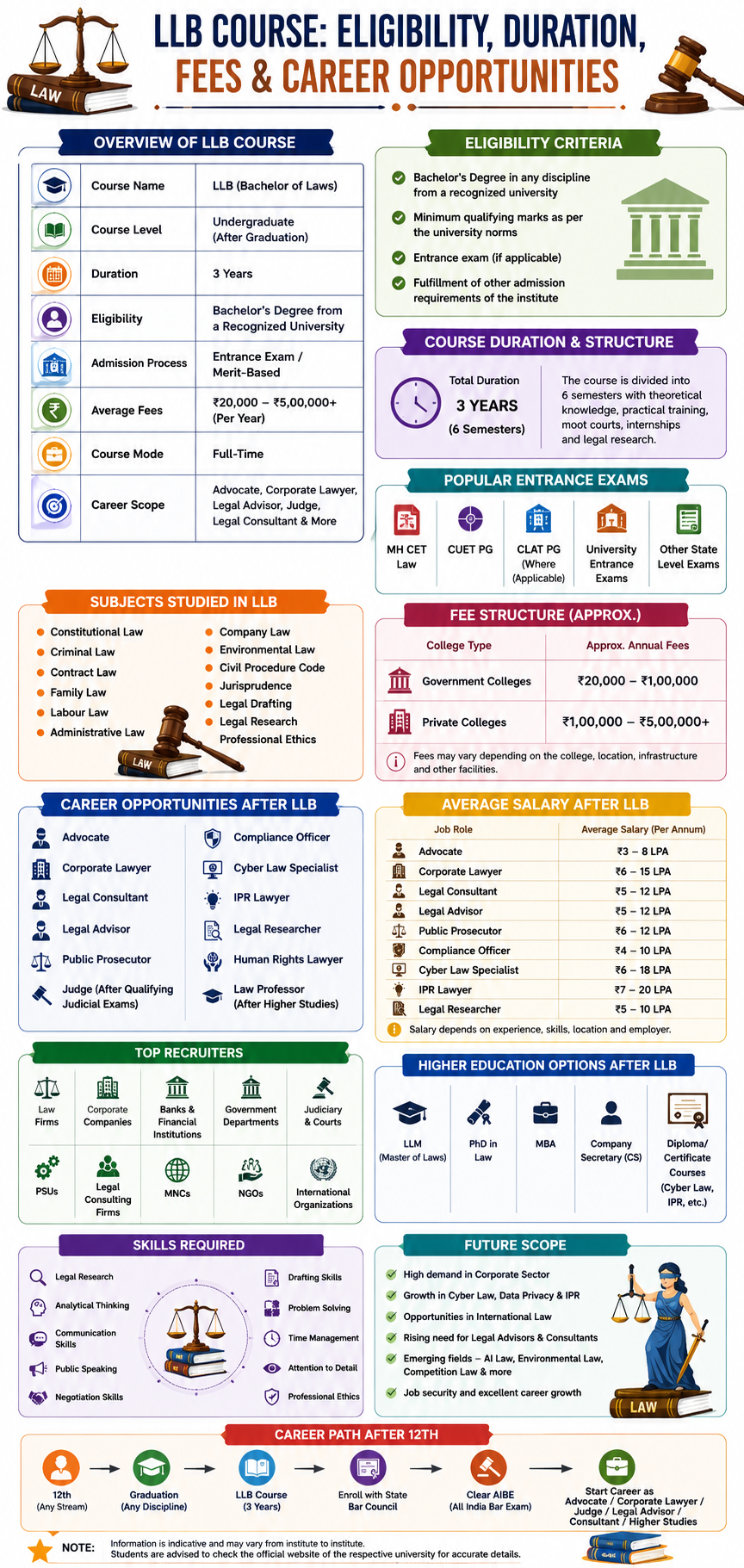
BA LLB Course Highlights
| Particular | Details |
|---|---|
| Course Name | BA LLB |
| Course Level | Undergraduate |
| Course Duration | 5 Years |
| Course Type | Integrated Degree Program |
| Eligibility | 10+2 from a recognized board |
| Admission Process | Entrance Exam / Merit-Based |
| Popular Entrance Exams | CLAT, AILET, SLAT, LSAT India, CUET (selected universities) |
| Average Course Fees | ₹80,000 – ₹4,00,000 per year (varies by college) |
| Career Scope | Litigation, Corporate Law, Judiciary, Legal Consulting |
BA LLB Eligibility Criteria
Students must fulfill the following requirements:
- Pass Class 12 from a recognized board
- Secure minimum qualifying marks as prescribed by the university
- Qualify the entrance examination (where applicable)
- Meet age and eligibility criteria of the respective institution
BA LLB Admission Process
Admission generally follows these steps:
- Complete Class 12 from a recognized board.
- Apply for national or university-level entrance exams.
- Appear for the entrance examination.
- Participate in counselling or interview (if required).
- Verify documents and complete admission formalities.
- Pay the admission fee to confirm your seat.

Popular BA LLB Entrance Exams
- CLAT (Common Law Admission Test)
- AILET (All India Law Entrance Test)
- SLAT (Symbiosis Law Admission Test)
- LSAT India
- CUET (Selected Universities)
- University-specific entrance examinations
BA LLB Syllabus
First Year
- Political Science
- Sociology
- History
- English
- Legal Methods
- Constitutional Law
Second Year
- Law of Contracts
- Family Law
- Law of Torts
- Administrative Law
- Economics
Third Year
- Criminal Law
- Property Law
- Company Law
- Environmental Law
- Labour Law
Fourth Year
- Human Rights Law
- Intellectual Property Rights
- Taxation Law
- Public International Law
- Civil Procedure Code
Fifth Year
- Cyber Law
- Moot Court Training
- Legal Drafting
- Professional Ethics
- Internship
- Dissertation / Project Work
BA LLB Course Fees
| College Type | Average Annual Fees |
|---|---|
| Government Colleges | ₹20,000 – ₹1,50,000 |
| Private Colleges | ₹80,000 – ₹4,00,000+ |
Fees vary depending on the college, infrastructure, facilities, and location.
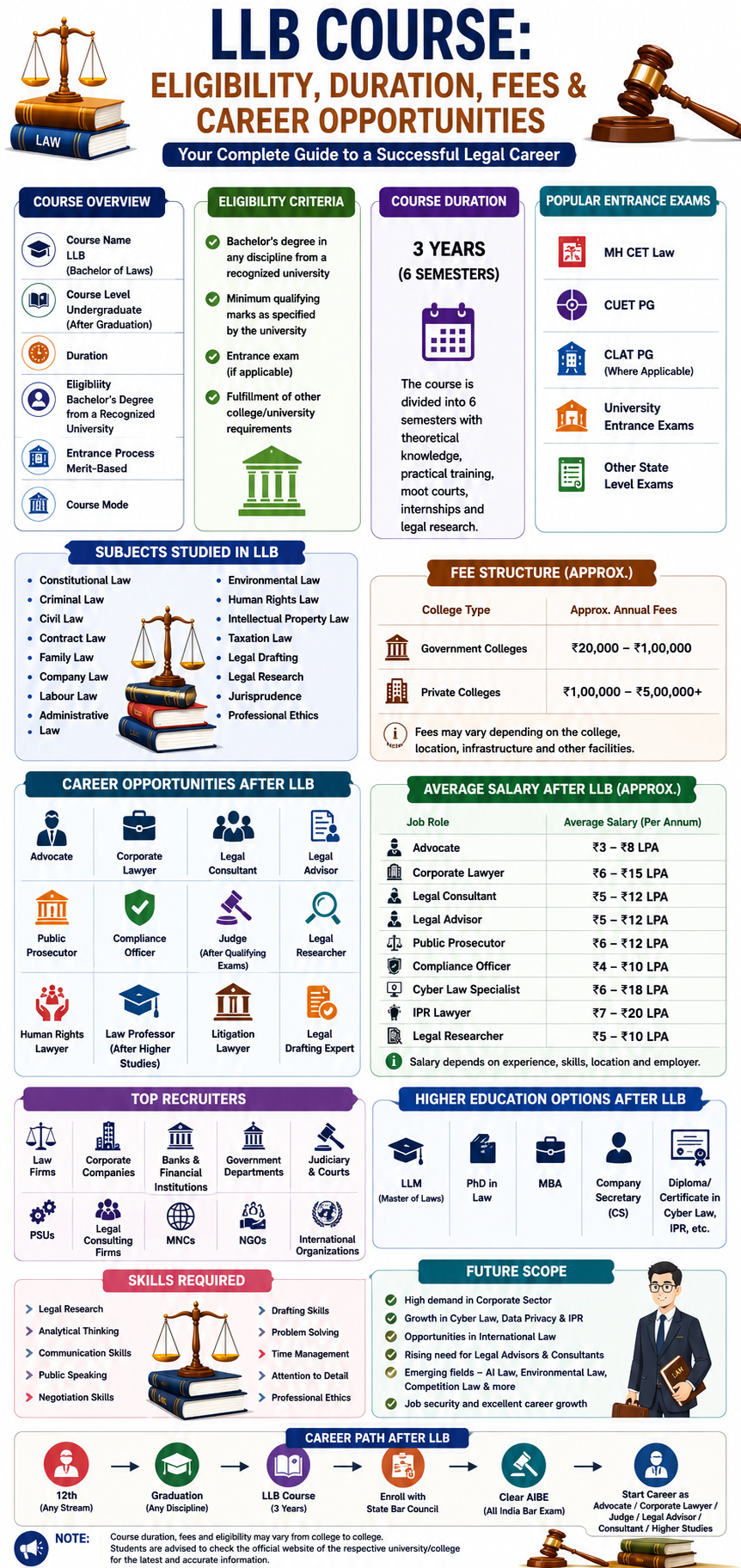
Skills Required
Students pursuing BA LLB should develop:
- Legal Research
- Critical Thinking
- Analytical Skills
- Communication Skills
- Public Speaking
- Negotiation Skills
- Drafting Skills
- Leadership
- Time Management
- Problem-Solving Ability

BA LLB Course Semester-wise Syllabus
| Semester | Subjects |
|---|---|
| Semester I | English, Political Science-I, Sociology-I, Law of Torts, Legal Methods, Computer Applications |
| Semester II | Political Science-II, Sociology-II, Law of Contracts-I, Family Law-I, Law of Crimes (IPC), Environmental Studies |
| Semester III | Constitutional Law-I, Law of Contracts-II, Family Law-II, Economics-I, Public International Law, Legal Language |
| Semester IV | Constitutional Law-II, Administrative Law, Economics-II, Jurisprudence, Property Law, Law of Evidence |
| Semester V | Company Law, Labour Law-I, Human Rights Law, Environmental Law, Civil Procedure Code (CPC), Alternative Dispute Resolution (ADR) |
| Semester VI | Labour Law-II, Intellectual Property Rights (IPR), Banking & Insurance Law, Criminal Procedure Code (CrPC), Drafting, Pleading & Conveyancing |
| Semester VII | Taxation Law, Interpretation of Statutes, Arbitration & Conciliation, Cyber Law, Professional Ethics, Moot Court Exercise |
| Semester VIII | Corporate Law, Competition Law, International Trade Law, Media & Entertainment Law, Women & Law, Legal Aid Clinic |
| Semester IX | Securities Law, Investment Law, Information Technology Law, White Collar Crimes, Internship & Viva Voce, Elective Paper-I |
| Semester X | Dissertation/Research Project, Professional Training, Internship, Seminar Paper, Elective Paper-II, Viva Voce |
Career Opportunities After BA LLB Apply Now
Graduates can pursue careers such as:
- Advocate
- Corporate Lawyer
- Legal Consultant
- Legal Advisor
- Public Prosecutor
- Compliance Officer
- Judicial Officer (after qualifying examinations)
- Human Rights Lawyer
- Legal Researcher
- Policy Analyst
- Company Legal Executive
- Arbitration Specialist
Sector-Wise Career Opportunities
| Sector | Career Options |
|---|---|
| Judiciary | Judge, Judicial Officer |
| Litigation | Advocate, Trial Lawyer |
| Corporate Sector | Corporate Lawyer, Legal Advisor |
| Government | Public Prosecutor, Legal Officer |
| Banking | Compliance Officer |
| Education | Law Professor, Researcher |
| NGOs | Human Rights Lawyer |
| Consultancy | Legal Consultant |
Average Salary After BA LLB Apply Now
| Job Role | Average Salary |
|---|---|
| Advocate | ₹3–8 LPA |
| Corporate Lawyer | ₹6–15 LPA |
| Legal Consultant | ₹5–12 LPA |
| Legal Advisor | ₹5–12 LPA |
| Public Prosecutor | ₹6–12 LPA |
| Compliance Officer | ₹4–10 LPA |
| Human Rights Lawyer | ₹5–10 LPA |
| Legal Researcher | ₹5–10 LPA |
Salary depends on experience, specialization, employer, and location.
Top Recruiters
Leading recruiters include:
- Top Law Firms
- Corporate Companies
- Banks & Financial Institutions
- Government Departments
- Public Sector Undertakings (PSUs)
- Multinational Companies (MNCs)
- Legal Consultancy Firms
- NGOs
- International Organizations
Higher Education Options
After BA LLB, students can pursue:
- LLM (Master of Laws)
- PhD in Law
- MBA
- Judicial Services Preparation
- Company Secretary (CS)
- Diploma in Cyber Law
- Intellectual Property Law Certification
- International Law Programs
Future Scope
The legal profession continues to grow due to increasing regulations, globalization, digital transformation, and technological advancements. Emerging areas creating excellent career opportunities include:
- Cyber Law
- Artificial Intelligence Law
- Data Privacy Law
- Intellectual Property Rights (IPR)
- Environmental Law
- Corporate Compliance
- International Trade Law
- Arbitration and Mediation
Graduates with practical legal knowledge and strong analytical skills are expected to remain in high demand across industries. Apply Now
Why Choose BA LLB?
Some key advantages include:
- Direct entry into the legal profession after Class 12
- Integrated five-year degree
- Strong career opportunities
- High earning potential
- Opportunities in both government and private sectors
- Global career prospects
- Wide range of legal specializations
- Professional recognition and career stability
Conclusion
The BA LLB Course: Eligibility, Admission, Fees, Syllabus & Career Opportunities offers students a strong foundation for building a successful legal career. From understanding the BA LLB Course: Eligibility, Admission, Fees, Syllabus & Career Opportunities to exploring admission procedures, syllabus, fee structure, and career prospects, this integrated law program provides everything needed to succeed in the legal profession. Whether your goal is litigation, corporate law, judiciary, legal consulting, or higher education, the BA LLB Course: Eligibility, Admission, Fees, Syllabus & Career Opportunities provides the knowledge, practical exposure, and professional skills required for long-term success. Apply Now
About Puran Murti Vidyapeeth Apply Now
The institute is known for its focus on technical education, practical learning, laboratory exposure, and career-oriented training. Students can explore engineering programs in modern technology domains while benefiting from academic support, industry interaction, and campus facilities. The availability of hostel facilities, skill-development activities, and placement assistance also makes it a consideration for students looking for engineering education near Delhi NCR. Apply Now
Top Engineering Branches
BTech (Bachelor of Technology)
BTech is among the most popular courses after 12th Science (PCM).
Top Specializations:
- Aeronautical Engineering
- Aerospace Engineering
- Aircraft Maintenance Engineering (AME)
- Computer Science & Engineering (CSE)
- CSE with Artificial Intelligence and Machine Learning (AI & ML)
- Civil Engineering
- Electrical Engineering
- Electronics & Communication Engineering (ECE)
- Mechanical Engineering
Unique Aviation Programs (USP)
One of the biggest advantages of Puran Murti Vidyapeeth is its aviation-based courses, which are rare in India:
- B.Tech + AME (DGCA approved)
- B.Tech Mechanical Engineering + AME (DGCA)
- B.Tech ECE + AME (DGCA)
- B.Tech Computer Science
(AI & ML)+ AME (DGCA) - B.Tech Aeronautical Engineering
+ CPL (Ground Classes) - B.Tech Aerospace Engineering
+ CPL (Ground Classes)
Diploma Courses
Students can also choose job-oriented diploma courses: Apply Now
- Diploma in Automobile Engineering (AE)
- Diploma in AME (Aircraft Maintenance Engineering)
- Diploma in Aeronautical Engineering
- Diploma in Civil Engineering (CE)
- Diploma in Mechanical Engineering (ME)
- Diploma in Computer Science & Engineering (CSE)
- Diploma in Electronics & Communication Engineering (ECE)
- Diploma in Electrical Engineering (EE)
- Diploma in Fire Technology & Safety
- Diploma in Medical Lab Technology (MLT)
- Diploma in Hotel Management
- Diploma in CSE (AI & ML)
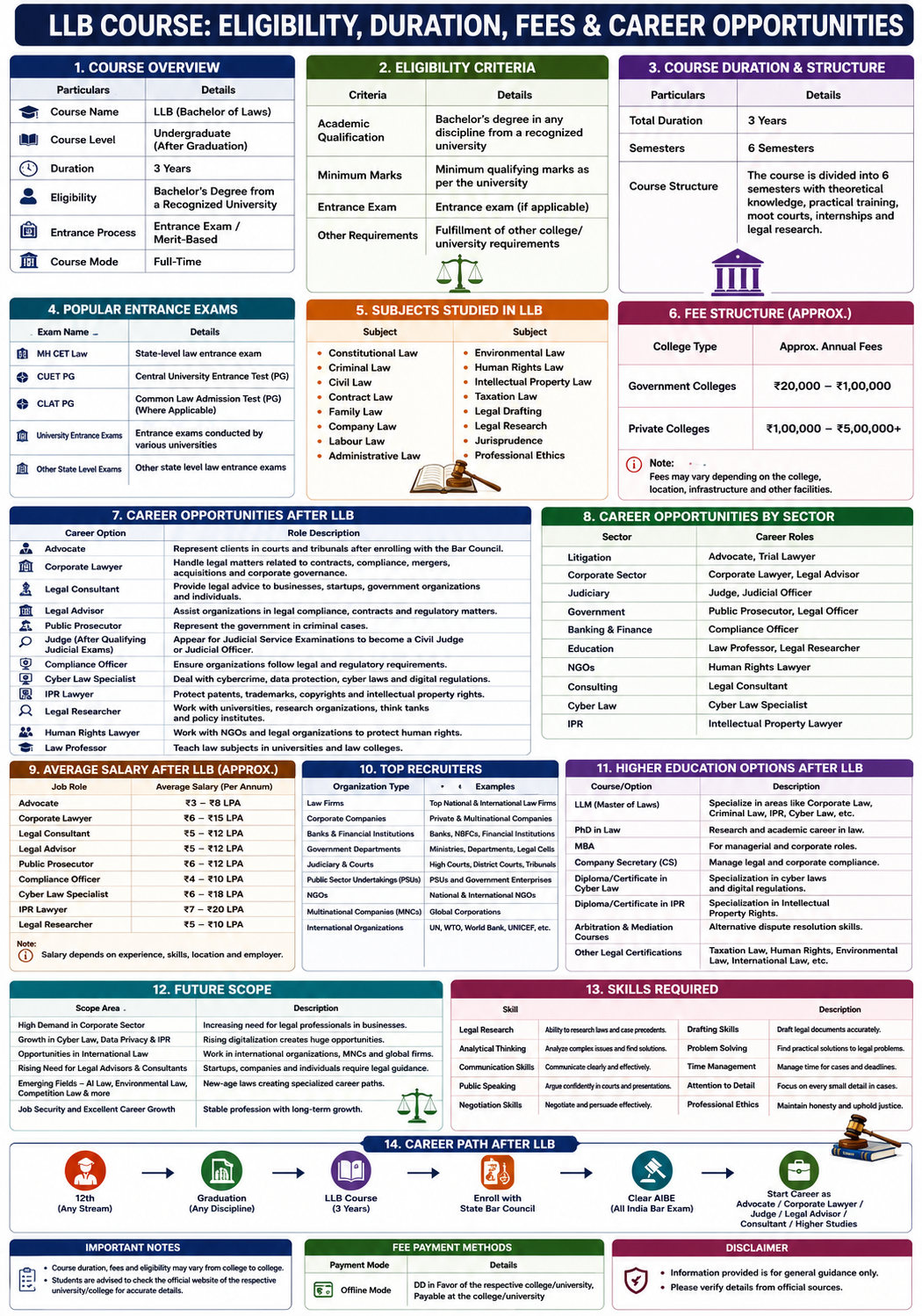
FAQs
1. What is the duration of the BA LLB course?
The BA LLB is a five-year integrated undergraduate law program that combines Arts and Law subjects.
2. What is the eligibility for BA LLB admission?
Candidates must have passed Class 12 from a recognized board and qualify for the required entrance exam or merit criteria.
3. Which entrance exams are accepted for BA LLB admission?
Popular exams include CLAT, AILET, SLAT, LSAT India, CUET (selected universities), and university-specific entrance tests.
4. What are the career opportunities after BA LLB?
Graduates can become advocates, corporate lawyers, legal advisors, compliance officers, public prosecutors, judicial officers, legal consultants, or pursue higher studies like LLM.
5. Is BA LLB a good career option after 12th?
Yes. BA LLB is one of the best professional courses after Class 12, offering excellent career growth, attractive salaries, and opportunities in litigation, corporate law, judiciary, and government sectors.