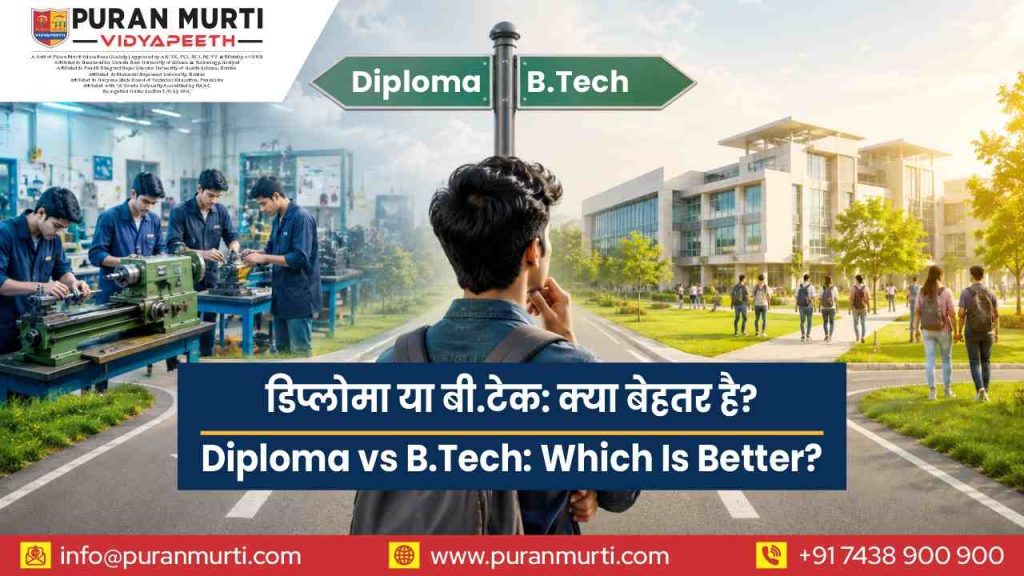
Diploma vs B.Tech: Which Is Better? Complete Career Guide 2027
Posted on : 10 July, 2026 3:45 am
Choosing the right engineering path is one of the biggest career decisions for students after Class 10 or Class 12. Many students ask, “Should I pursue a Diploma or B.Tech?” The answer depends on your career goals, budget, academic background, and long-term aspirations.
Both Diploma and B.Tech offer excellent career opportunities, but they serve different purposes. A diploma provides early technical exposure and faster entry into the workforce, while a B.Tech degree opens doors to higher-paying jobs, leadership roles, research, and global career opportunities.
In this comprehensive guide, we’ll compare Diploma vs B.Tech based on eligibility, duration, fees, career scope, salary, placements, higher education opportunities, and future prospects to help you make an informed decision.
Diploma vs B.Tech: Which is better?
A Diploma is ideal for students who want practical technical education after Class 10 and wish to start working earlier. A B.Tech degree is better for students seeking broader career opportunities, higher salaries, management roles, and long-term career growth. The right choice depends on your career objectives and educational background.
Diploma vs B.Tech at a Glance
| Feature | Diploma | B.Tech |
|---|---|---|
| Eligibility | After Class 10 | After Class 12 (PCM) |
| Duration | 3 Years | 4 Years |
| Entry Level | Technician | Engineer |
| Focus | Practical Skills | Theory + Practical |
| Higher Studies | Lateral Entry to B.Tech | M.Tech, MBA, MS |
| Average Salary | ₹2.5–5 LPA | ₹4–12+ LPA |
| Career Growth | Good | Excellent |
| Leadership Opportunities | Limited | High |
Diploma vs B.Tech After 10th: Which Option is Better After 10th?
What is a Diploma in Engineering?
A Diploma in Engineering is a three-year technical program that students can pursue after completing Class 10. It emphasizes practical skills, laboratory work, industrial training, and technical expertise.
Students gain hands-on knowledge in their chosen engineering branch and can either start working immediately or continue their education through lateral entry into B.Tech.
Popular Diploma Specializations
- Mechanical Engineering
- Civil Engineering
- Computer Engineering
- Electrical Engineering
- Electronics Engineering
- Automobile Engineering
What is B.Tech?
Bachelor of Technology (B.Tech) is a four-year undergraduate engineering degree designed to prepare students for professional engineering careers.
The curriculum combines engineering fundamentals, practical projects, internships, innovation, research, and emerging technologies like Artificial Intelligence, Robotics, Data Science, and Cyber Security.
Graduates are eligible for engineering jobs, higher education, entrepreneurship, and government examinations.
Diploma vs B.Tech: Detailed Comparison
1. Eligibility
Diploma
- After Class 10
- Merit-based or entrance-based admission
- Suitable for students wanting early technical education
B.Tech
- After Class 12 with Physics, Chemistry, and Mathematics
- Admission through entrance exams or merit
- Suitable for students targeting engineering careers
2. Course Duration
Diploma takes 3 years, allowing students to enter the workforce earlier.
B.Tech takes 4 years, offering a broader academic foundation and advanced engineering knowledge.
3. Course Curriculum
Diploma Focuses On
- Practical workshops
- Technical labs
- Industrial visits
- Skill-based learning
- Equipment handling
B.Tech Includes
- Engineering mathematics
- Core engineering concepts
- Programming
- Design projects
- Research
- Industry internships
- Innovation and entrepreneurship
4. Learning Approach
Diploma programs are highly practical and job-oriented.
B.Tech balances practical learning with theoretical knowledge, innovation, and research, preparing students for technical and managerial roles.
Why Choose a Diploma?
A Diploma can be an excellent choice if you:
- Want technical education after Class 10
- Prefer practical learning
- Wish to start earning early
- Plan to pursue B.Tech later through lateral entry
- Have budget constraints
Top Benefits
- Early career start
- Affordable fees
- Strong practical skills
- Industry-ready training
- Lateral entry opportunities
Why Choose B.Tech?
A B.Tech degree is ideal for students who:
- Want higher-paying engineering jobs
- Aim for multinational companies
- Plan higher education abroad
- Aspire to become engineers, project managers, researchers, or entrepreneurs
- Want better long-term career growth
Top Benefits
- Better placements
- Higher salary potential
- Leadership opportunities
- Global recognition
- Stronger career progression
Diploma vs B.Tech Salary Comparison
| Qualification | Average Starting Salary |
| Diploma | ₹2.5–5 LPA |
| B.Tech | ₹4–12+ LPA |
Salary depends on factors like:
- Skills
- College reputation
- Internship experience
- Industry demand
- Location
- Specialization
Professionals in AI, Data Science, Software Development, Cyber Security, and Electronics often command higher salary packages.
B.Tech & Diploma Courses
Popular Engineering Courses
- Aeronautical Engineering
- Aerospace Engineering
- Aircraft Maintenance Engineering (AME)
- Computer Science & Engineering (CSE)
- CSE with Artificial Intelligence and Machine Learning (AI & ML)
- Civil Engineering
- Electrical Engineering
- Electronics & Communication Engineering (ECE)
- Mechanical Engineering
Unique Aviation Programs (USP)
One of the biggest advantages of Puran Murti Vidyapeeth is its aviation-based courses, which are rare in India:
- B.Tech + AME (DGCA approved)
- B.Tech Mechanical Engineering + AME (DGCA)
- B.Tech ECE + AME (DGCA)
- B.Tech Computer Science
(AI & ML)+ AME (DGCA) - B.Tech Aeronautical Engineering
+ CPL (Ground Classes) - B.Tech Aerospace Engineering
+ CPL (Ground Classes)
Diploma Courses
Students can also choose job-oriented diploma courses: Apply Now
- Diploma in Automobile Engineering (AE)
- Diploma in AME (Aircraft Maintenance Engineering)
- Diploma in Aeronautical Engineering
- Diploma in Civil Engineering (CE)
- Diploma in Mechanical Engineering (ME)
- Diploma in Computer Science & Engineering (CSE)
- Diploma in Electronics & Communication Engineering (ECE)
- Diploma in Electrical Engineering (EE)
- Diploma in Medical Lab Technology (MLT)
- Diploma in Hotel Management
- Diploma in CSE (AI & ML)

Career Opportunities
After Diploma
Students can work as:
- Junior Engineer
- CAD Designer
- Technician
- Site Supervisor
- Maintenance Engineer
- Production Technician
Many diploma holders also choose lateral entry into B.Tech to enhance career prospects.
After B.Tech
Career options include:
- Software Engineer
- Mechanical Engineer
- Civil Engineer
- Data Analyst
- AI Engineer
- Electronics Engineer
- Design Engineer
- Project Engineer
- Product Engineer
- Research Associate
B.Tech graduates are also eligible for:
- UPSC
- PSU Recruitment
- GATE
- CAT
- MBA
- M.Tech
- MS Abroad
Can Diploma Students Pursue B.Tech?
Yes.
Students who complete a Diploma can take admission directly into the second year of B.Tech through the Lateral Entry program, depending on state regulations and institutional eligibility.
This allows students to save one academic year while earning a full engineering degree.
Which Has Better Placements?
Generally, B.Tech offers better placement opportunities because recruiters hire engineering graduates for technical, managerial, and leadership positions.
However, skilled diploma holders with strong practical knowledge also receive good opportunities in manufacturing, infrastructure, maintenance, and production industries.
Industry Trends in 2027
Engineering remains one of India’s fastest-growing professional sectors due to increasing investments in:
- Artificial Intelligence
- Electric Vehicles
- Robotics
- Semiconductor Manufacturing
- Smart Infrastructure
- Renewable Energy
- Automation
- Data Science
- Cyber Security
Employers increasingly value candidates with strong technical skills, internships, certifications, communication abilities, and project experience.
How to Choose Between Diploma and B.Tech
Ask yourself these questions:
Choose Diploma if:
- You have completed Class 10.
- You want early employment.
- You prefer practical education.
- You plan to pursue B.Tech later.
Choose B.Tech if:
- You completed Class 12 with PCM.
- You want long-term career growth.
- You aspire for higher salaries.
- You wish to work in multinational companies.
- You plan higher studies.
Why Students in Sonipat & Delhi NCR Choose Puran Murti Vidyapeeth
Choosing the right institution is as important as choosing the right course. Students from Sonipat, Delhi NCR, and nearby regions look for colleges that combine quality education with practical industry exposure.
Puran Murti Vidyapeeth has established itself as a preferred destination for engineering education by focusing on industry-oriented learning and holistic student development.
Highlights
- Diploma and B.Tech engineering programs
- Experienced faculty
- Modern laboratories
- Industry collaborations
- Skill development workshops
- Internship opportunities
- Placement assistance
- Innovation-focused learning environment
- Student-centric campus
- Excellent connectivity from Sonipat and Delhi NCR
Students benefit from practical training, project-based learning, technical events, personality development sessions, and career guidance that prepare them for today’s competitive engineering industry.
Frequently Asked Questions
Is Diploma better than B.Tech?
Neither is universally better. A Diploma is ideal for early technical education and practical skills, while B.Tech offers higher salaries, broader career opportunities, and stronger long-term growth.
Can I do B.Tech after Diploma?
Yes. Diploma holders can take admission into the second year of B.Tech through lateral entry, subject to eligibility criteria.
Which has a higher salary: Diploma or B.Tech?
On average, B.Tech graduates earn higher starting salaries because they qualify for engineering, design, software, and management roles.
Is Diploma easier than B.Tech?
Diploma focuses more on practical training, whereas B.Tech includes advanced mathematics, engineering theory, research, and design concepts.
Which is best after Class 10?
Students wanting immediate technical education should consider a Diploma. Those planning a professional engineering career may complete Class 12 and pursue B.Tech.
Can Diploma students get government jobs?
Yes. Diploma holders are eligible for many technical government positions in railways, public works, electricity boards, municipal corporations, and various state departments.
Best B.Tech College Near Delhi NCR for Industry-Ready Engineers
Final Verdict
Both Diploma and B.Tech have their own strengths. Your decision should depend on your academic background, financial situation, learning preferences, and long-term career aspirations.
If your goal is early employment and practical technical skills, a Diploma can be a smart starting point. If you aspire to become a professional engineer, secure higher salaries, pursue leadership roles, or continue higher education, a B.Tech degree is generally the stronger choice.
No matter which path you choose, success ultimately depends on continuous learning, practical experience, industry exposure, and skill development.
Ready to Build Your Engineering Career?
If you’re looking for quality engineering education in Sonipat and Delhi NCR, explore the Diploma and B.Tech programs at Puran Murti Vidyapeeth. With experienced faculty, modern infrastructure, industry-oriented learning, internships, and placement support, the institution helps students develop the skills and confidence needed for successful engineering careers.
Book a campus visit, connect with the admissions team, and take the first step toward a rewarding future in engineering.