Career Options After 12th Science
Posted on : 21 August, 2026 1:07 pm
Courses, Entrance Exams and Future Scope
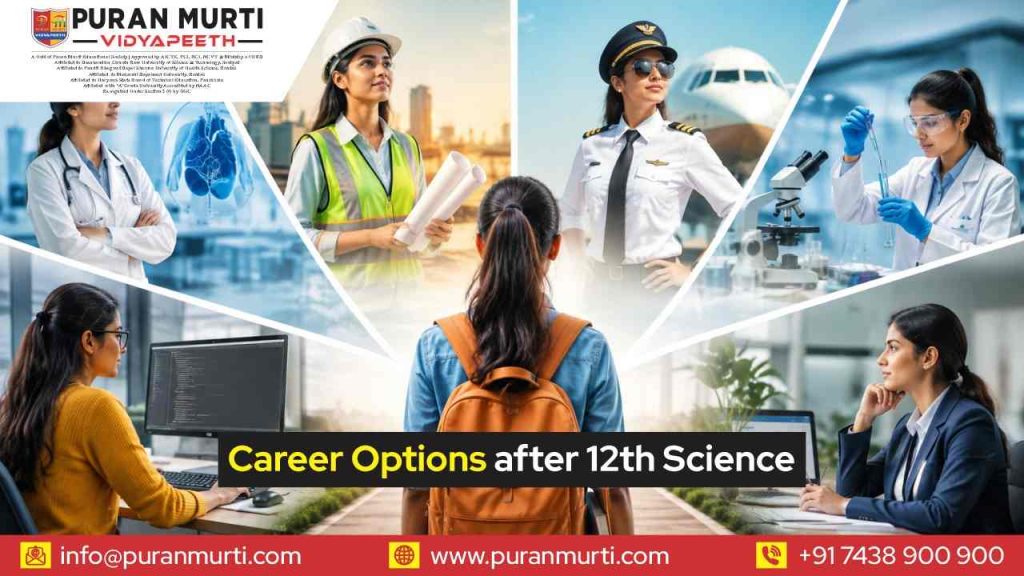
Choosing a career after 12th Science can feel exciting, confusing and slightly overwhelming at the same time. You may be thinking about engineering, medicine, computer applications, pharmacy, aviation, research, defence, architecture or a completely different field. Fortunately, your Science stream does not limit you to only becoming an engineer or doctor.
The best career option after 12th Science depends on four things: your subjects, interests, aptitude and long-term goals. Students with PCM can explore engineering, technology, architecture, aviation, defence and pure sciences. Those with PCB can consider medicine, dentistry, pharmacy, nursing, biotechnology, physiotherapy and allied healthcare. Meanwhile, PCMB students can keep both technical and medical pathways open. Apply Now
This guide explains the major career options after 12th Science, relevant entrance examinations, course durations, skills required and factors to consider before selecting a college. It also explains how institutions such as Puran Murti Vidyapeeth can fit into different academic pathways through engineering, pharmacy, nursing, aviation, management and skill-oriented programmes. Apply Now
What Can You Do After 12th Science?
After Class 12, you can choose from several broad career groups:
The important point is that Science gives you a strong foundation in logical reasoning, observation, calculation and problem-solving. Therefore, you can move into technical, healthcare, business, legal and interdisciplinary careers if you satisfy the relevant eligibility conditions. Apply Now
First Understand Your Science Combination
Before selecting a course, identify whether you studied PCM, PCB or PCMB. Your subject combination affects eligibility for entrance examinations and undergraduate programmes. Apply Now
PCM: Physics, Chemistry and Mathematics
PCM is generally suitable for students interested in:
-
Engineering and technology.
-
Computer science and software development.
-
Artificial intelligence and machine learning.
-
Architecture and planning.
-
Aerospace and aeronautical fields.
-
Mechanical, civil, electrical and automobile engineering.
-
Defence and technical services.
-
Mathematics, statistics and physical sciences.
-
Commercial pilot training, subject to regulatory requirements.
-
Data science and analytics.
Maths plays an important role in most engineering, architecture and technical programmes. Moreover, it develops structured reasoning, which is useful in coding, design, finance, research and operations.
PCB: Physics, Chemistry and Biology
PCB is commonly preferred by students who want to enter:
-
Medicine.
-
Dentistry.
-
Nursing.
-
Pharmacy.
-
Physiotherapy.
-
Medical laboratory technology.
-
Radiology and imaging technology.
-
Biotechnology.
-
Microbiology.
-
Nutrition and dietetics.
-
Agriculture and life sciences.
-
Veterinary and allied healthcare fields.
Students should not assume that MBBS is the only respectable or successful healthcare career. Healthcare depends on a wide ecosystem of doctors, nurses, pharmacists, laboratory professionals, therapists, researchers, administrators and public-health specialists. Apply Now
PCMB: Physics, Chemistry, Mathematics and Biology
PCMB offers the widest academic flexibility. You may apply for many engineering and medical pathways. However, flexibility also brings a responsibility: you must evaluate your preparation level, interests and financial plan before appearing for multiple examinations. Apply Now
PCMB can be valuable when you are genuinely undecided between medicine and engineering. Still, it can create a heavy academic workload. Therefore, avoid choosing PCMB only because someone says it keeps “all options open.” Choose it when you can manage both Mathematics and Biology consistently.
Engineering and Technology Careers
Engineering remains one of the most popular career options after 12th Science, particularly for PCM students. However, engineering is no longer limited to traditional branches. Today, students can combine core engineering knowledge with software, automation, sustainability, data and artificial intelligence. Apply Now
Computer Science Engineering
Computer Science Engineering covers programming, algorithms, databases, operating systems, computer networks and software development. Students may later specialise in cloud computing, cybersecurity, artificial intelligence, data science or application development.
Typical career roles include:
-
Software developer.
-
Web or mobile application developer.
-
Data analyst.
-
Cloud engineer.
-
Cybersecurity analyst.
-
DevOps professional.
-
Systems engineer.
-
Product associate.
-
Technology consultant.
However, a degree alone does not guarantee a software career. You should build projects, learn version control, practise problem-solving and understand at least one programming language properly.
CSE with Artificial Intelligence and Machine Learning
AI and machine learning programmes introduce students to programming, statistics, data structures, predictive models, neural networks and automation. This area can suit students who enjoy Mathematics, logic and technology. Apply Now
Possible career pathways include:
-
Machine learning engineer.
-
Data scientist.
-
AI application developer.
-
Computer vision associate.
-
Natural language processing professional.
-
Robotics software engineer.
-
AI product analyst.
At the same time, students should understand that AI is not merely a fashionable label. Strong fundamentals in mathematics, coding, data handling and computing remain essential.
Puran Murti Vidyapeeth lists Computer Science and Engineering, including a CSE pathway with AI and ML, among its engineering programmes. The brochure also describes industry-linked learning, technical laboratories and exposure to emerging areas such as AI, big data, cybersecurity and cloud computing. These details may be relevant for students seeking a practical technology-oriented environment, although applicants should verify the current programme structure and approvals before admission. Apply Now
Electronics and Communication Engineering
Electronics and Communication Engineering combines electronics, communication systems, embedded systems, signal processing and digital technologies. It can lead to careers in telecommunications, semiconductor systems, embedded programming, defence electronics, automation and the Internet of Things. Apply Now
Students may work as:
-
Embedded systems engineer.
-
Electronics design engineer.
-
Network engineer.
-
Verification engineer.
-
Telecommunication professional.
-
IoT developer.
-
Test and quality engineer.
This branch suits learners who enjoy both hardware and software. Furthermore, it can provide a useful foundation for postgraduate study in communication, VLSI, robotics and signal processing.
Mechanical Engineering
Mechanical Engineering focuses on machines, manufacturing, thermodynamics, materials, design and industrial systems. It remains relevant in automobiles, aerospace, energy, robotics, manufacturing and industrial automation. Apply Now
Career options include:
-
Design engineer.
-
Production engineer.
-
Quality engineer.
-
Maintenance engineer.
-
Manufacturing engineer.
-
Automotive engineer.
-
CAD professional.
-
Industrial operations specialist.
Students should look for programmes that offer computer-aided design, workshops, laboratory work, industrial visits and project-based learning. Puran Murti Vidyapeeth lists Mechanical Engineering at diploma, B.Tech and M.Tech levels, along with practical facilities and industry engagement in its brochure. Apply Now
Civil Engineering
Civil Engineering deals with buildings, roads, bridges, water systems, transportation, construction management and environmental infrastructure. It remains important because cities, housing, transport networks and sustainable infrastructure require trained professionals.
Civil engineering graduates can work in:
-
Structural design.
-
Construction management.
-
Quantity surveying.
-
Geotechnical engineering.
-
Transportation engineering.
-
Water-resource projects.
-
Urban infrastructure.
-
Government departments.
-
Real-estate development.
The profession increasingly uses tools such as Building Information Modelling, geographic information systems, drones and digital project management. Therefore, students should develop both engineering fundamentals and digital skills. Apply Now
Electrical Engineering
Electrical Engineering covers power systems, electrical machines, control systems, renewable energy, electronics and industrial systems. It can lead to opportunities in power generation, transmission, manufacturing, automation, railways, renewable energy and public-sector organisations.
Potential roles include:
-
Electrical design engineer.
-
Power systems engineer.
-
Maintenance engineer.
-
Automation engineer.
-
Renewable energy professional.
-
Control systems engineer.
-
Testing and commissioning engineer.
Because the energy sector is changing rapidly, knowledge of solar systems, energy storage, electric mobility and automation can strengthen employability. Apply Now
Aerospace and Aeronautical Engineering
Aerospace Engineering focuses on aircraft, spacecraft, propulsion, aerodynamics, materials and flight systems. Aeronautical Engineering focuses more specifically on aircraft and aviation-related systems.
These fields can suit students who are curious about:
-
Aircraft design.
-
Propulsion systems.
-
Flight mechanics.
-
Aerodynamics.
-
Space technology.
-
Aircraft materials.
-
Aviation safety.
-
Maintenance and operations.
Puran Murti Vidyapeeth lists Aerospace Engineering and Aeronautical Engineering at various academic levels. It also highlights aviation laboratories, aircraft-related practical exposure and integrated options involving AME and engineering programmes. However, students must distinguish carefully between an engineering degree and a regulator-controlled licence or certification. Apply Now
Automobile Engineering
Automobile Engineering combines mechanical engineering with vehicle design, manufacturing, maintenance and mobility technologies. The sector is expanding beyond conventional engines into electric vehicles, connected vehicles, battery systems and autonomous mobility. Apply Now
Career opportunities include:
-
Automotive design engineer.
-
Vehicle testing engineer.
-
Service engineer.
-
Production engineer.
-
Electric vehicle technician.
-
Battery systems associate.
-
Automobile quality professional.
-
Fleet maintenance manager.
A diploma can provide an earlier technical entry route, while a B.Tech may offer broader engineering and management progression. Apply Now
Diploma and Polytechnic Pathways
A three-year diploma after 10th or a relevant lateral-entry route can be useful for students who want practical technical education. Diploma programmes often focus on workshops, applied subjects and job-oriented skills. Apply Now
Common diploma areas include:
-
Computer Science Engineering.
-
Artificial Intelligence and Machine Learning.
-
Electrical Engineering.
-
Mechanical Engineering.
-
Civil Engineering.
-
Electronics and Communication.
-
Automobile Engineering.
Best AME Colleges in India 2026: Fees, Admission Process, Courses & Top Institutes
-
Fire Technology and Safety.
-
Medical laboratory technology.
-
X-ray technology.
-
Hotel management.
Puran Murti Vidyapeeth lists several three-year diploma programmes and lateral-entry options. Its brochure also identifies Polytechnic, ITI and technical degree routes within the same education ecosystem.
A diploma may lead directly to technician, junior engineer or supervisor-level roles. Alternatively, eligible students may later pursue a degree through lateral entry, subject to the applicable rules.
Medical and Healthcare Careers
Medical and healthcare careers after 12th Science are usually associated with PCB or PCMB. The right choice depends on your interest in patient care, biology, laboratory work, medicines, technology or public health.
MBBS
The Bachelor of Medicine and Bachelor of Surgery is the most sought-after medical programme. Admission generally involves a national medical entrance process, and the course includes classroom learning, clinical training and internship.
A student considering MBBS should be prepared for:
-
A long study pathway.
-
Competitive entrance preparation.
-
Clinical responsibility.
-
Regular examinations.
-
Continuous learning.
-
Emotional and physical demands.
Do not select MBBS only because it is considered prestigious. Choose it if you genuinely want patient-facing medical work and can commit to the training period.
BDS
Bachelor of Dental Surgery suits students interested in oral health, dental surgery, preventive care and clinical practice. Dentists may work in hospitals, clinics, public-health programmes, research and private practice.
The field requires:
-
Biological understanding.
-
Manual precision.
-
Communication skills.
-
Patient management.
-
Clinical discipline.
-
Interest in anatomy and oral health.
B.Sc. Nursing
Nursing is a professional healthcare career involving patient care, clinical procedures, health education, emergency support and hospital coordination. Nurses work in hospitals, clinics, community health programmes, research organisations and international healthcare systems.
A successful nursing professional needs:
-
Compassion.
-
Medical discipline.
-
Communication ability.
-
Physical stamina.
-
Teamwork.
-
Decision-making under pressure.
Puran Murti College of Nursing lists B.Sc. Nursing and GNM among its programmes. Students should confirm the current recognition, eligibility, clinical training arrangements and admission process before applying.
Physiotherapy
Physiotherapy focuses on movement, rehabilitation, pain management and recovery after injury or illness. Students work with patients who may have orthopaedic, neurological, sports-related or post-surgical conditions.
Possible work settings include:
-
Hospitals.
-
Rehabilitation centres.
-
Sports clinics.
-
Fitness and wellness centres.
-
Home healthcare.
-
Private practice.
-
Research and teaching.
This path suits students who enjoy anatomy, human movement and direct interaction with patients.
Pharmacy
Pharmacy combines chemistry, biology, medicines, dosage, drug safety, manufacturing and patient guidance. The field includes both healthcare and industrial opportunities.
Common career roles include:
-
Community pharmacist.
-
Hospital pharmacist.
-
Quality-control analyst.
-
Production executive.
-
Regulatory affairs associate.
-
Medical information professional.
-
Clinical research associate.
-
Drug-safety associate.
-
Pharmaceutical sales professional.
The major undergraduate route is B.Pharm., while D.Pharm. is a diploma pathway. Puran Murti College of Pharmacy lists B.Pharm., B.Pharm. lateral entry and D.Pharm. programmes. The institution’s brochure also describes laboratories and practical learning in pharmaceutical sciences.
Medical Laboratory Technology
Medical laboratory professionals support diagnosis by examining blood, tissue, urine and other clinical samples. Their work requires accuracy, safety awareness and knowledge of laboratory procedures.
Students may pursue roles in:
-
Hospital laboratories.
-
Diagnostic centres.
-
Pathology services.
-
Blood banks.
-
Research laboratories.
-
Public-health testing.
-
Pharmaceutical research.
Puran Murti Vidyapeeth lists a diploma in Medical Lab Technician and related healthcare technology programmes. This route may suit students who prefer diagnostic work and laboratory procedures over direct patient care.
X-Ray and Imaging Technology
Radiology and imaging-related programmes introduce students to diagnostic imaging equipment, patient preparation, safety protocols and hospital procedures. The work requires technical understanding and careful adherence to radiation-safety practices.
Depending on the programme and applicable rules, graduates may work in:
-
Hospitals.
-
Diagnostic centres.
-
Imaging clinics.
-
Emergency departments.
-
Medical equipment services.
Students should check the exact course title, duration, recognition and practical training requirements before enrolment.
Pure Science and Research Careers
Not every Science student wants a conventional professional degree. A B.Sc. in Physics, Chemistry, Mathematics, Biology, Biotechnology, Microbiology, Statistics or Computer Science can lead to research, teaching, analytics, technical services and postgraduate study.
B.Sc. Physics
Physics develops mathematical reasoning and an understanding of matter, energy, motion and natural systems. Graduates may pursue M.Sc., research, teaching, technical analysis, electronics, data-related work or competitive examinations.
B.Sc. Chemistry
Chemistry graduates can enter laboratory services, quality control, pharmaceuticals, environmental testing, food testing, materials research and education. A postgraduate degree often expands research and teaching opportunities.
B.Sc. Mathematics and Statistics
Mathematics and Statistics can lead to actuarial science, data analysis, financial modelling, operations research, teaching and research. Students should build computer skills because modern quantitative careers increasingly use programming and data tools.
Biotechnology and Microbiology
Biotechnology and Microbiology suit students interested in cells, genetics, microorganisms, medicine, agriculture and industrial processes. Career areas include:
-
Laboratory research.
-
Quality assurance.
-
Food and fermentation industries.
-
Pharmaceutical research.
-
Clinical testing.
-
Agricultural biotechnology.
-
Environmental science.
A postgraduate degree, laboratory experience and specialised skills can be especially valuable in these fields.
Integrated Science Programmes
Integrated programmes combine undergraduate and postgraduate study. They may suit students who already know that they want to pursue research or advanced academic work.
Before selecting such a programme, examine:
-
Research facilities.
-
Faculty expertise.
-
Laboratory access.
-
Internship opportunities.
-
Dissertation structure.
-
Higher-study pathways.
-
Placement support.
The National Education Policy 2020 encourages broader, multidisciplinary and flexible higher education, including connections between disciplines and multiple academic pathways.
Computer Applications and Digital Careers
Computer-related careers are not restricted to students who choose B.Tech. Depending on eligibility rules, students can also consider BCA, B.Sc. Computer Science, B.Sc. Information Technology and related programmes.
Bachelor of Computer Applications
BCA generally covers programming, databases, web technologies, computer networks, software development and application design. It can suit students who want to enter technology without following a conventional engineering curriculum.
Career roles may include:
-
Application developer.
-
Web developer.
-
Software support executive.
-
Database assistant.
-
Quality analyst.
-
Technical support professional.
-
Junior data analyst.
-
Digital solutions associate.
To improve job prospects, BCA students should build a portfolio of projects and consider certifications or postgraduate study such as MCA, subject to eligibility.
Puran Murti Vidyapeeth lists BCA along with BBA, BBA in Aviation Management and MBA specialisations. This combination may interest students who want to connect technology with business and operations.
Data Science and Analytics
Data careers involve collecting, cleaning, analysing and communicating information. Students interested in Mathematics, Statistics and computer programming may explore this area.
Useful skills include:
-
Spreadsheet analysis.
-
SQL.
-
Python.
-
Statistics.
-
Data visualisation.
-
Problem definition.
-
Business communication.
You should be cautious about short-term courses promising instant data-science jobs. A strong foundation and practical projects matter more than a certificate title.
Cybersecurity
Cybersecurity professionals protect systems, networks, applications and data. The work includes security testing, monitoring, incident response and compliance.
Students can develop relevant foundations through:
-
Computer networks.
-
Operating systems.
-
Programming.
-
Ethical security practices.
-
Digital forensics.
-
Risk management.
Because cybersecurity involves sensitive systems, professionalism and ethical conduct are as important as technical knowledge.
Aviation and Aircraft Careers
Aviation offers several distinct career routes. Students should understand the difference between flying, aircraft engineering, maintenance and airport management.
Aircraft Maintenance Engineering
Aircraft Maintenance Engineering is a specialised route involving aircraft inspection, maintenance and airworthiness responsibilities. It is not the same as a conventional aeronautical engineering degree.
Students should verify:
-
Approval from the relevant aviation regulator.
-
Licensing requirements.
-
Practical training arrangements.
-
Aircraft exposure.
-
Examination structure.
-
Eligibility and medical requirements.
Puran Murti Vidyapeeth presents AME, AME with EASA modules and integrated combinations involving AME and engineering. Applicants must independently confirm the current regulatory status and exact licence pathway before admission.
Aeronautical and Aerospace Engineering
Also read: https://www.puranmurti.com/colleges/best-aeronautical-engineering-college-in-delhi-ncr
These degree programmes focus on engineering principles used in aircraft and aerospace systems. Graduates may work in design, manufacturing, testing, maintenance planning, simulation, quality and research.
Commercial Pilot Training
Commercial pilot training is a highly specialised and financially demanding pathway. Students must examine medical fitness, training hours, licensing rules, aircraft availability, weather conditions, instructor quality and total cost.
Puran Murti Vidyapeeth lists Commercial Pilot and Drone Pilot licence courses, as well as CPL ground classes combined with selected engineering pathways. Students should request a written explanation of what each programme includes and what it does not include.
Aviation Management
Aviation Management combines business, airport operations, customer service, logistics, safety administration and airline processes. It can suit students who are interested in the aviation industry but do not necessarily want to become pilots or aircraft engineers.
Potential roles include:
-
Airport operations executive.
-
Airline customer-service manager.
-
Ground-handling supervisor.
-
Aviation logistics associate.
-
Airport safety coordinator.
-
Cargo operations professional.
Architecture, Design and Planning
Students with PCM may consider architecture, interior design, industrial design and urban planning. These fields require creativity, spatial understanding, technical drawing and communication.
Architecture
Architecture combines design, construction science, building services, environmental planning and client communication. Students should be ready for studio work, model-making, presentations and iterative design.
Interior and Industrial Design
Design careers can include:
-
Interior design.
-
Product design.
-
User-experience design.
-
Industrial design.
-
Furniture design.
-
Visual communication.
A strong portfolio often matters as much as examination performance. Therefore, begin documenting your sketches, models, digital designs and problem-solving process.
Urban Planning
Urban planning addresses land use, transportation, housing, public spaces and sustainable development. It can connect Science with geography, public policy, environmental studies and civic administration.
Defence, Government and Public Service
Science students may also explore defence and government careers. The National Defence Academy route is a common option for eligible students who want to pursue officer-level careers in the armed forces.
Before applying, check:
-
Age requirements.
-
Nationality conditions.
-
Subject requirements.
-
Physical standards.
-
Medical standards.
-
Written examination pattern.
-
Selection-board process.
Other options may include technical recruitment, scientific organisations, public-sector examinations and state-level services. However, eligibility varies significantly, so always rely on the latest official notification.
Law, Management and Entrepreneurship
Your Science background does not prevent you from entering law or business. In fact, technology, healthcare, intellectual property, environmental regulation and aviation increasingly need professionals who understand both Science and policy.
Integrated Law
Students can consider integrated law programmes such as BA LLB or BBA LLB, depending on the institution and admission requirements. Career areas include:
-
Technology law.
-
Intellectual property.
-
Corporate law.
-
Environmental law.
-
Healthcare regulation.
-
Litigation.
-
Legal operations.
-
Compliance.
Puran Murti College of Law lists integrated and postgraduate law programmes, and its brochure highlights moot courts, internships and practical exposure. Students should verify the current approval and admission requirements before choosing a law programme.
Business and Management
BBA can suit students interested in marketing, finance, operations, human resources, entrepreneurship and business analytics. Later, students may pursue an MBA or specialised professional qualification.
Puran Murti Vidyapeeth lists BBA, BBA in Aviation Management and MBA specialisations including finance, human resources, marketing, operations and aviation management.
Entrepreneurship
Entrepreneurship is not a backup option; it is a structured career path requiring problem identification, market research, financial planning and execution. Science students can build ventures in education technology, healthcare, clean energy, software, agriculture, manufacturing or mobility.
A campus incubator can help with mentoring, networking, prototyping and business planning. The Puran Murti Vidyapeeth describes an incubation initiative called Puran Murti Hatchery, including mentoring, investor connections, startup support and entrepreneurship courses. Students should ask about the current facilities, selection process and support available to student founders.
Entrance Exams to Track for admission
The following examinations are commonly relevant to Science students. The exact eligibility and schedule should be checked through official notifications.
Why Consider a Multidisciplinary Campus?
A multidisciplinary campus can help students understand related career pathways before and during their academic journey. For example, a student interested in aircraft may compare aeronautical engineering, aerospace engineering, AME and aviation management. A student interested in healthcare may compare pharmacy, nursing, medical laboratory technology and other allied-health pathways.
Puran Murti Vidyapeeth presents programmes across engineering, aviation, pharmacy, nursing, law, management, ITI, polytechnic and hotel management. The brochure also describes laboratories, hostels, sports, research, industry partnerships and employability support. Such breadth may be useful for students who want to compare multiple options in a Delhi-NCR setting, but the final choice should remain course-specific rather than brand-driven.
Puran Murti Vidyapeeth can be considered by families looking for an institution with several academic and professional routes under one educational group. Nevertheless, students should evaluate the exact department, faculty, approval, curriculum and career outcomes for their selected course.
A Simple Decision Worksheet
Write down your answers to these questions:
-
Which three subjects do I enjoy most?
-
Which type of work attracts me: people, machines, data, nature, business or ideas?
-
Am I comfortable with competitive entrance preparation?
-
What is my realistic education budget?
-
Do I prefer a degree, diploma, professional licence or research pathway?
-
Where do I want to work after graduation?
-
Which skills must I develop before college?
-
What are my first-choice and backup courses?
-
Which colleges meet my recognition and practical-learning requirements?
-
Have I spoken to students or professionals in the field?
After completing this worksheet, shortlist three career pathways instead of choosing one immediately. Then compare them using eligibility, interest, duration, cost, practical exposure and future progression.
Contact:
Query:
Frequently Asked Questions
What are the best career options after 12th Science?
There is no single best option for every student. Engineering, medicine, pharmacy, nursing, computer applications, pure sciences, aviation, architecture, law and management can all lead to meaningful careers when they match your abilities and goals.
Which course is best after 12th Science with PCM?
PCM students commonly consider B.Tech, B.E., B.Arch., B.Sc., BCA, defence, aviation, mathematics, statistics and technical diploma programmes. Your choice should depend on whether you prefer coding, machines, design, research, aviation or public service.
Which course is best after 12th Science with PCB?
PCB students can consider MBBS, BDS, nursing, pharmacy, physiotherapy, biotechnology, microbiology, agriculture, medical laboratory technology and other allied-health programmes. NEET is relevant to several medical pathways, but not every healthcare course follows identical admission rules.
Can a PCB student pursue engineering?
Eligibility depends on the specific engineering programme and institution. Most conventional engineering programmes require Mathematics, so PCB students should check the subject requirements carefully. Some interdisciplinary or alternative programmes may have different rules.
Can a PCM student pursue pharmacy?
Many pharmacy programmes accept PCM or PCB combinations, but eligibility can vary by programme and applicable regulations. Always check the latest admission notification and the institution’s official requirements.
Is BCA better than B.Tech?
Neither is automatically better. B.Tech usually offers broader engineering and technical training, while BCA focuses on computer applications and software-related foundations. Your choice should reflect your academic preparation, preferred curriculum and career plan.
Is a diploma after 12th Science a good option?
A diploma can be useful for students who prefer practical, skill-oriented education or want an earlier route into technical employment. It may also support later progression through lateral entry, subject to the applicable rules.
What should I check before joining an aviation course?
Check regulator approval, licence structure, practical training, equipment, instructors, medical conditions, total cost, examination requirements and placement transparency. Do not assume that every aviation course leads to a pilot licence or maintenance licence.
Is studying in a multidisciplinary institution beneficial?
It can be beneficial when the institution provides relevant academic departments, practical facilities, student support and credible progression pathways. However, students should still assess the particular programme instead of relying only on the institution’s overall reputation.
How can Puran Murti Vidyapeeth help Science students?
Depending on the programme and current eligibility rules, students may explore engineering, technology, aviation, pharmacy, nursing, management, law, polytechnic and ITI pathways associated with the Puran Murti Vidyapeeth. The practical laboratories, industry engagement, employability training, hostels and student facilities.
Final Guidance for Students
The right career after 12th Science is not necessarily the most popular course. It is the pathway that aligns your interests, aptitude, financial plan and willingness to develop relevant skills.
Start by identifying your subject combination. Next, shortlist careers based on the work you want to do, not merely the course name. Then verify eligibility, entrance exams, recognition, total cost, practical training and career outcomes.
If you are considering Puran Murti Vidyapeeth, compare the exact programme, department and admission conditions carefully. Visit the campus or speak with the admissions team, ask for current details and review the academic and practical facilities before making a decision.
Your Class 12 result is important, but it does not define your entire future. With informed planning, consistent effort and the right learning environment, Science can lead to a wide range of technical, healthcare, research, business and public-service careers.
Contact:
Query:
Call to Action
Students and parents can explore the latest course details, eligibility criteria, admission procedure and campus information through the official Puran Murti Vidyapeeth admission team. Shortlist your preferred pathway, prepare your documents and seek course-specific counselling before submitting an application.
Contact:
Query: