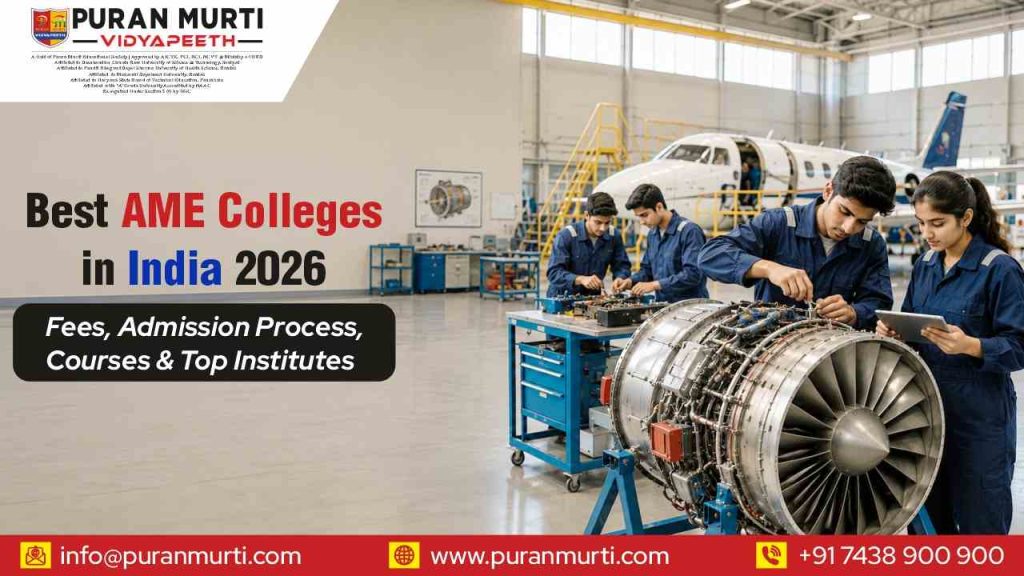
Best AME Colleges in India 2026: Fees, Admission Process, Courses & Top Institutes
Posted on : 16 June, 2026 5:13 pm
Best AME Colleges in India 2026 matter because Aircraft Maintenance Engineering is one of the most practical aviation careers for students who want technical work, safety responsibility, and strong industry relevance. India’s aviation sector is expanding quickly, and that growth is increasing the need for trained aircraft maintenance professionals across airlines, MROs, airports, and aviation training centers. Apply Now
If you are searching for a career that combines engineering, aviation, hands-on learning, and long-term demand, AME deserves serious attention. At the same time, choosing the right college matters just as much as choosing the course, because DGCA approval, workshop quality, industry exposure, and placements shape your future in a direct way.
Why AME is growing fast
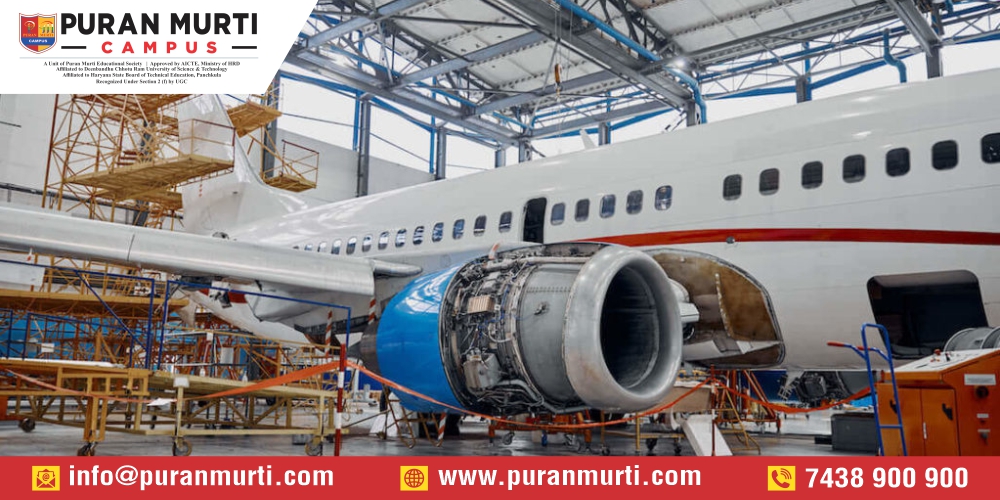
Aircraft Maintenance Engineering is not a conventional classroom-only program. Instead, it prepares students to inspect, maintain, troubleshoot, and certify aircraft systems so that every flight can operate safely. That makes the course highly practical, because students spend time in labs, hangars, tools rooms, and maintenance environments rather than only in lecture halls. Apply Now
The aviation industry in India is growing because airline fleets are increasing, airports are expanding, and regional connectivity is improving. As a result, the demand for certified AME professionals keeps rising, especially in line maintenance, base maintenance, and MRO operations. In addition, airlines increasingly need technicians who can handle modern aircraft systems, digital avionics, and compliance-heavy maintenance tasks.
What AME means
Aircraft Maintenance Engineering, or AME, is a licence-oriented aviation training path regulated through DGCA-linked standards in India. The course teaches students how aircraft systems work, how they are inspected, and how safety checks are carried out before an aircraft returns to service. In simple terms, AME is about making sure the aircraft is airworthy and safe to fly. Apply Now
Students usually specialize in one of two major streams. B1 focuses on mechanical systems such as structures, engines, hydraulics, and fuel systems, while B2 focuses on avionics, including electrical systems, navigation, communication, and instrumentation. Because of this, students should choose a stream based on whether they prefer mechanics or electronics.
Who should choose AME
AME is a good fit for students who enjoy practical problem-solving, aircraft technology, and structured technical work. It suits learners who do well in applied environments and want a career connected to aviation operations. It is also useful for students who do not want a purely theory-heavy path and prefer visible, skill-based outcomes. Apply Now
The course is especially appealing for students who want to enter the workforce with a specialised technical skillset. Moreover, because aviation is a regulated industry, the career path comes with seriousness, discipline, and clear professional standards. That combination often attracts students who want a career with both responsibility and prestige.
Eligibility criteria
Most AME colleges in India expect students to have completed 10+2 with Physics, Chemistry, and Mathematics. Many institutes also accept engineering diplomas for lateral entry or alternate entry routes depending on the program structure. Some institutes set a minimum aggregate requirement in PCM, often around 45% to 50% for general admission routes. Apply Now
Medical fitness matters as well, because aviation careers require physical suitability and proper vision standards. In addition, several institutes consider age limits and language proficiency, particularly English, since maintenance documentation and aviation communication often use English. So, before applying, students should confirm the exact eligibility rule of the institute they want to join.
Admission process
The AME admission process is usually simple, but it still needs careful planning. Most colleges follow a pattern that includes application submission, screening, entrance test or merit consideration, counseling, document verification, and fee payment. Some colleges use their own entrance tests, while others accept results from AME-specific entrance routes or direct admission procedures.
For students aiming at integrated aviation or engineering pathways, the route may also include JEE Main or other college-level admissions depending on the institution. Therefore, it helps to shortlist colleges early and keep the required marksheets, photographs, ID proof, and medical certificates ready. That way, you avoid missing deadlines during the admission season. Apply Now
AME course types
AME in India is not limited to one route. In fact, students can choose from a few different formats depending on their goals. Some colleges offer a standalone AME training path, while others combine AME with a degree such as B.Tech or engineering specializations. Apply Now
The main types are:
- Standalone DGCA-oriented AME programs, usually designed around licence preparation and practical training.
- Integrated B.Tech + AME programs, which combine degree education with DGCA-linked aviation training.
- Diploma-based or vocational aviation pathways, which may be useful for students seeking a shorter, more focused entry into maintenance support roles.
This flexibility is helpful because different students have different priorities. Some want a faster route into the job market, while others want a degree plus the licence track. Apply Now
Course duration
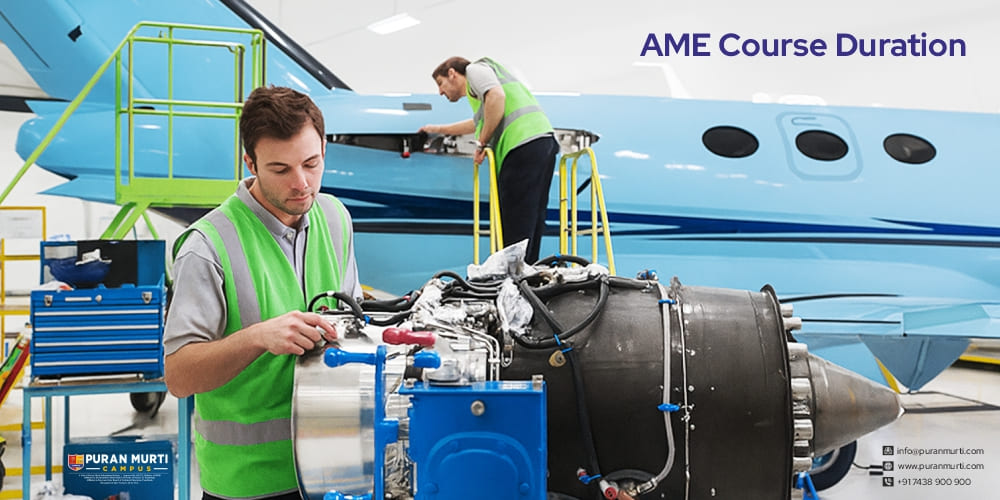
Most AME programs last between 2 and 4 years, depending on whether the student is taking a diploma-style, standalone licence-oriented, or integrated B.Tech route. A shorter route often leads more directly into technical training and practical modules, while integrated programs take longer because they include degree coursework and broader academic requirements. Since time and career goals differ from student to student, duration should be matched with long-term plans.
If you want a broader engineering base, a 4-year integrated route may be better. However, if your main goal is to enter aviation maintenance quickly, a standalone AME track can be more efficient. Either way, the key is to choose a program that actually supports DGCA-related learning and real workshop exposure. Apply Now
Fees in 2026
AME fees vary widely across institutes in India. A common estimate for full AME study is around ₹3 lakh to ₹6 lakh in many institutes, though some private programs may go higher depending on facilities, campus type, and degree integration. In some cases, the total cost can move into the ₹7 lakh to ₹8 lakh range or beyond for premium setups or extended degree-linked programs.
Fees usually cover tuition, labs, workshop exposure, and practical training support, but students should also check for extra charges such as hostel, uniform, tools, exam fees, and DGCA-related charges. Since pricing can differ a lot, the smartest approach is to compare the total course cost rather than only the first-year fee. That gives a much clearer picture of affordability. Apply Now
What affects fees
Several factors influence the cost of an AME program. The biggest ones are DGCA-linked training quality, workshop infrastructure, aircraft access, faculty experience, and industry partnerships. Colleges with stronger lab systems and better maintenance exposure often charge more, but they may also offer better practical readiness. Apply Now
Location also matters, because campuses in major aviation regions or metro-connected zones may have higher operating costs. Furthermore, integrated degree programs naturally cost more because they combine academic and technical training. So while fees are important, they should be viewed in relation to the training value you receive.
Best AME colleges in India 2026
Below is a representative list of institutes frequently highlighted in 2026 AME roundups and aviation education guides. Apply Now
- Indira Gandhi Institute of Aeronautics.
- School of Aeronautics.
- Puran Murti Vidyapeeth.
- Indian Institute of Aeronautics.
- Hindustan Institute of Engineering Technology.
- Rajiv Gandhi Aviation Academy.
- Western India Institute of Aeronautics.
- Sha Shib Aviation Academy.
- Nehru College of Aeronautics and Applied Sciences.
- Bombay Flying Club College of Aviation.
This list is useful as a starting point, but students should still verify current DGCA approval, course structure, placements, and workshop access before deciding. In AME, institute quality matters more than brand noise alone. Apply Now
Why Puran Murti Vidyapeeth stands out
Puran Murti Vidyapeeth appears in multiple 2026 AME and aviation-related listings as a strong Delhi-NCR option for students exploring aviation and engineering pathways. It is also promoted for integrated aviation options such as B.Tech + AME combinations, which can appeal to students who want both a degree and a maintenance-track skillset. Apply Now
Another important point is location. For students from Delhi and NCR, a Sonipat-based campus can be more accessible than distant aviation institutes, which matters when you are comparing cost, convenience, and routine travel. In addition, Puran Murti’s aviation-focused pages suggest a campus ecosystem built around technical learning, practical exposure, and career-oriented education.
How to compare colleges
The best AME college is not always the one with the loudest marketing. Instead, it is the one that helps you build maintenance competence, meet licence requirements, and move into real aviation work. That means you should compare colleges using a practical checklist. Apply Now
- DGCA approval and licence pathway.
- Workshop quality and aircraft availability.
- Avionics, engine, and airframe lab access.
- Faculty background and industry experience.
- Internship and MRO tie-ups.
- Placement history and alumni outcomes.
- Hostel, transport, and safety support.
- Total fees and hidden charges.
Once you compare these factors, the right choice becomes much easier to see. A college with modest branding but strong hands-on training may be better than a famous name with weak maintenance exposure. Apply Now
Mechanical and avionics streams
The B1 and B2 streams deserve special attention. B1 usually covers airframe structures, engines, hydraulics, fuel systems, and mechanical inspection practices. B2 is more focused on avionics, which includes electrical systems, radio navigation, cockpit instruments, and communication equipment.
Students who like machines, engines, and physical inspection often prefer B1. Students who enjoy electronics, circuits, and system troubleshooting may feel more comfortable in B2. Because both streams support aircraft safety, the right choice depends on your personal interest and long-term comfort with the subject matter. Apply Now
Practical training matters
AME is one of those careers where theory alone is not enough. Students must learn how to use maintenance tools, read technical documents, handle systems safely, and perform supervised practical tasks. That is why institutes with real workshop setups and actual aircraft exposure are usually more valuable. Apply Now
Practical training helps students build confidence much faster. It also prepares them for the discipline of airline and MRO environments, where mistakes are expensive and safety standards are strict. In short, the more realistic the training environment, the better your job readiness.
Career opportunities
After AME, students can work in airlines, MROs, airport maintenance teams, aircraft support companies, and technical service departments. Some graduates also move into aircraft manufacturing support, quality control, or aviation training roles. Since aviation is a tightly regulated industry, skilled maintenance professionals remain useful throughout the life cycle of aircraft operations.
Common roles include:
- Aircraft maintenance engineer.
- Maintenance technician.
- Quality control engineer.
- MRO engineer.
- Airline technical staff.
These roles often begin at entry-level, but practical experience can lead to stronger responsibilities over time. As the student grows, the job profile becomes more specialised and more rewarding.
Salary expectations
Salary in AME depends on the institute, stream, skills, and employer. Freshers often start in the range of ₹3 lakh to ₹6 lakh per year in many roles, while experienced professionals can earn much more as their experience grows. Some sources also suggest that salaries can rise to ₹8 lakh to ₹20 lakh for experienced professionals, especially when they work with major airlines or international aviation firms. Apply Now
The important thing to remember is that salary is not only about the college name. It also depends on hands-on ability, licence progress, troubleshooting speed, and practical familiarity with aircraft systems. Therefore, skill-building during college is just as important as the final certificate.
Future scope of AME in India
The future for AME looks strong because India’s aviation market continues to expand. New aircraft deliveries, airport development, and regional connectivity programs are all increasing the need for maintenance professionals. At the same time, India is investing in MRO capacity, which means more work can stay within the country rather than moving abroad. Apply Now
This is a good sign for students entering the field now. The more the aviation ecosystem grows, the more important trained maintenance professionals become. So, for the right student, AME is not just a course, it is a long-term technical career path with real industry importance.
Why India is becoming an AME hub
India is emerging as a major AME training and employment destination for several reasons. First, the aviation industry is expanding quickly and creating steady technical demand. Second, more colleges are offering DGCA-aligned training, which improves access for students across regions.
Third, India has a strong base of technically inclined students who can adapt well to aircraft maintenance work. Finally, the increase in domestic MRO services, international collaborations, and aviation infrastructure is making the sector more future-ready. Put together, these factors explain why AME is getting more attention every year. Apply Now
Admission timeline tips
A good admission strategy starts early. Students should begin shortlisting colleges after 10+2 results or even during the final school year if they already know they want aviation. That gives enough time to compare course structures, check eligibility, and prepare for entrance exams or interviews.
A simple application plan looks like this:
- Shortlist DGCA-linked colleges.
- Check PCM eligibility and marks.
- Confirm medical fitness requirements.
- Prepare documents and photographs.
- Apply for entrance or merit-based admission.
- Visit campus or attend online counseling.
- Compare the final fee structure before paying.
This process may look basic, but it saves time and prevents rushed decisions. Since aviation education is a career investment, the admission stage should be handled with the same care as the course itself.
What parents should ask
Parents often focus on safety, job outcomes, and return on investment. That is reasonable, because AME is a specialised and expensive career path. Before final admission, parents should ask about DGCA approval, lab facilities, hostel conditions, attendance rules, internship support, and placement history.
They should also ask whether the college offers integrated degree routes or only maintenance-focused training. That matters because some students benefit from a wider engineering credential, while others prefer a focused aviation licence path. When parents and students review the same facts together, admission decisions become much clearer. Apply Now
Common mistakes to avoid
One common mistake is choosing a college only because it appears on a “top 10” list. Lists are helpful, but they are not enough on their own. Another mistake is ignoring hidden charges, hostel costs, and tool expenses, which can create surprise pressure later. Apply Now
Students also make the error of comparing AME with ordinary engineering courses without understanding the difference in structure. AME is more licensing-focused and practical than many standard engineering paths. So, it should be chosen for the right reasons, not just because it sounds aviation-related. Apply Now
Puran Murti Vidyapeeth as a practical option
For North Indian students, Puran Murti Vidyapeeth can be a practical option because it appears in current AME lists and also promotes integrated aviation pathways. This makes it attractive for students who want a degree plus a maintenance-oriented profile in one campus ecosystem. It also helps that the institute is positioned within Delhi-NCR access routes, which can reduce relocation stress for many families. Apply Now
In addition, Puran Murti’s broader engineering presence can matter for students who want a more flexible academic environment. Since aviation is a field where practical exposure and classroom learning must work together, an institute that can support both becomes especially relevant. That is one reason the brand shows up repeatedly in 2026 education content about aviation and engineering.
FAQs
Q1. What is the duration of an AME course?
Most AME programs last between 2 and 4 years, depending on whether the student chooses a standalone or integrated route. Apply Now
Q2. Is DGCA approval necessary?
Yes, DGCA approval is essential for the licensing-oriented AME pathway in India. Apply Now
Q3. What is the minimum qualification for AME?
Usually, students need 10+2 with Physics, Chemistry, and Mathematics, though some colleges also accept engineering diplomas. Apply Now
Q4. Can AME students work abroad?
Yes, many AME skills are globally relevant, though overseas work may require additional local compliance or recognition. Apply Now
Q5. What is the fee range for AME in India?
A common fee range is around ₹3 lakh to ₹6 lakh, though some programs may cost more depending on facilities and structure. Apply Now
Q6. Is AME a good career for students after 12th?
Yes, AME can be a strong choice for students who like aviation, mechanics, avionics, and practical technical work. Apply Now
Conclusion
Best AME Colleges in India 2026 should be chosen with care, because this is not just a college decision but a career decision. The right institute will give you practical training, DGCA-aligned learning, and a clear pathway into aircraft maintenance work. If you want a balanced option in Delhi-NCR, Puran Murti Vidyapeeth is one of the names that appears repeatedly in current AME-related education content and deserves a place on your shortlist. Apply Now
The smartest move is to compare colleges on facts, not hype. Check eligibility, fees, training quality, and placement support, then choose the campus that best fits your goals. If you do that, you will be much closer to a stable and respected aviation career. Apply Now
CTA
Contact:
If you are planning an AME career for 2026, start by shortlisting DGCA-focused colleges, comparing workshops and fees, and visiting campuses before making a final decision. For students in Delhi-NCR, Puran Murti Vidyapeeth is worth evaluating alongside other leading AME institutes because it offers aviation-linked pathways, practical learning, and a location advantage. Apply Now
Query: