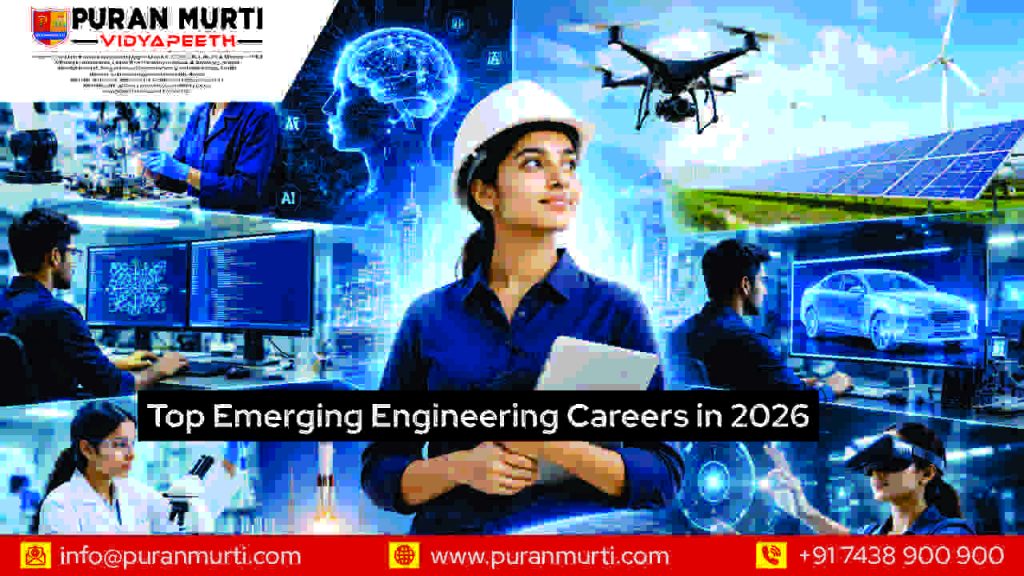
Top Emerging Engineering Careers in 2027
Posted on : 23 August, 2026 12:52 am
Engineering is no longer limited to traditional careers such as civil, mechanical, electrical, or computer engineering. In 2027, rapid advances in artificial intelligence, automation, semiconductors, electric vehicles, renewable energy, cybersecurity, robotics, and smart infrastructure are creating new career pathways for engineering graduates.
For students choosing an engineering branch after Class 12, this shift creates both an opportunity and a challenge: which engineering career will offer strong relevance, employability, and growth over the next decade?
The answer is not simply the branch with the most popular name. The strongest opportunities are increasingly found where engineering fundamentals meet emerging technology and real-world industry needs.
According to the World Economic Forum’s Future of Jobs Report 2025, technology-driven roles such as AI and machine learning specialists, data specialists, software developers, cybersecurity professionals, robotics-related roles, environmental engineers, and renewable energy engineers are among the areas expected to experience strong growth through 2030.
For students in Sonipat, Delhi NCR, Haryana, and across India, this makes 2027 an important time to understand how engineering careers are changing.
What Are the Top Emerging Engineering Careers in 2027?
The top emerging engineering careers in 2027 include Artificial Intelligence and Machine Learning, Data Engineering, Cybersecurity, Robotics and Automation, Semiconductor and VLSI Engineering, Electric Vehicle Engineering, Renewable Energy Engineering, Aerospace and Space Technology, IoT and Embedded Systems, and Smart Manufacturing.
The best choice depends on a student’s interests, academic strengths, preferred industry, and willingness to continuously develop technical skills.
Why Are Engineering Careers Changing in 2027?
Technology is changing how companies design products, manufacture goods, manage data, produce energy, transport people, and deliver services.
Artificial intelligence is being integrated into software and business operations. Manufacturing is becoming increasingly automated. Electric mobility is creating demand for battery, electronics, control-system, and power-engineering expertise. At the same time, India’s semiconductor and renewable-energy ecosystems are expanding.
The World Economic Forum identifies AI and information processing, robots and autonomous systems, energy generation and storage, semiconductors and computing, and related technologies as major forces expected to transform businesses by 2030.
This means engineering students need more than a degree. They need a combination of:
- Strong engineering fundamentals
- Digital and computational skills
- Problem-solving ability
- Practical project experience
- Communication skills
- Industry awareness
- Adaptability and lifelong learning
In other words, the future belongs to engineers who can connect different technologies rather than work inside only one narrow discipline.
https://blog.puranmurti.com/top-career-options-in-india-2027-best-careers-skills/
Top Engineering Courses in 2027
Popular Engineering Courses
- Aeronautical Engineering
- Aerospace Engineering
- Aircraft Maintenance Engineering (AME)
- Computer Science & Engineering (CSE)
- CSE with Artificial Intelligence and Machine Learning (AI & ML)
- Civil Engineering
- Electrical Engineering
- Electronics & Communication Engineering (ECE)
- Mechanical Engineering
Unique Aviation Programs (USP)
One of the biggest advantages of Puran Murti Vidyapeeth is its aviation-based courses, which are rare in India:
- B.Tech + AME (DGCA approved)
- B.Tech Mechanical Engineering + AME (DGCA)
- B.Tech ECE + AME (DGCA)
- B.Tech Computer Science
(AI & ML)+ AME (DGCA) - B.Tech Aeronautical Engineering
+ CPL (Ground Classes) - B.Tech Aerospace Engineering
+ CPL (Ground Classes)
Diploma Courses
Students can also choose job-oriented diploma courses: Apply Now
- Diploma in Automobile Engineering (AE)
- Diploma in AME (Aircraft Maintenance Engineering)
- Diploma in Aeronautical Engineering
- Diploma in Civil Engineering (CE)
- Diploma in Mechanical Engineering (ME)
- Diploma in Computer Science & Engineering (CSE)
- Diploma in Electronics & Communication Engineering (ECE)
- Diploma in Electrical Engineering (EE)
- Diploma in Medical Lab Technology (MLT)
- Diploma in Hotel Management
- Diploma in CSE (AI & ML)
Top 10 Emerging Engineering Careers in 2027
| Engineering Career | Key Technologies | Potential Career Roles |
|---|---|---|
| AI & Machine Learning | AI, ML, NLP, Generative AI | AI Engineer, ML Engineer |
| Data Engineering | Big Data, Cloud, Analytics | Data Engineer, Data Architect |
| Cybersecurity | Cloud Security, Network Security | Security Engineer, SOC Analyst |
| Robotics & Automation | Robotics, PLC, Computer Vision | Robotics Engineer, Automation Engineer |
| Semiconductor & VLSI | Chip Design, Electronics, VLSI | VLSI Engineer, IC Design Engineer |
| Electric Vehicle Engineering | EV, Batteries, Power Electronics | EV Engineer, Battery Engineer |
| Renewable Energy | Solar, Wind, Energy Storage | Renewable Energy Engineer |
| Aerospace & Space Technology | Aircraft, Satellites, Propulsion | Aerospace Engineer |
| IoT & Embedded Systems | Sensors, Microcontrollers, IoT | Embedded Engineer, IoT Engineer |
| Smart Manufacturing | Industry 4.0, Digital Twins | Manufacturing Engineer, Automation Specialist |
1. Artificial Intelligence and Machine Learning Engineering
AI and Machine Learning engineering is one of the most promising emerging engineering careers in 2027.
AI is moving beyond chatbots and recommendation systems. Businesses are using intelligent systems for forecasting, automation, computer vision, fraud detection, healthcare applications, manufacturing, customer service, and decision support.
The World Economic Forum lists AI and machine learning specialists among the fastest-growing job categories through 2030.
What Does an AI Engineer Do?
An AI engineer may:
- Develop machine learning models
- Build AI-powered applications
- Work with natural language processing
- Develop computer vision systems
- Integrate generative AI into products
- Analyse large datasets
- Deploy and monitor AI systems
Skills to Learn
Students interested in this field should build knowledge of:
- Python
- Mathematics and statistics
- Machine learning
- Data structures and algorithms
- Deep learning
- Cloud platforms
- Generative AI
- Responsible AI
Career options: AI Engineer, Machine Learning Engineer, AI Developer, Computer Vision Engineer, NLP Engineer, AI Researcher.
2. Data Engineering and Big Data
AI cannot function effectively without reliable data. As organisations generate enormous amounts of information, engineers who can build systems to collect, process, store, and manage data become increasingly important.
Data engineering is therefore an excellent option for students who enjoy programming, databases, systems, and analytical problem-solving.
Career Opportunities
Graduates can explore roles such as:
- Data Engineer
- Big Data Engineer
- Data Architect
- Cloud Data Engineer
- Analytics Engineer
- Database Engineer
The World Economic Forum also identifies big data specialists and data-related roles among the fastest-growing occupations.
3. Cybersecurity Engineering
As businesses, governments, banks, hospitals, and educational institutions become more digital, protecting systems and information becomes essential.
Cybersecurity engineers help organisations identify vulnerabilities, secure networks, protect applications, monitor threats, and respond to cyber incidents.
Why Is Cybersecurity a Future Career?
Cybersecurity is not simply an IT requirement. It has become part of business continuity and digital trust.
Students can build careers in:
- Network security
- Cloud security
- Application security
- Ethical hacking
- Security operations
- Digital forensics
- Security architecture
The WEF identifies networks and cybersecurity among the skills expected to see significant increases in use through 2030.
4. Robotics and Automation Engineering
Robots are increasingly being used in manufacturing, logistics, healthcare, agriculture, warehouses, and other industries.
However, robotics is not just about building physical machines. Modern robotics combines:
Mechanical engineering + electronics + programming + sensors + AI + control systems.
What Does a Robotics Engineer Do?
A robotics professional may design, program, test, maintain, or integrate robotic systems.
Typical roles include:
- Robotics Engineer
- Automation Engineer
- Control Systems Engineer
- Robot Programmer
- Industrial Automation Engineer
- Computer Vision Engineer
For students who enjoy both hardware and software, robotics can be an especially attractive career path.
5. Semiconductor and VLSI Engineering
Semiconductors are the foundation of modern electronics. Smartphones, automobiles, computers, medical devices, communication systems, and AI hardware all depend on semiconductor technology.
India is also working to develop a stronger semiconductor and electronics ecosystem. The India Semiconductor Mission aims to establish India as a global hub for electronics manufacturing and design.
Career Areas
Students specialising in electronics and related fields can explore:
- VLSI design
- Chip design
- Verification
- Semiconductor testing
- Embedded systems
- Electronics manufacturing
- IC design
- Semiconductor process engineering
This field is particularly suitable for students who enjoy electronics, physics, mathematics, and hardware systems.
6. Electric Vehicle and Battery Engineering
The transition toward electric mobility is creating opportunities beyond automobile manufacturing.
Modern EVs require expertise in:
- Battery technology
- Power electronics
- Electric motors
- Vehicle control systems
- Embedded software
- Charging infrastructure
- Battery management systems
- Thermal management
As the automotive industry becomes increasingly software- and electronics-driven, engineers who understand both mechanical systems and electrical/electronic technologies can build valuable career profiles.
Potential Careers
- EV Engineer
- Battery Engineer
- Power Electronics Engineer
- EV Systems Engineer
- Battery Management Engineer
- Automotive Embedded Engineer
7. Renewable Energy and Sustainable Engineering
Renewable energy is another major area of engineering growth.
India’s Ministry of New and Renewable Energy reported cumulative renewable-energy capacity of approximately 291.73 GW as of July 31, 2027, including about 164.59 GW of solar power and 58.14 GW of wind power.
These numbers demonstrate the scale of India’s energy transition.
What Can Renewable Energy Engineers Work On?
Career areas include:
- Solar power systems
- Wind energy
- Energy storage
- Power systems
- Smart grids
- Energy efficiency
- Sustainable infrastructure
- Green technologies
Students who want an engineering career connected with sustainability and large-scale infrastructure should consider this field seriously.
8. Aerospace and Space Technology Engineering
India’s expanding space ecosystem and growing interest in private space technology are creating opportunities for engineers in areas such as spacecraft systems, avionics, propulsion, satellite technology, aircraft design, and aerospace manufacturing.
Career Options
Aerospace graduates may work toward roles such as:
- Aerospace Engineer
- Aircraft Design Engineer
- Avionics Engineer
- Propulsion Engineer
- Satellite Systems Engineer
- Flight Systems Engineer
- Space Technology Researcher
This is a particularly strong option for students fascinated by aircraft, spacecraft, physics, mathematics, and advanced engineering systems.
9. IoT and Embedded Systems Engineering
The Internet of Things connects physical devices with sensors, software, networks, and cloud platforms.
From smart factories to connected vehicles and healthcare devices, IoT is changing how physical systems interact with digital platforms.
Skills for IoT Careers
Students should consider learning:
- C/C++
- Microcontrollers
- Embedded programming
- Sensors
- Communication protocols
- Electronics
- Cloud computing
- Cybersecurity
Potential careers: IoT Engineer, Embedded Systems Engineer, Firmware Developer, Hardware Engineer, Connected Systems Engineer.
10. Smart Manufacturing and Industry 4.0
Manufacturing is undergoing a major transformation through automation, sensors, robotics, artificial intelligence, digital twins, predictive maintenance, and connected production systems.
This creates opportunities for engineers who understand traditional engineering as well as digital technologies.
For example, a mechanical engineer who learns automation, data analysis, CAD/CAM, robotics, and AI-enabled manufacturing can develop a much broader career profile than someone relying only on traditional mechanical skills.
Career Opportunities
- Smart Manufacturing Engineer
- Industrial Automation Engineer
- Production Technology Engineer
- Robotics Integration Engineer
- Digital Manufacturing Specialist
- Quality Automation Engineer

Which Emerging Engineering Career Is Best for You?
There is no single “best” engineering career for every student.
Instead, match your interests with the type of problems you want to solve.
| If You Enjoy | Consider |
| Coding and mathematics | AI/ML, Data Engineering |
| Electronics and hardware | VLSI, Embedded Systems |
| Machines and programming | Robotics, Automation |
| Cars and technology | EV Engineering |
| Cyber and problem-solving | Cybersecurity |
| Space and aircraft | Aerospace |
| Environment and energy | Renewable Energy |
| Manufacturing | Smart Manufacturing |
| Sensors and connected devices | IoT |
This approach is more useful than selecting a branch simply because it is currently popular.
What Skills Will Engineering Students Need in 2027?
A degree remains important, but employers increasingly look for evidence that students can apply what they learn.
1. Technical Skills
Depending on the chosen field, students should develop:
- Programming
- Data analysis
- AI and machine learning
- CAD and simulation
- Electronics
- Cloud technologies
- Cybersecurity
- Automation
- Embedded systems
2. Problem-Solving
Engineering is ultimately about solving real problems.
Students should practise analysing a problem, identifying constraints, designing solutions, testing assumptions, and improving the final result.
3. Communication
A technically strong engineer still needs to explain ideas to colleagues, clients, managers, and non-technical stakeholders.
Therefore, written and verbal communication can become a meaningful career advantage.
4. Project Experience
Instead of collecting certificates alone, students should create projects that demonstrate what they can actually build.
For example:
- AI students can build a predictive model.
- Robotics students can develop an autonomous prototype.
- Electronics students can design an embedded system.
- EV students can study battery-management systems.
- Cybersecurity students can create a controlled security-testing project.
5. Adaptability
Technology changes quickly.
A student who learns how to learn can remain relevant even when specific tools become outdated.
Why Industry Exposure Matters for Future Engineering Careers
One of the biggest differences between academic knowledge and workplace expectations is practical application.
Industry exposure can help students understand:
- How engineering teams operate
- How products are developed
- How quality is managed
- How technical decisions affect businesses
- Which tools professionals use
- What employers expect from graduates
Therefore, students should look beyond classrooms when evaluating an engineering college.
Look for opportunities such as:
- Industrial visits
- Technical workshops
- Internships
- Live projects
- Innovation labs
- Hackathons
- Technical clubs
- Guest lectures
- Industry interaction
- Placement preparation
For students considering engineering colleges in Sonipat and Delhi NCR, these factors can be especially useful when comparing institutions.
What Should Students Look for in an Engineering College in 2027?
Choosing the right college is as important as choosing the right engineering branch.
Before taking admission, evaluate:
Academic Quality
Check the curriculum, faculty expertise, laboratories, teaching methods, and academic support.
Practical Learning
Ask whether students get opportunities to work on projects, prototypes, laboratory assignments, and industry-oriented applications.
Infrastructure
Modern engineering education requires appropriate laboratories, computing facilities, workshops, libraries, and learning resources.
Industry Exposure
Find out whether the institution provides industrial visits, internships, expert sessions, workshops, and industry-linked learning opportunities.
Placement Support
Review placement assistance, recruiter participation, training programs, internships, and career-development initiatives.
Location
For students from Delhi NCR and Haryana, Sonipat can offer access to the wider NCR ecosystem while providing a campus-based learning environment.
Emerging Engineering Careers vs Traditional Engineering Careers
Traditional engineering branches are not disappearing.
Instead, many traditional disciplines are evolving.
| Traditional Discipline | Emerging Direction |
| Mechanical Engineering | Robotics, EVs, smart manufacturing |
| Electrical Engineering | Renewable energy, smart grids, EVs |
| Electronics Engineering | Semiconductors, IoT, embedded systems |
| Civil Engineering | Smart cities, sustainable infrastructure |
| Computer Engineering | AI, cloud, cybersecurity, data |
| Aerospace Engineering | Space technology, autonomous systems |
The important lesson is simple: students do not necessarily need to abandon traditional engineering to enter emerging industries.
They can combine foundational engineering knowledge with new-age skills.
How to Prepare for an Emerging Engineering Career After Class 12
Students can follow a practical roadmap.
Step 1: Identify Your Strengths
Ask yourself:
- Do I enjoy mathematics?
- Do I like programming?
- Am I interested in machines?
- Do I enjoy electronics?
- Do I want to work with energy or sustainability?
- Am I interested in aircraft and space?
- Do I prefer software, hardware, or both?
Step 2: Select a Suitable Engineering Branch
Choose a branch that matches your interests and provides opportunities to build relevant skills.
Step 3: Build Fundamental Knowledge
Do not rush immediately toward advanced tools.
First develop strong foundations in mathematics, programming, electronics, mechanics, data structures, or other relevant engineering fundamentals.
Step 4: Build Projects
Turn concepts into practical applications.
A portfolio of meaningful projects can demonstrate initiative and problem-solving ability.
Step 5: Gain Industry Exposure
Participate in internships, workshops, competitions, industrial visits, and technical events wherever possible.
Step 6: Keep Learning
Technology will continue to evolve after graduation.
Therefore, continuous learning should become part of your career strategy.
Are Emerging Engineering Careers Good for the Future?
Yes. Emerging engineering careers can offer strong long-term opportunities because they are connected to major technological and industrial transformations. However, no career is completely future-proof. Students should focus on transferable skills, strong engineering fundamentals, practical experience, and continuous learning rather than relying on a job title alone.
This distinction is important.
A technology that is highly popular today may change tomorrow. But engineers who can learn, analyse, build, adapt, and solve problems can continue to find opportunities across changing industries.
Top Benefits of Choosing an Emerging Engineering Field
Students considering new-age engineering disciplines can benefit from:
- Exposure to fast-growing technologies
- Opportunities across multiple industries
- Potential for specialised career paths
- Strong scope for innovation and entrepreneurship
- Access to global technology careers
- Opportunities to work on real-world problems
- Possibility of combining multiple engineering disciplines
However, students should avoid choosing a course solely because someone calls it “high salary” or “future-proof.”
Career growth depends on skills, experience, performance, industry demand, location, employer, and continuous professional development.
Engineering Careers in Sonipat and Delhi NCR
Delhi NCR is an important education and employment ecosystem for students in North India.
For students studying engineering in Sonipat, the wider NCR region can provide proximity to technology companies, manufacturing organisations, startups, research institutions, service companies, and other industries.
That makes engineering colleges near Delhi NCR worth considering for students who want a balance between campus education and access to the broader regional ecosystem.
At Puran Murti Vidyapeeth, students can explore engineering education with an emphasis on academic learning, practical development, career preparation, and exposure to contemporary engineering disciplines.
Prospective students and parents should evaluate the latest course structure, facilities, eligibility requirements, admission process, placement support, and available industry-oriented opportunities before making a final decision.
Frequently Asked Questions
What are the top emerging engineering careers in 2027?
The leading emerging engineering career areas in 2027 include AI and machine learning, data engineering, cybersecurity, robotics and automation, semiconductor and VLSI engineering, electric vehicles, renewable energy, aerospace and space technology, IoT, embedded systems, and smart manufacturing.
Which engineering branch has the best future in 2027?
There is no single engineering branch that is best for every student. AI, computer science, electronics, cybersecurity, robotics, semiconductor technology, EVs, renewable energy, and aerospace offer strong opportunities, but the right choice depends on a student’s interests, abilities, career goals, and willingness to develop practical skills.
Is AI and ML engineering a good career in 2027?
Yes. AI and machine learning are among the fastest-growing technology areas. Engineers can work in software, healthcare, finance, manufacturing, automotive, cybersecurity, retail, research, and other industries. Strong mathematics, programming, data structures, machine learning, and project experience can improve career readiness.
What are the best engineering careers after 12th?
Students completing Class 12 with the required subjects can consider careers in computer science, AI and ML, electronics, electrical engineering, mechanical engineering, civil engineering, aerospace, robotics, renewable energy, cybersecurity, semiconductor technology, and other specialised areas.
Which engineering field is best for high-demand jobs in India?
AI, data engineering, cybersecurity, software, semiconductors, automation, renewable energy, and EV-related engineering are among the areas showing strong demand. However, job demand changes over time, so students should combine a relevant engineering degree with practical skills and industry exposure.
Are traditional engineering branches still relevant in 2027?
Yes. Mechanical, electrical, civil, electronics, and other traditional branches remain important. Their applications are evolving through automation, AI, renewable energy, smart infrastructure, EVs, robotics, and Industry 4.0 technologies.
How can engineering students prepare for future jobs?
Students should build strong engineering fundamentals, learn relevant digital tools, complete practical projects, develop communication skills, participate in internships and competitions, understand industry requirements, and continue learning throughout their careers.
Is semiconductor engineering a good career in India?
Semiconductor engineering has significant strategic importance as India develops its electronics manufacturing and semiconductor ecosystem. Career areas include VLSI design, chip design, verification, semiconductor testing, electronics manufacturing, and related hardware technologies.
What skills will engineers need in the future?
Future engineers will need technical knowledge combined with analytical thinking, creativity, problem-solving, communication, teamwork, digital literacy, and adaptability. The ability to learn new technologies will be particularly valuable as engineering roles continue to evolve.
Which engineering careers are suitable for students in Delhi NCR?
Students in Delhi NCR can consider AI, computer science, cybersecurity, electronics, semiconductor technology, robotics, mechanical engineering, EV technology, civil engineering, renewable energy, aerospace, and other disciplines depending on their interests and career goals.
https://blog.puranmurti.com/top-engineering-colleges-near-delhi-ncr-2027/
Final Takeaway
The engineering career landscape in 2027 is broader than ever.
Artificial intelligence, cybersecurity, robotics, semiconductors, electric vehicles, renewable energy, aerospace, IoT, data engineering, and smart manufacturing are opening new pathways for students. At the same time, traditional engineering disciplines are evolving rather than disappearing.
The smartest approach is therefore not to chase a fashionable course blindly.
Choose a strong engineering foundation, develop future-ready skills, gain practical experience, understand industry needs, and keep learning.
For students and parents exploring engineering admissions in Sonipat, Haryana, and Delhi NCR, Puran Murti Vidyapeeth can be considered as part of your college-selection journey.
Explore the available engineering programmes, compare your interests with the curriculum, understand the admission requirements, and speak with the admissions team before making your decision.
Ready to Explore Your Engineering Future?
Connect with Puran Murti Vidyapeeth for admission guidance, course information, campus details, and career-focused learning opportunities. Plan a campus visit and take the next step toward building your engineering career.