
IIT MTech Entrance Through GATE
Posted on : 1 September, 2026 12:30 pm
Pursuing an MTech from an IIT is a popular goal among BTech graduates who want advanced technical knowledge, research exposure, and specialised career opportunities. One of the major pathways to IIT MTech programmes is the Graduate Aptitude Test in Engineering (GATE).
Therefore, students planning their postgraduate education often search for information about the IIT MTech entrance through GATE. Understanding the eligibility criteria, application process, GATE score requirements, admission rounds, and important documents can make the process easier.
However, students should remember that qualifying GATE does not automatically guarantee admission to an IIT. Each IIT and MTech programme can have its own eligibility and selection criteria.
What Is IIT MTech Entrance Through GATE?
The IIT MTech entrance through GATE is an admission route in which eligible candidates use a valid GATE score to apply for postgraduate programmes offered by participating IITs.
Instead of having one common entrance examination specifically for all IIT MTech programmes, IITs generally use GATE scores as an important component of their admission process.
Candidates must apply separately to the IIT programmes they are interested in. After that, participating IITs may communicate admission offers through the Common Offer Acceptance Portal (COAP).
Therefore, students should understand an important distinction:
GATE exam → IIT programme application → COAP registration → Admission offers → Institute admission
COAP facilitates the offer process, but it does not replace the individual IIT application.
Why Is GATE Important for IIT MTech Admission?
GATE plays an important role in postgraduate engineering admissions.
A good GATE performance can help candidates compete for MTech programmes in areas such as:
- Computer Science and Engineering
- Artificial Intelligence
- Data Science
- Electrical Engineering
- Electronics and Communication
- Mechanical Engineering
- Civil Engineering
- Aerospace Engineering
- Chemical Engineering
- Biotechnology
- Materials Science
Moreover, GATE can also provide opportunities beyond IIT MTech programmes, including postgraduate education, research and certain PSU recruitment processes.
IIT MTech Eligibility Through GATE
Eligibility requirements can vary from one IIT and programme to another. Therefore, candidates should always check the latest admission brochure of their preferred programme.
Generally, applicants may need:
- A relevant BTech or equivalent qualification
- A valid GATE score
- Required marks or CGPA
- The appropriate GATE paper
- Any additional programme-specific qualification
Some programmes may accept candidates from multiple engineering or science backgrounds, while others may require a specific academic discipline.
General Eligibility Overview
| Requirement | General Expectation |
|---|---|
| Educational Qualification | BTech/BE or equivalent, depending on programme |
| GATE | Valid GATE score generally required |
| GATE Paper | Must meet the programme’s requirements |
| Academic Performance | Programme-specific criteria |
| Category | Applicable reservation rules |
| Additional Requirements | May include test/interview for certain programmes |
These are general guidelines. The actual requirements may differ between IITs.
IIT MTech Admission Process Through GATE
The admission process can be divided into several steps.
Step 1: Choose the GATE Paper
First, select the GATE paper that matches your academic background and intended postgraduate programme.
For example, a BTech CSE student may appear for GATE Computer Science and Information Technology. However, the GATE paper accepted by a particular MTech programme should always be checked before applying.
Step 2: Appear for GATE
Prepare for and appear in the GATE examination.
Step 3: Check Your GATE Result
After the result is released, candidates should check their:
- GATE score
- GATE rank
- Qualifying status
- GATE paper
A strong score and rank can improve your chances of competing for highly preferred MTech programmes.
Step 4: Research IIT MTech Programmes
Next, shortlist IITs and MTech programmes based on your:
- GATE paper
- Academic background
- GATE score
- Specialisation preference
- Career goals
- Eligibility
Do not select an IIT only because of its ranking. The curriculum, faculty, research areas, facilities, placements, and specialisation should also be considered.
Step 5: Apply to IITs
Candidates generally need to apply separately to the IITs and programmes they want to join.
This is an important point because COAP is not the IIT application portal.
If you want to apply to multiple IITs, you may have to complete the application process of each institute separately.
Step 6: Register for COAP
Candidates seeking offers from participating IITs should register on COAP according to the applicable admission cycle.
COAP provides a common platform for candidates to view and respond to admission offers from participating institutes.
Step 7: Check Admission Offers
If selected, candidates can view offers during the applicable COAP rounds.
Depending on the rules of the admission cycle, candidates may be provided with different options for responding to an offer.
Step 8: Accept the Offer and Complete Admission
Once you decide to accept an offer, complete the required steps within the deadline.
Finally, you may need to complete:
- Document verification
- Fee payment
- Registration
- Medical requirements, if applicable
- Institute joining formalities
GATE Score Required for IIT MTech
There is no single GATE score that guarantees admission to every IIT MTech programme.
The required score can vary based on:
- IIT
- MTech specialisation
- GATE paper
- Category
- Number of applicants
- Number of seats
- Admission criteria
- Competition
Highly competitive programmes may require a significantly stronger GATE performance.
Therefore, students should aim for the highest possible GATE score rather than preparing only to cross the qualifying cutoff.
GATE Rank for IIT MTech
Rank is another important factor students consider when planning IIT MTech admission.
| GATE Rank | General Competitiveness |
|---|---|
| 1–100 | Excellent for highly competitive programmes |
| 101–500 | Very strong position |
| 501–1,000 | Good opportunities across several programmes |
| 1,001–2,000 | Opportunities depend on programme and IIT |
| 2,001–5,000 | Some IIT options may remain available |
| 5,001–10,000 | Options become more programme-dependent |
| Above 10,000 | IIT opportunities can be limited and highly dependent on category/programme |
These are only broad indicative ranges and should not be treated as official IIT cutoffs.
GATE Qualifying Cutoff vs IIT Admission Cutoff
Students should not confuse the GATE qualifying cutoff with the IIT MTech admission cutoff.
| GATE Qualifying Cutoff | IIT MTech Admission Cutoff |
|---|---|
| Minimum score needed to qualify GATE | Competitive score/rank for a particular programme |
| Announced for each GATE paper | Varies by IIT and programme |
| Depends on paper and category | Depends on seats and competition |
| Qualification does not guarantee admission | Determines competitiveness for admission |
Consequently, a candidate may qualify for GATE but still not receive an IIT MTech offer.
Popular IIT MTech Specialisations
IITs offer postgraduate programmes across various engineering and technology fields.
Some popular areas include:
Computer Science and Engineering
Electrical Engineering
Students can explore power systems, control systems, power electronics, renewable energy, and related areas.
Electronics and Communication
Popular areas include VLSI, microelectronics, communication systems, signal processing, and embedded systems.
Mechanical Engineering
Students can choose areas such as design, manufacturing, thermal engineering, robotics, and industrial engineering.
Civil Engineering
MTech options can include structural engineering, transportation, geotechnical engineering, environmental engineering, and construction management.
About Puran Murti Vidyapeeth
The institute is known for its focus on technical education, practical learning, laboratory exposure, and career-oriented training. Students can explore engineering programs in modern technology domains while benefiting from academic support, industry interaction, and campus facilities. The availability of hostel facilities, skill-development activities, and placement assistance also makes it a consideration for students looking for engineering education near Delhi NCR. Apply Now
Top Engineering Branches
BTech (Bachelor of Technology)
BTech is among the most popular courses after 12th Science (PCM).
Top Specializations:
- Aeronautical Engineering
- Aerospace Engineering
- Aircraft Maintenance Engineering (AME)
- Computer Science & Engineering (CSE)
- CSE with Artificial Intelligence and Machine Learning (AI & ML)
- Civil Engineering
- Electrical Engineering
- Electronics & Communication Engineering (ECE)
- Mechanical Engineering
Unique Aviation Programs (USP)
One of the biggest advantages of Puran Murti Vidyapeeth is its aviation-based courses, which are rare in India:
- B.Tech + AME (DGCA approved)
- B.Tech Mechanical Engineering + AME (DGCA)
- B.Tech ECE + AME (DGCA)
- B.Tech Computer Science
(AI & ML)+ AME (DGCA) - B.Tech Aeronautical Engineering
+ CPL (Ground Classes) - B.Tech Aerospace Engineering
+ CPL (Ground Classes)
Diploma Courses
Students can also choose job-oriented diploma courses: Apply Now
- Diploma in Automobile Engineering (AE)
- Diploma in AME (Aircraft Maintenance Engineering)
- Diploma in Aeronautical Engineering
- Diploma in Civil Engineering (CE)
- Diploma in Mechanical Engineering (ME)
- Diploma in Computer Science & Engineering (CSE)
- Diploma in Electronics & Communication Engineering (ECE)
- Diploma in Electrical Engineering (EE)
- Diploma in Fire Technology & Safety
- Diploma in Medical Lab Technology (MLT)
- Diploma in Hotel Management
- Diploma in CSE (AI & ML)
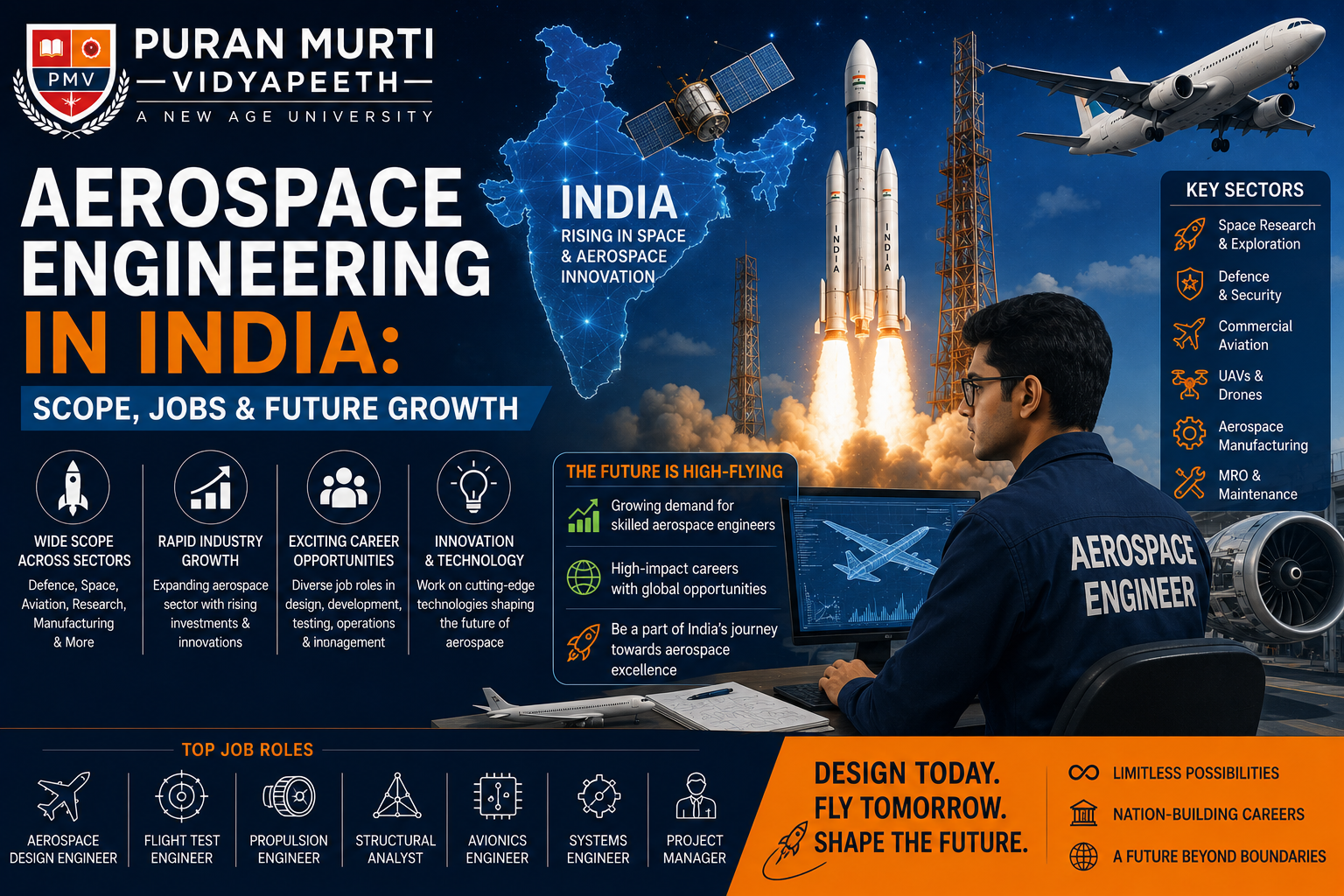
Aerospace Engineering
Students interested in aviation and space technology can explore areas such as aerodynamics, propulsion, aerospace structures, and flight mechanics.
Documents Required for IIT MTech Admission
Candidates should keep their documents ready before the application process begins.
| Document | Purpose |
|---|---|
| GATE Scorecard | Proof of GATE performance |
| BTech/BE Degree Certificate | Academic qualification |
| Semester Mark Sheets | Academic record |
| Class 10 Certificate | Date of birth/academic proof |
| Class 12 Certificate | Academic record |
| Category Certificate | Applicable reservation |
| PwD Certificate | Applicable benefits, if relevant |
| Government ID | Identity verification |
| Passport-size Photographs | Application/admission records |
| Medical Certificate | If required |
| Other Certificates | Programme-specific requirements |
Fees for IIT MTech
MTech fees vary between IITs and can also differ based on category and programme.
Students may have expenses related to:
- Tuition fees
- Institute fees
- Hostel fees
- Examination fees
- Registration fees
- Other academic charges
At the same time, eligible students may receive financial assistance according to applicable government and institute rules.
Therefore, candidates should check the latest fee structure and financial assistance information published by their chosen IIT.
COAP and IIT MTech Admission
The Common Offer Acceptance Portal (COAP) is an important part of the IIT MTech admission process for participating institutes.
However, candidates should remember:
COAP registration does not replace IIT applications.
The process can be understood as:
GATE → Apply to IIT → Register for COAP → Receive/View Offer → Respond to Offer → Complete IIT Admission
This distinction is important because students sometimes register for COAP but forget to apply to the IIT programmes separately.
COAP vs CCMT for MTech Admission
| Feature | COAP | CCMT |
|---|---|---|
| Main purpose | IIT admission offers | Common counselling for participating institutes |
| Primarily associated with | Participating IITs | Participating NITs, IIITs and other institutes |
| IIT application required | Yes | Not applicable in the same way |
| GATE score | Used | Used |
| Admission process | Offer-based through participating IITs | Centralised counselling process |
Therefore, candidates should select the correct admission process based on the institutes they want to apply to.
Benefits of IIT MTech Through GATE
There are several reasons why students consider this route.
Advanced Technical Knowledge
MTech provides an opportunity to study engineering concepts at a deeper level.
Research Opportunities
Students can work on advanced research projects under faculty guidance.
Specialisation
An MTech allows students to focus on a specific technical area.
Industry Exposure
Depending on the programme, students may receive opportunities for projects, internships, seminars, and industry interaction.
Career Growth
An IIT MTech can help students explore technical, research, development, academic, and specialised engineering roles.
Career Opportunities After IIT MTech
After completing an MTech from an IIT, graduates can explore several career paths.
| Career Area | Possible Roles |
|---|---|
| Technology | Software Engineer, Technical Specialist |
| Research | Research Associate, R&D Engineer |
| Engineering | Design Engineer, Development Engineer |
| Data & AI | Data Scientist, ML Engineer |
| Electronics | VLSI Engineer, Embedded Engineer |
| Academia | Teaching and Research Roles |
| Government Sector | Technical and Research Positions |
| Management | Technical Project and Product Roles |
Career opportunities depend on the candidate’s specialisation, skills, experience, and employer.
How to Prepare for IIT MTech Through GATE
Start Early
Begin preparation well before the examination so that you have enough time for learning and revision.
Understand the Syllabus
Make a topic-wise study plan based on the official GATE syllabus.
Strengthen Core Concepts
Focus on understanding fundamental concepts rather than memorising answers.
Practise Previous-Year Questions
Previous-year papers can help you understand the examination pattern and frequently tested concepts.
Take Mock Tests
Mock tests can improve your speed and time management.
Revise Regularly
Regular revision helps you retain important formulas, concepts, and problem-solving techniques.
Target a High Score
If IIT MTech is your goal, aim for a competitive score rather than simply qualifying GATE.
Common Mistakes to Avoid
Students should avoid the following mistakes during the IIT MTech admission process:
- Applying without checking eligibility
- Confusing COAP with the IIT application process
- Applying to only one IIT
- Ignoring application deadlines
- Not checking the accepted GATE paper
- Uploading incorrect documents
- Assuming GATE qualification guarantees admission
- Waiting until the last day to submit applications
- Ignoring backup institutes
Instead, maintain a list of IIT programmes, deadlines, eligibility requirements, and application status.
Is IIT MTech Through GATE a Good Option?
Yes, it can be a good option for students who want advanced technical education, specialised knowledge, research exposure, or a pathway towards certain technical careers.
However, it is not the only option after BTech.
Students can also consider:
- Direct employment
- MTech at NITs or IIITs
- Research programmes
- MBA
- Professional certifications
- Entrepreneurship
- Specialised industry training
Therefore, your decision should depend on your career interests and long-term goals.
Conclusion
The IIT MTech entrance through GATE provides an important pathway for BTech graduates who want to pursue postgraduate education at an IIT.
However, the process involves more than simply qualifying for GATE. Candidates need to understand their preferred programmes, check eligibility, apply separately to IITs, register for COAP where applicable, monitor admission offers, and complete institute-specific formalities.
Most importantly, there is no universal GATE score or rank that guarantees admission to every IIT MTech programme. Competition varies according to the IIT, specialisation, GATE paper, category, seats, and admission year.
Therefore, students should prepare thoroughly for GATE, aim for a strong score, research multiple IIT programmes, and keep suitable alternatives. With proper preparation and planning, GATE can become a valuable pathway towards an MTech and a specialised engineering career.
M.Tech Admission at Puran Murti Vidyapeeth
- Students who want to pursue M.Tech but are unable to secure their preferred IIT seat can also explore alternative postgraduate options.
Puran Murti Vidyapeeth, located in Sonipat, Delhi-NCR, can be considered by students exploring M.Tech pathways outside the IIT system.
Students should check the latest official admission information of the institution for: Apply Now
- Available M.Tech programmes
- Eligibility
- GATE requirements
- Merit-based admission
- Fees
- Admission dates
- Programme-specific requirements
Because institutional admission rules can change, candidates should verify the latest information before applying.
IIT vs Puran Murti Vidyapeeth for M.Tech
| Factor | IIT | Puran Murti Vidyapeeth |
|---|---|---|
| Admission competition | Very high for many programmes | Programme-dependent |
| GATE requirement | Programme-specific | Check current programme rules |
| Course duration | Programme-specific | Check current programme information |
| Academic focus | Advanced technical education and research | Technical and professional education |
| Admission process | Institute-specific | Institution-specific |
| Suitable for | Students targeting IIT-level competition | Students seeking alternative M.Tech pathways |
The comparison should be treated as a broad guide. Students should check the latest official admission notification of the respective institution. Apply Now
FAQs
1. Can I get MTech admission in IIT through GATE?
Yes. Eligible candidates can apply for participating IIT MTech programmes using a valid GATE score, subject to the individual programme’s eligibility and selection criteria.
2. Is GATE compulsory for IIT MTech?
For many IIT MTech programmes, a valid GATE score is an important admission requirement. However, eligibility and admission routes can vary by programme and candidate category.
3. Is COAP required for IIT MTech admission?
Candidates seeking admission offers from participating IITs generally need to register through COAP. However, they must also apply separately to the IIT programmes.
4. What GATE score is required for IIT MTech?
There is no single GATE score applicable to all IIT MTech programmes. The required level varies according to IIT, programme, GATE paper, category, seats, and competition.
5. Can I apply to multiple IITs through GATE?
Yes. Candidates can apply to multiple IIT MTech programmes if they meet the respective eligibility requirements and complete the individual application processes.
6. Does GATE qualification guarantee IIT admission?
No. GATE qualification only makes a candidate eligible to be considered where the programme’s requirements are met. Admission depends on the IIT’s selection criteria and competition.
7. What documents are needed for IIT MTech admission?
Common documents include the GATE scorecard, degree certificate, academic mark sheets, identity proof, and applicable category certificates. Additional documents may be required by individual IITs.