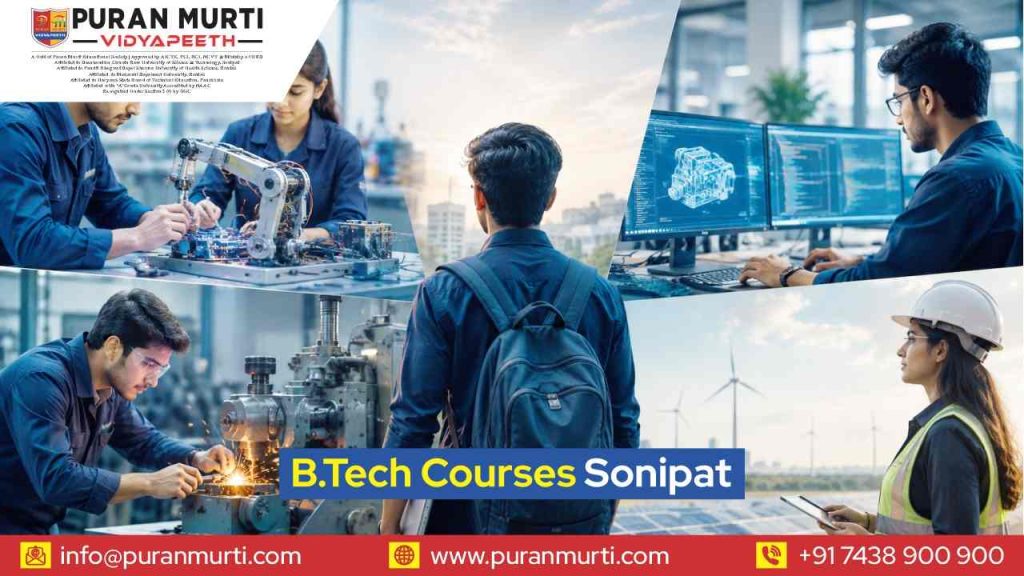
B.Tech Courses in Sonipat: Courses, Scope & Careers
Posted on : 30 September, 2026 12:59 am
Choosing an engineering degree after Class 12 is a major decision. More importantly, selecting the right specialization can influence the skills you develop, the industries you enter and the opportunities you pursue after graduation.
For students searching for B.Tech courses in Sonipat, the options have expanded beyond traditional engineering disciplines. Today, students can explore areas such as Computer Science, Artificial Intelligence, Machine Learning, electronics, automation, aerospace and other technology-driven fields.
At the same time, employers are placing greater emphasis on practical skills. According to the World Economic Forum’s Future of Jobs Report 2025, 170 million jobs could be created globally by 2030, while 92 million jobs may be displaced. The report also identifies AI and big data, networks and cybersecurity, and technological literacy among the fastest-growing skill areas.
Therefore, a successful B.Tech journey should go beyond classroom learning. Students need strong fundamentals, practical exposure, projects, internships, communication skills and the ability to keep learning.
What Are the Best B.Tech Courses in Sonipat?
The best B.Tech course depends on your interests, academic strengths and career plans. Popular options include Computer Science and Engineering, CSE with AI and Machine Learning, Civil Engineering, Mechanical Engineering, Electrical Engineering, Electronics and Communication Engineering, Aerospace Engineering, Aeronautical Engineering and Aircraft Maintenance Engineering.
| B.Tech Course | Ideal For | Career Areas |
|---|---|---|
| Computer Science & Engineering | Programming and technology enthusiasts | Software, IT, cloud, data |
| CSE with AI & ML | Students interested in AI and intelligent systems | AI, ML, data, automation |
| Civil Engineering | Infrastructure-focused students | Construction, infrastructure |
| Mechanical Engineering | Students interested in machines | Manufacturing, automotive, design |
| Electrical Engineering | Students interested in electrical systems | Power, automation, energy |
| ECE | Electronics and communication enthusiasts | Embedded systems, electronics, telecom |
| Aerospace Engineering | Aircraft and space enthusiasts | Aerospace, R&D, aviation |
| Aeronautical Engineering | Students interested in aircraft | Aviation, aircraft systems |
| Aircraft Maintenance Engineering | Aviation maintenance aspirants | Aircraft maintenance and support |
Why Choose B.Tech Courses in Sonipat?
Sonipat offers an appealing location for students who want to study close to the wider Delhi NCR education and employment ecosystem.
For many families, the location can make commuting and campus visits more convenient. Furthermore, being within the NCR region can provide students with opportunities to explore internships, industry interactions, professional events and employment opportunities across nearby cities.
However, location should not be the only factor behind an engineering college decision.
Instead, students and parents should evaluate several academic and career-related factors:
- Programme approvals and affiliations
- Faculty expertise
- Engineering laboratories
- Practical learning opportunities
- Curriculum relevance
- Internship support
- Industry exposure
- Placement preparation
- Campus infrastructure
- Student support services
- Total education cost
- Accessibility and location
Puran Murti Vidyapeeth’s published information states that its engineering programmes have AICTE approval and that the institution is recognized under Section 2(f) of the UGC framework. It also lists an affiliation with Deenbandhu Chhotu Ram University of Science and Technology, Sonipat, for applicable programmes. Students should verify the latest programme-specific status before admission.
B.Tech Courses Offered at Puran Murti Vidyapeeth
Puran Murti Vidyapeeth provides students with several engineering pathways. Its published programme information includes conventional branches alongside specialized fields related to computing, aviation and aerospace.
Top Engineering Courses in 2026
Popular Engineering Courses
- Aeronautical Engineering
- Aerospace Engineering
- Aircraft Maintenance Engineering (AME)
- Computer Science & Engineering (CSE)
- CSE with Artificial Intelligence and Machine Learning (AI & ML)
- Civil Engineering
- Electrical Engineering
- Electronics & Communication Engineering (ECE)
- Mechanical Engineering
Unique Aviation Programs (USP)
One of the biggest advantages of Puran Murti Vidyapeeth is its aviation-based courses, which are rare in India:
- B.Tech + AME (DGCA approved)
- B.Tech Mechanical Engineering + AME (DGCA)
- B.Tech ECE + AME (DGCA)
- B.Tech Computer Science
(AI & ML)+ AME (DGCA) - B.Tech Aeronautical Engineering
+ CPL (Ground Classes) - B.Tech Aerospace Engineering
+ CPL (Ground Classes)
Diploma Courses
Students can also choose job-oriented diploma courses: Apply Now
- Diploma in Automobile Engineering (AE)
- Diploma in AME (Aircraft Maintenance Engineering)
- Diploma in Aeronautical Engineering
- Diploma in Civil Engineering (CE)
- Diploma in Mechanical Engineering (ME)
- Diploma in Computer Science & Engineering (CSE)
- Diploma in Electronics & Communication Engineering (ECE)
- Diploma in Electrical Engineering (EE)
- Diploma in Medical Lab Technology (MLT)
- Diploma in Hotel Management
- Diploma in CSE (AI & ML)
How to Choose the Right B.Tech Specialization?
The right B.Tech specialization should match your interests, academic strengths and long-term career objectives. Rather than choosing a branch only because it is popular, compare its curriculum, practical requirements, career pathways and future skill demands. In addition, consider whether you genuinely enjoy the subjects because engineering requires consistent learning throughout the degree.
Choose CSE If You:
- Enjoy programming and computers
- Like logical problem-solving
- Want to explore software careers
- Are interested in digital technologies
Choose CSE with AI & ML If You:
- Enjoy mathematics and programming
- Are curious about artificial intelligence
- Want to explore machine learning
- Like working with data and intelligent systems
Choose Mechanical Engineering If You:
- Enjoy machines and design
- Like automobiles and manufacturing
- Are interested in robotics or automation
- Prefer practical engineering applications
Choose Civil Engineering If You:
- Are interested in buildings and infrastructure
- Enjoy field-oriented work
- Like construction and urban development
- Want to understand how physical infrastructure is designed
Choose Electrical Engineering If You:
- Enjoy physics and electrical concepts
- Are interested in power systems
- Want to explore automation
- Are curious about renewable energy technologies
Choose ECE If You:
- Enjoy electronics
- Like hardware and communication systems
- Are interested in embedded technology
- Want to explore IoT and automation
Choose Aerospace or Aeronautical Engineering If You:
- Have a strong interest in aircraft
- Enjoy physics and mathematics
- Want to explore aviation technology
- Are interested in advanced engineering systems
B.Tech Eligibility After Class 12
Students generally need to complete Class 12 with the required science subjects, particularly Physics and Mathematics, to pursue B.Tech. However, eligibility requirements vary by institution, programme and admission route. Therefore, applicants should check the latest official eligibility criteria before submitting an application.
Common Documents Required
Students should generally keep the following documents available:
- Class 10 certificate
- Class 12 marksheet
- Identity proof
- Passport-size photographs
- Entrance examination documents, where applicable
- Category certificate, if applicable
- Transfer or migration documents, where applicable
- Other documents requested by the institution
How to Get B.Tech Admission in Sonipat?
B.Tech admission usually involves selecting a specialization, checking eligibility, completing the application process and following the applicable admission or counselling procedure. Because requirements can vary between institutions and academic sessions, students should confirm the latest admission rules before applying.
Follow These Steps
Step 1: Select Your Engineering Branch
Start by identifying the subjects and career areas you genuinely enjoy.
Step 2: Shortlist Colleges
Compare colleges on academic quality, approvals, faculty, laboratories, industry exposure, internships and career support.
Step 3: Check Eligibility
Confirm your Class 12 subjects, marks and entrance requirements.
Step 4: Apply
Complete the application form and submit the required documents.
Step 5: Understand the Admission Route
Ask the institution about applicable merit-based, entrance-based or counselling procedures.
Step 6: Visit the Campus
A campus visit allows students and parents to evaluate classrooms, laboratories, infrastructure and the overall learning environment.
Step 7: Compare Before Finalizing
Finally, compare your shortlisted choices based on education quality, practical exposure, affordability and career preparation.
Why Practical Learning Matters in B.Tech
A strong engineering education cannot depend entirely on textbooks.
For example, a CSE student may understand programming concepts in class but still need practical experience to build a functioning application. Similarly, a mechanical engineering student benefits from using design tools and understanding how engineering concepts operate in manufacturing environments.
Therefore, students should look for colleges that encourage practical application.
A Career-Oriented B.Tech Experience Should Include
- Classroom learning
- Laboratory practice
- Project-based learning
- Technical competitions
- Industry visits
- Internships
- Live projects
- Innovation activities
- Communication development
- Placement preparation
This combination helps students connect academic knowledge with workplace expectations.
Industry Exposure and Placement Preparation
Industry exposure can help students understand how engineering concepts are applied in professional environments.
Puran Murti Vidyapeeth highlights practical training, internships, industry visits, live projects, innovation activities and training and placement support within its engineering-learning environment.
However, students should remember that placement success is not determined by a college name alone.
Individual preparation also matters considerably.
Build Your Profile Before Final Year
During the first year, focus on academic fundamentals and communication skills.
By the second year, begin developing technical projects and relevant certifications.
During the third year, prioritize internships, advanced technical skills and industry exposure.
Finally, use the fourth year for placement preparation, technical interviews, aptitude practice and career planning.
As a result, students enter recruitment season with evidence of their abilities rather than relying solely on their degree certificate.
Career Scope After B.Tech
A B.Tech degree can lead to diverse career paths. Nevertheless, the actual opportunities available to an individual depend on specialization, skills, academic performance, internships, experience and market conditions.
| B.Tech Branch | Possible Career Areas |
|---|---|
| CSE | Software Development, Cloud, Web Development, IT |
| CSE AI & ML | AI, Machine Learning, Data, Automation |
| Civil | Construction, Infrastructure, Structural Engineering |
| Mechanical | Manufacturing, Automotive, Design, Production |
| Electrical | Power, Automation, Electrical Systems |
| ECE | Embedded Systems, Electronics, Communication |
| Aerospace | Aerospace Design, R&D, Aviation |
| Aeronautical | Aircraft Systems, Aviation Engineering |
| AME | Aircraft Maintenance and Aviation Support |
Therefore, students should avoid choosing an engineering branch solely because of an advertised salary figure.
Instead, evaluate the skills, responsibilities, working environment and long-term growth associated with each career.
Skills Engineering Students Should Develop in 2026
Engineering careers are becoming increasingly interdisciplinary.
A mechanical engineer may need digital design skills. An electrical engineer may encounter automation and data systems. Likewise, a civil engineer may work with digital modelling and project-management technologies.
High-Value Skills to Consider
- Programming fundamentals
- Artificial intelligence awareness
- Data analysis
- Cloud computing
- Cybersecurity fundamentals
- IoT
- Automation
- CAD and simulation
- Embedded systems
- Technical communication
- Project management
- Analytical thinking
- Problem-solving
The World Economic Forum expects significant skill disruption through 2030 and highlights technological literacy, AI and big data, analytical thinking, creative thinking and adaptability as important capabilities.
Consequently, students who continue learning beyond their university syllabus can be better positioned to respond to changing employer expectations.
B.Tech vs B.Sc vs BCA: Which Should You Choose?
| Factor | B.Tech | B.Sc | BCA |
|---|---|---|---|
| Primary Focus | Engineering and technology | Science | Computer applications |
| Typical Duration | 4 years | 3 years | 3 years |
| Best Suited For | Engineering careers | Science-focused pathways | IT and application-oriented careers |
| Engineering Labs | Generally extensive | Programme dependent | Technology focused |
| Technical Engineering | Strong | Varies | Limited compared with B.Tech |
There is no single degree that is right for everyone.
If you want an engineering-focused education with substantial technical and laboratory components, B.Tech may be a strong choice. On the other hand, students interested in pure science or computer applications may find B.Sc or BCA more suitable.
How Can Students Improve Their B.Tech Career Prospects?
Students can improve their B.Tech career prospects by combining academic knowledge with projects, internships, technical skills, communication ability and industry exposure. Starting early is particularly useful because career preparation becomes more manageable when it is spread across four years rather than postponed until graduation.
First Year: Build Foundations
Focus on:
- Mathematics
- Engineering fundamentals
- Programming basics
- Communication
- Understanding your specialization
Second Year: Develop Skills
Start working on:
- Technical projects
- Certifications
- Coding practice
- Engineering software
- Competitions
Third Year: Gain Experience
Prioritize:
- Internships
- Industry projects
- Advanced technical skills
- Professional networking
- Resume development
Final Year: Prepare for the Next Step
Concentrate on:
- Placement preparation
- Technical interviews
- Aptitude tests
- Major projects
- Higher education planning
- Professional communication
This four-stage approach can help students develop confidence gradually instead of facing career pressure at the last moment.
What Should Parents Check Before Selecting a B.Tech College?
Parents play an important role in engineering education decisions. While fees and location matter, academic quality and career preparation deserve equal attention.
Before admission, ask:
- Is the programme appropriately approved and affiliated?
- What specializations are available?
- Are laboratories properly equipped?
- How much practical learning is included?
- Are internships encouraged?
- What industry exposure is available?
- What placement preparation is provided?
- What are the complete education costs?
- What student support facilities are available?
- Can the family visit the campus?
Moreover, families should review official information instead of relying entirely on promotional claims.
Why Choose Puran Murti Vidyapeeth for B.Tech in Sonipat?
For students exploring B.Tech colleges in Sonipat, Puran Murti Vidyapeeth provides several engineering pathways within the Delhi NCR region.
The institution’s published programme information includes CSE, CSE with AI and ML, Civil, Mechanical, Electrical, Electronics and Communication, Aerospace, Aeronautical Engineering and Aircraft Maintenance Engineering-related pathways.
Key Points Students Can Explore
- Multiple engineering specializations
- Engineering-focused academic programmes
- Laboratory-based learning
- Practical training opportunities
- Industry exposure
- Internship opportunities
- Training and placement support
- Emerging technology-focused options
- Delhi NCR location
The institution lists its campus at Kami Road, Sonepat, Haryana. Students should contact the admissions team to confirm current programme availability, eligibility, fees, admission procedures and programme-specific approvals for the relevant academic session.
Frequently Asked Questions About B.Tech Courses in Sonipat
What are the best B.Tech courses in Sonipat?
Popular B.Tech options in Sonipat include Computer Science and Engineering, CSE with AI and ML, Mechanical Engineering, Civil Engineering, Electrical Engineering, ECE, Aerospace Engineering and Aeronautical Engineering. Ultimately, the best choice depends on your interests, academic strengths and career goals.
Which B.Tech specialization has the best career scope in 2026?
CSE, AI and ML, ECE, Electrical and Mechanical Engineering can provide strong career pathways. However, the strongest career outcome depends on skills, internships, projects and industry readiness. Therefore, students should select a branch based on both interest and future career requirements.
Can I pursue B.Tech after Class 12?
Yes. Students who meet the applicable eligibility requirements can pursue B.Tech after Class 12. In most engineering admission routes, Physics and Mathematics are important subjects. However, exact marks, subject combinations and entrance requirements can differ by programme and institution.
Which B.Tech course is best for AI and Machine Learning?
B.Tech CSE with AI and ML is a direct choice for students targeting artificial intelligence and machine learning careers. Nevertheless, CSE, ECE and Electrical Engineering students can also develop AI-related skills through programming, data science, machine learning and interdisciplinary projects.
Is Sonipat a good place to study engineering?
Sonipat can be a convenient option for students seeking engineering education near Delhi NCR. Its location provides access to the wider NCR region while offering students a campus-based learning environment. Still, students should evaluate each college’s academics, facilities, practical training and career support before making a decision.
Final Thoughts: Build Skills Along With Your Degree
Searching for B.Tech courses in Sonipat is only the beginning of your engineering journey.
The more important decision is finding a programme and learning environment that can help you develop strong technical foundations and career-ready skills.
Engineering is changing rapidly. AI is influencing software development. Automation is transforming manufacturing. Renewable energy is creating new technical requirements. Meanwhile, aerospace, electronics, infrastructure and other engineering sectors continue to evolve.
Start Your Engineering Journey at Puran Murti Vidyapeeth
Contact Puran Murti Vidyapeeth to enquire about B.Tech programmes, admission opportunities, campus facilities, practical learning and career-oriented support.