Medical laboratory technology course
Posted on : 3 September, 2026 5:14 pm
Eligibility, Subjects, Career Scope and Admission Guide
Search intent: Informational and commercial. This guide explains what a Medical Laboratory Technology course is, eligibility after Class 10 or 12, course duration, subjects, practical training, career options, salary factors, higher-study pathways and important points to check before admission.
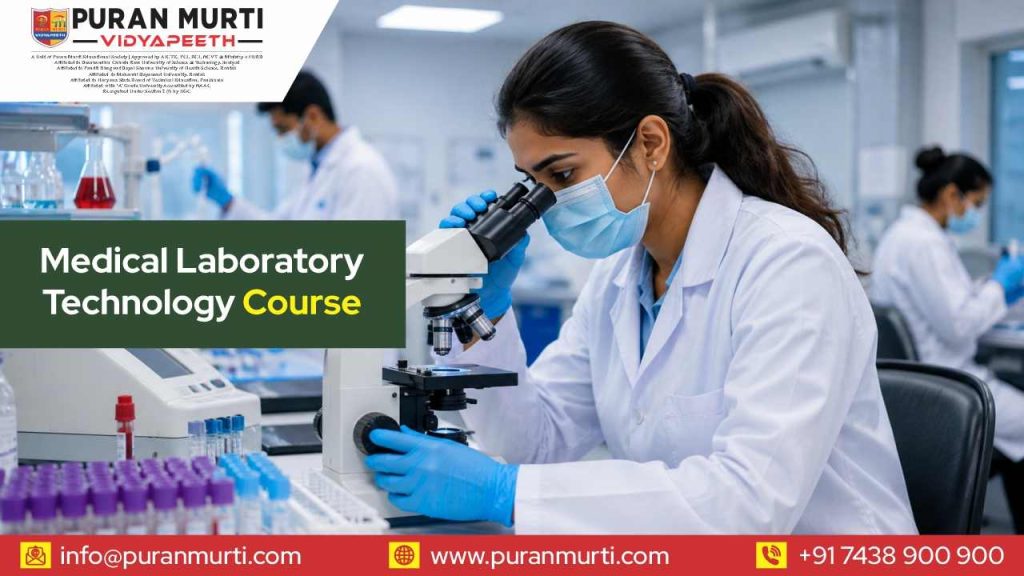
Medical Laboratory Technology is a healthcare-focused course for students who want to work with diagnostic tests, laboratory equipment, patient samples and scientific reporting. Medical laboratory professionals support doctors by helping identify diseases through blood, urine, tissue and other clinical investigations. Apply Now
In India, students can enter this field through certificate, diploma or undergraduate programmes. At Puran Murti Vidyapeeth, the available brochure lists a three-year Diploma in Medical Lab Technician under its polytechnic programmes. The pharmacy brochure also presents a three-year Diploma in Medical Lab Technology, with a lateral-entry pathway mentioned for eligible students. However, students should confirm the latest admission rules, affiliation, course title and intake directly with the institution before applying.
This field suits students who enjoy biology, laboratory work, observation and careful analysis. It can lead to opportunities in hospitals, diagnostic centres, pathology laboratories, blood banks, research facilities, public-health projects and healthcare companies. Apply Now
What Is Medical Laboratory Technology?
Medical Laboratory Technology, commonly called MLT, is the study of laboratory procedures used to examine patient samples and support disease diagnosis.
A Medical Lab Technician or Medical Laboratory Technologist may work with:
-
Blood samples.
-
Urine samples.
-
Stool samples.
-
Sputum and other body fluids.
-
Tissue specimens.
-
Microorganism cultures.
-
Blood-bank samples.
-
Biochemistry and pathology specimens.
The professional does not usually prescribe medicines or independently diagnose patients. Instead, the laboratory team follows approved procedures, analyses samples, records observations and prepares accurate reports for authorised medical professionals. Apply Now
Therefore, the work demands much more than operating a machine. A laboratory professional must understand sample collection, labelling, storage, testing, equipment handling, quality control, infection prevention, biomedical-waste management and report documentation.
The National Commission for Allied and Healthcare Professions identifies Medical Laboratory and Life Sciences as one of the recognised categories within allied and healthcare professions. Its competency-based curriculum initiative aims to reduce differences in educational standards and terminology across medical laboratory programmes. Apply Now
Why Does MLT Matter?
Doctors often depend on laboratory evidence before confirming a diagnosis or deciding on treatment. For example, a patient’s symptoms may suggest several possible conditions. Blood counts, glucose tests, liver-function tests, cultures or microscopic examinations can provide valuable clinical evidence.
Consequently, the accuracy of a laboratory result can influence:
-
Disease detection.
-
Treatment selection.
-
Monitoring of recovery.
-
Screening programmes.
-
Emergency-care decisions.
-
Public-health surveillance.
-
Blood transfusion safety.
Laboratory work also supports preventive healthcare. Routine tests can identify risk factors before symptoms become severe. In addition, laboratory services help track infectious diseases and support community-health programmes. Apply Now
The World Health Organization explains that laboratory quality includes the accuracy, reliability and timeliness of reported results. Its laboratory quality-management handbook covers the full laboratory process, from management and administration to bench-work operations.
Medical Laboratory Technology Course Options
Students can choose different MLT pathways depending on their educational qualification, career goals and the recognition status of the programme. Apply Now
These durations vary because institutions may follow different regulatory, university and curriculum structures. For that reason, students should never rely only on a coaching-centre advertisement or an unverified online listing. Apply Now
The Puran Murti brochures specifically mention a three-year Medical Lab Technician diploma and a three-year DMLT programme. The pharmacy brochure lists eligibility as Class 10 from a recognised board for the diploma, while its lateral-entry information mentions 10+2 with PCM or a two-year ITI qualification from any trade. Since admission rules may change, applicants should verify the current prospectus and official notification.
Eligibility After Class 10
Many diploma-level programmes accept students after Class 10. This route may suit learners who want to begin technical healthcare training without first completing Class 12.
The general requirements may include:
-
Passing Class 10 from a recognised board.
-
Meeting the minimum age requirement prescribed by the institution.
-
Providing academic and identity documents.
-
Completing the admission or counselling process.
-
Satisfying any state, university or affiliating-body conditions.
Candidates need Class 10 from a recognised board for the DMLT programme. However, the exact admission conditions, subjects, marks and document requirements should be checked for the current academic session. Apply Now
After completing a diploma, students may seek technician roles or explore further education. Nevertheless, progression to a degree programme depends on the rules of the receiving institution.
Eligibility After Class 12
Students who complete Class 12 with Science may have more course options. Many degree-level MLT programmes generally prefer Biology or a related science background.
Common requirements may include:
-
Passing Class 12 from a recognised board.
-
Studying Physics, Chemistry and Biology where required.
-
Meeting the prescribed minimum percentage.
-
Completing merit-based or institution-specific admission procedures.
-
Submitting migration, transfer and category documents where applicable.
The National Commission’s competency-based curriculum materials should be treated as an important reference point for the developing standardisation of medical laboratory education. However, colleges may still publish specific eligibility rules based on their affiliation and programme level. Apply Now
Students should ask the admission office these questions:
-
Is Biology compulsory for this programme?
-
Is the programme a diploma, degree or certificate?
-
Which body awards the final qualification?
-
Is the course affiliated or recognised under the applicable regulations?
-
Does the programme include practical training or internship?
-
Is lateral entry available?
-
What is the exact duration?
-
Are examination and registration requirements applicable?
DMLT at Puran Murti Vidyapeeth
The Puran Murti present DMLT and Medical Lab Technician as healthcare-oriented study options within the institution’s wider academic ecosystem. Apply Now
The 2026 campus brochure lists Medical Lab Technician among its three-year diploma courses. The pharmacy brochure separately describes DMLT as a three-year diploma covering medical laboratory sciences, diagnostic techniques and laboratory management. It also mentions careers in hospitals, diagnostic centres, research laboratories and healthcare institutions.
The brochure material also highlights campus facilities such as:
-
Laboratory infrastructure.
-
Library resources.
-
Computer centre.
-
Dispensary.
-
Wi-Fi campus.
-
Separate hostel facilities for boys and girls.
-
Sports and recreational facilities.
-
Cafeteria.
-
Transportation from parts of Delhi-NCR, Rohtak, Panipat and Baraut.
Because facilities can be updated, students and parents should inspect the relevant teaching laboratories and ask specifically which facilities are available for DMLT students. A large campus facility list does not automatically mean that every facility is dedicated to one programme.
The institution is located on Kami Road, Sonepat, Haryana, within the Delhi-NCR region. The brochure identifies Puran Murti College of Pharmacy and Puran Murti Campus as part of the Puran Murti Educational Society’s education network. Apply Now
What Do Students Study?
The subjects differ by programme and semester. Still, a well-designed MLT curriculum generally combines basic science, clinical laboratory disciplines, practical work and professional conduct.
Basic Human Sciences
Students usually begin with subjects that explain the human body and its functions, such as:
-
Anatomy.
-
Physiology.
-
Biochemistry fundamentals.
-
Medical terminology.
-
Basic pathology.
-
Health and disease concepts.
These subjects help students understand why a laboratory test is ordered and how a disease can affect the body. Apply Now
Hematology
Hematology focuses on blood and blood-forming tissues. Students may learn about:
-
Blood-cell types.
-
Haemoglobin estimation.
-
Complete blood count concepts.
-
Peripheral blood smears.
-
Blood-cell morphology.
-
Coagulation basics.
-
Anaemia-related investigations.
-
Quality checks in blood testing.
Practical training may include preparing slides, staining smears and observing cells under a microscope. Accuracy matters because poor smear preparation or incorrect identification can affect the report. Apply Now
Clinical Biochemistry
Clinical biochemistry examines chemical substances in blood and other body fluids. Common areas include:
-
Blood glucose.
-
Liver-function indicators.
-
Kidney-function indicators.
-
Lipid profile.
-
Enzyme testing.
-
Electrolytes.
-
Proteins.
-
Hormonal and metabolic investigations.
Students learn the principles behind tests, specimen requirements, equipment operation and result documentation. They also learn why calibration, controls and correct storage conditions matter.
Microbiology
Microbiology deals with microorganisms that may cause infection. Students may study:
-
Bacteria.
-
Viruses.
-
Fungi.
-
Parasites.
-
Sterilisation.
-
Culture methods.
-
Staining methods.
-
Antibiotic-sensitivity concepts.
-
Infection-control practices.
Laboratory microbiology requires discipline. Students must prevent contamination, follow safety protocols and handle potentially infectious materials responsibly. Apply Now
Histopathology and Cytology
Histopathology involves examining tissues, while cytology focuses on cells. Depending on the programme, students may learn:
-
Tissue fixation.
-
Processing and embedding.
-
Section cutting.
-
Slide preparation.
-
Staining methods.
-
Microscopic examination.
-
Basic documentation.
These procedures require patience and fine motor control. A small processing error can damage the specimen or reduce the quality of the final observation. Apply Now
Immunology and Serology
These subjects introduce the immune system and laboratory tests based on antigen-antibody reactions. Students may encounter:
-
Immune responses.
-
Antigens and antibodies.
-
Screening tests.
-
Serological reactions.
-
Rapid diagnostic methods.
-
Interpretation limitations.
The goal is not merely to memorise test names. Students must understand specimen quality, test principles and the need to interpret results within authorised laboratory procedures. Apply Now
Blood Banking
Blood-bank training may include:
-
Blood-group systems.
-
Compatibility testing.
-
Donor screening.
-
Component separation.
-
Storage requirements.
-
Transfusion safety.
-
Documentation.
This area carries significant responsibility. Therefore, students must follow standard operating procedures and never treat blood-bank work casually. Apply Now
Laboratory Management
Modern laboratory work also includes operational responsibilities. Students may learn about:
-
Sample registration.
-
Laboratory information systems.
-
Inventory control.
-
Equipment maintenance.
-
Quality assurance.
-
Internal quality control.
-
Biomedical-waste management.
-
Safety documentation.
-
Error reporting.
The WHO laboratory quality-management framework emphasises that quality must address all aspects of laboratory operations rather than one isolated testing step. Apply Now
Practical Training and Skills
Employers value students who can translate classroom knowledge into safe laboratory practice. Consequently, practical training should remain central to the course.
A student may gradually learn to:
-
Receive and identify a sample.
-
Check the request form.
-
Confirm patient and specimen details.
-
Select the correct container.
-
Follow collection or handling instructions.
-
Store the sample appropriately.
-
Prepare the specimen for testing.
-
Operate the relevant equipment under supervision.
-
Record observations accurately.
-
Apply quality-control procedures.
-
Dispose of waste safely.
-
Escalate unusual or unsafe situations.
Students also need communication skills. They may interact with patients during sample collection, coordinate with nurses, communicate with supervisors and clarify incomplete information.
However, students must understand their professional boundaries. A laboratory technician should not offer a medical diagnosis to a patient or alter a report without authorised procedures.
Qualities Needed for MLT
Medical Laboratory Technology suits students who combine scientific interest with careful working habits.
Important qualities include:
-
Attention to detail.
-
Patience during repetitive procedures.
-
Comfort with biology and chemistry.
-
Good hand-eye coordination.
-
Clean working habits.
-
Respect for confidentiality.
-
Ability to follow protocols.
-
Emotional steadiness.
-
Basic computer knowledge.
-
Clear communication.
-
Willingness to learn new equipment.
-
Responsibility during emergencies.
A student does not need to be a mathematical genius. Nevertheless, they should understand measurements, units, dilution concepts, percentages and basic data recording.
The field may also involve early shifts, standing for long periods, exposure to biological material and strict deadlines. Therefore, students should choose MLT because they appreciate healthcare science, not simply because they want a short course. Apply Now
Career Opportunities After MLT
After completing the required qualification and any applicable training, graduates may explore several work settings.
Hospitals
Hospitals employ laboratory staff in departments such as:
-
Hematology.
-
Biochemistry.
-
Microbiology.
-
Pathology.
-
Blood bank.
-
Emergency laboratory.
-
Sample-collection units.
Large hospitals may provide exposure to specialised sections. Smaller hospitals may offer broader responsibilities. Apply Now
Diagnostic Centres
Diagnostic chains and independent laboratories recruit technicians for sample collection, processing and reporting support. These roles may also involve patient interaction and front-desk coordination.
Students should learn whether a prospective employer follows quality systems, maintains equipment properly and provides adequate supervision. Apply Now
Pathology Laboratories
Pathology laboratories may offer roles related to specimen preparation, microscopy, slide handling, documentation and section-specific testing.
Career growth depends on qualification, accuracy, experience and the ability to learn advanced methods.
Blood Banks
Blood banks require trained personnel who understand grouping, compatibility, storage and documentation. Work in this area demands exceptional attention because patient safety depends on correct identification and process compliance. Apply Now
Research Laboratories
Research organisations, universities, biotechnology companies and pharmaceutical firms may employ laboratory assistants or technicians. Entry requirements vary according to the work and the level of qualification.
Public Health Laboratories
Public-health laboratories support disease surveillance, screening programmes and community-health investigations. Vacancies may arise through government departments, public institutions, contractual projects or outsourced services. Apply Now
Medical Equipment and Diagnostics Companies
Some graduates work with companies that supply laboratory analysers, reagents and diagnostic systems. Such roles may include:
-
Technical support.
-
Application assistance.
-
Product demonstrations.
-
Equipment installation support.
-
Customer training.
-
Quality documentation.
These positions often require stronger communication and computer skills.
Salary and Career Growth
Salary cannot be accurately promised through a general blog because it varies by city, employer, qualification, experience, laboratory section and job responsibilities.
A diploma holder may begin in an entry-level technician or sample-processing role. With experience, they may move into senior technician, section in-charge, supervisor or laboratory-management positions, subject to employer requirements. Apply Now
Income can improve when professionals develop skills in:
-
Automated analysers.
-
Molecular diagnostics.
-
Blood banking.
-
Histopathology.
-
Quality management.
-
Laboratory information systems.
-
Inventory and compliance.
-
Team supervision.
-
Technical support.
Students should compare job offers using more than salary. They should also examine working hours, training quality, safety standards, role clarity, overtime policy, leave, transport and opportunities for advancement. Apply Now
Higher Studies After DMLT
A diploma can provide an initial entry into laboratory work, but many students later pursue additional qualifications.
Possible pathways may include:
-
Bachelor’s programme in Medical Laboratory Technology.
-
Bachelor’s degree in medical or allied health sciences.
-
Specialised certification.
-
Advanced training in laboratory quality.
-
Postgraduate study after completing a relevant degree.
-
Research-oriented programmes.
-
Healthcare-management education.
The exact lateral-entry rules differ among universities and colleges. The Puran Murti pharmacy brochure mentions a two-year lateral-entry route for DMLT under its programme listing, but students must verify the current conditions, eligibility and awarding authority before admission.
A student should also check whether the diploma qualifies for entry into the intended degree programme. Do not assume that every certificate or diploma will receive the same credit.
MLT Versus Nursing and Pharmacy
Students often compare Medical Laboratory Technology with nursing or pharmacy. These fields all support healthcare, but their daily work differs.
Students who enjoy direct patient care may prefer nursing. Those interested in medicines may prefer pharmacy. Meanwhile, students who enjoy testing, microscopes, instruments and scientific processes may find MLT more suitable. Apply Now
How to Select a Good MLT College
Choosing a college requires more than checking advertisements. Parents and students should evaluate the programme carefully.
Verify the Qualification
Ask which institution or authority awards the final certificate or diploma. Also verify affiliation, approval and examination arrangements from current official documents. Apply Now
Inspect the Laboratories
A laboratory course needs practical facilities. Ask whether students receive regular access to:
-
Microscopes.
-
Centrifuges.
-
Biochemistry analysers.
-
Hematology equipment.
-
Microbiology facilities.
-
Histopathology equipment.
-
Blood-bank training resources.
-
Safety equipment.
-
Sample-handling areas.
Do not accept a general claim such as “advanced labs” without asking which facilities support the MLT curriculum.
Ask About Practical Hours
A course may include practical work on paper but provide limited hands-on exposure. Therefore, ask how many hours students spend in laboratories and whether batches are divided for effective practice.
Check Internship Arrangements
Ask whether the college provides supervised clinical exposure, where it takes place and whether the arrangement is formally documented. Apply Now
Review Faculty Experience
Find out whether teachers have relevant laboratory, pathology, microbiology or allied-health backgrounds. Also ask how frequently students receive feedback on practical work.
Understand the Total Cost
Calculate tuition, examination fees, hostel charges, transport, uniforms, instruments, books and other expenses. A transparent fee structure helps families plan responsibly. Apply Now
Check Student Support
Useful support may include academic counselling, remedial classes, communication training, placement assistance and guidance for higher studies.
Puran Murti Campus describes career services, employability training, industry engagement, internships and alumni support in its campus brochure. These are institutional claims that students should discuss with the admission team in relation to the specific MLT programme rather than assume that every service applies identically to every course. Apply Now
Admission Process
The admission process varies by institution. A typical process may include:
-
Check the current eligibility criteria.
-
Complete the online or offline application.
-
Upload or submit educational documents.
-
Attend counselling if required.
-
Receive a provisional offer or admission confirmation.
-
Pay the prescribed fee.
-
Complete document verification.
-
Attend orientation and begin classes.
Common documents may include:
-
Class 10 certificate.
-
Class 12 certificate, where applicable.
-
Transfer certificate.
-
Migration certificate, where applicable.
-
Identity proof.
-
Passport-size photographs.
-
Medical certificate, if required.
-
Category or domicile certificate, if applicable.
-
Gap-year affidavit, if applicable.
Always obtain a written fee receipt and read the refund, withdrawal and cancellation policy.
Safety and Professional Ethics
Laboratory professionals work with confidential health information and potentially hazardous materials. Ethical behaviour is therefore essential. Apply Now
Students should learn to:
-
Protect patient privacy.
-
Use personal protective equipment.
-
Label samples correctly.
-
Avoid cross-contamination.
-
Report errors honestly.
-
Follow waste-disposal rules.
-
Maintain accurate records.
-
Never fabricate results.
-
Avoid discussing patient information casually.
-
Seek supervision when uncertain.
A fast result is not useful if it is inaccurate. Similarly, a technically correct test can still create risk if the sample was misidentified or stored incorrectly. Apply Now
Common Mistakes Students Make
Choosing the Course Without Checking Recognition
A low-cost course may not provide the qualification needed for the desired job or further study. Verify the awarding body first.
Assuming Every MLT Course Is the Same
Certificate, diploma and degree programmes differ in duration, depth, practical exposure and progression opportunities.
Focusing Only on Placement Claims
Placement statistics may use different definitions. Ask whether the figures refer to internships, offers, joining, median salary or a small number of selected students.
Ignoring Practical Training
Laboratory careers depend on hands-on competence. A student should ask about equipment, supervised procedures and clinical exposure.
Expecting Immediate High Earnings
Entry-level salaries vary, and strong career growth usually requires experience, specialisation and continuous learning.
Neglecting Communication Skills
Laboratory professionals communicate with patients, doctors, nurses, supervisors and equipment companies. Clear communication supports safer work.
Frequently Asked Questions
What is a Medical Laboratory Technology course?
It is a healthcare education programme that trains students in clinical laboratory procedures, sample handling, diagnostic testing, equipment use, quality control and laboratory documentation.
Can I pursue DMLT after Class 10?
Some diploma programmes accept Class 10 students. The Puran Murti College of Pharmacy brochure lists Class 10 from a recognised board for its DMLT entry requirement. Verify the current rules before applying.
Can I pursue MLT after Class 12?
Yes, students can explore diploma or degree-level MLT programmes after Class 12, subject to the institution’s stream, marks and subject requirements.
Is Biology compulsory for MLT?
Biology is commonly preferred for many healthcare and degree-level programmes, but requirements vary. Check the exact prospectus of the programme you want.
What is the duration of DMLT?
The duration varies by institution. The Puran Murti Vidyapeeth list a three-year DMLT or Medical Lab Technician diploma, while other Indian programmes may follow different structures.
What does an MLT professional do?
An MLT professional may collect, process and analyse samples, operate equipment under approved procedures, maintain records, perform quality checks and support accurate laboratory reporting.
Can DMLT graduates work in hospitals?
Yes, eligible graduates may seek roles in hospitals, diagnostic centres, pathology laboratories, blood banks and other healthcare settings. Employment depends on the qualification, employer criteria and applicable regulations.
Is MLT a good career option?
MLT can be a suitable career for students who enjoy biology, laboratory science, precision and healthcare support. The best results come from choosing a recognised programme with strong practical training.
Can I study further after DMLT?
Students may explore bachelor’s-level programmes or other advanced courses, depending on the admission and lateral-entry rules of the receiving institution.
Does Puran Murti Vidyapeeth offer a Medical Laboratory Technology course?
The Puran Murti list a three-year Medical Lab Technician diploma and DMLT under the institution’s programme offerings. Students should confirm current admission availability, eligibility, affiliation and fees with the official admission office. Apply Now
The campus located at Kami Road, Sonepat, Haryana, in the Delhi-NCR region.
Final Checklist Before Admission
Before paying the admission fee, confirm:
-
Exact course name.
-
Course level.
-
Duration.
-
Eligibility.
-
Awarding authority.
-
Current affiliation.
-
Practical laboratory facilities.
-
Internship or clinical exposure.
-
Examination pattern.
-
Total fees.
-
Hostel and transport availability.
-
Refund policy.
-
Higher-study options.
-
Placement support for the specific programme.
Medical Laboratory Technology offers a meaningful route into healthcare for students who prefer scientific investigation and behind-the-scenes diagnostic work. The profession rewards accuracy, discipline, technical learning and ethical responsibility. Apply Now
For students in Delhi-NCR and nearby parts of Haryana, Puran Murti Vidyapeeth may be considered among the institutions to compare for DMLT-related study, based on the programme information presented in its brochures. However, a responsible decision should depend on current verification, laboratory access, practical training and the student’s long-term goals.
Admission Enquiry CTA
Interested students can contact the Puran Murti Vidyapeeth admission team to confirm the latest DMLT or Medical Lab Technician course details, eligibility, fees, campus facilities and application process.
Query:
About Puran Murti Vidyapeeth Apply Now
The institute is known for its focus on technical education, practical learning, laboratory exposure, and career-oriented training. Students can explore engineering programs in modern technology domains while benefiting from academic support, industry interaction, and campus facilities. The availability of hostel facilities, skill-development activities, and placement assistance also makes it a consideration for students looking for engineering education near Delhi NCR. Apply Now
Top Engineering Branches
BTech (Bachelor of Technology)
BTech is among the most popular courses after 12th Science (PCM).
Top Specializations:
- Aeronautical Engineering
- Aerospace Engineering
- Aircraft Maintenance Engineering (AME)
- Computer Science & Engineering (CSE)
- CSE with Artificial Intelligence and Machine Learning (AI & ML)
- Civil Engineering
- Electrical Engineering
- Electronics & Communication Engineering (ECE)
- Mechanical Engineering
Unique Aviation Programs (USP)
One of the biggest advantages of Puran Murti Vidyapeeth is its aviation-based courses, which are rare in India:
- B.Tech + AME (DGCA approved)
- B.Tech Mechanical Engineering + AME (DGCA)
- B.Tech ECE + AME (DGCA)
- B.Tech Computer Science
(AI & ML)+ AME (DGCA) - B.Tech Aeronautical Engineering
+ CPL (Ground Classes) - B.Tech Aerospace Engineering
+ CPL (Ground Classes)
Diploma Courses
Students can also choose job-oriented diploma courses: Apply Now
- Diploma in Automobile Engineering (AE)
- Diploma in AME (Aircraft Maintenance Engineering)
- Diploma in Aeronautical Engineering
- Diploma in Civil Engineering (CE)
- Diploma in Mechanical Engineering (ME)
- Diploma in Computer Science & Engineering (CSE)
- Diploma in Electronics & Communication Engineering (ECE)
- Diploma in Electrical Engineering (EE)
- Diploma in Fire Technology & Safety
- Diploma in Medical Lab Technology (MLT)
- Diploma in Hotel Management
- Diploma in CSE (AI & ML
Puran Murti Campus
Kami Road, Sonepat, Haryana, India
Phone: 7438 900 900
Email: info@puranmurti.com