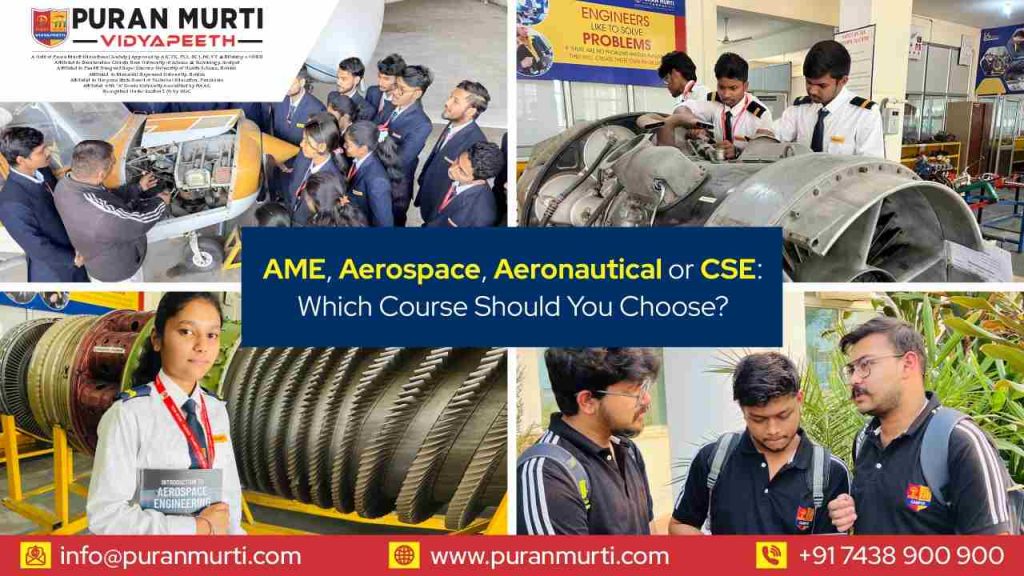
AME, Aerospace, Aeronautical or CSE: Which Course Should You Choose?
Posted on : 22 September, 2026 3:18 pm
Choosing between AME, Aerospace, Aeronautical or CSE Which Course Should You Choose? can be difficult after Class 12. All four courses offer good career opportunities. However, they lead to different types of work.
AME focuses on aircraft maintenance and safety. Aeronautical Engineering focuses on aircraft design and systems. Aerospace Engineering includes aircraft and spacecraft. CSE focuses on software, computers and digital technology. The right course depends on your interests, subjects, skills and career goals. This guide compares AME, Aerospace, Aeronautical or CSE Which Course Should You Choose? in simple language.It also explains the available options at Puran Murti Vidyapeeth in Sonepat, Haryana.
Quick Comparison
| Course | Main focus | Usual duration | Best for |
|---|---|---|---|
| AME | Aircraft maintenance and safety | 2–4 years | Students interested in aircraft servicing |
| Aeronautical Engineering | Aircraft design and technology | 4 years | Students interested in aircraft |
| Aerospace Engineering | Aircraft and spacecraft | 4 years | Students interested in aviation and space |
| CSE | Computers, software and technology | 4 years | Students interested in coding and digital careers |
The best choice is not the course with the most popular name. It is the course that matches your interests and abilities.
What Is AME?
What do AME students study?
The subjects may include:
- Aircraft maintenance practices.
- Aircraft structures.
- Aircraft systems.
- Aviation regulations.
- Aircraft engines.
- Electrical systems.
- Avionics.
- Human factors.
- Safety procedures.
- Maintenance documentation.
Students receive practical training along with classroom learning. They learn how to inspect aircraft parts and identify technical problems.
Career options after AME
AME graduates may work in:
- Airlines.
- Maintenance, repair and overhaul companies.
- Airports.
- Aircraft manufacturers.
- Defence aviation.
- Helicopter operators.
- Aviation support companies.
Possible job roles include:
- Aircraft maintenance technician.
- Aircraft maintenance engineer.
- Line maintenance professional.
- Base maintenance professional.
- Quality inspector.
- Technical services assistant.
AME is suitable for students who want to work directly with aircraft. It is less focused on designing new aircraft.
Who should choose AME?
Choose AME if you:
- Enjoy practical work.
- Like aircraft and machines.
- Want to work at airports or hangars.
- Can follow strict safety rules.
- Have strong attention to detail.
- Prefer maintenance over software work.
AME may not be the best choice if you want to design aircraft or build software applications.
What Is Aeronautical Engineering?
Aeronautical Engineering focuses on aircraft that fly within the Earth’s atmosphere.
Students learn how aircraft are designed, built and tested. The course combines Physics, Mathematics and engineering principles.
What do aeronautical engineering students study?
Common subjects include:
- Aerodynamics.
- Aircraft structures.
- Propulsion.
- Flight mechanics.
- Aircraft materials.
- Avionics.
- Control systems.
- Fluid mechanics.
- Thermodynamics.
- Computer-aided design.
Students may use design and simulation software. They also complete engineering projects and laboratory work.
Career options after Aeronautical Engineering
Graduates can work as:
- Aircraft design engineer.
- Aerodynamics engineer.
- Propulsion engineer.
- Flight testing engineer.
- Aircraft production engineer.
- Quality engineer.
- Maintenance planning engineer.
- Aerospace systems engineer.
Employers may include aircraft manufacturers, defence organisations, airlines and research institutions.
Who should choose Aeronautical Engineering?
Choose Aeronautical Engineering if you:
- Like aircraft design.
- Enjoy Physics and Mathematics.
- Want to work with aircraft systems.
- Like engineering drawings.
- Enjoy testing and problem-solving.
- Want to work in aviation manufacturing.
This course is a good option for students who want a technical career in aircraft engineering.\
What Is Aerospace Engineering?
Aerospace Engineering is broader than Aeronautical Engineering. It covers aircraft and spacecraft.
The course includes aviation, space technology and advanced engineering systems.
What do aerospace engineering students study?
The syllabus may include:
- Aerodynamics.
- Spacecraft systems.
- Propulsion.
- Flight mechanics.
- Orbital mechanics.
- Aerospace materials.
- Avionics.
- Control systems.
- Aircraft structures.
- Space mission design.
Aerospace students may work on aircraft, satellites, rockets, drones and space systems.
Career options after Aerospace Engineering
Graduates can work as:
- Aerospace design engineer.
- Space systems engineer.
- Propulsion engineer.
- Avionics engineer.
- Flight systems engineer.
- Research engineer.
- Defence technology engineer.
- Drone systems engineer.
They may find opportunities in aviation, defence, space research and advanced manufacturing.
Who should choose Aerospace Engineering?
Choose Aerospace Engineering if you:
- Are interested in aircraft and spacecraft.
- Enjoy advanced Physics and Mathematics.
- Like research and innovation.
- Want to work in space technology.
- Are interested in rockets, satellites or drones.
Aerospace Engineering may include more advanced mathematics and physics. Students should be ready for technical study.
What Is CSE?
CSE stands for Computer Science Engineering. It focuses on computers, software and digital systems.
CSE has applications in almost every industry. These industries include finance, healthcare, education, aviation, manufacturing and retail.
What do CSE students study?
Common subjects include:
- Programming.
- Data structures.
- Algorithms.
- Database management.
- Computer networks.
- Operating systems.
- Software engineering.
- Web development.
- Cloud computing.
- Cybersecurity.
- Artificial intelligence.
- Machine learning.
Students also build software projects. These projects help them develop practical skills.
Career options after CSE
CSE graduates can work as:
- Software developer.
- Web developer.
- Mobile application developer.
- Data analyst.
- Cloud engineer.
- Cybersecurity analyst.
- Machine learning engineer.
- Database administrator.
- DevOps engineer.
- Technical consultant.
CSE graduates can work in aviation companies too. For example, airlines and aerospace firms need software developers, data analysts and cybersecurity professionals.
Who should choose CSE?
Choose CSE if you:
- Enjoy computers.
- Like coding and logic.
- Want flexible career options.
- Prefer software over machines.
- Enjoy solving digital problems.
- Want to work in technology.
CSE is suitable for students who want careers in software, data, artificial intelligence or cybersecurity.
AME vs Aeronautical Engineering
AME and Aeronautical Engineering are both related to aircraft. However, the work is different.
AME focuses on maintenance, inspection and safety. Aeronautical Engineering focuses on aircraft design, testing and development.
| Feature | AME | Aeronautical Engineering |
|---|---|---|
| Main focus | Aircraft maintenance | Aircraft design |
| Work setting | Hangars, airports and workshops | Design offices, laboratories and factories |
| Study style | Practical and safety-focused | Engineering and design-focused |
| Career area | Maintenance and inspection | Design, production and testing |
| Best for | Students who like hands-on work | Students who like aircraft technology |
Choose AME if you want practical maintenance work. Choose Aeronautical Engineering if you want to design and improve aircraft.
Aerospace vs Aeronautical Engineering
Aerospace Engineering includes both aircraft and spacecraft. Aeronautical Engineering mainly focuses on aircraft.
| Feature | Aerospace Engineering | Aeronautical Engineering |
|---|---|---|
| Scope | Aircraft and spacecraft | Aircraft |
| Focus | Aviation and space systems | Aircraft design and operation |
| Subjects | Aerospace and space technology | Aerodynamics and aircraft systems |
| Career areas | Space, defence and aviation | Aviation, defence and manufacturing |
| Best for | Students interested in space | Students focused on aircraft |
Both courses require strong Physics and Mathematics. Read the syllabus before choosing a college.
CSE vs Aviation Courses
CSE and aviation courses lead to different work environments.
CSE graduates usually work with software, applications and data. Aviation graduates work with aircraft, systems and safety.
Choose CSE if you want:
- A software career.
- Remote work opportunities.
- Jobs in many industries.
- Coding and technology work.
- A career in artificial intelligence.
Choose AME, Aerospace or Aeronautical Engineering if you want:
- An aviation career.
- Aircraft or spacecraft work.
- Practical engineering work.
- A career in defence or aerospace.
- Work with aircraft systems.
Students should not choose an aviation course only because they like travelling. Aviation engineering involves technical study, safety rules and practical responsibility.
Eligibility After Class 12
Students usually need Physics and Mathematics for these technical courses. Some colleges may also require Chemistry, Biology, Biotechnology or another approved subject.
Common admission routes include:
- JEE Main.
- State entrance examinations.
- University entrance examinations.
- Merit-based admission.
- Aviation-specific entrance tests.
The requirements vary by institution. Check the current college prospectus before applying.
AME may have additional medical, age or licensing requirements. Students should verify the current rules with the approved training organisation and relevant aviation authority.
Puran Murti Vidyapeeth
Puran Murti Vidyapeeth is located on Kami Road in Sonepat, Haryana, in the Delhi-NCR region. The institution offers programmes in engineering, aviation, management, law, pharmacy and vocational education
Students can explore the following related programmes:
- B.Tech in Aeronautical Engineering.
- B.Tech in Aerospace Engineering.
- Aircraft Maintenance Engineering.
- B.Tech in Computer Science Engineering.
- CSE with Artificial Intelligence and Machine Learning.
- Electronics and Communication Engineering.
- Mechanical Engineering.
- Electrical Engineering.
- Polytechnic courses.
The published course information also lists integrated options that combine AME with Aerospace Engineering, Aeronautical Engineering, Mechanical Engineering, Electronics and Communication Engineering, and CSE with Artificial Intelligence and Machine Learning.
Why consider Puran Murti Vidyapeeth?
Students may consider the institution because it offers different technical pathways in one education group.
Potential advantages include:
- Aviation and engineering course options.
- Practical laboratory learning.
- Technical workshops.
- Aviation-focused programmes.
- Engineering specialisations.
- Integrated course choices.
- Delhi-NCR location.
- Career and internship guidance.
The institution’s published course list includes aviation programmes such as Aeronautical Engineering, Aerospace Engineering and AME. It also offers CSE and other B.Tech branches.
Before admission, students should verify:
- Course approval.
- University affiliation.
- AME regulatory status.
- Eligibility requirements.
- Fee structure.
- Hostel charges.
- Practical training.
- Internship support.
- Placement information.
Do not select a course based only on advertisements. Request the latest official brochure and written fee details.
Course Duration
The duration depends on the programme.
| Course | Typical duration |
|---|---|
| B.Tech CSE | 4 years |
| B.Tech Aeronautical Engineering | 4 years |
| B.Tech Aerospace Engineering | 4 years |
| AME | 2–4 years, depending on programme and pathway |
| Polytechnic diploma | 3 years |
AME duration can vary by category, training structure and licensing pathway. Confirm the exact duration before admission.
Which Course Has Better Scope?
All four courses have scope. The best option depends on your goals.
Choose AME for aviation maintenance
AME is suitable for students who want to inspect, repair and maintain aircraft.
Choose Aeronautical Engineering for aircraft design
Aeronautical Engineering is suitable for students who want to work with aircraft design, systems and testing.
Choose Aerospace Engineering for space and defence
Aerospace Engineering is suitable for students interested in spacecraft, satellites, rockets and advanced defence technology.
Choose CSE for software and digital careers
CSE is suitable for students who want flexible careers in programming, data, cloud computing and artificial intelligence.
Salary and Career Growth
Salary depends on college, skills, experience, location and employer.
Fresh graduates may start with entry-level roles. Salary can increase after internships, certifications and practical projects.
CSE may offer a wider range of private-sector jobs. Aviation courses may offer specialised roles in airlines, defence and aerospace companies.
AME professionals may need additional licensing or certification for specific maintenance duties. Aeronautical and aerospace engineers may benefit from design software and postgraduate study.
Do not choose a course only because of online salary claims. Compare the complete career path and qualification requirements.
Skills You Should Build
For AME
- Aircraft systems.
- Maintenance procedures.
- Safety standards.
- Technical documentation.
- Attention to detail.
- Practical troubleshooting.
For Aeronautical Engineering
- Aerodynamics.
- Aircraft structures.
- CAD software.
- Propulsion.
- Testing.
- Engineering analysis.
For Aerospace Engineering
- Advanced mathematics.
- Flight systems.
- Propulsion.
- Space technology.
- Simulation.
- Research skills.
For CSE
- Programming.
- Data structures.
- Databases.
- Web development.
- Cloud computing.
- Cybersecurity.
- Artificial intelligence.
Communication and teamwork are important in every field.
How to Make the Right Choice
Start by identifying the type of work you enjoy.
Ask yourself:
- Do I prefer aircraft or computers?
- Do I enjoy practical work or software projects?
- Am I interested in space technology?
- Do I like Physics and Mathematics?
- Can I follow strict safety procedures?
- Do I want a flexible technology career?
- Am I ready for advanced engineering subjects?
Next, compare the syllabus. A course title can sound attractive, but the subjects show what you will actually study.
Then, check the college. Review approvals, facilities, faculty, internships and placement data.
Finally, discuss your choice with parents, teachers and career counsellors. Make an informed decision instead of following trends.
Final Recommendation
Choose AME if your goal is aircraft maintenance and safety.
Choose Aeronautical Engineering if you want to design, test and improve aircraft.
Choose Aerospace Engineering if you are interested in aircraft, spacecraft, satellites and defence technology.
Choose CSE if you want a career in programming, software, data or artificial intelligence.
Puran Murti Vidyapeeth offers options across these areas. Students can compare aviation, engineering and computer courses in one institution. However, check the latest approvals, fees and admission requirements before enrolling.
Final Thoughts
The choice between AME, Aerospace, Aeronautical or CSE depends on your interests and career plan.
AME leads to aircraft maintenance. Aeronautical Engineering focuses on aircraft design. Aerospace Engineering includes aircraft and spacecraft. CSE opens opportunities in software and digital technology.
There is no universal best course. The right course is the one you can study with interest and commitment.
Build practical skills during your course. Complete internships, work on projects and improve communication. These steps can help you create better career opportunities.
Note: Course structures, fees, approvals and eligibility rules can change. Verify the latest information with Puran Murti Vidyapeeth and the relevant regulatory authorities before applying.
FAQs
Which is better, AME or Aeronautical Engineering?
AME is better for students who want aircraft maintenance work. Aeronautical Engineering is better for students who want aircraft design and testing.
Is Aerospace Engineering better than Aeronautical Engineering?
Neither course is automatically better. Aerospace Engineering covers aircraft and spacecraft. Aeronautical Engineering focuses mainly on aircraft.
Is CSE better than aviation courses?
CSE offers careers in software and technology. Aviation courses offer specialised careers in aircraft and aerospace. Choose according to your interests.
Can PCM students apply for these courses?
Yes. PCM students are generally eligible for engineering and aviation courses. The exact requirements vary by college and programme.
Does Puran Murti Vidyapeeth offer AME and CSE?
Published course information lists AME, Aeronautical Engineering, Aerospace Engineering, CSE and CSE with Artificial Intelligence and Machine Learning.
Does Puran Murti Vidyapeeth offer integrated courses?
The published programme list includes integrated options that combine AME with Aerospace Engineering, Aeronautical Engineering, Mechanical Engineering, ECE and CSE with AI and ML.
What should I check before joining AME?
Check the programme approval, training organisation status, practical facilities, licensing pathway, fees and placement information.
Which course is best for a student interested in space?
Aerospace Engineering is usually the most suitable option for students interested in spacecraft, satellites and space systems.
Which course is best for coding?
CSE is the best option among these four for students who want to learn programming, software development, data science or artificial intelligence.
Can I work in aviation after CSE?
Yes. Aviation companies need software developers, cybersecurity professionals, data analysts and technology specialists.