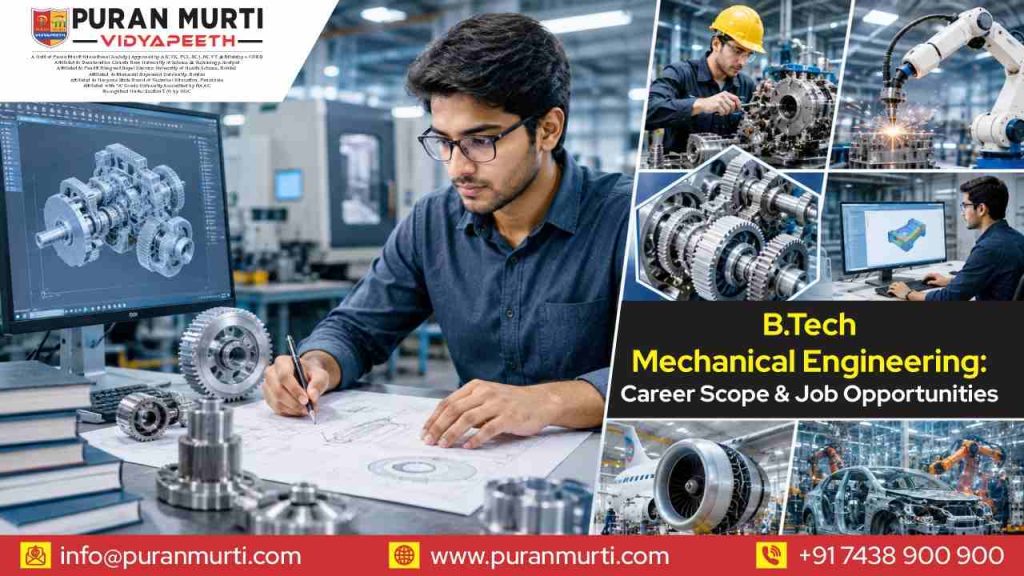
B.Tech Mechanical Engineering: Career Scope & Jobs
Posted on : 24 August, 2026 11:50 pm
What if choosing Mechanical Engineering today could open doors not only to traditional manufacturing but also to electric vehicles, robotics, automation, aerospace, renewable energy and smart factories?
That is exactly why B.Tech Mechanical Engineering remains a versatile engineering degree in India.
Mechanical engineers design machines, improve manufacturing processes, develop vehicles, maintain industrial systems, work with automation technologies and contribute to products used in everyday life. As industries become more digital, the role of a mechanical engineer is also changing.
For students considering engineering after Class 12, this creates an important question: What is the career scope after B.Tech Mechanical Engineering?
The short answer is: the scope is broad, but employability increasingly depends on combining strong mechanical fundamentals with practical, digital and industry-oriented skills.
India’s organised manufacturing sector added more than 10 lakh jobs in FY24, with manufacturing employment increasing by 6% year over year.
At the same time, government skill-development initiatives are increasingly focusing on areas such as robotics, electric vehicles, green energy, AI and digital manufacturing.
So, if you are a student in Sonipat, Delhi NCR or anywhere in India, B.Tech Mechanical Engineering can provide a strong foundation for both conventional and emerging engineering careers.
What Is the Career Scope of B.Tech Mechanical Engineering?
B.Tech Mechanical Engineering offers career opportunities in manufacturing, automobile, aerospace, energy, robotics, industrial automation, design, construction equipment, HVAC, maintenance, quality control and research. Graduates can work as design engineers, production engineers, mechanical engineers, quality engineers, maintenance engineers and automation professionals, or pursue higher studies and entrepreneurship.
What Is B.Tech Mechanical Engineering?
B.Tech Mechanical Engineering is a four-year undergraduate engineering programme focused on the design, analysis, manufacturing and operation of machines and mechanical systems.
Students learn how physical systems work and how engineers can design them to be safer, more efficient, economical and reliable.
The discipline typically covers areas such as:
- Engineering mechanics
- Thermodynamics
- Fluid mechanics
- Heat transfer
- Machine design
- Manufacturing processes
- Engineering materials
- CAD and computer-aided design
- Production engineering
- Industrial engineering
- Automobile engineering
- Robotics and automation
- Mechatronics
- Renewable energy systems
AICTE’s model curriculum places emphasis on fundamentals, discipline-specific subjects, electives, internships and practical exposure. It also highlights industry relevance and hands-on learning as important elements of engineering education.
https://blog.puranmurti.com/mechanical-engineering-course-details-2027-complete-guide/
Why Choose B.Tech Mechanical Engineering?
Mechanical Engineering is often described as one of the broadest engineering disciplines because its applications extend across many industries.
Top Benefits of Mechanical Engineering
- Wide range of career options
Graduates can explore manufacturing, automobiles, aerospace, energy, automation, design and other sectors. - Strong foundation in engineering
Students develop knowledge of mechanics, materials, thermodynamics, manufacturing and machine design. - Opportunities in emerging technologies
Mechanical engineers can move into robotics, EVs, Industry 4.0, additive manufacturing and smart factories. - Scope for higher education
Graduates can pursue M.Tech, MBA, research programmes and specialised certifications. - Entrepreneurship opportunities
Mechanical graduates can build businesses around manufacturing, fabrication, product development, maintenance and engineering services. - Cross-industry flexibility
Mechanical engineering skills can be applied across multiple industrial sectors rather than being limited to one type of company.
B.Tech Mechanical Engineering Career Scope in India
The future of mechanical engineering is closely connected to India’s manufacturing and infrastructure growth.
The engineering and capital goods ecosystem remains strategically important to India’s industrial development. Government data also shows that India’s automobile sector supports an estimated 30 million jobs across its direct and indirect value chain.
This creates opportunities for mechanical engineers in areas such as:
| Industry | Possible Mechanical Engineering Roles |
|---|---|
| Automobile | Automotive Engineer, Design Engineer |
| Manufacturing | Production Engineer, Manufacturing Engineer |
| Aerospace | Design Engineer, Maintenance Engineer |
| Energy | Thermal Engineer, Energy Engineer |
| EV | EV Systems Engineer, Battery-related Engineering Roles |
| Robotics | Robotics/Automation Engineer |
| Industrial Automation | Automation Engineer |
| Construction Equipment | Mechanical Design Engineer |
| HVAC | HVAC Engineer |
| Oil & Gas | Maintenance/Mechanical Engineer |
| Railways | Mechanical Engineering Roles |
| Defence | Design, Production and Maintenance Roles |
| Renewable Energy | Mechanical/Energy Engineering Roles |
| Research & Development | R&D Engineer |
| Quality | Quality Engineer |
Top Job Opportunities After B.Tech Mechanical Engineering
One of the biggest advantages of mechanical engineering is the variety of career paths available after graduation.
1. Mechanical Design Engineer
Mechanical design engineers create and improve components, machines and mechanical systems.
They commonly use tools such as:
- AutoCAD
- SolidWorks
- CATIA
- Creo
- NX
- ANSYS
A strong understanding of engineering drawing, materials, machine design and simulation can help students build careers in this area.
2. Production Engineer
Production engineers work closely with manufacturing operations.
Their responsibilities may include:
- Improving production processes
- Reducing manufacturing costs
- Monitoring production efficiency
- Coordinating manufacturing activities
- Improving workplace safety
- Implementing process improvements
This career path is particularly relevant as Indian manufacturing becomes more automated and technology-driven.
3. Manufacturing Engineer
Manufacturing engineers focus on how products are made.
They may work with CNC machines, robotics, automated production lines, additive manufacturing and digital production systems.
Current AICTE internship opportunities demonstrate the growing overlap between mechanical engineering and areas such as smart manufacturing, robotics, industrial automation, additive manufacturing and Industry 4.0.
4. Automobile Engineer
Automobile engineering is one of the most popular career directions for mechanical engineering graduates.
Students can explore:
- Vehicle design
- Powertrain systems
- Manufacturing
- Testing
- Vehicle dynamics
- Quality
- EV technology
- Automotive production
India’s automotive ecosystem continues to represent a major employment and manufacturing opportunity.
5. Quality Engineer
Quality engineers ensure that products and manufacturing processes meet defined standards.
They may work with:
- Quality assurance
- Quality control
- Root-cause analysis
- Six Sigma
- Lean manufacturing
- Process improvement
- Testing and inspection
This is a useful career option for students who enjoy analytical and problem-solving work.
6. Maintenance Engineer
Maintenance engineers help keep machines, equipment and industrial systems operational.
Their work can involve:
- Preventive maintenance
- Equipment inspection
- Troubleshooting
- Reliability improvement
- Maintenance planning
- Industrial safety
7. Robotics and Automation Engineer
Mechanical engineering is increasingly intersecting with robotics.
Modern industrial systems require professionals who understand mechanical structures as well as automation, sensors, controls and digital technologies.
AICTE internship listings specifically identify Mechanical Engineering graduates as eligible for roles involving robotics, automation, embedded technologies, smart manufacturing and Industry 4.0.
8. HVAC Engineer
HVAC professionals work on heating, ventilation and air-conditioning systems used in buildings, factories, hospitals, commercial facilities and other infrastructure.
Mechanical engineering provides a useful foundation for this career.
9. Research and Development Engineer
Students interested in innovation can pursue careers in R&D.
R&D engineers may work on:
- New products
- Machine components
- Energy-efficient systems
- Automotive technologies
- Industrial equipment
- Advanced materials
- Manufacturing technologies
Mechanical Engineering and Industry 4.0
The phrase Industry 4.0 refers to the increasing use of digital technologies in manufacturing and industrial operations.
These technologies include:
- Industrial Internet of Things
- Robotics
- Artificial intelligence
- Data analytics
- Digital twins
- Smart sensors
- Automation
- Cloud-connected manufacturing
- Additive manufacturing
This does not make mechanical engineering obsolete. Instead, it changes the skills expected from mechanical engineers.
A modern mechanical engineer may need to understand both physical engineering systems and digital production technologies.
For example, an engineer designing a production line may work alongside automation specialists, data analysts and software professionals.
Skills Every Mechanical Engineering Student Should Develop
A degree is important, but skills can make a major difference when students compete for internships and entry-level jobs.
Technical Skills
Students should consider developing knowledge of:
- AutoCAD
- SolidWorks
- CATIA
- Creo
- ANSYS
- MATLAB
- CNC
- GD&T
- Manufacturing processes
- Engineering drawing
- 3D modelling
- Basic programming
- Simulation
- Robotics
- PLC fundamentals
- Industrial automation
Professional Skills
Employers also value:
- Problem-solving
- Communication
- Teamwork
- Analytical thinking
- Project management
- Time management
- Technical documentation
- Presentation skills
Emerging Skills
Students who want to stay competitive can explore:
- Python
- Data analytics
- AI applications in engineering
- Industrial IoT
- Digital manufacturing
- Robotics
- Additive manufacturing
- EV technologies
- Renewable energy systems
An AICTE-listed Industry 4.0 internship, for example, identifies mechanical engineering among eligible disciplines and includes machine connectivity, IIoT, AI-driven analytics and digitalisation in its work environment.
What Is the Salary After B.Tech Mechanical Engineering?
B.Tech Mechanical Engineering salary depends on factors such as job role, technical skills, location, industry, employer, internship experience and academic performance. Fresh graduates may begin with entry-level packages, while engineers with specialised skills and several years of experience can progress into senior engineering, management, consulting or specialist roles.
Instead of focusing only on a single salary figure, students should evaluate the career trajectory of a role.
For example:
Graduate Engineer → Design/Production Engineer → Senior Engineer → Lead Engineer → Engineering Manager
or
Graduate Engineer → Automation Specialist → Industry 4.0 Engineer → Technical Lead
Actual compensation varies significantly between employers and roles, so students should treat online salary figures as indicative rather than guaranteed.
Mechanical Engineering Jobs in Delhi NCR and Sonipat
For students looking for engineering careers near Sonipat and Delhi NCR, the region offers proximity to a diverse industrial and business ecosystem.
Students can explore opportunities across:
- Manufacturing
- Automobile
- Engineering services
- Industrial equipment
- Construction
- Logistics
- Automation
- HVAC
- Product development
- Quality management
However, location alone does not guarantee employment. Students should use their college years to build portfolios, complete internships, participate in technical projects and develop job-relevant software skills.
Top B.Tech Mechanical Engineering Colleges in Delhi NCR
- Amity University, Noida
- Puran Murti Vidyapeeth, Sonipat
- Sharda University, Greater Noida
- Galgotias University, Greater Noida
- Bennett University, Greater Noida
- Jaypee Institute of Information Technology, Noida
- NIIT University, Neemrana
- Manav Rachna University, Faridabad
- J.C. Bose University of Science and Technology, Faridabad
- Gautam Buddha University, Greater Noida
B.Tech Mechanical Engineering: Career Options vs Higher Studies
After graduation, students generally have two broad directions: employment or further education.
| Career Path | Suitable For |
| Core Mechanical Jobs | Students interested in engineering and manufacturing |
| Design Engineering | Students interested in CAD and product development |
| Automation | Students interested in robotics and smart factories |
| Automobile/EV | Students interested in mobility |
| MBA | Students interested in business and management |
| M.Tech | Students interested in technical specialisation |
| Research | Students interested in innovation and academics |
| Entrepreneurship | Students interested in starting an engineering business |
| Government Careers | Students preparing for competitive examinations |
There is no single “best” option. The right choice depends on a student’s interests, strengths and long-term goals.
How to Get a Job After B.Tech Mechanical Engineering
Students can improve their employability by following a practical roadmap.
Step 1: Build Strong Fundamentals
Do not ignore subjects such as thermodynamics, manufacturing, mechanics and machine design.
These concepts form the foundation of many technical interviews.
Step 2: Learn Industry Software
Choose software according to your intended career.
For example:
- Design → SolidWorks, CATIA, Creo
- Simulation → ANSYS, MATLAB
- Manufacturing → CNC/CAM tools
- Data-driven engineering → Python, Excel, Power BI
- Automation → PLC and industrial automation tools
Step 3: Complete Internships
Internships allow students to understand how engineering works outside the classroom.
AICTE’s model curriculum specifically incorporates internships to help students understand industry requirements and gain hands-on experience.
Step 4: Build Projects
A project should demonstrate what you can actually do.
Examples include:
- Automated conveyor system
- Solar-powered mechanical system
- Electric vehicle prototype
- Robotic arm
- CNC-based project
- CAD product design
- 3D-printed component
- Energy-efficiency project
Step 5: Create a Strong Resume and Portfolio
Include:
- Technical projects
- Internship experience
- Certifications
- Software skills
- Competitions
- Workshops
- Research work
Step 6: Prepare for Interviews
Practice:
- Core mechanical questions
- Technical drawing
- Engineering concepts
- Aptitude
- HR questions
- Project explanations
Why Industry Exposure Matters in Mechanical Engineering
Mechanical engineering is a practical discipline.
Students understand concepts more effectively when classroom learning is supported by:
- Laboratory work
- Workshops
- Industrial visits
- Internships
- Live projects
- Design challenges
- Technical competitions
- Industry interaction
A good engineering programme should therefore focus on more than examinations.
For students evaluating a B.Tech Mechanical Engineering college in Sonipat or Delhi NCR, it is worth asking about laboratory facilities, faculty expertise, internships, project-based learning, industry interaction and placement support before making a decision.

B.Tech Mechanical Engineering at Puran Murti Vidyapeeth
For students considering B.Tech Mechanical Engineering in Sonipat, Puran Murti Vidyapeeth can be considered as an option for building an engineering foundation with an emphasis on academic learning, practical exposure and career development.
Students and parents should evaluate a college based on factors such as:
- Engineering laboratories
- Faculty and teaching methodology
- Practical learning opportunities
- Industry exposure
- Internship support
- Technical activities
- Placement assistance
- Campus environment
- Career guidance
Most importantly, students should select a programme where they can develop both engineering fundamentals and industry-relevant skills.
Future Scope of Mechanical Engineering in India
The future of mechanical engineering is increasingly connected to technological transformation.
Electric Vehicles
EV manufacturing requires engineers across mechanical design, thermal management, manufacturing, testing, materials and vehicle systems.
Renewable Energy
Mechanical engineers can contribute to wind, solar-related equipment, energy systems and other clean-energy technologies.
India’s installed power-generation capacity had crossed 520 GW by January 2027, with non-fossil sources accounting for more than half of total installed capacity, according to industry data compiled by IBEF.
Robotics
Robotics combines mechanical structures with electronics, controls and software.
Additive Manufacturing
3D printing is creating new possibilities in rapid prototyping, aerospace, automotive and specialised manufacturing.
Smart Manufacturing
Factories are increasingly integrating machines, sensors, automation and data.
The Government of India’s skill-development programmes are also expanding training in robotics, green energy, EVs, drones, semiconductors and other emerging areas.
Is Mechanical Engineering a Good Career in 2027?
Yes, Mechanical Engineering can be a strong career choice in 2027 for students who enjoy mathematics, physics, machines, design and problem-solving. Its scope extends beyond traditional manufacturing into EVs, robotics, automation, aerospace, renewable energy and smart manufacturing. However, students should combine their degree with practical experience and modern technical skills.
The broader employability picture is also encouraging: NITI Aayog cites BE/BTech graduate employability at 70.2% in 2027, based on the referenced Global Employability Report data.
That figure applies to BE/BTech graduates overall, not specifically to Mechanical Engineering, so it should not be interpreted as a guaranteed placement rate.
Mechanical Engineering vs Other Engineering Branches
| Factor | Mechanical Engineering | CSE | Electrical Engineering |
| Manufacturing | Excellent | Moderate | Excellent |
| Automobile | Excellent | Growing | Excellent |
| Robotics | Excellent with additional skills | Excellent | Excellent |
| Product Design | Excellent | Moderate | Moderate |
| Software Careers | Possible with upskilling | Strong | Possible |
| EV Industry | Strong | Growing | Strong |
| Core Engineering | Very Strong | Limited | Very Strong |
| Entrepreneurship | Strong | Strong | Strong |
The best engineering branch is not identical for every student.
A student who enjoys machines and physical systems may find Mechanical Engineering more engaging than a purely software-focused branch. Likewise, students passionate about programming may prefer CSE.
5-Year Career Roadmap for a Mechanical Engineering Student
Year 1: Build Foundations
Focus on:
- Mathematics
- Physics
- Engineering fundamentals
- Communication
- Basic computer skills
Year 2: Develop Technical Skills
Start learning:
- CAD
- Manufacturing
- Programming basics
- Engineering simulation
- Technical drawing
Year 3: Gain Industry Exposure
Focus on:
- Internships
- Industrial visits
- Technical projects
- Competitions
- Specialised certifications
Year 4: Become Job Ready
Prioritise:
- Final-year project
- Resume
- Portfolio
- Aptitude preparation
- Technical interviews
- Placement preparation
After Graduation
Choose among:
- Core engineering jobs
- Higher studies
- Government careers
- MBA
- Research
- Entrepreneurship
- Specialised technology roles
Frequently Asked Questions
What can I do after B.Tech Mechanical Engineering?
After B.Tech Mechanical Engineering, graduates can pursue careers in mechanical design, manufacturing, production, automobile engineering, quality control, maintenance, HVAC, aerospace, robotics, industrial automation, energy and research. They can also pursue M.Tech, MBA, government careers, research or entrepreneurship.
Is Mechanical Engineering good for the future?
Yes. Mechanical Engineering continues to have relevance because machines, manufacturing systems, vehicles, energy equipment and industrial infrastructure remain essential. Its future is expanding toward EVs, robotics, automation, smart manufacturing, additive manufacturing and renewable-energy technologies.
What are the highest-demand skills for Mechanical Engineers?
Important skills include CAD, 3D modelling, simulation, manufacturing processes, CNC, GD&T, data analysis, automation, robotics, programming basics, problem-solving and communication. The best skill combination depends on the student’s chosen career path.
Can Mechanical Engineers work in the EV industry?
Yes. Mechanical engineers can work in EV design, manufacturing, thermal management, vehicle systems, testing, materials, production, quality and related engineering functions. EVs therefore represent an important emerging area for mechanical engineering graduates.
Can Mechanical Engineers work in robotics?
Yes. Mechanical engineers can enter robotics and automation by developing additional skills in sensors, control systems, programming, mechatronics and industrial automation. AICTE internship listings already show Mechanical Engineering graduates being considered for robotics, automation and Industry 4.0 opportunities.
Final Takeaway
B.Tech Mechanical Engineering is no longer limited to traditional machines and factory-floor jobs.
The discipline is evolving alongside India’s manufacturing, automobile, EV, robotics, renewable energy and digital transformation.
For students, the winning strategy is simple:
Strong fundamentals + practical projects + internships + digital skills + communication = stronger career readiness.
The degree provides the foundation. Your skills, projects, industry exposure and willingness to keep learning can determine how far you take that foundation.