
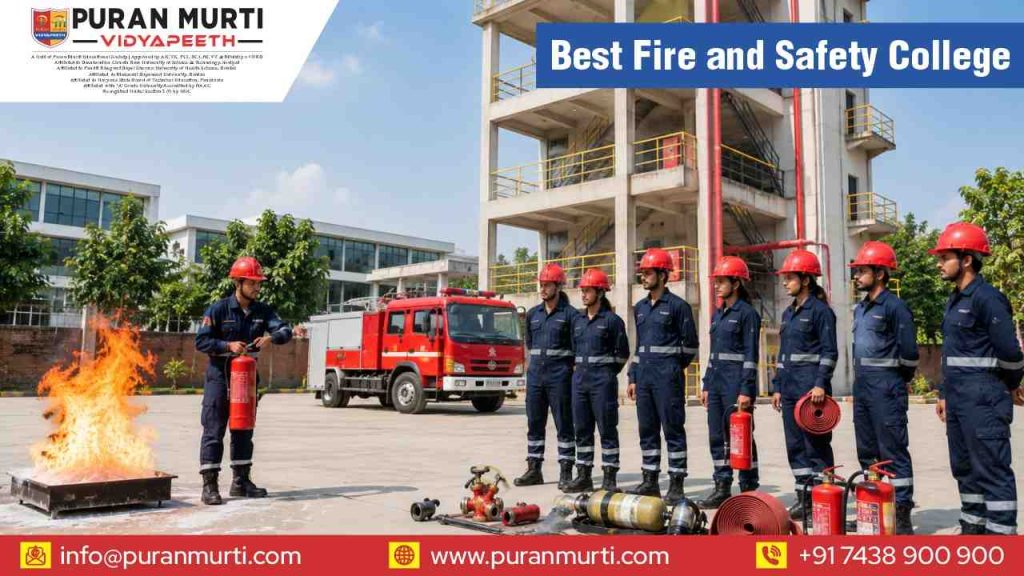
Best Fire and Safety College
Posted on : 1 August, 2026 10:34 am
Choosing the Best Fire and Safety College is one of the most important decisions for students who want to build a successful career in industrial safety, occupational health, disaster management, and fire protection engineering. Today, industries across the world are giving greater importance to workplace safety, risk management, and emergency preparedness. As a result, the demand for qualified fire and safety professionals is increasing rapidly in sectors such as oil and gas, construction, manufacturing, aviation, power plants, healthcare, and infrastructure.
If you are searching for the Best Fire and Safety College, selecting the right institution can make a significant difference in your career. Moreover, a quality college provides experienced faculty, modern laboratories, practical fire safety training, industry exposure, internships, and placement assistance. Furthermore, this complete guide on the Best Fire and Safety College covers eligibility, admission process, course curriculum, top colleges, practical training, career opportunities, salary, higher education options, and future scope.
“Safety is not just a profession—it is a responsibility that protects lives, workplaces, and communities.”
What is Fire and Safety Engineering?
Fire and Safety Engineering is a professional discipline that focuses on fire prevention, industrial safety, occupational health, disaster management, environmental safety, and emergency response systems. Moreover, students learn how to identify workplace hazards, manage emergencies, prevent accidents, and implement safety standards across different industries.
The course combines classroom learning with practical training, industrial visits, safety drills, and internships. Additionally, students develop technical knowledge, leadership abilities, risk assessment skills, and emergency management techniques. As a result, graduates are prepared for rewarding careers in government departments, private industries, and multinational companies.
Why Choose Fire and Safety Engineering?
Students choose Fire and Safety Engineering because it offers strong career prospects and opportunities across multiple industries.
Key Benefits
- High industry demand
- Excellent career opportunities
- Practical and skill-based education
- International job opportunities
- Government and private sector careers
- Attractive salary packages
- Opportunities in multinational companies
- Continuous professional growth
B.Pharm Course Details: Subjects, Scope and Career Opportunities
Course Overview
| Particular | Details |
|---|---|
| Course Name | Fire and Safety Engineering |
| Course Level | Diploma / Undergraduate |
| Duration | 2–4 Years |
| Eligibility | 10+2 / 10th (Course Dependent) |
| Admission Process | Merit / Entrance |
| Internship | Available |
| Placement Assistance | Available |
Best Fire and Safety Colleges in India
| Rank | College | Location |
|---|---|---|
| 1 | National Fire Service College | Nagpur |
| 2 | UPES | Dehradun |
| 3 | Gujarat Forensic Sciences University | Gandhinagar |
| 4 | Puran Murti Vidyapeeth, Delhi NCR | Sonipat |
| 5 | Delhi Institute of Fire Engineering | New Delhi |
| 6 | Institute of Fire Engineering | Nagpur |
| 7 | SGT University | Gurugram |
| 8 | Parul University | Vadodara |
| 9 | Jain University | Bengaluru |
| 10 | Lovely Professional University | Punjab |
Note: Students should verify the latest course availability, approvals, eligibility criteria, affiliations, and admission process directly from the respective institution before applying.
Why Choose Puran Murti Vidyapeeth?
Among the institutions listed as the Best Fire and Safety College, Puran Murti Vidyapeeth, Delhi NCR, offers industry-oriented education with modern laboratories, practical training, and experienced faculty. Moreover, the institution focuses on developing technical expertise and professional skills required by today’s safety industry.
Students benefit from:
- Experienced faculty
- Advanced fire safety laboratories
- Practical-oriented education
- Industrial visits
- Internship opportunities
- Modern infrastructure
- Hostel facilities
- Digital library
- Placement assistance
- Personality development programs
Eligibility Criteria
Students seeking admission generally need to meet the following requirements.
| Requirement | Details |
|---|---|
| Educational Qualification | 10th / 10+2 (Course Dependent) |
| Recognized Board | Mandatory |
| Minimum Marks | As per Institution Norms |
| Age Limit | As per College Guidelines |
Admission Process
| Step | Admission Process |
|---|---|
| Step 1 | Check Eligibility |
| Step 2 | Fill Application Form |
| Step 3 | Submit Required Documents |
| Step 4 | Merit / Entrance Process |
| Step 5 | Document Verification |
| Step 6 | Fee Payment |
| Step 7 | Admission Confirmation |
Subjects Covered
The curriculum combines classroom learning with practical industrial training.
| Core Subjects |
|---|
| Fire Prevention and Protection |
| Industrial Safety |
| Occupational Health and Safety |
| Disaster Management |
| Fire Fighting Equipment |
| Safety Engineering |
| Environmental Safety |
| Risk Assessment |
| Safety Legislation |
| Emergency Planning |
| Industrial Hygiene |
| Safety Audit |
“A skilled safety professional prevents accidents before they happen through knowledge, planning, and quick response.”
Practical Training
Practical training is one of the most important parts of Fire and Safety Engineering. Moreover, students gain hands-on experience through fire drills, industrial visits, safety audits, and emergency response exercises. Additionally, practical exposure helps students understand workplace hazards and safety procedures. As a result, graduates become confident professionals who are ready to handle real-world safety challenges.
| Practical Training | Learning Outcome |
|---|---|
| Fire Fighting Drills | Emergency Response Skills |
| Safety Audits | Risk Assessment |
| Industrial Visits | Industry Exposure |
| Rescue Operations | Crisis Management |
| First Aid Training | Emergency Healthcare |
| Mock Disaster Drills | Disaster Preparedness |
| PPE Demonstration | Workplace Safety |
| Fire Equipment Handling | Technical Skills |
Laboratory & Campus Facilities
Modern infrastructure plays a vital role in developing practical knowledge. Furthermore, advanced laboratories and smart learning facilities help students gain industry-relevant skills. Therefore, students receive both theoretical knowledge and practical exposure throughout the course.
| Facility | Available |
|---|---|
| Fire Safety Laboratory | Yes |
| Safety Equipment Lab | Yes |
| Smart Classrooms | Yes |
| Digital Library | Yes |
| Computer Lab | Yes |
| Hostel Facilities | Yes |
| Wi-Fi Campus | Yes |
| Sports Facilities | Yes |
| Seminar Hall | Yes |
| Transportation | Yes |
Internship Opportunities
Internships provide valuable industry experience before graduation. Moreover, students work with experienced professionals and learn industrial safety practices. Consequently, internships improve technical knowledge and increase employability.
| Internship Area | Experience |
|---|---|
| Manufacturing Industries | Industrial Safety |
| Construction Companies | Site Safety |
| Oil & Gas Industry | Hazard Management |
| Power Plants | Plant Safety |
| Aviation Industry | Airport Safety |
| Fire Departments | Fire Prevention |
| Hospitals | Emergency Safety |
| Corporate Organizations | Workplace Safety |
Skills Developed
Students develop technical, managerial, and communication skills during the program. Additionally, these skills help graduates perform efficiently in different industries. As a result, they become capable of handling safety operations and emergency situations.
| Skill | Importance |
|---|---|
| Fire Prevention | High |
| Risk Assessment | High |
| Emergency Management | High |
| Safety Auditing | High |
| Leadership | High |
| Communication Skills | High |
| Decision Making | High |
| Industrial Safety | High |
| Teamwork | High |
| Problem Solving | High |
Career Opportunities
Graduates of the Best Fire and Safety College have excellent career opportunities in both government and private sectors. Moreover, industries continuously recruit qualified safety professionals to maintain workplace safety and regulatory compliance. Therefore, Fire and Safety Engineering offers stable and rewarding career prospects.
| Job Role | Industry |
|---|---|
| Fire Safety Officer | Manufacturing |
| Safety Engineer | Construction |
| HSE Officer | Oil & Gas |
| Safety Supervisor | Industrial Plants |
| Fire Protection Engineer | Infrastructure |
| Risk Assessment Officer | Corporate Sector |
| Industrial Safety Officer | Factories |
| Disaster Management Officer | Government Organizations |
| Safety Consultant | Private Companies |
| HSE Manager | Multinational Companies |
Top Recruiters
Graduates may receive opportunities with:
- Reliance Industries
- ONGC
- Indian Oil Corporation (IOCL)
- Bharat Petroleum (BPCL)
- Hindustan Petroleum (HPCL)
- Larsen & Toubro (L&T)
- Tata Projects
- Adani Group
- GAIL India
- Delhi Metro Rail Corporation (DMRC)
- Airports Authority of India (AAI)
- Fire & Emergency Services Departments
https://blog.puranmurti.com/pharmacy-admission-2027-eligibility-fees-and-admission-process/
Salary After Fire and Safety Engineering
Salary depends on qualifications, certifications, employer, experience, and industry. However, professionals working in oil & gas, petrochemicals, aviation, and multinational companies generally receive higher salary packages. Therefore, continuous skill development and certifications can significantly improve career growth.
| Job Role | Average Starting Salary | Experienced Salary |
|---|---|---|
| Fire Safety Officer | ₹3–5 LPA | ₹6–10 LPA |
| Safety Engineer | ₹4–6 LPA | ₹8–15 LPA |
| HSE Officer | ₹4–7 LPA | ₹10–18 LPA |
| Industrial Safety Officer | ₹3.5–6 LPA | ₹8–14 LPA |
| HSE Manager | ₹6–8 LPA | ₹15–25 LPA |
Salary packages vary depending on skills, certifications, employer, experience, industry, and location.
Higher Education Options
Students can continue their education after graduation. Moreover, advanced qualifications improve career opportunities in management, research, and specialized safety domains.
| Course | Career Benefit |
|---|---|
| M.Tech in Safety Engineering | Advanced Technical Expertise |
| MBA in Safety Management | Management Career |
| PG Diploma in Industrial Safety | Industry Specialization |
| NEBOSH Certification | International Career Opportunities |
| IOSH Certification | Professional Safety Qualification |
| Ph.D. in Safety Engineering | Research & Academic Career |
Frequently Asked Questions (FAQs)
1. Which is the Best Fire and Safety College in India?
Several institutions offer quality Fire and Safety Engineering programs. However, students should compare faculty, practical training, laboratory facilities, industry exposure, internships, and placement records before selecting a college.
2. What is the eligibility for Fire and Safety Engineering?
Generally, students must have completed 10+2 or 10th, depending on the diploma or degree program. Moreover, eligibility criteria may vary from one institution to another.
3. Does the Fire and Safety course include practical training?
Yes. The course includes fire drills, industrial visits, safety audits, emergency response training, rescue operations, workshops, and internships. Additionally, students gain hands-on experience with modern fire safety equipment.
4. What is the average salary after Fire and Safety Engineering?
Fresh graduates generally earn ₹3 LPA to ₹6 LPA. However, professionals with experience and international certifications such as NEBOSH or IOSH can earn ₹8 LPA to ₹20 LPA or more, depending on the industry, employer, and location.
5. What are the career opportunities after Fire and Safety Engineering?
Graduates can work as Fire Safety Officers, Safety Engineers, HSE Officers, Industrial Safety Officers, Fire Protection Engineers, Risk Assessment Officers, Safety Consultants, Disaster Management Officers, and HSE Managers. Furthermore, they can find opportunities in oil & gas, construction, manufacturing, aviation, power plants, healthcare, and government organizations.