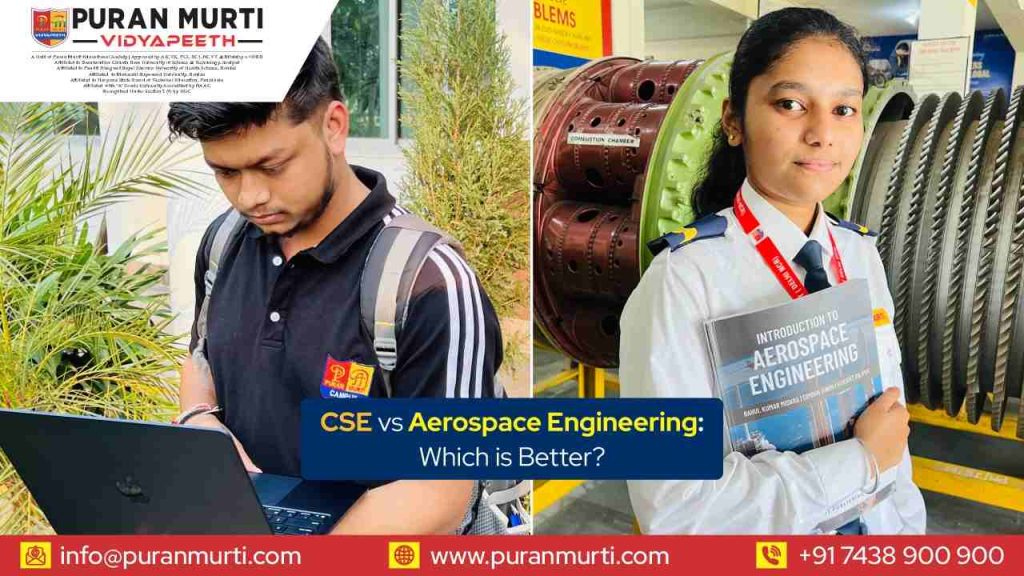
CSE vs Aerospace Engineering: Which Is Better?
Posted on : 19 September, 2026 4:02 pm
Choosing between Computer Science Engineering and Aerospace Engineering can be difficult. Both branches offer exciting careers, but they are very different. CSE focuses on software, computers, data and digital technology. Aerospace Engineering focuses on aircraft, spacecraft, rockets and flight systems.
So, which is better? The answer depends on your interests, skills and career goals. This guide compares CSE vs Aerospace Engineering by subjects, jobs, salary, scope and future opportunities.
What Is CSE?
Computer Science Engineering is a technical branch that focuses on computer systems and software. Students learn how to design, develop and maintain digital products. They also learn how computers process information and solve problems.
Main CSE subjects
- Programming.
- Data structures.
- Algorithms.
- Database management.
- Computer networks.
- Operating systems.
- Software engineering.
- Artificial intelligence.
- Machine learning.
- Cybersecurity.
- Cloud computing.
- Web development.
CSE students practise coding and problem-solving. They also build applications, websites and software projects.
What Is Aerospace Engineering?
Aerospace Engineering focuses on aircraft, spacecraft and related systems. It combines physics, mathematics, materials and mechanical design. Students learn how vehicles fly. They also study how engineers design, test and improve flight systems.
Main Aerospace Engineering subjects
- Aerodynamics.
- Aircraft structures.
- Flight mechanics.
- Propulsion.
- Thermodynamics.
- Fluid mechanics.
- Avionics.
- Aerospace materials.
- Control systems.
- Aircraft design.
- Spacecraft systems.
- Computer-aided design.
Aerospace students often work with design tools and simulation software. They may also study aircraft testing and safety.
CSE vs Aerospace Engineering: Quick Comparison
| Factor | CSE | Aerospace Engineering |
|---|---|---|
| Main focus | Software and computing | Aircraft and spacecraft |
| Course duration | Usually four years | Usually four years |
| Key subjects | Coding, algorithms and databases | Aerodynamics, propulsion and structures |
| Work style | Software and digital projects | Design, testing and physical systems |
| Common industries | IT, finance, e-commerce and technology | Aviation, defence, space and manufacturing |
| Career flexibility | Very broad | More specialised |
| Important skills | Programming and problem-solving | Physics, design and engineering analysis |
| Work locations | Offices, technology hubs and remote roles | Labs, factories, airports and research centres |
Admission and Eligibility
Both courses are usually available as B.Tech or B.E. programmes.
Students generally need:
- Physics in Class 12.
- Mathematics in Class 12.
- A required third subject.
- The minimum marks set by the college.
- A valid entrance score, where required.
JEE Main is accepted by many engineering institutions. Some colleges also use state entrance exams or their own tests.For exact requirements, check the current admission notice. Eligibility rules can differ between colleges.
CSE Career Options
CSE offers many career paths. Graduates can work in almost every modern industry.
Common CSE jobs
- Software developer.
- Web developer.
- Mobile app developer.
- Data analyst.
- Data scientist.
- Machine learning engineer.
- Cloud engineer.
- DevOps engineer.
- Cybersecurity analyst.
- Database administrator.
- UI developer.
- Technical consultant.
CSE graduates can work in IT services, product companies, banks, hospitals, education and government technology projects. The field also supports freelancing and remote work. This gives CSE graduates more flexibility in some career paths.
Aerospace Engineering Career Options
Aerospace Engineering offers specialised careers in aviation, space and defence.
Common aerospace jobs
- Aerospace design engineer.
- Aerodynamics engineer.
- Propulsion engineer.
- Flight systems engineer.
- Aircraft maintenance engineer.
- Avionics engineer.
- Quality engineer.
- Manufacturing engineer.
- Flight testing engineer.
- Research engineer.
Graduates can work in aircraft companies, defence organisations, space agencies, research laboratories and aerospace manufacturers.
Aerospace engineers may work with aircraft, helicopters, satellites, drones or rockets. The field also connects with robotics and unmanned vehicles.
Career Scope of CSE
CSE has a broad career scope. Technology is used in nearly every sector.
CSE professionals can work in:
- Information technology.
- Banking.
- Insurance.
- Healthcare.
- E-commerce.
- Education.
- Telecommunications.
- Gaming.
- Government services.
- Artificial intelligence.
- Cybersecurity.
- Cloud computing.
The demand for software skills remains strong. Artificial intelligence, cloud platforms and cybersecurity are important areas for future growth.Students can also change specialisations after gaining experience. For example, a software developer may move into cloud engineering or data science.
Career Scope of Aerospace Engineering
Aerospace Engineering has a focused career scope. It is connected to aviation, defence, space research and manufacturing.
Graduates can work in:
- Aircraft design.
- Aircraft manufacturing.
- Defence technology.
- Space research.
- Satellite systems.
- Propulsion.
- Avionics.
- Drones.
- Aircraft maintenance.
- Aerospace research.
Aerospace roles are available in both public and private sectors. However, the number of employers is smaller than in the technology sector.
Students who want advanced research may pursue an M.Tech or master’s degree. Research experience can help with specialist roles.
Salary Comparison
Salary depends on college, skills, location, employer and experience. The figures below are broad estimates.
| Experience | CSE salary range | Aerospace salary range |
|---|---|---|
| Fresher | ₹3 lakh–₹8 lakh per year | ₹4 lakh–₹7 lakh per year |
| 2–5 years | ₹6 lakh–₹15 lakh per year | ₹7 lakh–₹15 lakh per year |
| 5–10 years | ₹12 lakh–₹30 lakh per year | ₹12 lakh–₹25 lakh per year |
| Senior roles | ₹25 lakh or more | ₹20 lakh–₹50 lakh or more |
These are not guaranteed salaries. CSE can offer more entry-level jobs because the IT industry is larger. Aerospace roles can pay well when you develop specialised skills or join research and defence organisations.
Published course guides estimate aerospace starting salaries at about ₹4 lakh to ₹12 lakh. The amount depends on college, specialisation and employer.[lpu]
Skills Required for CSE
CSE students should develop practical technology skills.
Important skills include:
- Programming.
- Data structures.
- Algorithms.
- Database management.
- Web development.
- Git and GitHub.
- Cloud computing.
- Cybersecurity.
- Communication.
- Teamwork.
You should build projects during college. A project portfolio can help you demonstrate your abilities to employers.
Examples include:
- A task management application.
- A personal finance website.
- A mobile app.
- A chatbot.
- A data dashboard.
- A cybersecurity tool.
How to Choose the Best Aerospace Engineering College?
- Course curriculum – Check what subjects and specialisations are offered.
- Approvals and affiliation – Verify the current status of the specific programme.
- Laboratories – Practical learning is important in aerospace engineering.
- Faculty – Experienced faculty can improve academic and technical learning.
- Industry exposure – Look for internships, projects and practical training.
- Placement support – Check placement information and participating recruiters.
- Location – Delhi-NCR can be convenient for students from North India.
- Total cost – Compare tuition, hostel and other expenses.
- Higher education opportunities – Consider whether you may want M.Tech, MS or research later. Apply Now
Skills Required for Aerospace Engineering
Aerospace students need strong engineering and analytical skills.
Important skills include:
- Aerodynamics.
- Aircraft structures.
- Propulsion.
- Fluid mechanics.
- CAD software.
- MATLAB.
- ANSYS.
- CATIA.
- Simulation.
- Technical writing.
- Quality testing.
- Project management.
Internships are useful. They help you understand aircraft design, manufacturing and maintenance.
Practical projects can also strengthen your resume. You may work on drones, model aircraft, propulsion systems or computer-aided design.
Work Environment
CSE professionals usually work in offices, technology campuses or remote settings. They spend much of their time using computers.
Some CSE roles include meetings, coding, testing and project planning. Work hours can vary during product launches or urgent releases.
Aerospace engineers may work in laboratories, factories, hangars, testing centres and design offices. Their work may involve physical inspections and safety procedures.
Some aerospace roles require protective equipment. Others may involve travel to manufacturing plants or testing locations.
Which Branch Is More Flexible?
CSE is usually more flexible. A CSE graduate can work in many industries and job roles.
Aerospace Engineering is more specialised. It focuses on a smaller group of industries. However, its skills can also support careers in mechanical design, manufacturing, robotics and defence.
Choose CSE if you want more options to change industries. Choose Aerospace Engineering if you want focused work with aircraft or space systems.
Which Branch Is More Difficult?
Both branches can be challenging. They require mathematics, science and problem-solving.
CSE can be difficult because of programming, algorithms and abstract thinking. Students must practise regularly.
Aerospace Engineering can be difficult because of physics, mechanics, fluid dynamics and complex design. It also requires attention to safety and precision.
The easier branch is the one that matches your interests. Motivation can make difficult subjects easier to learn.
Higher Studies
Both degrees offer higher-study opportunities.
After CSE
You can pursue:
- M.Tech in Computer Science.
- M.Sc. Computer Science.
- Master’s in Data Science.
- Master’s in Artificial Intelligence.
- Master’s in Cybersecurity.
- MBA in Technology Management.
- PhD in Computer Science.
After Aerospace Engineering
You can pursue:
- M.Tech in Aerospace Engineering.
- M.Tech in Aeronautical Engineering.
- Master’s in Space Technology.
- Master’s in Avionics.
- Master’s in Propulsion.
- MBA in Aviation Management.
- PhD in Aerospace Engineering.
Higher education is useful for research, teaching and specialist positions.
CSE vs Aerospace Engineering: Pros and Cons
Advantages of CSE
- Wide range of jobs.
- Opportunities in many industries.
- Possibility of remote work.
- Many specialisations.
- Strong freelance opportunities.
- Easy access to online learning.
Disadvantages of CSE
- Strong competition.
- Regular skill updates are necessary.
- Long periods of screen time.
- Some jobs involve demanding deadlines.
Advantages of Aerospace Engineering
- Specialised and respected field.
- Work with aircraft and spacecraft.
- Opportunities in defence and space research.
- Strong connection with advanced technology.
- Suitable for students who enjoy physics and design.
Which Is Better for You?
Choose CSE if:
- You enjoy coding.
- You like software and computers.
- You want flexible career options.
- You are interested in artificial intelligence.
- You want opportunities in many industries.
- You prefer office or remote work.
Choose Aerospace Engineering if:
- You love aircraft or spacecraft.
- You enjoy Physics and Mathematics.
- You like machines and design.
- You want to work in aviation or defence.
- You are interested in research.
- You enjoy physical engineering systems.
CSE vs Aerospace Engineering: Which Is Better?
CSE may be better for students who want broad career options, more jobs and flexible work opportunities. It offers paths in software, data, cloud computing, artificial intelligence and cybersecurity.
Aerospace Engineering may be better for students who have a strong interest in aircraft, spacecraft, defence and advanced mechanical systems. It offers specialised work in aviation and space technology.
Neither branch is universally better. The right choice depends on your interests and career plans.
How to Make the Final Decision
Follow these steps before selecting a branch:
- Read the complete syllabus of both courses.
- Watch introductory lessons in programming and aerodynamics.
- Talk to current students.
- Compare college facilities.
- Check placement reports.
- Review total fees.
- Consider higher-study plans.
- Think about your preferred work environment.
Do not choose a branch only because of salary. Interest and consistent effort affect your long-term success.
Final Thoughts
The choice between CSE vs Aerospace Engineering depends on the type of work you want to do.
CSE offers broad opportunities in software, data, cloud computing and cybersecurity. Aerospace Engineering offers specialised opportunities in aircraft, spacecraft, defence and research. Choose CSE if you want flexibility and a wide job market. Choose Aerospace Engineering if you have a genuine interest in flight systems and space technology. Research carefully before admission. A suitable branch, good college and strong practical skills can help you build a successful engineering career.
FAQs
Which is better, CSE or Aerospace Engineering?
CSE is better for students who want flexible technology careers. Aerospace Engineering is better for students who want to work with aircraft, spacecraft and defence systems.
Which branch has more job opportunities?
CSE usually has more job opportunities because technology is used across many industries. Aerospace Engineering has fewer but more specialised roles.
Is Aerospace Engineering harder than CSE?
Both branches are challenging. Aerospace Engineering includes advanced physics and mechanics. CSE includes programming, algorithms and logical problem-solving.
Can aerospace engineers work in software?
Yes. Aerospace engineers can enter software, data analysis, simulation and automation after developing programming skills.
Can CSE graduates work in aerospace companies?
Yes. CSE graduates can work on aerospace software, avionics, simulation, cybersecurity, data systems and artificial intelligence.
Which branch has a higher salary?
Salary depends on skills, role, college and experience. CSE may provide more entry-level opportunities. Aerospace specialists can earn well after gaining experience.
Is CSE a good choice in 2026?
CSE remains a strong option for students interested in software, AI, cloud computing, data science and cybersecurity. Continuous learning is important.
Is Aerospace Engineering a good career?
Yes. It can be a good career for students interested in aircraft, space, defence and research. Students should be ready for specialised study and competition.
Can I pursue higher studies after both courses?
Yes. CSE graduates can pursue computer science and technology specialisations. Aerospace graduates can pursue aerospace, avionics, propulsion and space technology.
Should I choose a branch based only on salary?
No. Consider your interest, skills, college quality, career goals and preferred work environment before choosing a branch.