Diploma Courses After 10th: Courses, Fees & Careers
Posted on : 27 November, 2026 1:32 am
After completing Class 10, one important decision students must make is the selection of a path. While some students prefer to proceed with Class 11 and 12, others wish to gain practical, hands-on experience in career-oriented skills with diploma courses.
Diploma courses after 10th give you an opportunity to start your technical and professional learning early. These courses offer a combination of theoretical and practical knowledge and give students skills that can be useful in jobs, further studies and in professional growth.
For students thinking of an academic degree in engineering, computers, construction, automobiles, electrical systems and other technical fields, a diploma is a viable alternative.
At Puran Murti Vidyapeeth, Sonipat (Haryana), we believe in understanding before course selection. We prepare to inform the students and their parents about the possibilities and so on, which comprises the significance of selecting an apt program as per interest, joining future prospects, available diploma paths, etc.
What Are Diploma Courses After 10th?
Diploma Courses after 10th: These are the courses that students can opt to study after completing their secondary education (Class 10). They provide specialist education in some technical, vocational, and professional subjects, often for part of the time spent in teaching theoretical subjects and practical skills training.
A diploma is more focused, covering one area of study, like mechanical engineering, civil engineering, electrical engineering, or computer technology, rather than a broad range of topics as a traditional academic programme would.
In India, most engineering diploma courses last for 3 years after the 10th class, but other diploma courses have different durations.
Key features of diploma programmes include:
-
Early exposure to a specialised subject.
-
Practical and technical skill development.
-
Laboratory and workshop-based learning.
-
Industry-relevant subject knowledge.
-
Opportunities for employment after completion.
-
Options for pursuing higher education.
Polytechnic Diploma Programmes
The following programmes are listed under our polytechnic offerings:
| No. | Diploma Course | Main Area of Study |
|---|---|---|
| 1 | Aeronautical Engineering | Aircraft and aviation technology |
| 2 | Aircraft Maintenance Engineering | Aircraft systems and maintenance |
| 3 | Automobile Engineering | Vehicles and automobile systems |
| 4 | Civil Engineering | Construction and infrastructure |
| 5 | Computer Science and Engineering | Programming and computer technology |
| 6 | CSE (AI & ML) | Artificial intelligence and machine learning |
| 7 | Electrical Engineering | Electrical systems and power |
| 8 | Electronics and Communication Engineering | Electronic and communication systems |
| 9 | Fire Technology and Safety | Fire prevention and safety |
| 10 | Hotel Management and Catering Technology | Hospitality and catering |
| 11 | Mechanical Engineering | Machines and manufacturing |
| 12 | Medical Lab Technician | Laboratory technology |
| 13 | Technician X-Ray Technology | Diagnostic imaging technology |
Eligibility Criteria for Diploma Courses After 10th
| Eligibility Factor | General Requirement |
|---|---|
| Educational qualification | Class 10 passed from a recognised board |
| Subjects | Mathematics and Science are important for engineering pathways |
| Duration | Generally 3 years for engineering diplomas |
| Admission process | Merit-based or as prescribed by the relevant admission authority |
| Documents | Class 10 marksheet, certificates, photographs and identity documents |
How to Choose the Right Diploma Course After 10th?
Here is a simple process to make a more informed decision.
-
Identify your interests: Decide whether you enjoy computers, machines, construction, automobiles, aviation, healthcare or another subject.
-
Understand the syllabus: Review the subjects, practical sessions and specialisations included in the programme.
-
Check eligibility: Verify Class 10 subject requirements, minimum marks and admission conditions.
-
Explore career opportunities: Research the industries and job roles related to the diploma.
-
Compare institutions: Review approvals, affiliations, faculty qualifications, laboratories and practical facilities.
-
Understand the fees: Ask for a detailed fee structure, including tuition, examination and other applicable charges.
-
Consider higher education: Assess whether the diploma provides suitable pathways for further studies.
Diploma Course Selection Based on Student Interests
| Student Interest | Suitable Diploma Course |
|---|---|
| Computers and programming | Computer Science Engineering |
| Machines and engines | Mechanical Engineering |
| Buildings and construction | Civil Engineering |
| Electricity and power systems | Electrical Engineering |
| Vehicles and automobiles | Automobile Engineering |
| Aircraft and aviation | Aeronautical Engineering |
| Electronic devices | Electronics and Communication Engineering |
| Fire prevention and safety | Fire Technology and Safety |
| Hotels and hospitality | Hotel Management |
| Healthcare laboratories | Medical Lab Technology |
Top Benefits of Pursuing a Diploma After 10th
Here are some important benefits.
1. Technical education at a young age
Students can pick a subject after Class 10 instead of waiting until Class 12.
2. Gain practical experience.
Many diploma programmes include workshops, labs, practical tests, and technical work.
3. Career Education
Students learn industry skills and the needs and responsibilities to survive in the workplace.
4. Opportunities in Higher Education
Holders of engineering diplomas can be admitted to B.Tech through lateral entry on terms and conditions as decided by their respective state/university authority.
5. Lots of Career Options
After receiving their diploma, students can go to college, go to vocational training, work, or get a professional certification.
6. Enhanced Knowledge in a Particular Field
A diploma can help students learn more about something. This way, they can easily choose the field they want to be in for the long term.
Career Options by Engineering Specialisation
| Diploma Specialisation | Potential Employment Sectors |
|---|---|
| Mechanical Engineering | Manufacturing, production and maintenance |
| Civil Engineering | Construction, infrastructure and surveying |
| Computer Science | IT services, software support and networking |
| Electrical Engineering | Power distribution, manufacturing and maintenance |
| Automobile Engineering | Automobile manufacturing and vehicle servicing |
| Electronics Engineering | Electronics manufacturing and communication |
| Aeronautical Engineering | Aircraft manufacturing and aviation-related technical services |
| Fire Technology and Safety | Industrial safety and fire protection |
Can you do a B.Tech after a diploma?
Yes. Students who complete an eligible engineering diploma can pursue B.Tech through lateral entry, subject to the admission requirements of the relevant university and applicable regulations.
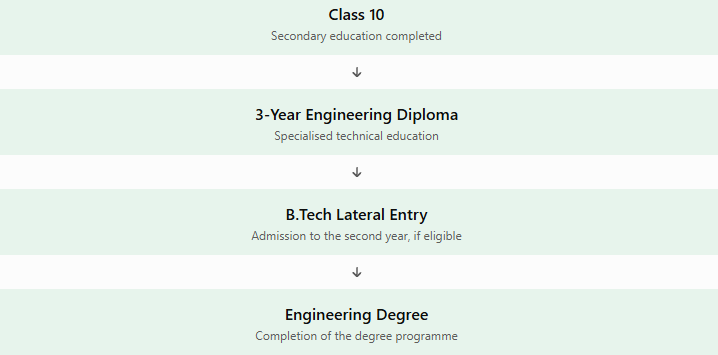
Often, eligible diploma holders can enter directly into the second year of a B.Tech programme. This provides an opportunity to continue higher education without repeating the first year.
Diploma to B.Tech: Understanding the Pathway
Class 10
Secondary education completed
3-Year Engineering Diploma
Specialised technical education
B.Tech Lateral Entry
Admission to the second year, if eligible
Engineering Degree
Completion of the degree programme
For example, a student completing a Diploma in Mechanical Engineering may explore B.Tech Mechanical Engineering through an eligible lateral-entry route.
Diploma vs Class 11 and 12: Which Is Better After 10th?
Both pathways have value. The right option depends on a student’s interests and future plans.
| Comparison | Diploma After 10th | Class 11 and 12 |
|---|---|---|
| Main focus | Specialised technical or professional education | General academic education |
| Learning approach | Subject-focused and practical | Academic and theoretical foundation |
| Duration | Generally 3 years for engineering | 2 years |
| Career preparation | Technical and vocational skills | Broad academic preparation |
| Higher education | Relevant degree programmes, including eligible lateral entry | Undergraduate degree programmes |
| Suitable for | Students interested in a particular professional field | Students who want broader academic choices |
Diploma Admission Process at Puran Murti Vidyapeeth
At Puran Murti Vidyapeeth, we aim to make the admission process understandable for students and parents.
Students interested in our polytechnic diploma programmes can contact our admission team to understand the available courses, eligibility requirements, fee structure and admission procedure.
Steps to Apply for Admission
- Explore available courses: Review the diploma programmes offered by our institution.
- Check eligibility: Confirm whether you meet the educational requirements for your preferred course.
- Contact our admission team: Request information about programme duration, fees and admission requirements.
- Complete the application: Submit the application through the available admission process.
- Please submit the required academic certificates, identity documents, and photographs.
- Complete admission formalities: Follow the instructions provided by our admission office.
Conclusion: Start Your Career Journey with the Right Diploma Course
Selecting the right course after Class 10 can make correct future shape of you. Diploma courses give students special knowledge, professional fields, and first-hand experience earlier.
Mechanical engineering, civil engineering, computer science, aviation, cars or electrical technology. A programme that’s right for building a meaningful career for you.
Courses of Polytechnic for the aspirants for various courses in technical professional education at Sonipat Puran Murti Vidyapeeth.
Frequently Asked Questions About Diploma Courses After 10th
1. What is the best diploma course after 10th?
The best diploma course after 10th is going to depend on your interests and career aspirations. In technical education, a few common diploma courses after 10th are Mechanical, Civil, Computer Science, Electrical, and Automobile and Aeronautical Engineering.
2. Can we do diploma after Class 10?
Yes, students who have passed Class 10 from a recognised board can apply for diploma courses. The duration of engineering diploma courses is usually 3 years depending on the admissions criteria of the institute and concerned authorities.
3. How long is the diploma course after 10th?
Most engineering diplomas after 10th are of 3 years or 6 semesters long. Some professional and special diplomas have different course durations and rules according to their course content.