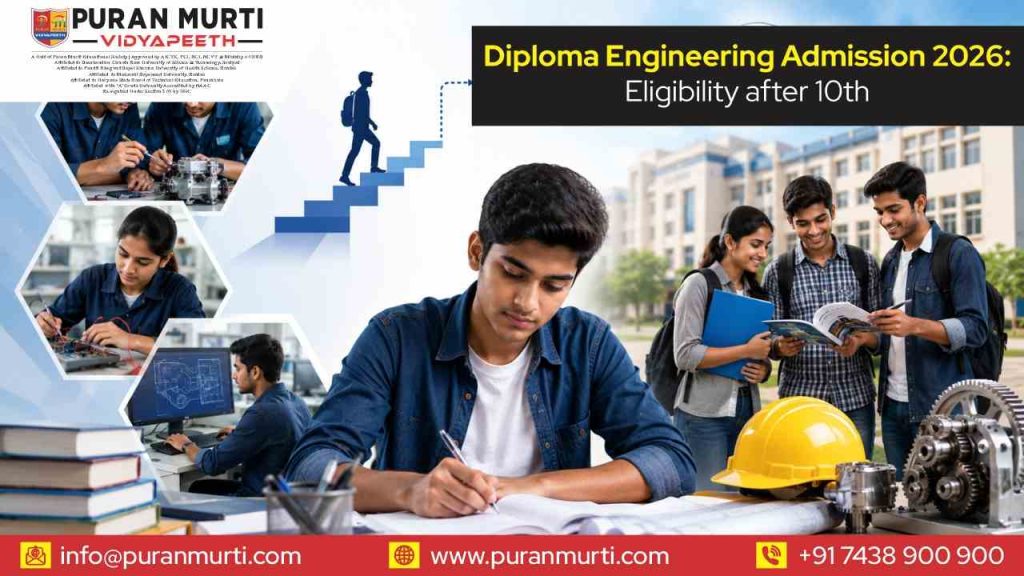
Diploma Engineering Admission 2026: Eligibility After 10th
Posted on : 9 September, 2026 2:31 am
Choosing a career immediately after Class 10 can feel like a major decision. Students often hear about B.Tech, JEE Main and engineering colleges, but there is another practical route that deserves serious attention: Diploma Engineering after 10th.
A Polytechnic or Diploma Engineering programme allows students to begin technical education soon after Class 10. Instead of spending two more years in school before entering a degree programme, students can start learning engineering fundamentals, laboratory skills and industry-oriented concepts through a three-year diploma.
For students in Sonipat, Haryana and Delhi NCR, Diploma Engineering can be an attractive option because of its combination of technical education, practical training and future pathways to employment or higher studies.
In Haryana, HSTES currently lists Diploma Engineering as a three-year programme for candidates who have passed the 10th/SSC examination. For the 2026–27 session, HSTES states that Diploma Engineering admissions are made on the basis of merit in the qualifying examination.
So, if you have recently completed Class 10 and are considering a technical career, this guide explains Diploma Engineering Admission 2026 eligibility, courses, admission process, career opportunities, higher-study options and how to choose the right college.
Can I Do Diploma Engineering After 10th?
Yes. Students who have passed Class 10 or an equivalent SSC examination can apply for a three-year Diploma Engineering programme in Haryana, subject to the applicable admission rules of the state and institute. For the 2026–27 session, HSTES lists 10th/SSC as the eligibility qualification for Diploma Engineering.
| Factor | Diploma Engineering 2026 |
|---|---|
| Minimum qualification | Class 10/SSC or equivalent |
| Course duration | 3 years |
| Admission route in Haryana | Merit-based for Diploma Engineering |
| Admission authority | HSTES for applicable Haryana counselling |
| Course type | Technical/engineering diploma |
| Suitable for | Students interested in practical engineering education |
| Higher-study option | B.Tech through eligible lateral-entry routes |
| Major areas | CSE, Civil, Mechanical, Electrical, ECE and other branches |
What Is Diploma Engineering After 10th?
Diploma Engineering is a technical education programme that students can pursue after completing Class 10. It combines engineering theory with practical learning through laboratories, workshops, projects and industry-oriented training.
Unlike a four-year B.Tech programme, a standard Diploma Engineering programme generally takes three years after Class 10.
Students can choose a branch according to their interests and career goals. Popular options include:
- Diploma in Computer Science Engineering
- Diploma in Civil Engineering
- Diploma in Mechanical Engineering
- Diploma in Electrical Engineering
- Diploma in Electronics and Communication Engineering
- Diploma in Automobile Engineering
- Diploma in Aeronautical Engineering
- Other specialised technical programmes offered by individual institutions
The exact availability of branches, intake and admission rules can change by institution and academic session. Therefore, students should always verify the current course list and approval status before taking admission.
Diploma Engineering Eligibility After 10th in 2026
For Haryana, the official HSTES eligibility page states that candidates seeking admission to the standard three-year Diploma Engineering programme must have passed the 10th Standard/SSC examination.
A student should generally:
- Have passed Class 10/SSC or an equivalent qualifying examination.
- Meet the specific requirements of the selected diploma branch and institution.
- Complete the required application and document-verification process.
- Satisfy applicable state counselling or institute-level admission requirements.
It is important not to confuse Diploma Engineering after 10th with Diploma Engineering Lateral Entry.
HSTES treats these as separate routes. Standard Diploma Engineering is a three-year course, while lateral entry is a two-year route for eligible candidates entering the second year.
Is 10th Percentage Important for Diploma Admission 2026?
Yes, your Class 10 marks can matter because Haryana’s 2026–27 Diploma Engineering admissions are based on the merit of the Secondary School Examination or equivalent qualifying examination.
However, students should not assume that a particular percentage guarantees admission to every college or branch.
Cut-offs can vary depending on:
- College
- Engineering branch
- Available seats
- Category
- Counselling round
- Student demand
- Admission route
- Institute-specific policies
Therefore, students with average marks should not give up. Instead, they should explore multiple branches and colleges and monitor available seats during counselling.
Diploma Engineering Admission 2026 in Haryana: How to Apply
The admission process can differ by state and institution. For Haryana, HSTES manages the applicable technical admission process.
For the 2026–27 session, HSTES published online admission information for Diploma Engineering and stated that applications are invited through the designated online admission portal.
Step-by-Step Admission Process
Step 1: Check eligibility
Confirm that you have passed Class 10/SSC and meet the applicable requirements.
Step 2: Check the admission brochure
Read the latest HSTES prospectus and institute-specific instructions before submitting your application.
Step 3: Register online
Complete the online registration using the official admission portal when the relevant application window is open.
Step 4: Upload documents
Keep the required academic and identification documents ready in the prescribed format.
Step 5: Verify details
Check your name, date of birth, marks and other details carefully before final submission.
Step 6: Merit preparation
For Haryana Diploma Engineering admissions, merit is prepared based on the qualifying examination as prescribed by HSTES.
Step 7: Choice filling and counselling
Eligible candidates participate in the applicable counselling process and select preferred colleges and branches.
Step 8: Seat allotment
If a seat is allotted, complete the reporting, document verification and fee-payment requirements within the specified deadline.
Important 2026 Update
HSTES published a 2026–27 Diploma Engineering schedule and subsequently updated its online key-date information. Because admission schedules can change, students should check the latest official HSTES notification before relying on an old deadline.
Popular Diploma Engineering Courses After 10th
The best branch depends on the student’s interests rather than simply choosing the branch with the most popular name.
1. Diploma in Computer Science Engineering
A strong option for students interested in:
- Programming
- Software development
- Web technologies
- Databases
- Computer networks
- Cybersecurity
- Artificial intelligence
Students who enjoy mathematics, logical thinking and computers may find CSE particularly suitable.
2. Diploma in Civil Engineering
Civil Engineering is suitable for students interested in:
- Construction
- Roads and highways
- Buildings
- Surveying
- Infrastructure
- Structural work
- Project supervision
The field also connects with construction companies, infrastructure firms, government projects and engineering consultancies.
3. Diploma in Mechanical Engineering
Mechanical Engineering focuses on machines, manufacturing and mechanical systems.
Students learn concepts related to:
- Manufacturing
- Machine design
- Production
- CAD/CAM
- Thermal engineering
- Automobile systems
- Maintenance
4. Diploma in Electrical Engineering
Electrical Engineering can suit students interested in:
- Electrical machines
- Power systems
- Industrial electrical systems
- Automation
- Control systems
- Renewable energy
- Electrical maintenance
5. Diploma in Electronics and Communication Engineering
ECE combines electronics, communication and technology.
Students may explore:
- Electronic circuits
- Communication systems
- Embedded systems
- Digital electronics
- Microprocessors
- Telecommunications
- Control systems
Why Choose Diploma Engineering After 10th?
Diploma Engineering is not simply a shortcut to engineering. It is a technical education pathway designed to introduce students to engineering concepts earlier.
Top Benefits of Diploma Engineering
- Start technical education after Class 10
- Complete the standard diploma in three years
- Develop practical engineering skills
- Gain laboratory and workshop experience
- Explore technical careers
- Become eligible for further education pathways
- Build industry-oriented skills
- Develop a foundation for B.Tech lateral entry, subject to applicable rules
For students who prefer learning by doing rather than spending several additional years in purely academic education, this route can be especially attractive.
Diploma Engineering vs B.Tech: Which Is Better After 10th?
This is one of the most common questions students ask.
The important point is that B.Tech and Diploma Engineering are different qualification pathways.
| Feature | Diploma Engineering | B.Tech |
|---|---|---|
| Entry after | Class 10 | Usually Class 12 |
| Typical duration | 3 years | 4 years |
| Learning style | Technical + practical | Degree-level engineering + theory |
| Early technical exposure | High | Begins after 12th |
| Admission requirements | Class 10 qualification | Class 12 with prescribed subjects |
| Career option | Technician, junior technical roles, further study | Engineer-level degree roles, further study |
| Higher education | B.Tech lateral entry where eligible | M.Tech, MBA and other programmes |
Haryana’s B.E./B.Tech eligibility requirements are different from Diploma Engineering. HSTES lists Class 12-based eligibility for the regular four-year B.E./B.Tech route.
Which should you choose?
Choose Diploma Engineering if you:
- Want to begin technical education after Class 10.
- Prefer practical learning.
- Want an engineering-oriented qualification before deciding on a degree.
- Are interested in technician or junior technical career pathways.
- Want to keep a potential B.Tech lateral-entry route open.
Choose B.Tech after Class 12 if you:
- Want to complete Class 12 first.
- Plan to pursue a conventional engineering degree.
- Want to prepare for engineering entrance examinations.
- Prefer a direct four-year undergraduate degree route.
There is no universal “better” option. The right choice depends on your academic goals, preferred learning style and long-term career plan.
Can Diploma Students Do B.Tech After Diploma?
Yes. Eligible Diploma Engineering graduates can pursue B.Tech through lateral entry, subject to the rules of the relevant university, state counselling authority and academic session. In Haryana, HSTES separately lists B.Tech lateral entry eligibility for candidates with qualifying engineering diplomas.
HSTES currently states that eligible candidates with a minimum three-year engineering and technology diploma can be considered for admission to the second year of B.E./B.Tech, subject to the applicable marks and admission conditions.
This creates a potential pathway:
Class 10 → Diploma Engineering → B.Tech Lateral Entry → Engineering Career
For many students, this progression provides both an early technical foundation and a route toward a bachelor’s degree.
Career Opportunities After Diploma Engineering
A diploma can provide entry-level technical career opportunities. However, students should understand that employability depends on branch, skills, academic performance, internships, communication abilities and employer requirements.
Potential job roles include:
- Junior Engineer
- Technician
- Maintenance Technician
- CAD Technician
- Production Assistant
- Quality Technician
- Site Supervisor
- Service Technician
- Electrical Technician
- Network Support Technician
- Design Assistant
- Machine Operator
- Technical Sales Executive
The exact job title and eligibility depend on the employer and discipline.
Government Career Opportunities
Diploma holders may also explore technical recruitment examinations and vacancies where the relevant notification accepts diploma qualifications.
Possible areas include:
- Public sector organisations
- Railways
- Electricity departments
- Public Works-related organisations
- Defence production
- Municipal and infrastructure projects
- State technical departments
Always check the latest recruitment notification because eligibility requirements differ between posts.
Why Practical Training Matters in Diploma Engineering
A strong diploma programme should go beyond classroom lectures.
Students should look for opportunities involving:
- Engineering laboratories
- Workshops
- Industrial visits
- Technical projects
- CAD and simulation tools
- Internships
- Technical competitions
- Industry interaction
- Problem-solving activities
- Communication and interview preparation
These experiences help students understand how engineering concepts work outside textbooks.
For example, a mechanical engineering student can understand manufacturing more effectively when theoretical concepts are supported by workshop practice. Similarly, a CSE student benefits from writing actual programs and developing projects rather than learning programming concepts only from notes.

Diploma Engineering Admission in Sonipat and Delhi NCR
For students searching for Diploma Engineering colleges in Sonipat, Haryana or Delhi NCR, location is only one factor to consider.
A college should be evaluated on several parameters.
Checklist for Choosing a Diploma College
Before taking admission, compare:
- Course availability
- Current regulatory approvals
- University/board affiliation
- Faculty
- Laboratories
- Workshops
- Library resources
- Computer facilities
- Internship opportunities
- Industry exposure
- Training and placement support
- Hostel facilities, if required
- Transportation
- Fee structure
- Scholarship provisions
- Student safety
- Previous academic outcomes
Parents should also ask the college for the latest official fee structure and admission terms rather than relying on outdated third-party websites.
Diploma Engineering at Puran Murti Vidyapeeth
Students considering Diploma Engineering in Sonipat and Delhi NCR can explore the diploma programmes offered by Puran Murti Vidyapeeth, located on Kami Road, Sonepat, Haryana.
The institution lists multiple three-year diploma/polytechnic options, including areas such as Computer Science, Civil, Mechanical, Electrical, Electronics and Communication, Automobile and other technical programmes. It offers merit-based admission routes for its diploma programmes.
Puran Murti Vidyapeeth also highlights practical learning, specialised technical skills, internships and training and placement support as part of its student-development approach.
What students should look for
When comparing Puran Murti Vidyapeeth with other diploma colleges, prospective students should evaluate:
- The exact diploma branch they want
- Current course approval and affiliation
- Laboratory and workshop facilities
- Practical exposure
- Internship opportunities
- Training and placement processes
- Fee structure
- Hostel and transportation
- Higher-study pathways
- Current admission availability
The college’s official website should be treated as the primary source for its current course list, fees and admission instructions.
What Documents Are Usually Needed for Diploma Admission?
Students should keep their documents organised before beginning the application process.
Commonly required documents may include:
- Class 10 marksheet/certificate
- Date-of-birth proof
- Passport-size photographs
- Identity proof
- Address/residence proof
- Category certificate, where applicable
- Haryana domicile/residence documentation, where applicable
- Migration certificate, where applicable
- Transfer certificate
- Medical/fitness documentation, if required
- Other documents specified by the admission authority
Haryana applicants should pay particular attention to the requirements mentioned in the current HSTES admission instructions. For 2026–27, HSTES notes that Haryana resident candidates are required to enter their Parivar Pehchan Patra (PPP) ID during registration, with relevant information fetched from the PPP database.
Common Mistakes Students Should Avoid
Diploma admission may look straightforward, but small mistakes can create unnecessary problems.
Avoid these mistakes:
1. Choosing a branch only because it is popular
Your interests and aptitude matter more than trends.
2. Ignoring practical facilities
Engineering is not learned effectively through theory alone.
3. Selecting a college without checking current approval
Always verify current institutional and course status.
4. Waiting until the last admission date
Application portals and counselling deadlines can change.
5. Comparing colleges only on fees
A lower fee does not automatically mean better value.
6. Believing every placement advertisement
Ask for current, verifiable placement information and understand whether statistics apply specifically to the diploma programme.
7. Ignoring higher-study opportunities
Ask whether the diploma can support your intended future pathway, including B.Tech lateral entry where applicable.
How to Prepare for a Successful Diploma Engineering Career
Getting admission is only the first step.
Students can improve their career prospects by developing skills throughout the three-year programme.
First Year
Focus on:
- Mathematics
- Engineering fundamentals
- Communication
- Basic computer skills
- Laboratory practice
Second Year
Build:
- Branch-specific technical skills
- Software/tool knowledge
- Mini projects
- Industry awareness
- Problem-solving ability
Third Year
Prioritise:
- Major project
- Internship
- Resume building
- Aptitude preparation
- Technical interview preparation
- Communication skills
- Career planning
This approach can help turn a diploma qualification into a stronger career foundation.
2026 Diploma Engineering Admission: Key Takeaways
If you are searching for Diploma Engineering Admission 2026 after 10th, remember these points:
- Class 10 students can pursue a three-year Diploma Engineering programme in Haryana.
- HSTES lists merit in the qualifying examination as the basis for Diploma Engineering admission for 2026–27.
- Students can choose from different engineering and technical branches depending on college availability.
- Diploma education combines technical theory with practical learning.
- Eligible diploma graduates can explore B.Tech lateral entry under applicable rules.
- College selection should consider academics, labs, practical exposure, internships, placement support and fees.
- Students should always verify the latest admission dates because schedules can be revised.
Frequently Asked Questions About Diploma Engineering Admission 2026
### Can I do Diploma Engineering after 10th in 2026?
Yes. In Haryana, HSTES lists a three-year Diploma Engineering programme for candidates who have passed Class 10/SSC or an equivalent examination. Students must also follow the current admission and counselling requirements applicable to their chosen college and course.
### What is the eligibility for Diploma Engineering after 10th?
The basic eligibility for the standard three-year Diploma Engineering programme in Haryana is passing the 10th Standard/SSC examination. However, students should check the latest prospectus for branch-specific, counselling and institute-level requirements before applying.
### Is Diploma Engineering better than B.Tech?
Neither qualification is universally better. Diploma Engineering is suitable for students who want technical education after Class 10, while B.Tech is a degree-level programme generally entered after Class 12. Eligible diploma graduates can later explore B.Tech lateral entry.
### How many years is Diploma Engineering after 10th?
A standard Diploma Engineering programme after Class 10 generally takes three years. Haryana HSTES specifically lists Diploma Engineering as a three-year course for the 2026–27 admission cycle.
### Can I do B.Tech after Diploma Engineering?
Yes. Eligible diploma holders can pursue B.Tech through lateral entry where permitted by the applicable university or state admission rules. HSTES lists a separate B.Tech lateral-entry route for eligible diploma candidates.
### Is there an entrance exam for Diploma Engineering admission in Haryana?
For Haryana Diploma Engineering admissions, HSTES states that admission is based on merit in the qualifying examination. This is different from the admission process for some other technical programmes and from regular B.Tech admissions.
Conclusion: Start Your Engineering Journey After Class 10
For students who already know that they want a technical career, Diploma Engineering after 10th can be a practical and career-oriented choice.
It offers an opportunity to begin engineering education earlier, develop technical skills through practical learning and build a foundation for employment or further studies.
For students looking for Diploma Engineering admission in Sonipat, Haryana or Delhi NCR, the next step should not be to choose a college solely because of advertisements or rankings. Compare the branch, curriculum, facilities, fees, practical exposure, internships, placement support and future education pathways.
If you are considering Diploma Engineering Admission 2026, explore the available programmes at Puran Murti Vidyapeeth, review the latest admission requirements and speak with the admission team about the branch that best matches your career goals.