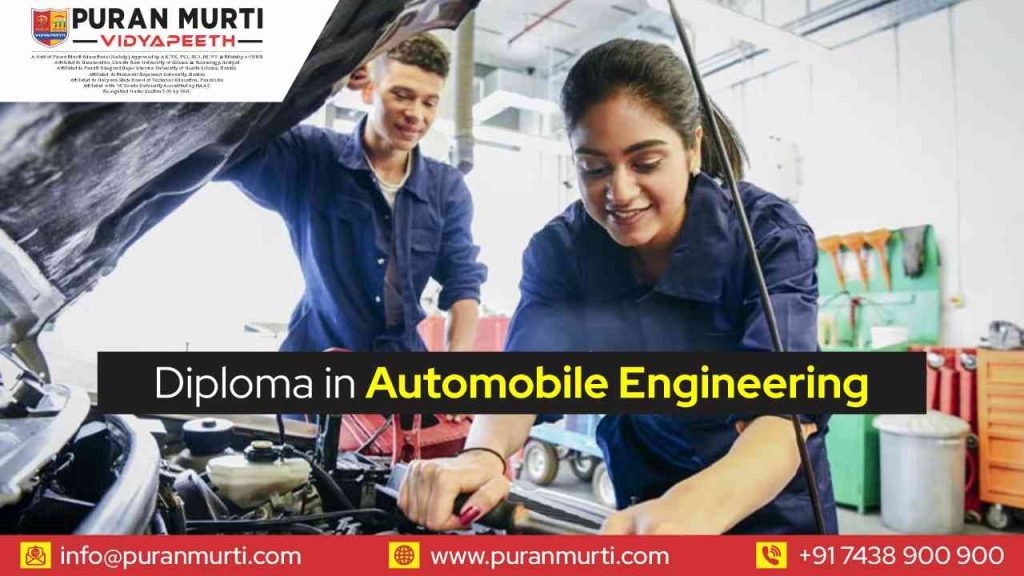
Diploma in Automobile Engineering: Admission & Career
Posted on : 17 October, 2026 1:51 am
The automobile industry is changing rapidly. Electric vehicles, advanced driver-assistance systems, connected cars, vehicle diagnostics and automated manufacturing are creating new opportunities for technically skilled professionals. For students who enjoy understanding how vehicles work and want a practical route into engineering, a Diploma in Automobile Engineering can be a valuable starting point.
At Puran Murti Vidyapeeth, Sonipat, Haryana, we recognise the importance of combining engineering fundamentals with practical learning and career awareness. Our aim is to help students explore technical education pathways, understand industry expectations and make informed decisions about their future.
Whether you have completed Class 10, are exploring diploma engineering courses in Delhi NCR, or want to understand career opportunities in the automotive sector, this guide explains the course, eligibility, subjects, admission considerations, career options and emerging technologies in automobile engineering.
What Is a Diploma in Automobile Engineering?
A Diploma in Automobile Engineering is a technical programme that introduces students to the design, construction, operation, maintenance and servicing of automobiles. It covers the engineering principles behind vehicles, including engines, transmission systems, braking mechanisms, suspension, automotive electrical systems and vehicle diagnostics.
In India, this diploma is commonly offered as a three-year polytechnic programme after Class 10, although entry routes, duration and eligibility can vary by institution and applicable regulations.
The course combines classroom instruction, laboratory work, workshop practice and technical problem-solving. Depending on the curriculum and available facilities, students may also learn about automotive electronics, computer-aided design, vehicle testing and electric mobility.
In simple terms: A Diploma in Automobile Engineering gives students foundational technical knowledge and practical skills for entry-level roles in vehicle manufacturing, servicing, maintenance, inspection, and related automotive operations.
Why Choose a Diploma in Automobile Engineering After Class 10?
Students who want to start technical education early often explore diploma programmes after secondary school. Automobile engineering is especially relevant for those interested in vehicles, mechanical systems, troubleshooting, and emerging automotive technologies.
Start your technical education early
A diploma provides a structured introduction to engineering concepts after Class 10. Rather than waiting until after Class 12 to begin specialised technical education, eligible students can start building automotive knowledge earlier.
Develop practical engineering skills
Automobile engineering involves understanding how individual components work together. Students learn to approach technical problems methodically, interpret engineering drawings, understand mechanical systems and identify possible causes of vehicle faults.
Explore different career pathways
Graduates can explore opportunities with automobile manufacturers, authorised service centres, vehicle component suppliers, fleet operators, workshops, testing facilities and automotive support businesses, depending on their skills and employer requirements.
Prepare for changing automotive technologies
The sector increasingly involves electronic control systems, sensors, diagnostic equipment, battery technology and software-supported vehicle functions. A sound engineering foundation can help students prepare for further training in these areas.
Keep further education options open
Depending on applicable admission rules and qualifications, diploma holders may be eligible to apply for lateral entry into the second year of a relevant B.Tech or B.E. programme. Admission is subject to the rules of the university, state counselling authority and receiving institution.
Course Overview: Diploma in Automobile Engineering
The following table provides a general overview of the programme. Students should verify the current course structure and admission conditions for their chosen institution.
| Course detail | General information |
|---|---|
| Course name | Diploma in Automobile Engineering |
| Level | Diploma / polytechnic |
| Typical duration | 3 years after Class 10 |
| Common entry qualification | Class 10 from a recognised board |
| Core subjects | Automobile systems, mechanics, engines, vehicle maintenance and engineering drawing |
| Learning approach | Theory, laboratory work, workshop practice and projects |
| Career sectors | Manufacturing, servicing, automotive components, diagnostics and fleet operations |
| Further education | Potential lateral entry into a relevant engineering degree, subject to eligibility |
| Study location | Students seeking technical education in Sonipat and Delhi NCR can explore suitable institutions, including Puran Murti Vidyapeeth |
The exact duration, eligibility criteria, examination structure and available specialisations should always be confirmed through the current admission information.
Diploma in Automobile Engineering Eligibility Criteria
Eligibility is one of the first things students and parents should check before applying.
Educational qualification
For the standard entry route, applicants generally need to have passed Class 10 from a recognised board. Some admission pathways may specify minimum marks or subject requirements.
Mathematics and Science are particularly useful for understanding engineering calculations, forces, energy, materials and mechanical systems. Students should check whether these subjects and any minimum percentage are mandatory under the applicable admission rules.
Age and admission conditions
Age limits, qualifying marks, reservation benefits and other conditions may depend on the relevant state admission authority, institution and admission category.
Direct admission and counselling
Diploma admissions in Haryana may involve merit-based selection, counselling or other institution-approved processes, depending on the programme and applicable regulations. Students should not assume that one admission route applies to every college.
Before applying, confirm:
- Whether your Class 10 qualification meets the current requirements.
- Whether a minimum percentage is prescribed.
- Which documents are required.
- Whether admission is through counselling, merit or another approved process.
- Whether the programme and institution have the required approvals for the relevant academic session.
At Puran Murti Vidyapeeth, our admissions team can help prospective students understand the applicable admission process and identify the requirements they need to verify before completing an application.
Diploma in Automobile Engineering Syllabus and Subjects
The syllabus is designed to develop a foundation in engineering science, mechanical systems and automobile technology. The exact subjects and their semester-wise distribution vary by institution and curriculum.
First year: Engineering fundamentals
The first year generally builds the foundation needed for more specialised technical subjects.
Common areas of study may include:
- Engineering mathematics
- Applied physics and chemistry
- Engineering drawing
- Workshop technology and practice
- Basic electrical and electronic engineering
- Computer fundamentals
- Communication and professional skills
These subjects help students understand measurements, materials, technical diagrams, electrical principles and safe workshop practices.
Second year: Automobile systems
Students begin exploring vehicle-specific engineering concepts in greater depth.
Typical subject areas may include:
- Internal combustion engines
- Automobile chassis and body engineering
- Transmission and drivetrain systems
- Braking and suspension systems
- Automotive electrical equipment
- Vehicle maintenance and servicing
- Engineering materials and manufacturing processes
- Thermodynamics and applied mechanics
For example, when studying a vehicle’s braking system, students need to understand friction, mechanical components, hydraulic principles and safety requirements. This connects theoretical engineering knowledge with real-world vehicle performance.
Third year: Diagnostics, maintenance and applications
The final year typically builds more advanced technical understanding and may include practical projects or industrial exposure, depending on the curriculum.
Potential subject areas include:
- Automotive diagnostics and troubleshooting
- Vehicle testing and inspection
- Automobile design fundamentals
- Production and quality control
- Workshop management
- Project work and industrial training
- Emerging automotive technologies
Students should consult the official syllabus for their specific programme rather than treating this illustrative subject list as a guaranteed semester-wise curriculum.
Practical Skills Students Should Develop
A diploma becomes more valuable when students can apply their knowledge to technical situations. Employers may look for a combination of engineering fundamentals, hands-on ability, safety awareness and professional conduct.
Important skills include:
1. Vehicle system knowledge: Understanding how engines, transmissions, brakes, steering and suspension systems function.
2. Diagnostic thinking: Identifying symptoms, considering possible causes and following a systematic troubleshooting process.
3. Workshop safety: Using tools correctly, following safety procedures and understanding the importance of preventive maintenance.
4. Technical drawing and measurement: Reading engineering diagrams, interpreting specifications and using measuring instruments appropriately.
5. Digital and diagnostic literacy: Becoming familiar with electronic diagnostic tools, sensor systems and computer-based technical information.
6. Communication and teamwork: Explaining technical problems clearly, documenting work and cooperating with technicians, engineers and customers.
7. Quality awareness: Following inspection procedures, maintaining records and understanding why consistency and reliability matter in automotive operations.
At Puran Murti Vidyapeeth, we encourage prospective students to ask about the practical components, laboratory facilities, workshop learning and project opportunities available for their intended programme before enrolling.
Electric Vehicles and the Future of Automobile Engineering
The automotive industry is moving beyond conventional petrol and diesel vehicles. Electrification, electronics, connectivity and increasingly sophisticated manufacturing systems are influencing the skills expected across the sector.
Electric vehicle technology
Electric vehicles use electric motors, battery packs, power electronics and electronic control systems. Professionals working in this area may need additional training in high-voltage safety, battery management, charging systems and electrical diagnostics.
Automotive electronics
Modern vehicles depend on sensors, electronic control units and interconnected electrical systems. Understanding wiring diagrams, fault codes and electronic components can be useful in vehicle servicing and diagnostics.
Connected and software-supported vehicles
Vehicle functions increasingly rely on software, communication systems and electronic monitoring. Diploma graduates interested in this area can build their skills through relevant technical courses, manufacturer training and further education.
Advanced manufacturing and quality control
Automobile production involves precision, process control, inspection and continuous improvement. Understanding manufacturing principles and quality procedures can support opportunities in component production and assembly operations.
India’s electric mobility sector is an important part of this transition. The Ministry of Heavy Industries’ electric mobility initiatives and the government’s PM E-DRIVE scheme illustrate the policy attention given to electric vehicles and related infrastructure. However, policy support does not guarantee a particular job outcome, and the number and type of opportunities will depend on market conditions, location and individual skills.
Students should therefore focus on strong fundamentals while developing relevant additional skills as technology changes.
Career Opportunities After a Diploma in Automobile Engineering
A diploma can lead to several technical and operational career paths. The position available to a graduate depends on the employer, practical experience, additional certifications and specific job requirements.
| Career option | Typical responsibilities |
|---|---|
| Automobile service technician | Inspecting vehicles, performing servicing and assisting with repairs |
| Maintenance technician | Supporting routine maintenance and identifying mechanical faults |
| Automotive production technician | Assisting with vehicle or component manufacturing processes |
| Quality control technician | Checking components and processes against technical specifications |
| Vehicle inspection assistant | Supporting inspection, testing and documentation procedures |
| Automotive diagnostic technician | Using diagnostic equipment to investigate vehicle faults |
| Spare parts and service coordinator | Supporting parts identification, service records and workshop operations |
| Fleet maintenance assistant | Helping maintain commercial vehicles and fleet service schedules |
| CAD technician trainee | Assisting with technical drawings and basic design documentation, where qualified |
| Electric vehicle service trainee | Supporting EV inspection and servicing after appropriate safety training |
Where can diploma holders work?
Potential employment settings include:
- Automobile manufacturing companies
- Automotive component manufacturers
- Authorised vehicle dealerships
- Independent repair and service workshops
- Commercial vehicle service centres
- Fleet management companies
- Automotive testing and inspection organisations
- Electric vehicle service providers
- Parts distribution and technical support businesses
Some roles require additional certifications, manufacturer-specific training, experience or licences. Graduates should review individual job descriptions to understand the actual requirements.
What about placements?
Placement outcomes depend on employer demand, student performance, practical competence, location and the opportunities available in a particular recruitment cycle.
At Puran Murti Vidyapeeth, prospective students should contact our admissions or placement team for current, programme-specific information about internship opportunities, placement assistance, recruiting organisations and recent outcomes. Students should ask for verifiable details rather than relying on general placement percentages or salary promises.
Salary After a Diploma in Automobile Engineering
Salary varies according to the job role, city, employer, experience and technical specialisation. Entry-level workshop roles, manufacturing positions and specialised diagnostic jobs may offer different compensation packages.
Instead of treating a single online salary figure as guaranteed, students should compare current job advertisements for their preferred location and role. Check whether the advertised figure represents monthly pay, annual cost to company (CTC), take-home salary or an internship stipend.
To improve employability, students can:
- Develop strong workshop and troubleshooting skills.
- Learn to use relevant diagnostic tools.
- Gain supervised practical experience where available.
- Build familiarity with automotive electrical and electronic systems.
- Improve communication, documentation and computer skills.
- Consider specialised EV, CAD or manufacturer training where appropriate.
- Review job requirements regularly to identify skill gaps.
A first job is a starting point, not a fixed measure of long-term potential. Experience, further qualifications and specialisation may open different opportunities over time.
Diploma in Automobile Engineering vs B.Tech in Automobile Engineering
Both pathways relate to automotive technology, but they differ in educational level, entry requirements and the depth of study.
| Factor | Diploma in Automobile Engineering | B.Tech in Automobile Engineering |
|---|---|---|
| Typical entry route | After Class 10 | After Class 12 with required subjects, or eligible diploma lateral entry |
| Typical duration | 3 years after Class 10 | Generally 4 years through regular entry |
| Learning emphasis | Engineering foundations, practical skills and technical applications | Broader and deeper engineering theory, analysis, design and applications |
| Early career focus | Technician, trainee, maintenance and operational roles | Graduate engineer and other degree-level roles, subject to employer requirements |
| Further study | Potential lateral entry into a related degree | Potential postgraduate study, subject to eligibility |
| Best suited to | Students seeking an earlier technical qualification | Students seeking a degree-level engineering pathway |
Neither option is automatically right for every student. Your decision should reflect your academic preparation, budget, learning preferences, long-term goals and the entry rules for the programme you wish to pursue.
Can You Pursue B.Tech After a Diploma in Automobile Engineering?
Yes, eligible diploma holders may be able to enter the second year of a relevant B.Tech or B.E. programme through lateral entry.
However, eligibility is not automatic. The diploma must meet the receiving institution’s requirements, and admission may depend on prescribed marks, entrance examinations, counselling procedures, available seats and subject or branch compatibility.
Before choosing a diploma, students who intend to pursue a degree later should check the current lateral-entry rules for Haryana and any other state where they may apply. They should also confirm whether the diploma branch is accepted for the intended degree programme.
Planning this pathway early can help students select appropriate qualifications and avoid assumptions about future admission.
Why Explore Automobile Engineering at Puran Murti Vidyapeeth, Sonipat?
Choosing an engineering institution involves more than comparing course names. Students and parents should understand the programme’s recognition, teaching approach, practical facilities, admission requirements, total fees and support available during the course.
At Puran Murti Vidyapeeth, Sonipat, we encourage prospective students to make informed decisions based on their academic goals and the programme’s verified details.
Before applying, we recommend discussing the following with our admissions team:
- Programme availability: Confirm that the Diploma in Automobile Engineering is offered for your intended academic session.
- Recognition and approval: Verify the programme’s applicable regulatory approval, affiliation and awarding authority.
- Curriculum: Request the current syllabus, subject structure and examination details.
- Practical learning: Ask about relevant laboratories, workshop facilities, equipment and project work.
- Industry exposure: Enquire about industrial visits, internships, technical projects or employer engagement opportunities, where available.
- Placement support: Ask about programme-specific assistance, eligibility requirements and documented recent outcomes.
- Fees and financial planning: Request a written breakdown of tuition, examination, registration, hostel and other applicable charges.
- Student support: Understand the academic guidance, attendance requirements, mentoring and grievance procedures available.
Our objective is to help students understand their options and approach technical education with realistic expectations, clear goals and a practical plan for their future.
How to Choose the Right Automobile Engineering Diploma College
A thoughtful college comparison can help students avoid selecting a programme based only on advertisements or general reputation.
Use the following checklist before taking admission:
- Verify the qualification: Check the institution’s current approval, affiliation and authority to award the qualification.
- Review the syllabus: Ensure the curriculum covers relevant mechanical, electrical and automotive fundamentals.
- Ask about practical facilities: Find out how workshop sessions, laboratory work and technical projects are organised.
- Understand the admission process: Confirm eligibility, application dates, selection criteria and required documents.
- Compare total costs: Look beyond tuition fees and include transport, accommodation, equipment and examination charges.
- Investigate career support: Ask about internships, placement assistance and verifiable programme-specific outcomes.
- Visit the campus if possible: Discuss your goals with the admissions team and assess whether the learning environment suits your needs.
For students in Sonipat, Haryana and the wider Delhi NCR region, location, commuting time and access to practical training can also influence the overall learning experience.
Admission Process for Diploma in Automobile Engineering
Admission procedures may change by academic year and institution. The following is a general guide to the steps students should expect.
- Make an enquiry: Contact the institution to confirm programme availability and current admission dates.
- Check eligibility: Review educational qualifications, marks and any additional requirements.
- Understand the selection route: Confirm whether admission follows counselling, merit-based selection or another approved process.
- Prepare documents: Commonly requested documents may include Class 10 marksheets, certificates, photographs and identity documents. Additional documents may be required according to the applicable rules.
- Submit the application: Complete the prescribed form and provide accurate information.
- Verify fees and conditions: Review the written fee structure, refund policy and relevant admission terms before paying.
- Complete enrolment: Follow the institution’s instructions after admission is confirmed.
At Puran Murti Vidyapeeth, our admissions team can guide interested students through the applicable enquiry and application process. Contact us directly for current programme availability, eligibility, fees and important dates.
Frequently Asked Questions (FAQs)
1. Can I do a Diploma in Automobile Engineering after Class 10?
Yes. A Diploma in Automobile Engineering is commonly available as a three-year polytechnic programme after Class 10. Applicants must meet the relevant institution’s current eligibility criteria, including any prescribed marks, subject requirements and admission procedures.
2. What is the duration of a Diploma in Automobile Engineering?
The standard diploma route after Class 10 generally takes three years. The duration and structure should be confirmed with the institution offering the programme, particularly if an alternative entry route applies.
3. What jobs can I get after a Diploma in Automobile Engineering?
Graduates may explore roles such as automobile service technician, maintenance technician, production technician, quality control technician, diagnostic technician and fleet maintenance assistant. Actual opportunities depend on skills, experience, employer requirements and local recruitment demand.
4. Can I pursue B.Tech after a Diploma in Automobile Engineering?
Yes, eligible diploma holders may apply for lateral entry into the second year of a relevant B.Tech or B.E. programme. Admission depends on the receiving institution’s eligibility rules, branch compatibility, marks, entrance or counselling requirements and available seats.
5. How can I enquire about a Diploma in Automobile Engineering at Puran Murti Vidyapeeth?
Students can contact the Puran Murti Vidyapeeth admissions team to confirm whether the programme is available for the intended academic session and to obtain current details about eligibility, fees, curriculum, practical training and the application process.
Conclusion: Take the Next Step Towards an Automotive Career
A Diploma in Automobile Engineering can be a practical starting point for students interested in vehicle technology, mechanical systems, automotive servicing and the changing world of electric mobility. It provides an opportunity to build engineering fundamentals, develop technical skills and explore employment or further-study pathways.
Success depends on choosing an appropriately recognised programme, gaining practical competence, staying informed about industry developments and making realistic career plans.
At Puran Murti Vidyapeeth, Sonipat, we welcome students and parents who want to explore technical education options and understand the requirements before making a decision. Contact our admissions team to enquire about the availability of the Diploma in Automobile Engineering, current fees, eligibility and practical learning opportunities. You can also arrange a campus visit to discuss your goals and determine whether the programme aligns with your plans.