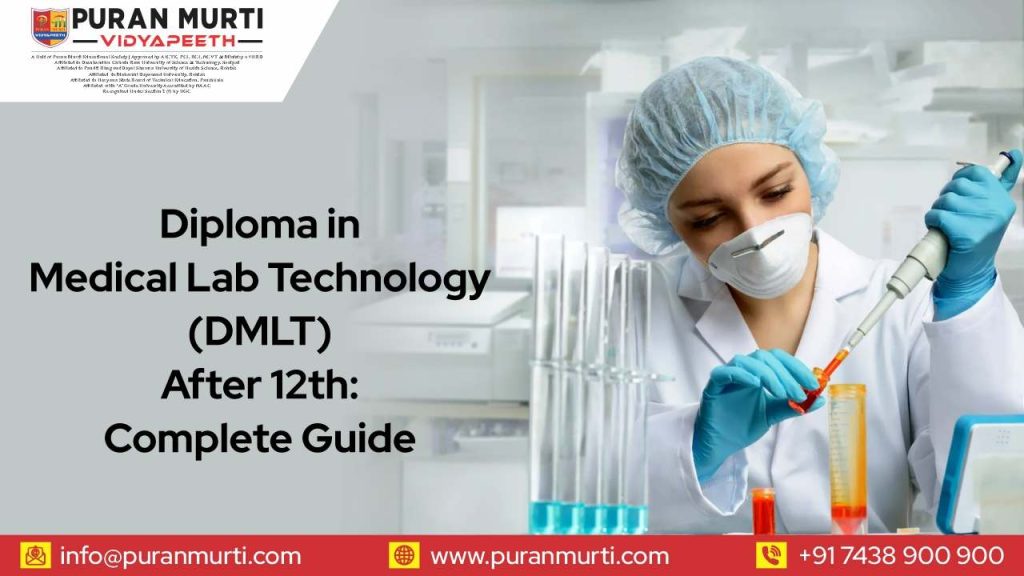
Diploma in Medical Lab Technology After 12th 2027
Posted on : 5 November, 2026 12:24 am
Choosing a career after Class 12 is crucial. Pharmacy can be an excellent way to pursue a career in the medical field, while many students are going to study engineering, management, and medicine. If you have an interest in medicines, healthcare services, pharmaceutical science, and patient care, then D.Pharm is a good starting point for you.
If you are searching for a pharmacy diploma in Sonipat, then Puran Murti Vidyapeeth, Sonipat, Haryana offers pharmacy education at Kami Road campus in Sonipat. Our goal is to equip students with the academic knowledge and practical skills necessary to begin a career in pharmacy.
D.Pharm is suitable for students who want to enter the pharmaceutical and healthcare sectors. This course teaches students about medicines, their preparation, uses, effects, storage, and dispensing.
In this blog, we will understand the D.Pharm course, eligibility requirements, duration, subjects, career opportunities, further education options, and important factors to consider before selecting colleges.
What Is a Diploma in Medical Laboratory Technology (DMLT)?
Diploma in Pharmacy (D.Pharm) is a diploma course that teaches students pharmaceutical sciences and the fundamentals of pharmacy practice. Students gain knowledge of medicines, drug formulations, pharmaceutical chemistry, pharmacology, hospital pharmacy, and community healthcare.
The programme is suitable for students who want to understand how medicines are prepared, stored, dispensed, and used safely. It also introduces the professional responsibilities of pharmacists in hospitals, pharmacies, and other healthcare settings.
Quick overview of the D.Pharm course
| Course Detail | Information |
|---|---|
| Full Name | Diploma in Pharmacy |
| Course Name | D.Pharm |
| Course Level | Diploma |
| Duration | 2 academic years |
| Basic Qualification | 10+2 with Physics and Chemistry and Biology or Mathematics |
| Field | Pharmacy and Pharmaceutical Sciences |
| Practical Learning | Laboratory work and prescribed practical training |
| Career Sector | Healthcare and Pharmaceutical Industry |
| Location | Sonipat, Haryana |
Why Choose DMLT After 12th?
Students who are interested in biology, medical science and laboratory work can consider DMLT as an entry point into the diagnostic healthcare sector.
Here are some reasons to explore this course:
Early Entry into the Pharmacy Profession
D.Pharm provides a diploma-level route into pharmacy education. After completing the prescribed qualification, practical training, and applicable registration requirements, eligible graduates can pursue pharmacy-related professional opportunities.
Understanding Medicines and Healthcare
Students learn about different categories of medicines, their formulations, therapeutic uses, and possible effects. This knowledge helps them understand the importance of responsible medicine handling and dispensing.
Practical and Laboratory-Based Learning
Pharmacy education involves more than classroom teaching. Laboratory sessions and practical activities help students understand pharmaceutical formulations, drug properties, calculations, and basic pharmacy procedures.
Opportunities in Different Healthcare Settings
D.Pharm graduates may explore opportunities in retail pharmacies, hospital pharmacies, pharmaceutical businesses, and other related areas, subject to applicable qualifications and registration requirements.
Further Education Opportunities
Students who want to continue studying can explore B.Pharm. Eligible D.Pharm graduates from PCI-approved institutions may seek lateral entry into the second year of B.Pharm, subject to the applicable admission rules.
DMLT Eligibility Criteria After 12th
The eligibility requirements for DMLT may differ from institution, programme structure and applicable regulatory or university guidelines.
| Eligibility Parameter | General Requirement |
|---|---|
| Educational qualification | Class 12 or equivalent |
| Preferred stream | Science |
| Relevant subjects | Physics, Chemistry and Biology |
| Minimum marks | As specified by the institution |
| Admission process | Merit-based or as per institutional rules |
| Age requirement | As per applicable admission guidelines |
Important subjects in DMLT
First-Year Subjects
| Subject | What Students Learn |
|---|---|
| Pharmaceutics | Basic principles of medicine preparation and dosage forms |
| Pharmaceutical Chemistry | Chemical properties and composition of medicines |
| Pharmacognosy | Medicines and pharmaceutical ingredients obtained from natural sources |
| Human Anatomy and Physiology | Structure and functions of the human body |
| Social Pharmacy | Public health, healthcare awareness, and community pharmacy |
Second-Year Subjects
| Subject | What Students Learn |
|---|---|
| Pharmacology | How medicines act on the human body |
| Community Pharmacy and Management | Pharmacy operations and patient support |
| Biochemistry and Clinical Pathology | Body chemicals and basic laboratory investigations |
| Pharmacotherapeutics | Principles of medicine use in treating diseases |
| Hospital and Clinical Pharmacy | Pharmacy services in hospital environments |
| Pharmacy Law and Ethics | Legal responsibilities and professional ethics |

How Does a Medical Laboratory Work?
A diagnostic laboratory follows a systematic process to examine patient samples. Every stage requires attention, accuracy and proper documentation.
This process is divided into three major stages:
1. Pre-Analytical Stage
It includes patient identification, sample collection, labelling, transportation and sample preparation.
2. Analytical Stage
During this stage, laboratory professionals perform the desired tests using appropriate methods and equipment. They follow standard procedures to maintain accuracy.
3. Post-Analytical Stage
After testing, the results are checked, documented and processed for reporting. Proper quality checks help reduce errors before reports are released.
Career Opportunities After DMLT
One of the main reasons students pursue DMLT after 12th is the opportunity to enter the diagnostic healthcare sector.
Some common career options include:
| Job Profile | Main Responsibilities |
|---|---|
| Medical Laboratory Technician | Performs laboratory tests and handles samples |
| Laboratory Assistant | Supports daily laboratory activities |
| Pathology Lab Technician | Assists with pathology testing |
| Haematology Technician | Works with blood samples and related tests |
| Microbiology Lab Technician | Assists with microbiological testing |
| Clinical Biochemistry Technician | Supports biochemical investigations |
| Laboratory Quality Assistant | Helps maintain testing standards and records |
| Blood Bank Technician | Performs permitted blood bank duties after relevant training |
Where can DMLT graduates work?
DMLT graduates can explore employment opportunities in different healthcare settings, depending on their qualification and applicable requirements.
1. Hospitals
Hospitals operate diagnostic laboratories to support patient examinations, treatment and medical monitoring.
2. Diagnostic Centres
Private diagnostic centres perform routine and specialised laboratory tests. They require trained staff to support sample processing and testing.
3. Pathology Laboratories
Pathology laboratories examine biological samples to help identify infections, diseases and other medical conditions.
4. Blood Banks
Blood banks require trained professionals to assist with permitted testing, screening and blood-related laboratory procedures.
5. Research Laboratories
Some research facilities employ laboratory support professionals for sample preparation, testing and documentation.
6. Public Healthcare Facilities
Government hospitals and healthcare laboratories may recruit eligible laboratory personnel through formal recruitment processes.
DMLT Salary in India: What Can You Expect?
The following figures are indicative planning estimates, not an official salary scale or guaranteed starting package.
| Experience Level | Indicative Monthly Salary |
|---|---|
| Fresher | ₹12,000–₹20,000 |
| 1–3 Years | ₹15,000–₹25,000 |
| 3–5 Years | ₹20,000–₹35,000 |
| Experienced Professional | ₹25,000–₹40,000+ |
How can DMLT graduates improve their earning potential?
To build a stronger professional profile, graduates should:
Develop practical skills in laboratory procedures.
Learn to operate relevant diagnostic equipment.
Understand quality control and laboratory safety.
Improve computer and laboratory information system skills.
Gain supervised experience in suitable healthcare settings.
Pursue further education or specialised training when eligible.
Emerging trends in medical laboratory technology
1. Automation in Diagnostic Laboratories
Modern laboratories increasingly use automated analysers to improve testing efficiency and consistency. Therefore, students should understand both manual procedures and automated equipment.
2. Digital Laboratory Systems
Laboratory Information Management Systems (LIMS) help laboratories organise samples, records and test reports. Digital skills are becoming increasingly useful.
3. Preventive Healthcare
Routine health check-ups and preventive screening increase the need for reliable diagnostic services.
4. Quality Assurance
Accurate testing depends on standard procedures, calibration, documentation and quality control. Laboratory professionals must understand these practices.
5. Advanced Diagnostic Techniques
Molecular diagnostics, immunological testing and specialised laboratory methods continue to expand the range of diagnostic services.
D.Pharm Admission Process at Puran Murti Vidyapeeth
Step 1: Check Eligibility
Ensure that you have passed Class 12 with Physics, Chemistry, and Biology or Mathematics from a recognised board.
Step 2: Explore the Programme
Before applying, understand the course duration, subjects, practical training requirements, and career opportunities.
Step 3: Complete the Application
Submit the required application and academic details through the applicable admission channel.
Step 4: Document Verification
Keep your educational certificates and other required documents ready for verification.
Step 5: Confirm Admission
After completing the prescribed admission formalities, confirm your seat by following the instructions provided by the admissions office.
DMLT vs BMLT: Which Course Should You Choose?
| Comparison | DMLT | BMLT / BMLS |
|---|---|---|
| Full form | Diploma in Medical Laboratory Technology | Bachelor of Medical Laboratory Technology / Science |
| Qualification | Diploma | Undergraduate degree |
| Study level | Diploma-level education | Degree-level education |
| Learning focus | Laboratory fundamentals and technical skills | Broader laboratory science and advanced concepts |
| Duration | Two years under the 2026 NCAHP DMLT curriculum | Depends on the applicable approved curriculum |
| Career opportunities | Entry-level and technical laboratory roles | Degree-level laboratory and specialist pathways, subject to eligibility |
| Further education | Advanced diploma or relevant degree, subject to admission rules | Postgraduate education, subject to eligibility |
Which is better: DMLT or BMLT?
The right choice depends on your educational goals, eligibility, and preferred career path.
-
Choose DMLT if you want to pursue diploma-level training in medical laboratory technology.
-
Choose BMLT/BMLS if you want a bachelor’s degree and a broader academic foundation in medical laboratory sciences.
Students should compare the current curriculum, recognition, clinical training, and future education options before making a decision.
How to Choose the Right DMLT College in Sonipat and Delhi NCR
If you are searching for a DMLT college in Sonipat, Delhi NCR, or nearby areas, consider the following factors.
1. Check Recognition and Course Approval
Before taking admission, verify the institution’s legal status, applicable university or awarding-body affiliation, programme approval and compliance with current NCAHP requirements.
Do not rely only on advertisements or verbal assurances.
2. Review the Curriculum
A good curriculum should cover the important areas of medical laboratory technology, including:
Human anatomy and physiology.
Haematology.
Microbiology.
Clinical biochemistry.
Pathology.
Laboratory management.
Quality assurance and safety.
Also, check whether the programme follows the latest applicable competency-based curriculum.
3. Evaluate Laboratory Facilities
Practical learning is essential in medical laboratory technology. Therefore, check whether students have access to suitable laboratory equipment and supervised practical sessions.
4. Ask About Clinical Training
Find out whether the programme includes structured hospital or diagnostic laboratory exposure. Ask about the duration, training arrangements and supervision.
5. Understand Placement Support
Ask the admissions team about placement assistance, previous recruitment records, employer connections and the types of roles available to graduates.
Remember that placement assistance is not the same as a guaranteed job.
6. Compare Fees and Additional Expenses
Before enrolling, understand the complete fee structure, including:
Tuition fees.
Admission charges.
Examination fees.
Laboratory charges.
Uniform and equipment expenses.
Internship or training-related expenses, where applicable.
DMLT Admission Process After 12th
The admission process may differ between institutions. However, students can generally follow these steps when applying for a DMLT programme.
Step 1: Check Eligibility
First, verify your Class 12 qualification, subjects and minimum marks against the institution’s current admission requirements.
Step 2: Research Colleges
Compare colleges based on recognition, curriculum, practical training, laboratory facilities and fees.
Step 3: Submit the Application
Complete the application form through the official admission portal or the institution’s authorised admission office.
Step 4: Submit Required Documents
Commonly required documents include:
-
Class 10 marksheet and certificate.
-
Class 12 marksheet and certificate.
-
Transfer or migration certificate, where applicable.
-
Identity proof.
-
Passport-size photographs.
-
Category certificate, if applicable.
Step 5: Complete Admission Formalities
After eligibility verification and selection, complete the required fee payment and document verification.
Step 6: Begin Academic Training
Once admission is confirmed, students can begin their academic and practical training according to the programme schedule.
Skills Required to Become a Successful Medical Laboratory Technician
| Skill | Why It Matters |
|---|---|
| Attention to detail | Helps reduce errors during testing |
| Analytical thinking | Supports accurate examination of samples |
| Technical knowledge | Helps in operating laboratory equipment |
| Time management | Supports efficient sample processing |
| Communication | Helps with teamwork and documentation |
| Laboratory safety | Reduces the risk of contamination and accidents |
| Ethical responsibility | Protects patient information and sample integrity |
Top Benefits of Studying Medical Laboratory Technology
Here are five important benefits of choosing medical laboratory technology as a career pathway:
-
Healthcare sector exposure: Understand how diagnostic services support patient care.
-
Practical learning: Develop skills in sample handling and laboratory procedures.
-
Multiple work settings: Explore hospitals, diagnostic centres and research laboratories.
-
Further education: Pursue relevant advanced qualifications when eligible.
-
Scientific skill development: Improve analytical thinking, technical knowledge and accuracy.
Start Your Pharmacy Education Journey with Puran Murti Vidyapeeth
A career in pharmacy begins with the right education, a willingness to learn, and an understanding of professional responsibilities.
If you have completed Class 12 and are interested in pharmaceutical sciences, the Diploma in Pharmacy can help you build a foundation for exploring the healthcare and pharmaceutical sectors.
At Puran Murti Vidyapeeth, our Puran Murti College of Pharmacy offers a D.Pharm programme at our Kami Road campus in Sonipat, Haryana. We welcome students and parents to explore our programme, understand the admission requirements, and learn more about the academic environment.