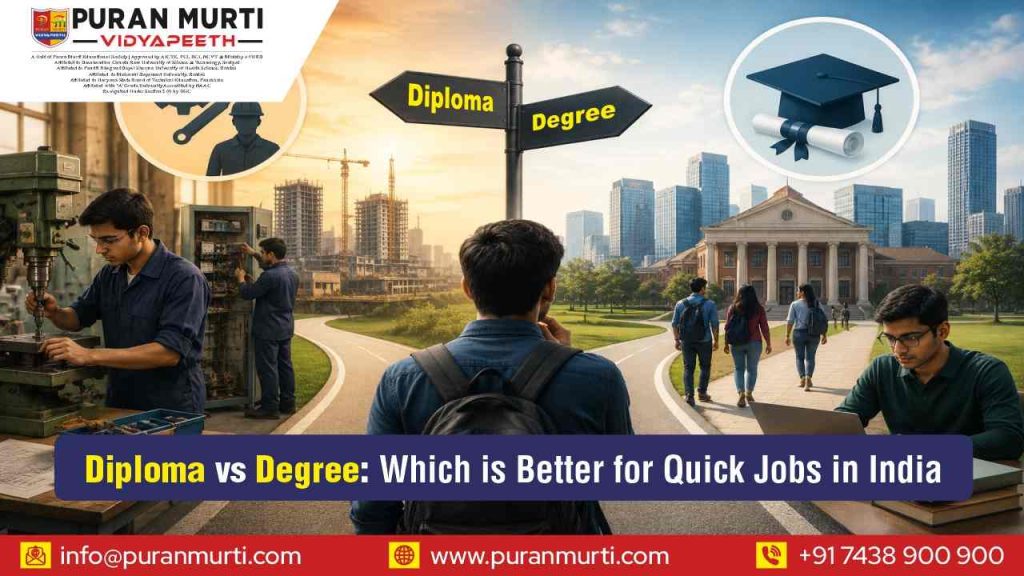
Diploma vs Degree: Which is Better for Quick Jobs in India
Posted on : 18 May, 2026 9:22 pm
Diploma vs Degree: Which is Better for Quick Jobs in India. A diploma is usually the faster route to a first job in India, while a degree is usually the stronger route for long-term growth, promotions, and higher study options. If your main goal is to start earning quickly, a job-focused diploma can work well; if your goal is broader career mobility, a degree often becomes the better investment. Apply Now
What students really want
Also Read: Best College for Diploma in X-Ray Technology in Delhi NCR
Most students do not ask this question because they love comparing certificates. They ask it because they want a clear answer: which path gets them into work sooner, with less confusion and better confidence. That is exactly why this topic matters for school leavers, parents, and career-switchers in India. Apply Now
In practical terms, the answer depends on your timeline, budget, learning style, and job target. However, when the question is limited to quick jobs, diploma programs usually give a faster entry because they are shorter and more skill-oriented. At the same time, a degree can still be the smarter option if you want stronger ceilings later in life. Apply Now
Why this choice matters
India’s job market rewards both skills and credentials, but not in the same way for every role. Technical, operational, and support roles often value job-ready skills first, which is where diplomas tend to shine. Corporate, managerial, research, and many government-related paths usually prefer a degree because it signals broader academic preparation.
That makes this decision more than an academic preference. It is really a strategy question: do you want speed now, or do you want a wider runway later ? For many students, the best answer is not emotional at all; it is practical, affordable, and aligned to a specific career target. Apply Now
Diploma explained
A diploma is a focused qualification built around one field, one set of skills, and one job direction. It is usually shorter than a degree and often emphasizes practical learning, labs, workshops, and hands-on work. Because of that structure, students can often become employable sooner than their peers in longer academic programs. Apply Now
In India, diploma routes are common in engineering, pharmacy, nursing support, IT support, design-related fields, automobile work, electrical trades, and several vocational tracks. These programs often attract students who want early entry into the workforce or who want to build technical confidence before moving further. In a fast-moving economy, that kind of focused preparation can be a real advantage. Apply Now
Degree explained
Best Aeronautical Engineering College in India | AI‑Ready Campus
A degree is a longer and broader qualification that usually includes more theory, analytical learning, and subject depth. Compared with a diploma, it takes more time, but it often opens more doors for higher studies, research, promotions, and leadership roles later. Degrees are common in engineering, management, commerce, science, arts, law, and professional fields. Apply Now
The main benefit of a degree is flexibility over time. A student may not start working as quickly as a diploma holder, but they often gain access to a wider set of roles across companies and sectors. If you want to move from entry-level work into supervisory or strategic roles, a degree usually supports that path better.
Also Read: B.Tech Aerospace Engineering
Speed to first job
If the goal is “job fast,” diploma courses generally have the edge because they are designed around shorter timelines and applied learning. This matters in India, where many families want a quicker return on education spending and students want to start earning early. For that reason, diploma holders can often enter technical and support roles sooner than degree students. Apply Now
That does not mean a diploma automatically guarantees a job. It means the structure of the program is more immediately work-oriented. In fields where employers need technicians, assistants, operators, or support staff, a diploma can match the requirement very well.
Salary and growth
Salary is often the second question after speed, and the answer is mixed. In the early stage, degree holders may earn more on average in many corporate and technical fields, while diploma holders may start earlier and begin earning sooner. Some job families, especially trade and skill-based work, can reward diploma holders well if the skills are strong and demand is high. Apply Now
For long-term growth, degrees usually have the advantage because they often unlock promotions, specialized roles, and higher study pathways. A diploma can get you into the workplace quickly, but a degree can help you climb further over time. So the real question is not only “who earns first,” but also “who grows more after five years.”
Job roles after diploma
Diploma holders usually fit into practical, operational, and technical positions. Common roles include technician, junior engineer, lab assistant, machine operator, maintenance support staff, electrical support, automotive support, network support, or healthcare support roles depending on the stream. These jobs are attractive because they let students apply what they learned quickly. Apply Now
Here is where a diploma becomes especially strong: when an employer wants someone who can work with tools, machines, systems, labs, or standard procedures right away. The diploma student often reaches that point earlier because the course is narrower and more practical. That focus is exactly why many students choose it after class 10th or 12th.
Job roles after degree
Degree holders usually qualify for a wider range of roles, especially where companies want analytical thinking, cross-functional work, and leadership potential. Depending on the field, these roles can include analyst, engineer, supervisor, coordinator, executive, associate, consultant, researcher, or manager. The variety is one of the biggest strengths of the degree route. Apply Now
A degree also tends to matter more when a job needs deeper subject knowledge, formal communication, or long-term promotion potential. That is why many students who want corporate, academic, or government-adjacent careers still choose the degree path first. The payoff may arrive later, but the pathway is often broader. Apply Now
When diploma wins
Best Fire Safety College in India — 2026 Student Guide For Smarter Careers
A diploma is usually better when you want to enter the workforce quickly, spend less time in college, and learn more through doing than through theory. It is also a strong choice if you already know a field you like and do not want to spend years studying general subjects. For some students, that directness feels more natural and less stressful. Apply Now
A diploma can also work well if your family wants lower education cost and faster earning potential. In addition, many diploma programs can later support lateral entry into degree programs, which means you do not have to treat the choice as permanent. That flexibility is useful for students who want to keep options open. Apply Now
When degree wins
A degree is usually better when you care about long-term career growth, better role variety, and access to advanced study. It is also the stronger option if you want to compete for managerial or research-oriented positions later. In many fields, a degree is still the default qualification employers look for first.
A degree also helps students who are still exploring their interests. Since the curriculum is broader, it gives more time to understand a field before specializing. That can prevent rushed career decisions and can be especially helpful for students who are not fully sure about a single trade or technical role.
Best Aeronautical Engineering College in Delhi NCR: How to choose the right campus in 2026
Diploma vs degree table
| Factor | Diploma | Degree |
| Typical duration | Shorter, usually 1 to 3 years | Longer, usually 3 to 5 years |
| Learning style | Practical, skill-based | Theoretical plus practical |
| Job entry speed | Faster | Slower, but broader |
| Early job focus | Technician, support, operational roles | Professional, analytical, and managerial roles |
| Long-term growth | Good in skill-driven fields | Usually stronger across more sectors |
| Higher study path | Possible through lateral entry or further study | Stronger base for postgraduate study |
This table makes the core trade-off simple. A diploma is usually about speed and focus, while a degree is usually about breadth and growth. The better option depends on what you value most at this stage of life. Apply Now
Quick jobs in India
If you are asking specifically about quick jobs in India, diploma pathways often fit that goal better because they match employer demand for hands-on roles. Sectors like manufacturing, maintenance, automotive services, electrical work, healthcare support, lab work, and technical operations often hire for practical ability first. That is one reason diploma programs remain relevant in a market that moves quickly. Apply Now
Still, “quick job” should not mean “short thinking.” A diploma can get you into work fast, but the quality of the institution, lab exposure, internships, and placement support matters just as much. If the training is weak, the speed advantage shrinks. If the training is strong, the diploma can become a smart launchpad. Apply Now
Puran Murti Vidyapeeth context
Puran Murti Vidyapeeth fits this topic very well because it offers both diploma and engineering pathways that are clearly built for employability, practical learning, and upward mobility. It presents a strong case for job-oriented learning because its ecosystem combines diploma, degree, and lateral entry options with industry exposure. Highlights include AICTE, PCI, BCI, NCVT, and UGC-recognized pathways, along with affiliations and accreditation support that add institutional credibility. It also emphasizes practical learning, life skills, entrepreneurship, and collaboration with industry partners.
For a student comparing diploma vs degree, that matters because the institution does not treat a diploma as a lesser route; instead, it treats it as a faster, skill-first entry into technical careers, with degree options available later for students who want to grow further. In other words, the campus supports both speed and scale, which is exactly what many students and parents want when they compare quick jobs with long-term growth. Apply Now
The diploma branches at Puran Murti Vidyapeeth are broad and job-oriented, and they are listed across the website and brochure as follows:
These branches are especially relevant for quick jobs because they are closely linked to hands-on work, technical operations, lab roles, maintenance roles, and industry support positions. The diploma format is useful for students who want to enter the workforce faster, learn by doing, and build confidence through practical exposure rather than waiting several years for a longer degree. That practical focus is also visible in the way the campus presents its workshops, labs, and industry-linked learning environment. Apply Now
The engineering degree branches at Puran Murti Vidyapeeth are equally important because they give students a natural upgrade path after diploma or a direct route for those who want a broader academic base from the beginning. The B.Tech branches highlighted include these:
This matters in a diploma vs degree conversation because the student is not locked into one path forever. A student can begin with a diploma for faster employment, then move into lateral entry or integrated pathways later if they want stronger academic depth and better long-term mobility. That flexibility makes Puran Murti Vidyapeeth a useful example of how a campus can serve both immediate employability and future advancement.
The placement and career ecosystem also strengthens the relevance of the campus in this discussion. The brochure highlights strong placement support, alumni working with national and international companies, and outcomes that include notable packages in engineering and technical streams. The website also emphasizes placement records and student career support, which is especially important for students choosing a course mainly for quick job entry. When the goal is early employment, that kind of ecosystem can make a real difference. Apply Now
-
Diploma works well for students who want faster entry into technical jobs.
-
Degree works well for students who want wider career mobility and higher-study options.
-
Puran Murti Vidyapeeth supports both through diploma, B.Tech, lateral entry, and integrated routes.
-
Its industry exposure, labs, and placement support make the learning path more job-ready.
So, in simple terms, Puran Murti Vidyapeeth shows that diploma and engineering education do not need to compete with each other. Instead, they can work as two stages of the same career journey, where a diploma offers speed and a degree offers expansion. That is why the campus fits naturally into a blog about quick jobs in India, especially when the audience wants both practical training and a clear route forward. Apply Now
Why students choose diploma
Many students choose a diploma because they want early confidence, not just a certificate. They prefer structured lab work, shorter course duration, and an easier transition into entry-level employment. For students who learn best by doing, this route often feels more natural than a theory-heavy degree.
Another reason is flexibility. A diploma does not always close the door to higher education. In many cases, it becomes a stepping stone, letting students work early and then continue studying later through lateral entry or advanced programs. Apply Now
Why students choose degree
Many students choose a degree because they want more room to grow over time. They are willing to spend extra years in education if that increases the range of jobs, salary ceilings, and career transitions later. In a competitive market, that extra depth can matter a lot. Apply Now
Parents often prefer degrees because they are widely recognized across sectors. Students who are aiming for government exams, postgraduate study, or leadership tracks also tend to benefit from the degree path. So, even if it is slower, it may still be the better long-term bet. Apply Now
Trade-offs to think about
The smartest choice is not based on hype. It is based on your real situation, including finances, academic strength, interest in practical work, and how soon you need income. A diploma may be ideal if you want immediate employability and a direct skill path. A degree may be better if you want more options and a stronger ceiling over time. Apply Now
Also, the college or campus matters almost as much as the qualification. Strong labs, internship exposure, faculty support, and placement networks can make a diploma outperform a weak degree in the job market. That is why students should compare institutions, not just course titles.
Who should choose what
Choose a diploma if you are a student who wants to start earning soon, prefers practical work, and has a clear technical career target. Choose a degree if you want broader growth, higher studies, or roles beyond the entry level. If you are uncertain, a diploma followed by lateral entry into a degree can be a balanced strategy. Apply Now
This is where many students get relief: the choice is not always permanent. You can start with a diploma, work early, and then continue upward later. That path can reduce pressure while still keeping your future open. Apply Now
Industry reality
Employers do not hire only by degree title. They also care about what you can actually do on day one. That is why diploma students who build strong practical ability, communication skills, and workplace discipline can perform very well in the market. Likewise, degree students who add projects, internships, and certifications often become highly employable too. Apply Now
In other words, qualification gives you the entry point, but skill decides the momentum. A diploma gives faster access to skill-based work, while a degree gives more room to expand that skill base. Both can work; the stronger path is the one that matches your target role and your timeline. Apply Now
Practical examples
Consider two students. One wants to join a workshop, lab, or maintenance role as soon as possible and start earning. A diploma is often the better fit for that student because the training is shorter and more direct. Another student wants to become a manager, analyst, or engineer with future postgraduate options. A degree is usually the better fit for that student. Apply Now
Now think about a family that wants lower fees and earlier income. A diploma may reduce both time and pressure. Think about a student who wants campus life, broader education, and a long career ladder. A degree will likely suit that plan better. Apply Now
Conclusion
For quick jobs in India, a diploma is usually the better choice because it is faster, more practical, and closely aligned to entry-level technical work. However, if you are planning a long career with broader opportunities, a degree often becomes the stronger investment. The best decision is the one that matches your job goal, budget, learning style, and future study plans. Apply Now
Puran Murti Vidyapeeth adds value here because it offers both job-oriented diploma pathways and broader degree routes with placement support, industry exposure, and a career-focused ecosystem. That combination gives students a real choice instead of a forced one. In a market where timing matters, that flexibility can make all the difference. Apply Now
CTA
If your goal is faster employment with practical skills, explore diploma options first; if your goal is wider growth, compare degree routes carefully. For students who want both speed and future mobility, a campus with strong labs, placements, and lateral entry support is worth serious attention.
FAQs
Which is better for a quick job in India, diploma or degree?
A diploma is usually better for a quick job in India because it is shorter and more skill-focused.
Can diploma holders get good jobs?
Yes, diploma holders can get good jobs in technical, operational, and support roles, especially when their practical skills are strong.
Is a degree better than a diploma?
A degree is usually better for long-term growth, broader job options, and higher study pathways.
Can I do a degree after diploma?
Yes, many programs offer lateral entry or further study options after a diploma.
Which is better for salary?
A degree often offers a higher long-term salary ceiling, while a diploma can help you start earning sooner.
Is a diploma enough for a stable career?
A diploma can be enough for a stable career in skill-based fields if you keep building experience and practical ability.