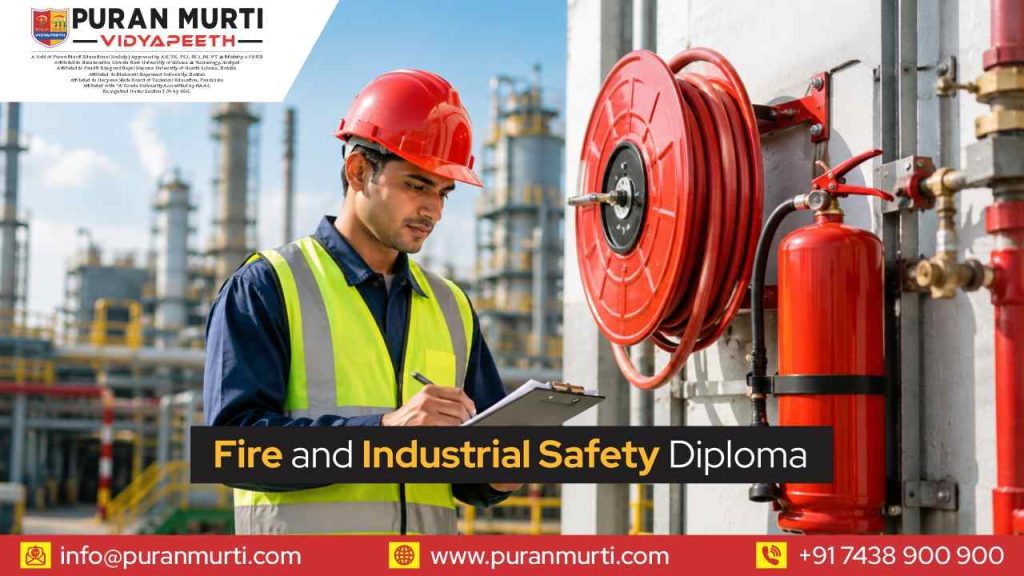
Fire and Industrial Safety Diploma
Posted on : 20 August, 2026 2:26 pm
A Fire and Industrial Safety Diploma is a career-oriented programme designed for students who want to build a career in fire prevention, workplace safety, industrial risk management and emergency response. The course focuses on practical knowledge that can help students understand workplace hazards, fire protection systems, safety procedures and emergency management.
For students looking for a job-oriented course after Class 10 or 12, a Fire and Industrial Safety Diploma can be an option worth considering. Course eligibility and duration can vary between institutions, so students should always check the specific admission requirements of the institute before applying. Current course offerings in India commonly range around one year, although programmes with different structures are also available. Apply Now
What Is a Fire and Industrial Safety Diploma?
- A Fire and Industrial Safety Diploma combines two important areas: fire safety and industrial safety.
- Fire safety focuses on preventing and controlling fire-related accidents. Students learn about fire prevention, fire-fighting equipment, emergency evacuation, rescue operations and basic fire protection systems.
- Industrial safety focuses on preventing accidents and health hazards at workplaces such as factories, construction sites, warehouses, chemical plants and other industrial environments. Apply Now
Why Choose a Fire and Industrial Safety Diploma?
The course can be attractive to students who:
- Want a short-term professional programme
- Are interested in safety and emergency management
- Prefer practical and field-oriented careers
- Want to work in industrial environments
- Are interested in fire prevention and rescue operations
- Want to develop skills related to occupational safety
- Plan to build a career in the Safety, Health and Environment sector
The Directorate General of Training also offers a one-year Fire Technology and Industrial Safety Management trade with Class 10 as the qualification requirement, showing that fire and industrial safety is also represented within India’s vocational training ecosystem. Apply Now
Fire and Industrial Safety Diploma
| Particular | Details |
|---|---|
| Course Name | Diploma in Fire and Industrial Safety |
| Course Level | Diploma |
| Common Duration | Around 1 year |
| Eligibility | Depends on institute; commonly Class 10, 12 or ITI |
| Main Areas | Fire Safety, Industrial Safety, Emergency Management |
| Learning Method | Theory + Practical Training |
| Suitable For | Students interested in safety and emergency management |
| Career Areas | Manufacturing, Construction, Fire Safety, Oil & Gas, Warehouses, Infrastructure |
| Higher Study Options | Advanced Diploma, PG Diploma or related degree programmes |
| Career Focus | Fire Safety, Industrial Safety, HSE and Safety Management |
Note: Eligibility and course duration are not identical across all institutions. Some programmes accept Class 10, while others require Class 12 or ITI. Apply Now
Fire and Industrial Safety Diploma Eligibility
- Eligibility depends on the college or institute offering the programme.
Many one-year diploma programmes accept students who have completed Class 10, while some institutions require Class 12 or ITI. For example, current programmes in India show eligibility requirements ranging from Class 10 or above to Class 12/ITI.
Basic Eligibility
Students should generally check whether they meet the following requirements: Apply Now
- Passed Class 10 or Class 12 from a recognised board
- ITI candidates may also be eligible for some programmes
- Meet the minimum age requirement, if applicable
- Fulfil the institute’s admission requirements
- Submit required academic and identity documents
Admission Process for Fire and Industrial Safety Diploma
Step 1: Check Eligibility
- Read the eligibility requirements carefully.
Step 2: Select the Institute
- Compare curriculum, practical training, faculty, facilities, recognition/affiliation and placement support.
3 Step: Submit the Application
- Complete the application form and upload or submit the required documents.
Step 4: Document Verification
- The institute verifies academic certificates and other documents.
Step 5: Pay the Admission Fee
- After confirmation, students complete the admission formalities.
6 Step: Start the Course
- Students attend classroom sessions, practical training and other activities according to the institute’s academic schedule.

Fire and Industrial Safety Diploma Syllabus
| Subject Area | What Students Learn |
| Fire Safety | Fire prevention and protection |
| Fire Technology | Basic fire science and fire protection systems |
| Fire Fighting | Fire-fighting methods and equipment |
| Industrial Safety | Workplace safety procedures |
| Construction Safety | Hazards and safety at construction sites |
| Risk Assessment | Identifying and controlling workplace risks |
| Occupational Health | Workplace health and safety |
| Environmental Safety | Environmental hazards and protection |
| Emergency Management | Emergency response and evacuation |
| Safety Inspection | Workplace inspection and safety practices |
| PPE | Personal protective equipment |
| Industrial Internship | Practical exposure to workplace safety Apply Now |
Practical Training in Fire and Industrial Safety
- Practical learning is an important part of safety education.
Students may receive exposure to areas such as:
- Fire extinguishers and fire-fighting equipment
- Emergency response
- Rescue procedures
- Personal protective equipment
- Safety inspections
- Hazard identification
- Risk assessment
- Workplace emergency planning
- Confined-space safety
- Work-at-height safety
- Industrial safety procedures
For this reason, students should look beyond the course name and check whether the college provides practical laboratories, demonstrations, industrial visits, internships and field exposure. Apply Now
Skills You Develop During the Course
A Fire and Industrial Safety Diploma can help students develop both technical and professional skills.
Technical Skills
- Fire prevention
- Fire-fighting techniques
- Safety inspection
- Hazard identification
- Risk assessment
- Emergency response
- PPE selection and use
- Workplace safety procedures
- Basic safety documentation
- Industrial accident prevention
Soft Skills
- Communication skills
- Teamwork
- Leadership
- Problem-solving
- Emergency decision-making
- Observation skills
- Discipline
- Time management
Career Scope After Fire and Industrial Safety Diploma
After completing the diploma, students can explore entry-level opportunities in industries where workplace safety is important.
- Manufacturing industries
- Construction companies
- Warehouses
- Infrastructure projects
- Oil and gas
- Chemical industries
- Power plants
- Hotels and commercial buildings
- Hospitals
- Logistics companies
- Fire and emergency services
- Safety service providers
Jobs After Fire and Industrial Safety Diploma
| Job Role | Main Responsibility |
| Safety Supervisor | Monitor workplace safety practices |
| Fire Safety Supervisor | Support fire prevention and emergency preparedness |
| Safety Assistant | Assist safety officers with inspections and documentation |
| Fire & Safety Technician | Support fire safety systems and equipment |
| Safety Coordinator | Coordinate workplace safety activities |
| HSE Assistant | Assist with Health, Safety and Environment activities |
| Safety Inspector | Conduct workplace safety checks |
| Fire Safety Assistant | Support fire prevention and emergency response |
| Site Safety Supervisor | Monitor safety at construction or project sites |
Higher Studies After Fire and Industrial Safety Diploma
Possible options may include:
- Advanced Diploma in Industrial Safety
- Advanced Diploma in Fire and Industrial Safety
- Diploma in Industrial Safety Management
- PG Diploma in Industrial Safety
- PG Diploma in Fire and Safety
- Health, Safety and Environment programmes
- Related undergraduate programmes
How to Choose the Best Fire and Industrial Safety College
Choosing the right institute is one of the most important decisions. Apply Now
Course Recognition
- Check the awarding body, affiliation, accreditation or recognition applicable to the programme.
Practical Training
- A safety course should not be limited to classroom theory. Look for practical demonstrations and field exposure.
Fire Safety Facilities
- Check whether students have access to appropriate fire-safety training equipment and demonstrations.
Industrial Exposure
- Industrial visits and internships can help students understand real workplace conditions.
Faculty
- Experienced faculty can make technical safety subjects easier to understand.
- Ask the institute about career guidance, internships, recruitment assistance and previous placement information.
- Consider laboratories, classrooms, library, hostel and student-support facilities.
Location
- A college located close to industrial areas can potentially provide better opportunities for industrial exposure, depending on its partnerships.

Why Consider Puran Murti Vidyapeeth?
When comparing educational institutions, students can use Puran Murti Vidyapeeth as a reference for the type of academic environment and student facilities they should evaluate. Apply Now
| Factor | What to Check |
| Academic Environment | Learning atmosphere and faculty support |
| Practical Exposure | Labs, demonstrations and field activities |
| Infrastructure | Classrooms, laboratories and other facilities |
| Student Support | Academic and career guidance |
| Industry Exposure | Visits, internships and practical learning |
| Campus Facilities | Hostel, library and other student facilities |
| Career Support | Placement assistance and skill development |
| Course Details | Eligibility, duration, syllabus and awarding body |
Documents Required for Admission
Common documents may include:
- Class 10 certificate
- Class 12 certificate, if applicable
- ITI certificate, if applicable
- Passport-size photographs
- Government-issued identity proof
- Transfer certificate, if required
- Migration certificate, if applicable
- Other documents requested by the institute
Is Fire and Industrial Safety Diploma a Good Career Option?
- For students interested in workplace safety, emergency management and industrial environments, the course can be a useful starting point.
- The biggest advantage is that it is generally a short-duration, skill-oriented programme. Students can learn about fire safety, industrial hazards, emergency response and workplace safety in a relatively short period.
Fire and Industrial Safety Diploma: Career Roadmap
A simple career path can look like this:
- Class 10/12 → Fire and Industrial Safety Diploma → Practical Training/Internship → Entry-Level Safety Job → Industry Experience → Advanced Safety Qualification → Senior Safety/HSE Roles Apply Now
Frequently Asked Questions
What is a Fire and Industrial Safety Diploma?
It is a career-oriented diploma programme covering fire prevention, fire-fighting, industrial safety, workplace hazards, emergency response and related safety practices.
What is the duration of a Fire and Industrial Safety Diploma?
Many programmes have a duration of around one year, but the exact duration depends on the institution and programme structure.
Can I do a Fire and Industrial Safety Diploma after Class 10?
Yes, some programmes accept students after Class 10. However, other institutes may require Class 12 or ITI, so students should check the specific eligibility criteria.
What subjects are taught in the course?
Common areas include fire technology, fire prevention, industrial safety, construction safety, occupational health, risk assessment, emergency management and safety inspection.
What jobs can I get after this diploma?
Depending on qualification and employer requirements, students may explore roles such as Safety Assistant, Safety Supervisor, Fire Safety Supervisor, Fire & Safety Technician and HSE Assistant. Apply Now
Is practical training important?
Yes. Practical exposure can help students understand how fire-fighting equipment, PPE, risk assessment and emergency procedures are used in real situations.
Can I study further after the diploma?
Yes. Depending on eligibility and the awarding body’s requirements, students can explore advanced diplomas, PG diplomas and related degree-level programmes.
Is Fire and Industrial Safety a good career?
It can be a suitable career field for students interested in safety, emergency management and industrial work. Career growth depends on experience, skills, qualifications and the industry in which a person works. Apply Now
Final Thoughts
A Fire and Industrial Safety Diploma can be a practical starting point for students who want to enter the growing field of workplace safety and emergency management. The programme introduces students to fire prevention, industrial hazards, risk assessment, emergency response and safety procedures. However, choosing the right institute is just as important as choosing the course. Students should compare recognition, syllabus, practical training, internship opportunities, faculty, infrastructure, fees and career support before taking admission. Apply Now
For students considering institutions such as Puran Murti Vidyapeeth as a reference, the best approach is to focus on the overall learning environment and verify the current details of the specific safety programme directly with the institution.