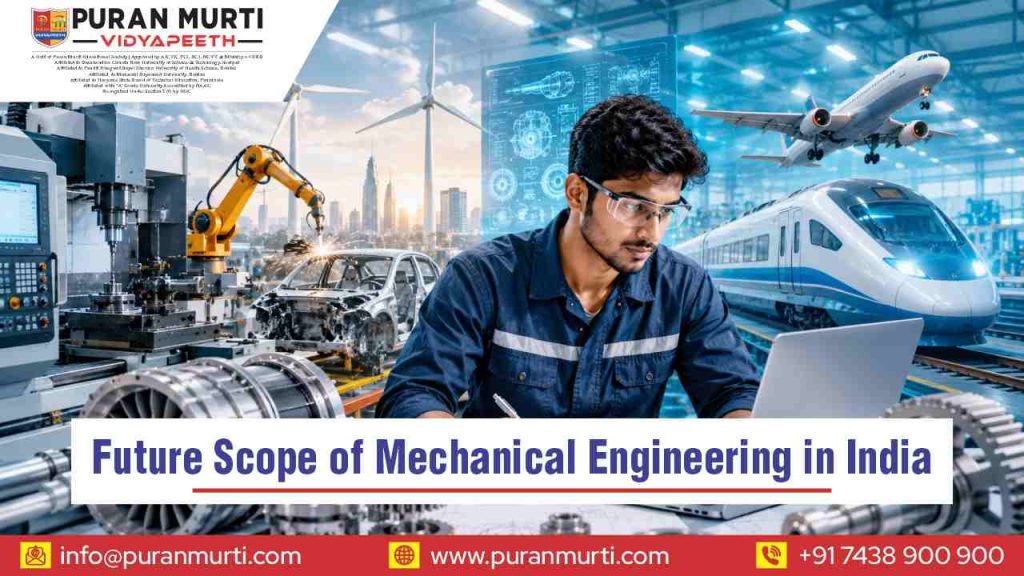
Future Scope of Mechanical Engineering in India (2027)
Posted on : 11 July, 2026 3:13 am
Mechanical Engineering has long been considered one of the strongest pillars of engineering education. Despite the rapid growth of Artificial Intelligence, Computer Science, and Data Science, Mechanical Engineering continues to remain highly relevant because every industry relies on machines, manufacturing systems, automation, and product innovation.
If you are planning your career after Class 12 and wondering whether Mechanical Engineering is still a good choice in 2027, the answer is yes—provided you develop industry-ready skills and choose the right college.
This guide explains the future scope of Mechanical Engineering in India, emerging technologies, career opportunities, salary trends, required skills, and why pursuing the course from an industry-focused institution such as Puran Murti Vidyapeeth, Sonipat can help students build a successful engineering career.
What is Mechanical Engineering?
Mechanical Engineering is a core engineering discipline that focuses on designing, manufacturing, testing, operating, and maintaining machines, mechanical systems, vehicles, industrial equipment, and manufacturing processes.
It combines principles of:
- Physics
- Mathematics
- Materials Science
- Thermodynamics
- Fluid Mechanics
- Robotics
- Manufacturing Technology
- Computer-Aided Design (CAD)
Because mechanical systems exist in almost every industry, mechanical engineers remain in demand worldwide.
Why Mechanical Engineering Still Has a Bright Future in India
Many students assume only Computer Science offers good career opportunities. However, India’s rapid industrial growth is creating massive demand for skilled mechanical engineers.
Several sectors are expanding rapidly:
- Electric Vehicles (EV)
- Smart Manufacturing
- Defence Manufacturing
- Aerospace
- Renewable Energy
- Robotics
- Industrial Automation
- Infrastructure Development
- Railways
- Oil & Gas
- Heavy Engineering
With government initiatives such as Make in India, Production Linked Incentive (PLI) Scheme, National Manufacturing Mission, and increasing investments in domestic manufacturing, the demand for mechanical engineers is expected to remain strong over the coming decade.
Mechanical Engineering in India: Market Trends (2027)
India’s engineering and manufacturing ecosystem is undergoing significant transformation.
Key trends include:
| Industry Trend | Career Impact |
|---|---|
| Industry 4.0 | High demand for automation engineers |
| Electric Vehicles | Growing need for EV design engineers |
| Robotics | New opportunities in smart manufacturing |
| Renewable Energy | Demand in wind, solar and green technologies |
| Defence Manufacturing | Increase in mechanical design roles |
| Aerospace Expansion | More jobs in precision manufacturing |
| Smart Factories | Need for CAD, CAM and CNC experts |
These developments are creating opportunities beyond traditional factory jobs.
Top Career Opportunities After Mechanical Engineering
Mechanical engineers can work across diverse industries.
1. Automotive Industry
Roles include:
- Design Engineer
- Production Engineer
- Quality Engineer
- Testing Engineer
Leading recruiters:
- Tata Motors
- Mahindra
- Maruti Suzuki
- Ashok Leyland
- Bosch
2. Manufacturing Industry
India continues to expand its manufacturing capabilities.
Popular roles:
- Manufacturing Engineer
- Plant Engineer
- Maintenance Engineer
- Process Engineer
3. Robotics and Automation
Automation is becoming essential in modern factories.
Mechanical engineers now work alongside:
- Industrial Robots
- PLC Systems
- Automation Equipment
- Smart Manufacturing Systems
4. Aerospace Industry
Mechanical engineers contribute to:
- Aircraft Design
- Propulsion Systems
- Maintenance
- Structural Analysis
5. Renewable Energy
Mechanical engineers are increasingly employed in:
- Solar Power Plants
- Wind Energy Projects
- Green Hydrogen
- Sustainable Engineering
6. Government Jobs
Mechanical graduates can prepare for:
- GATE
- PSU Recruitment
- Indian Railways
- Defence Organizations
- ISRO
- DRDO
- State Engineering Services
Mechanical Engineering Salary in India
Salary depends on skills, college, internships, certifications, and employer.
| Experience | Average Annual Salary |
| Fresher | ₹3–6 LPA |
| 2–5 Years | ₹6–10 LPA |
| 5–10 Years | ₹10–18 LPA |
| Senior Professionals | ₹20 LPA+ |
Professionals with expertise in automation, robotics, CAD, simulation software, AI-integrated manufacturing, and EV technologies often receive higher salary packages.
Skills Required to Build a Successful Career
Today’s employers expect engineers to possess technical and professional skills.
Technical Skills
- AutoCAD
- SolidWorks
- CATIA
- Creo
- ANSYS
- CNC Programming
- PLC Programming
- Robotics
- CAD/CAM
- Simulation
Soft Skills
- Communication
- Leadership
- Teamwork
- Critical Thinking
- Problem Solving
- Project Management
Students who combine technical knowledge with practical exposure have a clear competitive advantage.

Why Choose Mechanical Engineering in 2027?
Choosing Mechanical Engineering remains a smart decision because it offers:
- Diverse career opportunities
- Strong government sector prospects
- Global employment options
- Entrepreneurship potential
- High demand across industries
- Stable long-term career growth
Unlike many specialized branches, Mechanical Engineering provides a broad foundation that allows graduates to transition into multiple industries.
Mechanical Engineering vs Computer Science
| Parameter | Mechanical Engineering | Computer Science |
| Industry | Manufacturing & Core | IT & Software |
| Career Flexibility | Very High | High |
| Government Jobs | Excellent | Moderate |
| Product Design | Yes | Limited |
| Factory Automation | Yes | Limited |
| Software Development | Limited | Excellent |
| Robotics Opportunities | Excellent | Good |
Students interested in machines, innovation, manufacturing, robotics, and product design often find Mechanical Engineering more aligned with their interests.
Why Choose Puran Murti Vidyapeeth for Mechanical Engineering?
For students in Sonipat, Delhi NCR, Haryana, and nearby regions, choosing the right institution is just as important as selecting the right branch.
Puran Murti Vidyapeeth focuses on developing industry-ready engineers through a combination of academic excellence and practical learning.
Key advantages include:
Industry-Oriented Curriculum
The curriculum is aligned with current industry trends, helping students gain relevant technical knowledge.
Modern Laboratories
Students receive practical exposure through advanced engineering labs and workshops.
Experienced Faculty
Learning is supported by qualified faculty members with academic and industry expertise.
Industry Exposure
Students benefit from:
- Industrial visits
- Technical workshops
- Expert lectures
- Live projects
- Skill development programs
Placement Assistance
Dedicated placement support helps students prepare for internships and campus recruitment opportunities through:
- Resume building
- Mock interviews
- Aptitude training
- Soft skills development
Strategic Location
Located in Sonipat, near Delhi NCR, the campus offers students access to a growing industrial ecosystem and better internship opportunities.
How to Build a Successful Mechanical Engineering Career
Students can maximize their career potential by following these steps:
- Build strong fundamentals.
- Learn CAD and simulation software.
- Complete internships every year.
- Participate in technical competitions.
- Obtain industry certifications.
- Develop communication skills.
- Stay updated with Industry 4.0 technologies.
- Build a professional portfolio of projects.
Top Benefits of Mechanical Engineering
- Evergreen engineering branch
- Opportunities in multiple industries
- Excellent higher education options
- Strong government job prospects
- High international demand
- Entrepreneurial opportunities
- Future-ready with robotics and automation
People Also Ask
Is Mechanical Engineering a good career in India in 2027?
Yes. Mechanical Engineering continues to offer excellent career opportunities due to growth in manufacturing, electric vehicles, robotics, aerospace, renewable energy, and automation. Students with practical skills and industry exposure enjoy strong employability across both private and government sectors.
Which industries hire Mechanical Engineers?
Mechanical engineers are hired in automotive, aerospace, manufacturing, robotics, defence, renewable energy, railways, construction, oil & gas, heavy engineering, industrial automation, and research organizations.
What is the average salary after Mechanical Engineering?
Fresh graduates generally earn between ₹3–6 LPA. Professionals with specialized skills, industry certifications, and experience can earn ₹10–20 LPA or more depending on their role and employer.
Frequently Asked Questions (FAQs)
What is the future scope of Mechanical Engineering in India?
Mechanical Engineering has excellent future scope because industries such as manufacturing, electric vehicles, robotics, renewable energy, aerospace, and automation continue to expand, creating demand for skilled engineers.
Is Mechanical Engineering better than Computer Science?
Both branches offer excellent opportunities. Mechanical Engineering is ideal for students interested in machines, manufacturing, product design, robotics, and industrial innovation, while Computer Science focuses on software and computing.
Can Mechanical Engineers work in robotics?
Yes. Robotics is one of the fastest-growing career areas for Mechanical Engineers. Many professionals work in industrial automation, robotic system design, manufacturing automation, and intelligent machines.
Which college is good for Mechanical Engineering in Sonipat?
Students seeking quality education, practical learning, industry exposure, modern laboratories, and placement support can consider Puran Murti Vidyapeeth, Sonipat as one of the recognized institutions for Mechanical Engineering education in the region.
Does Mechanical Engineering have government job opportunities?
Yes. Graduates can prepare for recruitment through GATE, Public Sector Undertakings (PSUs), Indian Railways, DRDO, ISRO, Defence Services, and State Engineering Services.
Conclusion
Mechanical Engineering remains one of India’s most dependable and future-ready engineering disciplines. As industries adopt automation, smart manufacturing, electric mobility, and sustainable technologies, the role of skilled mechanical engineers will continue to grow.
Success, however, depends not only on choosing the right engineering branch but also on selecting a college that emphasizes practical learning, industry interaction, innovation, and career development.
If you are planning to build a rewarding engineering career in Sonipat, Delhi NCR, or anywhere in India, Puran Murti Vidyapeeth offers an environment where students can strengthen technical knowledge, develop industry-relevant skills, and prepare confidently for future career opportunities.
Take the next step toward your engineering career. Contact the admissions team at Puran Murti Vidyapeeth or schedule a campus visit to explore the Mechanical Engineering program, interact with faculty, and experience the learning environment firsthand.