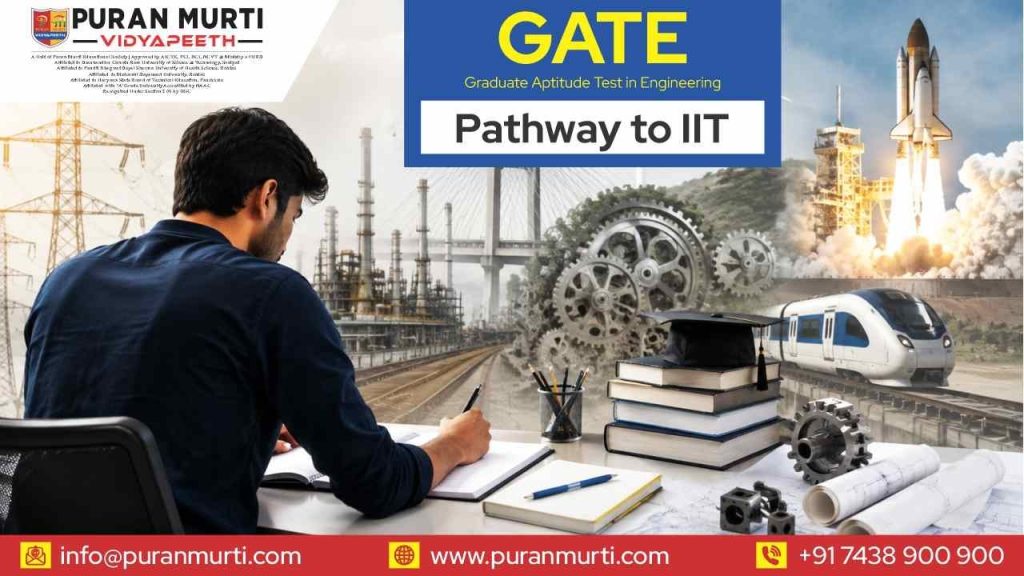
GATE: The Pathway to IIT
Posted on : 25 August, 2026 8:05 pm
For a B.Tech student, an IIT M.Tech seat is not simply a postgraduate admission. It can be a turning point towards deeper technical knowledge, serious research, stronger industry exposure, and a more specialised career path. GATE, the Graduate Aptitude Test in Engineering, is one of the most important routes that makes this goal possible for engineering graduates across India. Apply Now
At Puran Murti Vidyapeeth, the GATE journey is increasingly becoming a visible ambition among B.Tech students. The institution’s GATE 2027 achievers include students with All India Ranks from 161 to 1934, showing what focused preparation can produce when students connect classroom learning with disciplined competitive-exam practice. Their progress matters because a strong GATE performance can open the door to M.Tech applications at IITs, IISc, NITs, and other leading technical institutions.
However, students and parents should understand the pathway clearly. Qualifying GATE is a major achievement, but it is not, by itself, an automatic IIT admission. Each IIT sets programme-specific eligibility, shortlisting, test, interview, and selection rules. Therefore, a student must combine a valid GATE score with timely institute applications, careful programme choices, complete documents, and a realistic preference strategy. Apply Now
This guide explains how the GATE-to-IIT M.Tech route works, why it is valuable, what Puran Murti Vidyapeeth B.Tech students can learn from recent GATE outcomes, and how aspirants can prepare without losing sight of their undergraduate degree.
What Is GATE and Why Does It Matter After B.Tech?
GATE is a national-level examination that tests an engineering or science graduate’s understanding of core subjects, engineering mathematics, and general aptitude. In practical terms, it asks whether a student can use foundational knowledge accurately under time pressure. It does not reward only memorisation. Instead, it rewards conceptual clarity, calculation discipline, problem selection, and consistent revision. Apply Now
For B.Tech students, GATE can serve several purposes at once:
- It supports applications to full-time M.Tech and research programmes at IITs and other institutions.
- It can strengthen eligibility for certain public-sector recruitment processes when organisations use GATE scores.
- It helps students revise the technical foundation that employers, interviews, and advanced programmes often expect.
- It creates a structured route for students who want to move from a broad B.Tech curriculum to a specialised field.
- It can lead to a stipend-supported postgraduate experience, subject to the rules of the admitting institute and the applicable scheme.
In other words, GATE is not an escape from career uncertainty. Rather, it is a demanding academic route that suits students who want to build a stronger technical profile. A student interested in VLSI, structural engineering, thermal systems, artificial intelligence, aerospace systems, power electronics, cyber security, manufacturing, or data-driven engineering may use M.Tech to move closer to that area.
The value of GATE also lies in its portability. A student’s score can be considered by multiple institutions, although every institution may use the score differently. Some programmes rely heavily on score-based merit, while others may add a written test or interview. Consequently, students should never treat one rank as a guarantee of one particular branch or IIT. They should treat it as a strong credential that must be used strategically. Apply Now
https://blog.puranmurti.com/gate-2027-pro-guide-results-counseling-top-ranks/
Why IIT M.Tech Is a Meaningful Next Step
An IIT M.Tech programme usually involves advanced coursework, laboratory work, design assignments, seminars, and a major project or thesis. This academic format differs from many undergraduate experiences because students are expected to read more independently, define problems carefully, work with faculty mentors, and present technical reasoning in a structured way.
For the right student, an IIT M.Tech can offer the following advantages:
| Area | What students may gain |
| Technical depth | Opportunity to study a chosen specialisation beyond B.Tech fundamentals |
| Research exposure | Experience with literature review, experimentation, simulation, design validation, and thesis work |
| Peer learning | Interaction with students from different states, branches, and academic backgrounds |
| Faculty mentoring | Guidance from researchers working in focused technical domains |
| Career options | Preparation for R&D, product engineering, analytics, design, doctoral study, teaching, and specialised industry roles |
| Professional maturity | Better communication, project ownership, documentation, and analytical problem-solving |
Still, students should select M.Tech for the right reason. It is not a shortcut that replaces effort. A postgraduate programme can become highly rewarding when a student is interested in the subject, ready to work on a sustained project, and willing to improve technical communication. On the other hand, someone who wants to enter a job immediately may choose a placement-led route, industry certification, or entrepreneurial project instead. Both choices can be valid. Apply Now
The real question is not, “Is M.Tech better than a job?” The better question is, “Which path matches my present skills, interests, financial position, and long-term role?” A thoughtful answer helps a student choose with confidence. Apply Now
The GATE-to-IIT M.Tech Pathway, Step by Step
The process becomes far less intimidating when students see it as a sequence rather than one single result day. A strong rank is important; nevertheless, planning before and after the examination is equally important. Apply Now
1: Choose the right GATE paper
Students should begin by identifying the GATE paper that fits their B.Tech background and intended M.Tech direction. The most natural choice is often the core paper linked to the undergraduate branch. For example, a Mechanical Engineering student may prepare for the Mechanical Engineering paper, while an Electronics and Communication Engineering student may focus on the relevant ECE paper.
Yet the decision should not be copied from friends. Students must review the syllabus, their strongest subjects, the programmes they may later apply to, and the eligibility rules of target departments. Interdisciplinary opportunities exist in many places, but eligibility combinations vary. Therefore, read the official admission brochure of each target IIT before assuming that one paper automatically qualifies a candidate for every programme.
2: Build concepts before chasing mock-test scores
A common mistake is starting with an excessive number of mock tests before completing core concepts. Mock tests are valuable, but they cannot repair an unclear understanding of networks, thermodynamics, data structures, structural analysis, control systems, machine design, or engineering mathematics. Apply Now
A better sequence is simple:
- Download the official syllabus and divide it into subject-wise units.
- Study one concept group at a time from dependable notes and standard textbooks.
- Solve topic-wise previous-year questions immediately after studying a unit.
- Maintain an error notebook for formulas, misleading assumptions, and repeated mistakes.
- Take full-length tests only after completing enough of the syllabus to make analysis meaningful.
This approach feels slower in the beginning. However, it saves time later because revision becomes organised. It also makes students more confident when a question changes its language or combines two familiar concepts. Apply Now
3: Use previous-year questions as a diagnostic tool
Previous-year GATE questions are among the most useful resources because they show the exam’s level, style, and recurring concepts. Students should not solve them merely to count correct answers. Instead, they should ask four questions after every error:
- Did I lack the concept?
- Did I know the concept but choose the wrong method?
- Did I make a calculation or unit mistake?
- Did I spend too much time on a question that should have been skipped?
For instance, an Electrical Engineering student may know the formula but mishandle a phasor sign. A CSE student may understand an algorithm but miss the complexity condition. A Civil Engineering student may know the theory but apply an incorrect boundary condition. These are different errors, so they need different fixes. Apply Now
4: Protect B.Tech academics while preparing
GATE preparation should strengthen B.Tech learning, not damage it. Semester subjects often overlap with GATE topics, and laboratory work can make theory more concrete. Therefore, students should map their current semester subjects to their GATE plan.
A practical weekly model might include concept study on weekdays, problem practice in short daily blocks, and one deeper revision or test-analysis session during the weekend. During university examination weeks, students should prioritise semester performance and use short revision sessions to retain GATE momentum. Consistency is more reliable than extreme study schedules that collapse after two weeks. Apply Now
At Puran Murti Vidyapeeth, students can use department classes, laboratories, peer discussion, faculty interaction, projects, and technical events as part of this learning loop. A laboratory experiment or final-year project should not remain a line on a résumé. It can become a way to understand why equations, models, components, codes, and design constraints matter in real engineering work.
5: Treat aptitude and mathematics as scoring opportunities
Many aspirants postpone General Aptitude and Engineering Mathematics because core subjects look more technical. That can be costly. These sections can improve the final score when prepared regularly. Moreover, the habits developed through aptitude practice—reading carefully, avoiding assumptions, estimating quickly, and checking options—also help in technical questions.
Students should set aside regular time for these sections from the first month. Short sessions work well: a few quantitative problems, one reasoning set, formula revision, and an error review. Gradually, the student develops speed without depending on guesswork. Apply Now
6: Plan applications separately from GATE preparation
After results, candidates must move quickly and carefully. IIT M.Tech admission is generally not a one-form process. Candidates normally register on the Common Offer Acceptance Portal, known as COAP, and also submit applications separately to the IITs and programmes they want. COAP is the platform on which participating institutes present offers; it does not replace individual institute applications.
Students should create a document checklist well before application windows open:
- Valid GATE scorecard
- Semester grade cards or consolidated marksheets
- Degree or provisional certificate, when available
- Category certificate, if applicable and valid in the prescribed format
- Identification and nationality documents required by the institute
- Photograph and signature files in the specified format
- Programme-specific documents, if requested
This stage rewards careful reading. A missed deadline, wrong category document, incomplete upload, or poorly ordered programme preference can affect an otherwise strong application. Consequently, students should save confirmations, monitor official notices, and check emails regularly. Apply Now
GATE 2027 Momentum at Puran Murti Vidyapeeth
Recent GATE 2027 results provide an encouraging signal for students who are considering higher studies after B.Tech. Puran Murti Vidyapeeth has highlighted 11 GATE-qualified students, including Aniket Rathor with AIR 161, Paras Kumar with AIR 339, Prabhat Prakash with AIR 582, Anurag Tiwari with AIR 689, Mohammad Saif with AIR 791, and Harshit K.S. Rajput with AIR 995.
The list also includes Manav Dev Singh at AIR 1032, Simran Singh at AIR 1495, Sujal Saini at AIR 1552, Piyush Lohani at AIR 1732, and Tapas Gangwar at AIR 1934. These outcomes deserve recognition because every GATE result represents months of revision, practice, self-correction, and composure during a high-stakes examination. Apply Now
More importantly, these ranks offer a useful message to younger students. An IIT M.Tech aspiration does not begin only after B.Tech graduation. It begins when a student starts taking fundamentals seriously in the first, second, and third year. A student who learns circuits carefully, writes clean code, understands mechanics, checks calculations, asks questions in class, and builds a meaningful project is already creating the base needed for GATE.
That said, it is important to be precise in language. A GATE qualification and a good All India Rank make a student eligible to explore IIT M.Tech admissions, subject to each IIT’s programme criteria and selection process. Final admission comes only when the relevant IIT issues an offer and the candidate completes the required admission formalities. This distinction protects students from unrealistic expectations and keeps the achievement credible. Apply Now
Puran Murti Vidyapeeth offers B.Tech programmes in areas including Aerospace Engineering, Aeronautical Engineering, Aircraft Maintenance Engineering, Civil Engineering, Computer Science and Engineering, CSE with AI and ML, Electrical Engineering, Mechanical Engineering, and Electronics and Communication Engineering. This spread of disciplines can help aspirants connect their undergraduate interests with a suitable GATE paper and postgraduate specialisation. Apply Now
A Four-Year GATE Roadmap for B.Tech Students
The best GATE preparation is rarely a last-semester sprint. It is a layered four-year process in which each phase has a different purpose.
https://blog.puranmurti.com/top-b-tech-colleges-in-india-2027-how-to-choose-the-right-campus/
First year: Build engineering habits
First-year students do not need to begin full-scale coaching immediately. Instead, they should develop the habits that later make GATE preparation easier: attending classes consistently, writing organised notes, learning basic mathematics properly, becoming comfortable with problem-solving, and asking for help early.
This is also a good year to strengthen programming basics, technical English, spreadsheet use, scientific calculators, and presentation skills. Although these may look separate from GATE, they support academic confidence. Students who learn how to study independently in the first year usually adapt better when the syllabus becomes more specialised. Apply Now
Second year: Identify strengths and gaps
By the second year, branch-specific subjects become more prominent. Students should keep a one-page tracker for each major subject: key formulas, difficult chapters, useful textbooks, and common question types. They should also begin collecting previous-year GATE questions subject-wise, even if they do not solve every question yet.
At this stage, group study can help when it is structured. One student may explain a concept, another may prepare a short quiz, and everyone may compare methods. However, the group should not become a place for copying solutions. GATE rewards independent thinking, so every student must eventually solve problems alone. Apply Now
Third year: Start a planned preparation cycle
Third year is often the ideal time to begin systematic preparation. The student has already encountered many core subjects, yet there is enough time to revise weak areas without panic. A realistic plan may cover two or three subjects per term, along with aptitude and mathematics.
Students should also select projects carefully. For example, an ECE student interested in VLSI may choose a project involving digital design, embedded systems, or signal processing. A Mechanical student interested in thermal engineering may work on energy efficiency, heat transfer, simulation, or a design problem. A CSE student may deepen foundations through algorithms, systems, security, AI, or data engineering. The project need not be huge; it needs to be understood well enough to explain its method, limitations, and learning. Apply Now
Final year: Revise, test, and apply wisely
In the final year, the focus should shift from collecting resources to executing a revision plan. Students need full-length tests, but the most valuable activity is test analysis. For every test, track attempted questions, accuracy, time spent, topics missed, and careless errors. Then revise according to data rather than mood.
A final-year student should also prepare an admission folder, a draft résumé, a brief project explanation, and a list of target programmes. If an IIT calls for an interview or written test, these preparations reduce last-minute stress. Furthermore, students should discuss choices with faculty mentors who know their academic strengths and project work. Apply Now
How Different B.Tech Branches Can Connect GATE to IIT M.Tech
The route is not identical for every branch. Students should connect preparation with the kind of technical problems they genuinely want to solve.
Computer Science and Engineering
CSE aspirants often need strong command over programming, data structures, algorithms, theory of computation, operating systems, databases, computer networks, digital logic, compiler design, and engineering mathematics. Yet the goal is not to memorise definitions. Students should practise tracing algorithms, proving complexity, analysing concurrency issues, and explaining design choices.
For students at Puran Murti Vidyapeeth interested in CSE, AI and ML, cybersecurity, systems, or data science, the GATE route can support applications to advanced programmes where research and implementation both matter. A portfolio of well-documented projects can also help students discuss their interests with clarity during interviews. Apply Now
Electronics and Communication Engineering
ECE preparation may involve networks, signals and systems, electronic devices, analog circuits, digital circuits, control systems, communications, electromagnetic theory, and engineering mathematics. Students should connect formulas to physical meaning. For example, rather than remembering a transform mechanically, they should understand what signal behaviour it represents.
Potential M.Tech directions can include communication and signal processing, microelectronics, VLSI, embedded systems, RF, photonics, control, and electronic system design. Therefore, students should read programme descriptions before choosing preferences. Apply Now
Electrical Engineering
Electrical Engineering students usually work across circuits, electrical machines, power systems, power electronics, control systems, measurements, and signals. Their preparation benefits from repeated numerical practice because speed and accuracy both matter. Lab work can be especially useful when students link circuit diagrams and machine characteristics to the equations they solve.
An M.Tech can lead towards power systems, power electronics, electric vehicles, control, energy systems, smart grids, and related research areas. Nevertheless, programme names and eligibility conditions differ across IITs, so the student should verify details on official portals for the relevant admission year. Apply Now
Mechanical Engineering
Mechanical Engineering preparation often covers engineering mechanics, strength of materials, theory of machines, machine design, thermodynamics, heat transfer, fluid mechanics, manufacturing, industrial engineering, and mathematics. The breadth can feel overwhelming. Therefore, Mechanical students should build a formula sheet that includes assumptions and units, not just equations.
M.Tech options may include thermal engineering, design, manufacturing, computational engineering, robotics, materials, energy, and interdisciplinary areas. Students can make their profile more coherent by connecting GATE preparation, internship learning, and final-year project work around one or two areas of interest. Apply Now
Civil Engineering
Civil Engineering students may prepare subjects such as structural engineering, geotechnical engineering, environmental engineering, transportation engineering, hydrology, geotechnical mechanics, construction materials, and engineering mathematics. Diagrams, assumptions, soil or material behaviour, and units are critical.
Students who want to pursue advanced civil studies should look beyond only the broad label of “Civil Engineering.” They should understand whether they are more drawn to structures, transportation, water resources, environment, construction management, or geotechnical systems. A clearer choice improves both preparation and application preferences. Apply Now
Aerospace and Aeronautical Engineering
For Aerospace and Aeronautical aspirants, the GATE journey can be especially exciting because it links foundational engineering to aircraft, propulsion, structures, aerodynamics, flight systems, and advanced design. However, it also requires a serious base in mathematics, mechanics, thermodynamics, fluid dynamics, and related core concepts.
Puran Murti Vidyapeeth’s engineering offerings include aerospace and aeronautical pathways, alongside related technical exposure. Students should use this environment to move beyond fascination with aircraft and towards disciplined understanding of the engineering behind flight. Reading technical material, participating in design discussions, and documenting projects can make the higher-studies objective more concrete. Apply Now
Best Aeronautical Engineering College in India | AI‑Ready Campus
Preparation Methods That Actually Work
Students are surrounded by notes, videos, apps, test series, and advice. The challenge is not lack of material; it is choosing a method that produces measurable improvement. The following practices are consistently practical.
Make a limited resource plan
Too many resources create the illusion of study while reducing revision time. Choose one dependable source for theory, one problem source, previous-year questions, and a test series when ready. Finish and revise them. Depth is more useful than endless collection. Apply Now
Use active recall
After reading a chapter, close the book and write the key idea, formula, assumptions, and one example from memory. Then check what you missed. This is harder than rereading, but it reveals whether learning is real.
Keep an error log
Your error log may become your most valuable revision document. Include the question type, the mistake, the correct concept, and a one-line prevention rule. For example: “Check sign convention before substituting values” or “Read whether complexity is worst-case or average-case.” Apply Now
Review weekly, not only before the exam
Every week, reserve time for old topics. Without spaced revision, even a well-studied chapter fades. A simple system is to revisit a topic after one day, one week, one month, and before the exam.
Protect health and focus
Long hours without sleep do not equal productive preparation. Students need reasonable sleep, movement, breaks, and a routine that can continue for months. A tired mind often makes avoidable errors in numericals and misreads straightforward questions. Apply Now
Seek feedback early
When a concept remains unclear after sincere effort, ask a faculty member or knowledgeable peer. At Puran Murti Vidyapeeth, students can make better use of academic support by coming with a specific doubt, attempted solution, and clear question. This shows seriousness and makes guidance more effective.
What Parents Should Know About the IIT M.Tech Goal
Parents play an important role in helping students make a balanced decision. Encouragement matters, but pressure without understanding can harm both confidence and performance. GATE preparation is demanding, and results can vary even for good students because rank depends on performance relative to a large national pool. Apply Now
Parents can support students by asking useful questions:
- Which subject areas do you enjoy most?
- Are you aiming for M.Tech, a job, a PSU opportunity, research, or more than one option?
- What is your realistic study plan alongside B.Tech?
- Have you checked the official eligibility rules for target IIT programmes?
- What will you do if the first result is below expectations?
A healthy plan includes alternatives. A student can reattempt GATE, take a job and prepare later, join another strong postgraduate programme, build skills through projects, or choose a different career direction. One exam should be important, but it should not become the entire identity of a young engineer. Apply Now
Common Myths About GATE and IIT M.Tech
Qualifying GATE guarantees IIT admission
Reality: A qualifying score makes a candidate eligible to apply to many opportunities, but IIT admissions remain programme-specific. Institutes may use GATE score, academic record, written tests, interviews, category rules, and seat availability.
Only toppers should attempt GATE
Reality: Students at different performance levels can benefit from systematic preparation. The objective may be an IIT M.Tech seat, an NIT programme, a PSU opportunity, stronger core knowledge, or an improved second attempt. The student should set a target and prepare honestly. Apply Now
Coaching alone produces a good rank
Reality: Coaching can provide structure, but the rank comes from the student’s learning, revision, problem-solving, and test analysis. A passive learner with premium material may still struggle.
M.Tech is useful only for teaching jobs
Reality: M.Tech can support careers in research, R&D, design, product engineering, analytics, semiconductor work, energy systems, manufacturing, software, consulting, doctoral research, and academia. Outcomes depend on the branch, institute, skills, projects, and student initiative.
You must decide in first year
Reality: Early clarity helps, yet students can discover an interest later. The key is to start structured preparation with enough time for concept-building and revision. Apply Now
How Puran Murti Vidyapeeth Can Support the Journey
A college contributes to a GATE aspirant’s growth through much more than a classroom timetable. Strong fundamentals, accessible mentoring, laboratory practice, technical projects, peer groups, and exposure to industry or research questions all create a stronger learning base.
Puran Murti Vidyapeeth, located on Kami Road in Sonipat within the Delhi-NCR region, offers undergraduate and postgraduate engineering pathways across multiple disciplines. Its wider campus information highlights engineering laboratories, computer facilities, a library, student accommodation, and career-oriented support. For a GATE-focused student, the practical task is to use these opportunities deliberately. Apply Now
That means attending labs with questions, treating faculty feedback as a resource, forming a small serious study group, participating in relevant technical activities, and choosing projects that build understanding. A student does not need perfect circumstances to begin. They need a workable schedule and the willingness to improve every week.
The GATE 2027 achievers also give current students a reference point. Their ranks show that sustained preparation can place Puran Murti Vidyapeeth students in a competitive national conversation. The next step for every aspirant is individual: identify the preferred discipline, prepare methodically, apply responsibly, and remain open to the learning that happens throughout the process. Apply Now
Frequently Asked Questions
Can Puran Murti Vidyapeeth B.Tech students apply for IIT M.Tech through GATE?
Yes. B.Tech graduates from recognised institutions can apply to IIT M.Tech programmes when they meet the relevant IIT’s eligibility requirements and hold a valid GATE score where required. Each IIT and programme may have different academic, score, written-test, interview, and document conditions.
Does a GATE rank mean confirmed IIT M.Tech admission?
No. A GATE rank or qualification is a strong step towards eligibility and shortlisting. Final admission depends on the selection process of the specific IIT and programme, along with seat availability and completion of admission formalities. Apply Now
What is COAP in IIT M.Tech admission?
COAP is the Common Offer Acceptance Portal used by participating institutes to display and manage admission offers for GATE-qualified candidates. Students normally must apply separately on the relevant IIT admission portals as well.
When should a B.Tech student start GATE preparation?
Students can build foundations from the first year, begin organised subject-wise preparation by the second or third year, and use the final year for intensive revision, mock tests, and applications. The ideal start point depends on present basics and target score, but earlier steady preparation is usually better than a last-minute rush. Apply Now
Which B.Tech branches at Puran Murti Vidyapeeth can use GATE for higher studies?
Students from engineering branches such as Computer Science and Engineering, CSE AI and ML, Civil Engineering, Electrical Engineering, Mechanical Engineering, Electronics and Communication Engineering, Aerospace Engineering, Aeronautical Engineering, and related eligible disciplines can explore GATE-linked postgraduate routes according to each institute’s current programme criteria.
Is M.Tech the right option for every B.Tech student?
No. M.Tech is a strong option for students who want specialisation, research exposure, and advanced technical work. Students seeking immediate employment, entrepreneurship, or another professional route may choose differently. The best choice depends on career goals, academic interest, finances, and readiness for postgraduate study. Apply Now
Final Thought: Build the Route, Not Just the Rank
The phrase “GATE pathway to IIT” sounds simple, but the path is built through everyday choices: taking a core subject seriously, revising a weak chapter, solving one more problem, asking one clear doubt, and learning from every mock test. A rank is visible at the end. The discipline behind it is what creates the result.
For Puran Murti Vidyapeeth B.Tech students, the GATE 2027 achievements offer motivation without false promises. They show that strong national performance is possible. At the same time, they remind aspirants that IIT M.Tech admission requires a complete process—valid score, institute application, COAP participation where applicable, programme fit, documents, and final selection.
If you are planning your B.Tech journey in Sonipat or Delhi-NCR and want to keep higher studies open, begin with your fundamentals today. Build your branch knowledge, work on projects, use mentor guidance, and make a preparation plan you can sustain. With the right effort and a clear strategy, GATE can become more than an examination. It can become a pathway to advanced learning, meaningful research, and the next stage of your engineering career. Apply Now
Call to action: Explore the engineering programmes at Puran Murti Vidyapeeth, speak with the admissions or academic counselling team about your B.Tech options, and begin building a higher-studies plan that matches your interests and ambitions.
Contact:
Query: