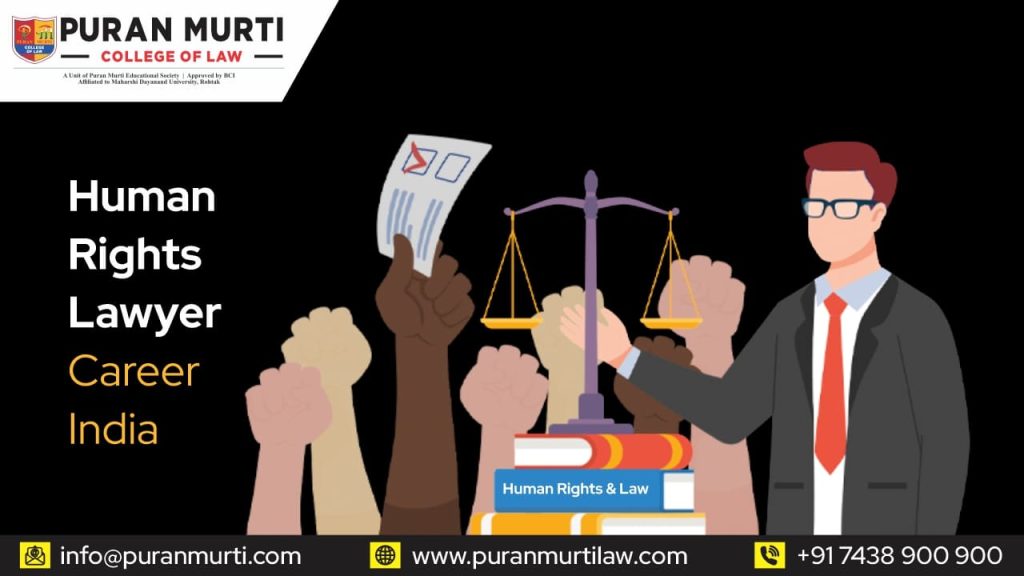
Human Rights Lawyer Career India
Posted on : 28 September, 2026 3:41 pm
A human rights lawyer career in India gives you the opportunity to protect people and support social justice. Human rights lawyers work on cases related to equality, discrimination, unlawful detention, violence and child protection.
They may work in courts, law firms, NGOs, government bodies and research organisations. Some professionals also work in public policy, legal education and human rights campaigns.
This career needs legal knowledge, strong research skills and compassion. It also requires patience because many cases take time to resolve.
This guide explains how to build a human rights lawyer career in India. It also covers courses, eligibility, job roles, skills, salary and career opportunities at Puran Murti Vidyapeeth.
What Does a Human Rights Lawyer Do?
A human rights lawyer protects the legal rights of individuals and communities. The work may involve court cases, legal advice, research and public awareness.
Common responsibilities include:
- Advising clients about their legal rights.
- Preparing petitions and legal notices.
- Representing clients in court.
- Researching laws and judgments.
- Investigating rights violations.
- Preparing legal reports.
- Supporting victims and vulnerable groups.
- Conducting legal-awareness programmes.
- Working with government departments.
- Filing public interest cases.
A lawyer may work on one case for several months. Some complex matters can continue for many years.
Areas of Human Rights Law
Human rights law covers several important areas. You can choose a specialisation based on your interests.
Women’s Rights
Lawyers may work on domestic violence, workplace harassment, equality and access to justice.
Child Rights
This area includes child labour, abuse, trafficking, education and juvenile justice.
Prisoners’ Rights
Lawyers may challenge unlawful detention and poor prison conditions. They may also help prisoners access legal aid.
Disability Rights
This work supports equal access to education, employment, transport and public services.
Minority Rights
Lawyers may work on discrimination, violence, representation and cultural rights.
Labour Rights
This area includes unsafe workplaces, unpaid wages, forced labour and unfair dismissal.
Environmental Rights
Pollution can affect health, housing and access to clean water. Human rights lawyers may support communities affected by environmental damage.
Refugee and Migrant Rights
Lawyers may help displaced people understand their legal rights. They may also assist with documentation and protection.
How to Become a Human Rights Lawyer
Complete Class 12
Students from any stream can study law after Class 12. Arts is a popular choice, but Science and Commerce students can also apply.
Choose a Law Degree
You can choose one of these options:
- BA LLB after Class 12.
- BBA LLB after Class 12.
- B.Com LLB after Class 12.
- Three-year LLB after graduation.
BA LLB is a useful choice for students interested in law, society and politics. It usually takes five years.
Study Relevant Subjects
During your law degree, choose subjects such as:
- Constitutional Law.
- Human Rights Law.
- Criminal Law.
- Administrative Law.
- International Law.
- Environmental Law.
- Public Interest Law.
- Gender Justice.
- Child Rights.
- Legal Aid.
Gain Practical Experience
Complete internships with:
- Human rights NGOs.
- Legal-aid clinics.
- Courts.
- Law firms.
- Government commissions.
- Research centres.
- Social organisations.
- Legal service authorities.
Practical experience helps you understand real legal problems.
Enrol as an Advocate
If you want to practise in court, follow the applicable enrolment process with a State Bar Council. The Bar Council of India provides information about advocate enrolment and the All India Bar Examination
A valid Certificate of Practice is required for professional legal practice under the applicable rules.
Check the latest Bar Council notifications before applying.
Entrance Exams for Law
CLAT
The Common Law Admission Test is accepted by participating National Law Universities. It tests:
- English.
- Current affairs.
- Legal reasoning.
- Logical reasoning.
- Quantitative techniques.
AILET
The All India Law Entrance Test is used for admission to National Law University Delhi.
University Entrance Tests
Many universities conduct their own law entrance tests. Some accept CLAT scores or Class 12 marks.
Merit-Based Admission
Some colleges offer admission based on qualifying marks. Always check the latest college notification.
Human Rights Law Subjects
A strong foundation in several law subjects is important.
Constitutional Law
This subject covers Fundamental Rights, equality, liberty and constitutional remedies.
Criminal Law
Criminal Law is useful in cases involving violence, abuse, unlawful detention and criminal responsibility.
Administrative Law
This subject explains how public authorities must exercise their powers. It helps lawyers challenge unfair government decisions.
International Law
International Law covers treaties, global organisations and international human rights standards.
Law of Evidence
Evidence Law helps lawyers understand how facts are proved in court.
Public Interest Litigation
Public Interest Litigation allows lawyers to raise issues that affect communities or the public.
Skills Required
Legal Research
You must find relevant laws, judgments and reports. Learn to use reliable legal databases.
Legal Writing
Human rights lawyers prepare petitions, reports and written submissions. Your writing must be clear and accurate.
Communication
You need to explain legal issues in simple language. This is important when working with people who have limited legal knowledge.
Client Interviewing
Sensitive cases require careful interviews. Listen patiently and avoid making quick assumptions.
Critical Thinking
Human rights cases often involve complex facts. Study each document before forming an opinion.
Empathy
Clients may have faced violence, discrimination or displacement. Treat them with respect.
Teamwork
Human rights work often includes lawyers, researchers, social workers and community leaders.
Time Management
Court deadlines and urgent applications require good organisation.
Career Options
Courts and Law Firms
You can practise constitutional law, criminal law and public interest litigation. Some law firms have dedicated human rights teams.
Non-Governmental Organisations
NGOs work on legal aid, child rights, women’s rights, labour rights and social justice.
Government Commissions
Government commissions investigate complaints and promote human rights. They may recruit legal officers, researchers and consultants.
National Human Rights Commission
The National Human Rights Commission has legal and judicial roles. Some positions require a recognised law degree and professional experience.
State Human Rights Commissions
State commissions investigate complaints and conduct awareness programmes. They may offer roles in legal research and case review.
International Organisations
Experienced lawyers may work with international agencies and humanitarian organisations. These roles often require strong research and policy skills.
Universities and Research Centres
You can work as a legal researcher, lecturer or policy analyst. Higher qualifications may be needed for teaching positions.
Corporate Social Responsibility Teams
Some companies hire legal professionals for labour standards, human rights due diligence and community programmes.
Human Rights Lawyer Salary in India
Salary depends on experience, employer, location and job role.
Entry-Level Salary
Fresh graduates may earn around ₹2.5 lakh to ₹5 lakh per year. Salaries vary between NGOs, law firms and research organisations.
Mid-Level Salary
Professionals with experience may earn approximately ₹5 lakh to ₹12 lakh per year.
Senior-Level Salary
Senior lawyers, consultants and policy experts may earn ₹12 lakh to ₹30 lakh or more per year.
These are broad estimates. NGO salaries may be lower at the beginning. However, NGO work can provide valuable experience.
Professionals in international organisations, specialist law firms and consulting roles may earn more. Salary also depends on qualifications and specialisation.
Human Rights Law at Puran Murti Vidyapeeth
Puran Murti Vidyapeeth is located on Kami Road, Sonipat, Haryana, in the Delhi-NCR region. Its official website lists law programmes through Puran Murti College of Law.
The institution lists these law courses:
- BA LLB (Hons.).
- LLB (Hons.).
- LLM.
The BA LLB (Hons.) programme is a five-year integrated course for students who have completed Class 12. The programme combines arts subjects with legal education.
The LLB (Hons.) programme is a three-year course for graduates. The institution also lists LLM study with areas such as Constitutional Law, Corporate Law, Criminal Law, International Law and Human Rights Law.
Learning Opportunities
Students interested in human rights can build a strong foundation through:
- Constitutional Law.
- Criminal Law.
- Public law.
- Legal research.
- Moot courts.
- Legal drafting.
- Internships.
- Seminars.
- Legal-aid activities.
The institution’s law information also highlights practical training, moot courts and internships.
Students should confirm current approval, affiliation, eligibility, fees and admission details directly with the institution before applying.
Higher Studies
Higher education can improve your career opportunities.
You can pursue:
- LLM in Human Rights Law.
- LLM in Constitutional Law.
- LLM in International Law.
- LLM in Criminal Law.
- Postgraduate Diploma in Human Rights Law.
- Diploma in International Humanitarian Law.
- PhD in Law.
- Master’s degree in Public Policy.
A postgraduate programme can help you specialise in research, policy, litigation or international law.
Useful Certifications
Short courses can improve your knowledge. Consider courses in:
- Human rights law.
- Child rights.
- Gender justice.
- International humanitarian law.
- Environmental law.
- Legal research.
- Public policy.
- Mediation.
- Human rights documentation.
- Cyber rights.
Choose a course from a recognised institution. Check its syllabus, faculty and assessment method.
Internship Roadmap
First Year
Learn basic legal research and writing. Join a legal-aid clinic or student law society.
Second Year
Intern with a local lawyer, NGO or district legal services organisation. Observe court proceedings.
Third Year
Work on a human rights project. Prepare case summaries and research reports.
Fourth Year
Apply to national NGOs, commissions, research centres or law firms. Choose an area of interest.
Fifth Year
Complete a focused internship. Build a portfolio of research papers, writing samples and certificates.
Challenges in This Career
Human rights work can be meaningful, but it also has challenges.
- Cases may take years.
- Funding may be uncertain.
- Clients may face serious risks.
- Fieldwork may involve travel.
- Emotional stress can be high.
- Starting salaries may be modest.
- Court results may not be immediate.
You should understand these challenges before choosing this career. Professional boundaries and emotional support are important.
How to Build a Strong Profile
Write Legal Articles
Write about constitutional rights, recent judgments and legal reforms. Use reliable sources.
Join Moot Courts
Moot courts improve research, drafting and public speaking.
Attend Seminars
Seminars help you learn from lawyers, judges, researchers and activists.
Learn Documentation
Human rights work requires accurate records. Learn how to organise statements, interviews and evidence.
Follow Current Affairs
Read important judgments, government reports and human rights developments.
Create a Portfolio
Keep your research papers, internships, certificates and writing samples together.
Is Human Rights Law a Good Career?
Human rights law can be a rewarding career for students who care about justice and social change. It combines legal knowledge with public service.
The career may grow more slowly than some corporate law careers. You may begin with internships, volunteering or research work.
Choose this path because you value the work. Do not select it only because of salary expectations.
Final Thoughts
A human rights lawyer career in India offers opportunities in courts, NGOs, government commissions, research centres and international organisations.
Start with a recognised law degree. Build skills in research, drafting, communication and public speaking. Gain experience through internships and legal-aid work.
Puran Murti Vidyapeeth offers BA LLB (Hons.), LLB (Hons.) and LLM programmes through its law education setup in Sonipat, Haryana. Students interested in human rights can explore relevant subjects, practical training and higher-study options.
If you want to practise in court, follow the current State Bar Council enrolment process and professional examination requirements.
Human rights law needs committed professionals. With patience, knowledge and practical experience, you can build a meaningful legal career.
Note: Course details, approval status, admission rules, professional requirements and salary figures can change. Confirm the latest information on official university, Bar Council and employer websites.
FAQs
What does a human rights lawyer do?
A human rights lawyer protects legal rights. They may represent clients, file petitions, conduct research and support public awareness.
How do I become a human rights lawyer in India?
Complete an LLB degree. Gain experience in human rights work. Then follow the applicable State Bar Council and All India Bar Examination requirements if you want to practise in court.
Which law degree is best for human rights?
BA LLB, BBA LLB and the three-year LLB can all lead to human rights work. Choose a recognised course with relevant subjects and practical training.
Does Puran Murti Vidyapeeth offer law courses?
Yes. Puran Murti Vidyapeeth lists BA LLB (Hons.), LLB (Hons.) and LLM programmes through Puran Murti College of Law.
Is human rights law a good career?
Yes, it can be meaningful for students who care about justice, equality and public service.
What skills does a human rights lawyer need?
Important skills include legal research, drafting, communication, client interviewing, empathy, teamwork and critical thinking.
What is the salary of a human rights lawyer?
Freshers may earn around ₹2.5 lakh to ₹5 lakh per year. Experienced lawyers and specialists may earn ₹12 lakh to ₹30 lakh or more.
Can I work in an NGO after LLB?
Yes. NGOs hire law graduates for legal aid, research, documentation, advocacy and programme roles.
Can I study human rights law after graduation?
Yes. You can pursue an LLM, postgraduate diploma or certificate course in human rights law.
What subjects help in human rights law?
Constitutional Law, Criminal Law, International Law, Administrative Law, Evidence Law and Public Interest Litigation are useful subjects.