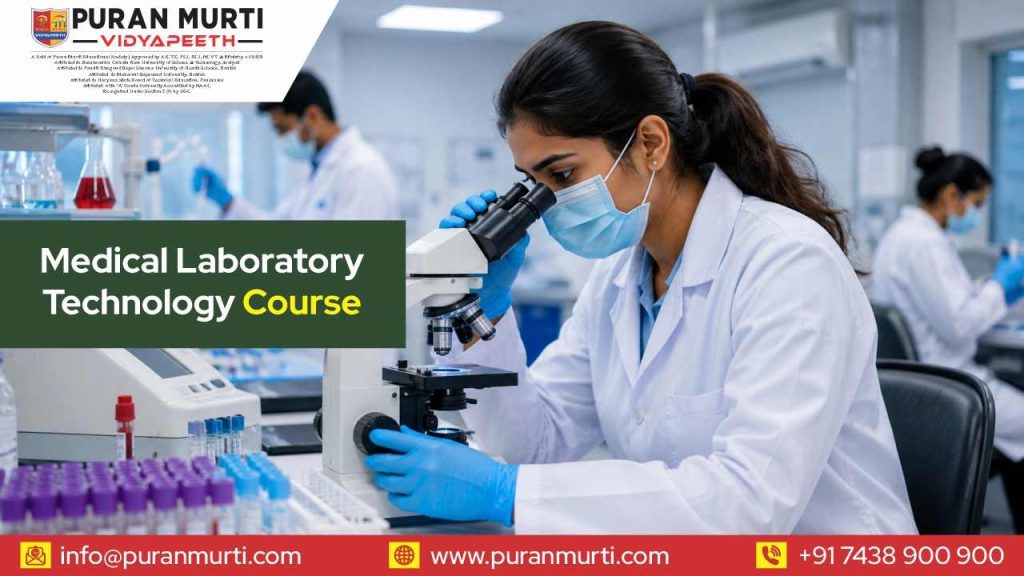
Medical Laboratory Technology Course in Sonipat
Posted on : 19 August, 2026 12:59 am
Choosing a healthcare career does not always mean becoming a doctor or nurse. Medical Laboratory Technology (MLT) offers another important route for students who are interested in science, diagnostics, laboratory work, and healthcare technology.
Every day, doctors depend on laboratory reports to support diagnosis and treatment. Behind these reports are trained laboratory professionals who collect, process, test, and document clinical samples with accuracy and care.
Therefore, students looking for a Medical Laboratory Technology course in Sonipat should understand more than just the course name. Eligibility, syllabus, practical training, laboratory facilities, career opportunities, higher studies, and institutional support all matter when making this decision.
For students in Sonipat and the wider Delhi-NCR region, Puran Murti Vidyapeeth provides a healthcare-focused academic environment with laboratory-based learning opportunities. Its published DMLT information covers subjects such as pathology, microbiology, hematology, and biochemistry.
What Is Medical Laboratory Technology?
Medical Laboratory Technology is an allied healthcare field that focuses on the testing and analysis of clinical samples.
These samples may include blood, urine, body fluids, tissues, and other specimens. Laboratory professionals use established procedures and equipment to generate accurate results that can assist healthcare professionals in diagnosis, treatment, and monitoring.
In simple terms:
Medical Laboratory Technology is the science of performing laboratory investigations that support medical diagnosis and patient care.
The field combines biology, chemistry, laboratory science, technology, accuracy, and healthcare practices.
Moreover, India’s healthcare system increasingly emphasizes the standardization and regulation of allied healthcare professions. WHO reports that the National Commission for Allied and Healthcare Professions was constituted in 2024 to strengthen governance, transparency, and standardization across 57 allied healthcare fields.
Why Is Medical Laboratory Technology Important?
A medical diagnosis often requires more than symptoms and a physical examination.
For example, a doctor may need laboratory information to investigate:
- Blood disorders
- Infections
- Diabetes
- Kidney-related conditions
- Liver-related conditions
- Certain hormonal conditions
- Microbial infections
- Other clinical abnormalities
Consequently, laboratory professionals have an important supporting role in modern healthcare.
What Does a Medical Laboratory Technician Do?
Depending on their qualification and job role, laboratory professionals may:
- Collect and receive clinical samples
- Label and handle specimens
- Operate laboratory equipment
- Perform laboratory procedures
- Assist with blood and other sample testing
- Maintain laboratory records
- Follow safety protocols
- Support quality-control procedures
- Prepare reports according to professional protocols
- Work alongside pathologists and healthcare teams
Accuracy is particularly important because an incorrect or poorly handled sample can affect the reliability of a test result.
Why Choose a Medical Laboratory Technology Course in Sonipat?
Sonipat is part of the Delhi-NCR region and offers students access to an expanding educational and healthcare environment.
For students from Haryana, Delhi, and nearby areas, studying in Sonipat can also provide the advantage of staying relatively close to home while pursuing a career-oriented healthcare program.
Key Advantages of Studying in Sonipat
- Delhi-NCR connectivity
Students can benefit from access to the wider NCR education and employment ecosystem. - Career-focused education
MLT combines classroom learning with laboratory-oriented practical skills. - Healthcare exposure
Students can prepare for potential roles across hospitals, diagnostic centres, laboratories, and related organizations. - Practical learning
Laboratory-based education allows students to develop technical confidence. - Scope for further education
Students can explore higher qualifications after completing their initial program, subject to eligibility.
Puran Murti Vidyapeeth describes its Sonipat campus as a multidisciplinary educational environment with 100+ laboratories and a focus on practical learning.
DMLT vs Medical Laboratory Technology: Are They the Same?
Students frequently see the terms DMLT, MLT, and Medical Laboratory Technology while searching for courses.
DMLT generally refers to Diploma in Medical Laboratory Technology, while MLT is the broader name of the field. The exact qualification, duration, eligibility, and progression opportunities depend on the institution and program.
| Feature | DMLT | Degree-Level MLT |
|---|---|---|
| Full form | Diploma in Medical Laboratory Technology | Medical Laboratory Technology degree |
| Qualification | Diploma | Undergraduate degree |
| Main focus | Technical and practical laboratory skills | Broader academic and professional preparation |
| Career entry | Entry-level laboratory roles | Wider opportunities depending on qualification |
| Higher studies | Available through eligible pathways | Further specialization and postgraduate options |
Always check the current institutional prospectus before admission, because course nomenclature and progression rules can differ.
Medical Laboratory Technology Eligibility
Who Can Apply for DMLT?
Eligibility depends on the specific institution and qualification.
Puran Murti Vidyapeeth currently publishes DMLT eligibility information for students entering through different academic pathways. Its official pages contain varying descriptions of entry routes and should therefore be checked against the latest admission notification before applying.
Generally, students should check:
- Required educational qualification
- Class 10 or Class 12 requirements
- Science-subject requirements, where applicable
- Minimum marks
- Category-specific requirements
- Admission mode
- Lateral-entry eligibility
Why Should Students Check Eligibility Carefully?
Online information about DMLT eligibility is often inconsistent.
Therefore, students should not rely solely on third-party education portals. Instead, check the latest official admission notification, prospectus, and institutional counselling information before submitting an application.
DMLT Course Duration
Course duration can vary according to the institution and entry route.
Puran Murti Vidyapeeth’s official course pages currently describe DMLT as a multi-semester program, while other official pages mention different structures for fresh and lateral-entry students.
For this reason, prospective students should confirm the 2026–27 course duration applicable to their admission category directly with the college.
What Can Affect Course Duration?
The duration may depend on:
- Entry qualification
- Fresh admission
- Lateral entry
- Institutional curriculum
- Affiliation requirements
- Semester structure
This is especially important for students comparing multiple DMLT colleges in Sonipat and Delhi NCR.
Medical Laboratory Technology Syllabus
The syllabus generally combines basic medical sciences with specialized laboratory subjects.
Foundation Subjects
Students may study:
- Anatomy
- Physiology
- Pharmacology
- Community medicine
- Statistics
These subjects help students understand the human body and basic healthcare concepts.
Core Laboratory Subjects
As students progress, they may study:
- Pathology
- Hematology
- Blood banking
- Microbiology
- Biochemistry
- Immunohematology
These areas form the foundation of laboratory-based diagnostic education.
Advanced Laboratory Areas
Depending on the curriculum, students may also encounter:
- Histotechnology
- Cytology
- Immunology
- Serology
- Parasitology
- Virology
Puran Murti Vidyapeeth’s published DMLT syllabus includes these broad areas across its course structure.
Why Practical Training Matters in MLT
Medical laboratory technology is a practical profession.
Consequently, students should not select a college based only on classroom teaching. They should also examine the availability of laboratories, equipment, demonstrations, supervised practical work, and industry exposure.
What Should Students Look for in a Laboratory?
A good learning environment should encourage students to understand:
- Sample handling
- Laboratory safety
- Testing procedures
- Equipment operation
- Documentation
- Quality control
- Hygiene and infection-control practices
- Professional laboratory behaviour
Puran Murti Vidyapeeth highlights practical learning and laboratory facilities as part of its DMLT education environment.
Top Career Opportunities After Medical Laboratory Technology
Completing an MLT qualification can open pathways into several healthcare and laboratory environments.
1. Medical Laboratory Technician
Medical laboratory technicians may assist with sample processing, laboratory procedures, documentation, and routine diagnostic workflows.
2. Pathology Laboratory Assistant
Pathology laboratories require trained staff to support sample preparation, testing processes, record keeping, and other technical activities.
3. Hospital Laboratory Professional
Hospitals maintain laboratories that support different clinical departments and patient-care services.
4. Diagnostic Centre Professional
Diagnostic centres conduct various investigations and require trained personnel for laboratory operations.
5. Blood Bank Technician
Students with appropriate training and qualifications can explore roles related to blood-bank operations.
6. Microbiology Laboratory Roles
Students interested in microorganisms can develop careers in laboratories working with microbiological testing.
7. Biochemistry Laboratory Roles
This area involves biochemical investigations and laboratory analysis.
8. Research and Quality Control
With additional education and experience, professionals may explore research, quality assurance, quality control, or laboratory management pathways.
Where Can Medical Laboratory Technicians Work?
A trained laboratory professional may find opportunities in:
- Hospitals
- Pathology laboratories
- Diagnostic centres
- Clinics
- Blood banks
- Research laboratories
- Healthcare organizations
- Pharmaceutical organizations
- Public and private healthcare facilities
However, the exact job title and responsibilities depend on the individual’s qualification, employer, experience, and applicable regulations.
Medical Laboratory Technology Career Scope in India
The healthcare sector requires professionals across many disciplines, and laboratory personnel form an important part of the healthcare workforce.
WHO’s India health-workforce information specifically discusses allied and healthcare professionals and the development of regulatory frameworks for these fields.
Therefore, MLT can offer a useful pathway for students who want to work behind the scenes of healthcare while contributing to diagnosis and patient management.
Career Growth Can Look Like This
MLT Qualification → Entry-Level Laboratory Role → Practical Experience → Specialization → Senior Technical/Quality Roles → Further Education
The journey is not identical for every student. Nevertheless, continuous skill development can improve long-term career readiness.
Medical Laboratory Technician Salary in India
Salary is one of the most searched questions among students.
However, there is no single salary figure that applies to every MLT graduate.
Income can vary according to:
- Qualification
- Experience
- Employer
- Location
- Job responsibilities
- Laboratory specialization
- Government or private sector
- Additional certifications
Puran Murti Vidyapeeth’s published information provides indicative salary figures for DMLT graduates, but these should be treated as estimates rather than guaranteed salaries.
How Can Students Improve Their Career Prospects?
Students can strengthen their profile by developing:
- Strong laboratory fundamentals
- Practical experience
- Communication skills
- Computer knowledge
- Documentation skills
- Quality-control awareness
- Professional ethics
- Specialized technical skills
What Skills Are Important for a Medical Laboratory Technician?
A successful laboratory professional needs more than textbook knowledge.
Important Technical Skills
Students should work on:
- Sample handling
- Laboratory equipment use
- Basic diagnostic procedures
- Safety protocols
- Quality-control practices
- Laboratory documentation
Important Soft Skills
Equally important are:
- Attention to detail
- Time management
- Teamwork
- Communication
- Responsibility
- Patience
- Professional discipline
For example, a technician may perform a technically correct procedure but still create problems if the sample is mislabeled or documentation is incomplete.
Therefore, accuracy and responsibility are just as important as technical knowledge.
How to Choose the Best DMLT College in Sonipat
Selecting the right institution requires careful comparison.
Before applying, consider these factors:
| Factor | What to Check |
| Course Recognition | Current approval or affiliation |
| Curriculum | Relevant medical laboratory subjects |
| Laboratories | Equipment and practical facilities |
| Faculty | Qualifications and teaching experience |
| Practical Training | Hands-on laboratory opportunities |
| Industry Exposure | Training, visits or internships |
| Placement Support | Career preparation and employer connections |
| Fees | Complete fee structure |
| Location | Connectivity and accessibility |
| Student Facilities | Library, hostel, transport and campus support |
| Higher Studies | Available progression pathways |
A Simple Rule for Students
Do not select a college only because a website calls it the “best.”
Instead, compare the course, facilities, faculty, practical exposure, official affiliation, fees, and career support.
Most importantly, verify current information directly with the institution.
Why Choose Puran Murti Vidyapeeth for DMLT?
Students searching for a DMLT college in Sonipat or Delhi NCR can consider Puran Murti Vidyapeeth based on its published academic and campus information.
Delhi-NCR Location
The institution is located on Kami Road, Sonipat, Haryana, within the Delhi-NCR region.
Laboratory Infrastructure
The institution highlights 100+ laboratories across its campus ecosystem, supporting practical learning across different disciplines.
Healthcare-Focused Learning
The DMLT curriculum covers key areas such as pathology, microbiology, hematology, and biochemistry.
Career Support
Puran Murti Vidyapeeth states that it provides training and placement support for students. However, prospective students should always ask for the latest course-specific placement information rather than assuming that every graduate will receive the same outcome.
Further Study Opportunities
Students completing DMLT can explore further education. Puran Murti Vidyapeeth’s published information mentions B.Sc. MLT and other related higher-study pathways, subject to eligibility and institutional rules.
DMLT Course Fees at Puran Murti Vidyapeeth
Fees can change according to academic session and admission category.
The institution’s currently published fee information lists separate structures for fresh and lateral entry. It gives a published total of ₹1,42,500 for fresh-entry DMLT students for three years, excluding hostel, and ₹1,02,500 for lateral entry, according to the current fee page.
What Should Students Confirm Before Admission?
Before paying fees, ask about:
- Tuition fees
- Registration charges
- Admission charges
- Examination fees
- Hostel charges
- Books and uniform
- Transportation
- Scholarship eligibility
- Any additional institutional charges
Since fee structures can change, students should confirm the latest 2026–27 fee schedule with the admissions office.
Can You Pursue Higher Studies After DMLT?
Yes, higher education can be an important next step for students who want broader career opportunities.
Possible pathways may include:
- B.Sc. Medical Laboratory Technology
- Related life-science programs
- Advanced diplomas
- Specialized certifications
- Research-oriented programs
Puran Murti Vidyapeeth’s published information specifically mentions B.Sc. MLT and related study options for eligible diploma holders.
Why Consider Higher Education?
Further study can help students:
- Develop advanced technical knowledge
- Explore specialized laboratory fields
- Become eligible for additional roles
- Build research skills
- Improve long-term career progression
However, students should verify lateral-entry and eligibility rules with the university or institution offering the next qualification.
Is Medical Laboratory Technology a Good Career Option?
Yes, Medical Laboratory Technology can be a good career option for students who enjoy science, diagnostics, laboratory work, and healthcare technology. It provides opportunities across hospitals, diagnostic centres, pathology laboratories, blood banks, and research environments. However, career growth depends on qualification, practical skills, experience, specialization, and continuous learning.
Who Should Choose MLT?
MLT may be suitable if you:
- Like biology and science
- Enjoy practical laboratory work
- Have good attention to detail
- Prefer analytical tasks
- Are interested in healthcare
- Want a technical healthcare career
- Can follow safety procedures carefully
On the other hand, students who strongly prefer continuous face-to-face patient care may want to compare MLT with nursing, physiotherapy, or other healthcare programs.
MLT vs Other Healthcare Courses
Choosing between healthcare programs becomes easier when students understand their primary focus.
| Course/Career | Primary Focus |
| Medical Laboratory Technology | Diagnostic laboratory testing |
| Nursing | Patient care and clinical support |
| Pharmacy | Medicines and pharmaceutical sciences |
| Physiotherapy | Physical rehabilitation |
| Radiology/Imaging | Medical imaging and diagnostic technology |
Therefore, MLT can be particularly attractive for students who enjoy science, laboratory technology, testing, and analytical work.
Future of Medical Laboratory Technology
Medical laboratories are evolving alongside healthcare technology.
Automation, digital laboratory systems, advanced diagnostic methods, molecular testing, data management, and quality systems are changing how laboratories operate.
As a result, future laboratory professionals will need more than basic technical knowledge.
They will increasingly benefit from understanding:
- Modern laboratory equipment
- Digital documentation
- Quality assurance
- Laboratory safety
- Data handling
- Automation
- New diagnostic technologies
The Future Skill Formula
Medical Knowledge + Laboratory Skills + Technology + Accuracy + Continuous Learning = Better Career Readiness
This approach can help students prepare for a healthcare environment that continues to change.

How to Build a Successful MLT Career
Follow these practical steps:
- Choose the right qualification.
- Verify the institution’s current recognition and affiliation.
- Understand pathology, microbiology, hematology, and biochemistry fundamentals.
- Take practical laboratory sessions seriously.
- Learn proper sample handling and safety procedures.
- Develop computer and documentation skills.
- Seek practical exposure wherever available.
- Improve communication and teamwork.
- Consider higher education or specialization.
- Continue learning as diagnostic technology evolves.
Frequently Asked Questions
What is Medical Laboratory Technology?
Medical Laboratory Technology is an allied healthcare field focused on laboratory examination of clinical samples. Professionals use laboratory procedures and equipment to produce test results that support medical diagnosis, treatment, and monitoring.
What is the full form of DMLT?
DMLT stands for Diploma in Medical Laboratory Technology. It is a diploma-level qualification focused on developing theoretical and practical skills for medical laboratory work.
Is DMLT a good career after Class 12?
Yes. DMLT can be a practical career option for students interested in science, healthcare, diagnostics, and laboratory technology. However, students should compare eligibility, course structure, practical facilities, recognition, fees, and career support before choosing a college.
What subjects are taught in DMLT?
Common DMLT subjects include anatomy, physiology, pathology, hematology, microbiology, biochemistry, blood banking, immunology, serology, cytology, histotechnology, and laboratory practices. The exact syllabus varies by institution.
What is the eligibility for a DMLT course?
Eligibility differs between institutions. Therefore, students should check the latest admission notification. Puran Murti Vidyapeeth currently publishes specific eligibility information for its DMLT program and different admission pathways.
How long is the DMLT course?
The duration depends on the institution and entry route. Puran Murti Vidyapeeth’s current official pages describe different structures for fresh and lateral-entry students. Students should confirm the applicable duration for the 2026–27 admission session directly with the institution.
Where can DMLT graduates work?
Graduates can explore opportunities in hospitals, pathology laboratories, diagnostic centres, clinics, blood banks, research facilities, and other healthcare organizations, depending on their qualification and the employer’s requirements.
Can I pursue higher studies after DMLT?
Yes. Eligible students can explore B.Sc. MLT and related higher-education pathways. The exact admission route depends on the university, qualification, and current academic regulations.
Is DMLT available in Sonipat?
Yes. Students searching for DMLT education in Sonipat can explore institutions including Puran Murti Vidyapeeth and compare course details, eligibility, laboratories, fees, practical exposure, and admission requirements.
Why choose Puran Murti Vidyapeeth for DMLT?
Puran Murti Vidyapeeth offers a Sonipat location within Delhi-NCR, laboratory-focused learning, multidisciplinary academic facilities, and published career-support initiatives. Students should verify the latest course-specific details before admission.
Final Thoughts
Medical Laboratory Technology is more than a course about laboratory tests. It is a career path that connects science, technology, diagnostics, and healthcare.
For students who enjoy biology and practical work, MLT can provide an opportunity to build technical skills while contributing to an essential part of patient care.
However, choosing the right college is equally important.
Look beyond advertisements and compare the curriculum, laboratory facilities, faculty, practical training, recognition, fees, student support, and career opportunities.
If you are searching for a Medical Laboratory Technology course in Sonipat, Puran Murti Vidyapeeth can be one institution to explore as you compare your options in Delhi-NCR.
Ready to Take the Next Step?
If MLT matches your interests and career goals, start by understanding the current admission requirements and visiting the campus.
Explore the DMLT program, speak with the admissions team, see the learning facilities, and make an informed decision about your healthcare career.
Your journey toward a career in medical diagnostics can begin with the right education, practical skills, and determination.