
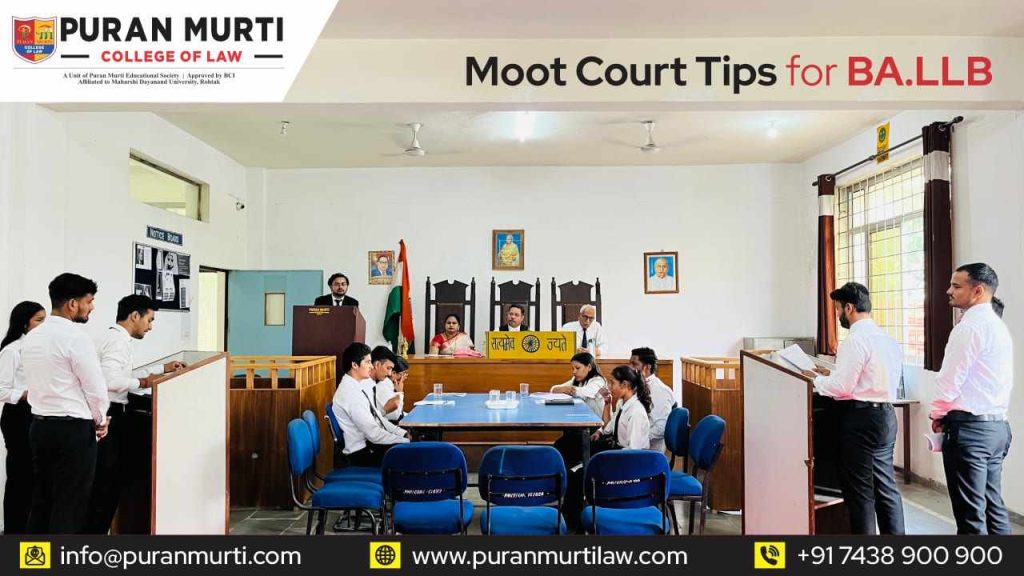
Moot Court Tips for BA LLB
Posted on : 28 September, 2026 10:25 am
Moot court is an important part of the BA LLB course. It gives students a chance to practise legal research, writing and oral arguments.
A moot court simulates a real court hearing. Students receive a legal problem and argue for both sides. They prepare written memorials and present their arguments before judges. Many students feel nervous before their first moot. That is normal. With regular practice, you can improve your confidence and performance. This guide shares practical moot court tips for BA LLB students. It covers research, memorial writing, oral arguments, teamwork and courtroom etiquette.
What Is a Moot Court?
A moot court is a simulated legal hearing. It follows a format similar to a court case.
Students usually work in teams. Some students act as speakers. Others research the law and help prepare the memorial.
A typical moot includes:
- A proposition or legal problem.
- A petitioner or appellant.
- A respondent.
- Written memorials.
- Oral submissions.
- Questions from judges.
- A final prayer or request for relief.
A moot court does not focus only on speaking. It also tests legal research, analysis, drafting and teamwork.
Read the Moot Proposition Carefully
The first step is to read the moot proposition several times.
Do not begin research immediately. First, understand the facts and legal questions.
While reading, mark:
- Names of the parties.
- Important dates.
- Events in order.
- Relevant documents.
- Legal disputes.
- Procedural history.
- Relief requested.
- Facts that support each side.
Create a simple timeline. It will help you remember the facts during the hearing.
Also, separate facts from assumptions. Do not add facts that are not present in the proposition. Judges may ask questions about this point.
Identify the Legal Issues
The next step is to frame the issues.
An issue is a legal question that the court must decide. Each issue should be clear and connected to the facts.
For example:
Whether the respondent violated the petitioner’s fundamental right by restricting access to the service?
Avoid writing issues that are too long. A clear issue helps you organise both the memorial and the oral argument.
Tips for framing issues
- Use a question format.
- Mention the relevant legal dispute.
- Avoid unnecessary facts.
- Do not include your conclusion.
- Keep each issue focused.
- Follow the proposition and rules.
Usually, a moot has two to four major issues. Check the competition rules before finalising them.
Divide the Research Work
Good teamwork can save time. Divide the research between team members.
One person can research the first issue. Another can study the second issue. A third member can check cases, statutes and procedural points.
However, every team member should understand the complete case. Speakers may receive questions on any issue.
Create a shared research document. Add:
- Case names.
- Court and year.
- Important facts.
- Legal principles.
- Relevant paragraphs.
- Statutory provisions.
- Web links or database details.
- Use of the case in your argument.
Do not add cases without reading them. A judge may ask about the exact facts or legal principle.
Use Reliable Legal Sources
Use primary legal sources whenever possible.
These include:
- The Constitution.
- Statutes.
- Rules.
- Regulations.
- Court judgments.
- Official reports.
- Government websites.
Secondary sources can help you understand difficult topics. These include textbooks, commentaries, journals and legal articles.
However, do not rely only on blogs or summaries. Read the original judgment or legal provision before using it in the memorial.
Find the Best Authorities
A strong argument needs relevant authorities. The number of cases is less important than their quality.
Look for cases that:
- Address the same legal issue.
- Come from a higher court.
- Support your legal principle.
- Explain the relevant statute.
- Include similar facts.
- Remain good law.
Read the ratio of each case. The ratio is the legal principle that supports the decision.
Also check whether a later judgment has changed or overruled the case.
Prepare a Case Chart
A case chart makes research easier.
| Case | Legal issue | Principle | Use in argument |
|---|---|---|---|
| Case A | Right affected | Explains the legal test | Supports Issue 1 |
| Case B | Contract dispute | Defines breach | Supports Issue 2 |
| Case C | Court power | Explains jurisdiction | Supports preliminary objection |
This chart helps you avoid repeated research. It also makes memorial writing faster.
Understand the Memorial Format
A memorial is the written argument of a party. It explains the facts, issues, law and relief requested.
Competition rules differ. Always follow the official rulebook.
A memorial may include:
- Cover page.
- Table of contents.
- List of abbreviations.
- Index of authorities.
- Statement of jurisdiction.
- Statement of facts.
- Issues for consideration.
- Summary of arguments.
- Arguments advanced.
- Prayer for relief.
Many competitions require memorials for both sides. Some rules also require hard copies and soft copies. Submission deadlines are strict.
A national moot rulebook may require a fixed order of sections and a page limit. It may also prohibit identification of the team or college in the memorial.
Write a Clear Statement of Facts
The statement of facts should be accurate and persuasive.
Do not argue heavily in this section. Present the facts in a way that supports your client, but avoid changing the proposition.
Use a logical order:
- Introduce the parties.
- Explain the important events.
- Mention the legal action.
- Describe the decision or dispute.
- End with the current issue before the court.
Keep the language neutral and professional.
Write a Strong Summary of Arguments
The summary gives judges a quick view of your case.
Write one short section for each issue. Explain:
- Your position.
- The main legal rule.
- The important authority.
- The result you want.
Do not copy the complete argument into the summary. Present the central reasoning in a concise way.
Structure Your Arguments
Use a clear structure for every argument.
A simple method is:
- State the legal rule.
- Explain the rule.
- Cite authority.
- Apply the rule to the facts.
- State the conclusion.
This method helps judges follow your reasoning.
For example:
The petitioner has a right to notice before the decision. The relevant statute requires prior notice. The respondent did not provide notice. Therefore, the decision is invalid.
This structure is simple, direct and persuasive.
Prepare Arguments for Both Sides
Even if you represent only one side during the final round, research both sides.
The opposing team may raise arguments that you did not expect. You should know how to answer them.
Prepare:
- The strongest point for your side.
- The strongest point for the other side.
- A response to that point.
- A fallback argument.
- A suitable remedy.
This preparation helps you answer questions with confidence.
Practise Oral Arguments
Oral arguments are different from reading a memorial. You should speak naturally and maintain eye contact.
Begin with a respectful introduction:
May it please the Court. I am [name], counsel for the petitioner/respondent.
Then provide a short roadmap:
I will make two submissions. First, the petition is maintainable. Second, the respondent violated the petitioner’s legal right.
A clear roadmap helps judges understand your argument. Oral advocacy guides commonly recommend an opening, a short roadmap, focused arguments and a clear prayer.
Keep Your Opening Short
Do not spend too much time introducing the case. Move quickly to your strongest point.
A good opening should include:
- Greeting.
- Your name.
- Your side.
- Your team number, if required.
- The issues you will argue.
- Your first submission.
Memorise the opening. This helps you begin confidently.
Answer Judicial Questions Directly
Judges may interrupt your argument. This is normal.
Listen carefully. Stop speaking when a judge begins to ask a question.
Answer the question first. Then return to your argument.
Use phrases such as:
- Yes, Your Lordship.
- No, Your Ladyship.
- With respect, the answer is no.
- The relevant distinction is this.
- May I clarify the factual position?
- I respectfully submit that.
If you do not understand a question, ask the judge to repeat or clarify it. It is better to request clarification than to give an unrelated answer.
Do Not Avoid Difficult Questions
Every case has weak points. Judges may ask about them.
Do not ignore the weakness. Acknowledge it respectfully and explain why your main argument still succeeds.
For example:
Your Lordship is correct that the provision creates a limitation. However, that limitation applies only when the required procedure is followed. In this case, the procedure was not followed.
This answer shows honesty and legal reasoning.
Use Time Wisely
Moot courts have strict time limits. Practise with a timer.
Divide your time between:
- Opening.
- First issue.
- Second issue.
- Rebuttal or sur-rebuttal.
- Prayer.
Do not spend all your time on the first issue. Leave enough time for the remaining submissions.
Some competitions allocate equal time to both sides. Others allow different times for rebuttal. Check the rules before preparing your speech.
Prepare a Speaking Outline
Do not write and read a complete speech. Prepare a short outline instead.
Your outline can include:
- The opening.
- The roadmap.
- Three points per issue.
- Important case names.
- Statutory sections.
- Possible questions.
- The prayer.
Use keywords rather than long paragraphs. This helps you maintain eye contact and respond naturally.
Learn Courtroom Etiquette
Professional behaviour creates a good impression.
Follow these basic rules:
- Stand when addressing the judges.
- Use the correct form of address.
- Speak clearly.
- Do not interrupt the judges.
- Avoid unnecessary gestures.
- Keep your documents organised.
- Follow the time limit.
- Thank the court before sitting down.
- Dress formally.
- Remain respectful to the opposing team.
Courtroom etiquette may differ between competitions. Read the official rules before the event.
Work as a Team
A moot court team usually includes speakers and researchers. Each member has an important role.
Speakers should understand the memorial fully. Researchers should help speakers prepare for questions.
Before the competition:
- Conduct practice hearings.
- Ask different people to act as judges.
- Exchange questions.
- Check citations.
- Review the memorial.
- Practise the handover between speakers.
- Prepare for technical problems.
A team should support its speakers instead of criticising them during the round.
Conduct Practice Rounds
Practice is one of the best moot court tips for BA LLB students.
Hold at least three types of practice rounds:
Basic round
Focus on structure and timing. Check whether the speaker covers all issues.
Question round
Ask difficult questions. Interrupt the speaker as a judge would.
Final round
Wear formal clothes and follow the complete competition format.
Record the practice if possible. Watch the recording and note speaking speed, posture and repeated words.
Improve Your Voice and Body Language
Speak at a moderate speed. Do not rush through legal points.
Use short pauses after important submissions. This gives judges time to follow your reasoning.
Maintain good posture. Stand straight and avoid leaning on the podium.
Keep your gestures controlled. Excessive movement can distract from your argument.
Make eye contact with the judges. Do not look only at your notes.
Common Mistakes to Avoid
Reading the memorial
Reading reduces eye contact and makes the argument sound less natural.
Using too many cases
Too many authorities can make the argument confusing. Use the strongest cases.
Ignoring the facts
Legal rules matter only when you apply them to the facts.
Speaking too fast
Fast speech can make even a good argument difficult to understand.
Avoiding questions
Judges expect you to answer questions. Do not continue with a prepared speech.
Exceeding time
Time limits are part of the competition. Practise until you can finish comfortably.
Adding new facts
Use only the facts in the proposition or permitted materials.
Neglecting rebuttal
A good rebuttal responds to the opponent’s strongest point. It does not repeat the entire memorial.
One-Week Preparation Plan
Seven days before
Finish the research and identify the strongest authorities.
Six days before
Prepare the first memorial draft and check the issues.
Five days before
Complete the arguments for both sides.
Four days before
Finish the memorial and check formatting.
Three days before
Practise the complete oral argument.
Two days before
Conduct a question-based practice round.
One day before
Review the outline, documents, dress and travel plan.
On the competition day, arrive early. Carry the required memorials, identity documents and stationery.
Final Thoughts
Moot court is a valuable part of BA LLB education. It teaches legal research, drafting, public speaking and professional discipline.
The most important moot court tips for BA LLB students are simple. Read the proposition carefully, research reliable authorities, write a clear memorial and practise answering questions.
Stay calm during the hearing. Judges may interrupt you, but that does not mean your argument is failing. Listen, answer directly and return to your main point.
With preparation and teamwork, your moot court performance can improve greatly.
About Puran Murti Vidyapeeth
The institute is known for its focus on technical education, practical learning, laboratory exposure, and career-oriented training. Students can explore engineering programs in modern technology domains while benefiting from academic support, industry interaction, and campus facilities. The availability of hostel facilities, skill-development activities, and placement assistance also makes it a consideration for students looking for engineering education near Delhi NCR. Apply Now
Top Engineering Branches
BTech (Bachelor of Technology)
BTech is among the most popular courses after 12th Science (PCM).
Top Specializations:
- Aeronautical Engineering
- Aerospace Engineering
- Aircraft Maintenance Engineering (AME)
- Computer Science & Engineering (CSE)
- CSE with Artificial Intelligence and Machine Learning (AI & ML)
- Civil Engineering
- Electrical Engineering
- Electronics & Communication Engineering (ECE)
- Mechanical Engineering
Unique Aviation Programs (USP)
One of the biggest advantages of Puran Murti Vidyapeeth is its aviation-based courses, which are rare in India:
- B.Tech + AME (DGCA approved)
- B.Tech Mechanical Engineering + AME (DGCA)
- B.Tech ECE + AME (DGCA)
- B.Tech Computer Science
(AI & ML)+ AME (DGCA) - B.Tech Aeronautical Engineering
+ CPL (Ground Classes) - B.Tech Aerospace Engineering
+ CPL (Ground Classes)
Diploma Courses
Students can also choose job-oriented diploma courses: Apply Now
- Diploma in Automobile Engineering (AE)
- Diploma in AME (Aircraft Maintenance Engineering)
- Diploma in Aeronautical Engineering
- Diploma in Civil Engineering (CE)
- Diploma in Mechanical Engineering (ME)
- Diploma in Computer Science & Engineering (CSE)
- Diploma in Electronics & Communication Engineering (ECE)
- Diploma in Electrical Engineering (EE)
- Diploma in Fire Technology & Safety
- Diploma in Medical Lab Technology (MLT)
- Diploma in Hotel Management
- Diploma in CSE (AI & ML)
FAQs
What is the purpose of a moot court?
A moot court helps students practise legal research, memorial writing and oral arguments in a simulated court setting.
How should I start a moot court argument?
Start with a respectful greeting, introduce yourself and identify your side. Then give a short roadmap of your submissions.
Should I memorise the complete speech?
No. Memorise the opening and roadmap. Use a short outline for the rest of the argument.
How do I answer a difficult question?
Listen carefully and answer directly. If needed, ask the judge to repeat or clarify the question.
What is a memorial?
A memorial is the written submission prepared by a moot court team. It contains facts, issues, arguments, authorities and the prayer.
Do all moot courts require memorials for both sides?
No. Rules vary. Many competitions require a petitioner or applicant memorial and a respondent memorial. Check the official rulebook.
How many cases should I use?
Use the most relevant authorities. A few strong cases are better than many unrelated citations.
Can BA LLB beginners participate in moot courts?
Yes. Beginners can participate. Moot courts help students build confidence and understand legal procedure.
What should I wear for a moot court?
Wear formal professional clothing. Follow the dress code mentioned in the competition rules.
How can I improve my moot court performance?
Practise regularly, record your arguments, study the proposition and prepare answers to difficult questions. Feedback from teachers and senior students can also help.
