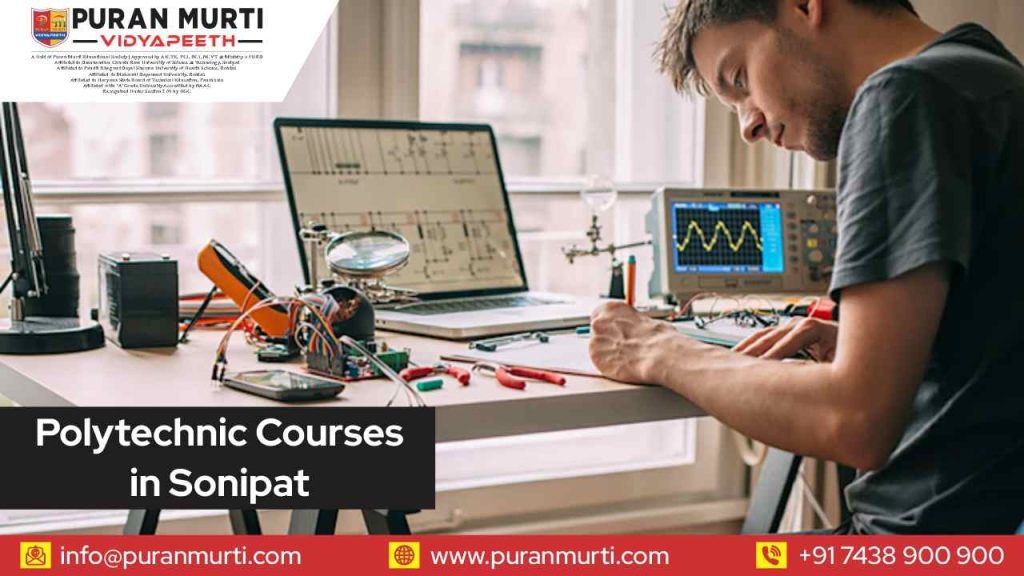
Polytechnic Courses in Sonipat: Guide for 2026
Posted on : 16 October, 2026 12:21 am
Choosing the right course after Class 10 or Class 12 can shape your future career. For students who enjoy practical learning, technology, machines, computers, construction, or electrical systems, a polytechnic diploma can be a valuable starting point.
With growing interest in technical education across Sonipat, Haryana, and Delhi NCR, many students and parents are exploring diploma engineering courses that combine classroom learning with practical skills. The right programme can help students build a technical foundation, prepare for employment opportunities, and explore further education in engineering.
At Puran Murti Vidyapeeth, we understand that choosing a course involves more than selecting a specialisation. Students also need clear information about eligibility, admission, fees, practical training, career opportunities, and future study options. This guide explains what to consider when exploring polytechnic courses in Sonipat so that you can make an informed decision.
What Are Polytechnic Courses?
Polytechnic courses are technical diploma programmes designed to develop knowledge and practical skills in engineering and related fields. Diploma engineering programmes typically combine theoretical subjects, laboratory work, workshop practice, technical drawing, projects, and industrial exposure where included in the curriculum.
A diploma in engineering commonly takes three years when entered after Class 10. Some institutions also offer lateral-entry pathways for eligible candidates, subject to applicable admission rules.
For example, a student interested in electrical systems may study electrical machines, circuits, measurements, and electrical safety. Someone interested in construction may explore engineering drawing, surveying, construction materials, and structural fundamentals.
The main purpose of polytechnic education is to help students understand how engineering concepts are applied in real-world settings.
Why Choose Polytechnic Courses in Sonipat?
Sonipat is an important education destination in Haryana, with access to the wider Delhi NCR region. Students researching polytechnic colleges in Sonipat can compare local study options while considering connectivity, educational costs, practical learning facilities, and future career plans.
Here are some important reasons to consider a diploma programme.
-
Early entry into technical education: Students can begin specialising in an engineering field after Class 10.
-
Practical learning: Laboratory sessions, workshop exercises, and technical projects help students connect theory with application.
-
Multiple career pathways: Diploma holders may explore relevant technician, junior technical, maintenance, production, or site-support roles, depending on their qualifications and employer requirements.
-
Further education: Eligible diploma holders may pursue B.Tech through lateral entry where permitted by the applicable admission rules.
-
Specialisation options: Students can select a branch that matches their interests in computing, construction, electrical systems, mechanical equipment, or other technical areas.
The value of a diploma depends on the programme’s recognition, the student’s skills, the quality of practical training, and the opportunities available in the chosen field. Location alone should not determine the final decision.
Polytechnic in Delhi 2026 | Diploma Courses, Fees, Admission
Top Polytechnic Specialisations to Explore
The right specialisation depends on your interests, academic strengths, and long-term career goals. Before applying, check which diploma branches are actually offered by your chosen institution for the relevant academic session.
| Polytechnic Course | Duration | Suitable For |
|---|---|---|
| Diploma in Aeronautical Engineering | 3 Years | Students interested in aircraft and aviation technology |
| Diploma in Aircraft Maintenance Engineering (AME) | 3 Years | Students interested in aircraft maintenance |
| Diploma in Automobile Engineering | 3 Years | Students interested in vehicles and automobile technology |
| Diploma in Civil Engineering | 3 Years | Students interested in construction and infrastructure |
| Diploma in Computer Science & Engineering | 3 Years | Students interested in computers, software and IT |
| Diploma in CSE – AI & ML | 3 Years | Students interested in artificial intelligence and machine learning |
| Diploma in Electrical Engineering | 3 Years | Students interested in electrical systems and power |
| Diploma in Electronics & Communication Engineering | 3 Years | Students interested in electronics and communication technology |
| Diploma in Fire Technology & Safety | 3 Years | Students interested in industrial and fire safety |
| Diploma in Hotel Management & Catering Technology | 3 Years | Students interested in hospitality and hotel operations |
| Diploma in Mechanical Engineering | 3 Years | Students interested in machines and manufacturing |
| Diploma in Medical Lab Technician (MLT) | 3 Years | Students interested in laboratory and healthcare work |
| Diploma in Technician – X-Ray Technology | 3 Years | Students interested in medical imaging technology |
| Diploma in ITI (Electrician, Draughtsman (Civil),Mechanic Diesel Engine) | 2-1 Years | Student interested in Electrician, Draughtsman ,Mechanic Diesel Engine |
Eligibility Criteria for Polytechnic Admission
Eligibility requirements depend on the course, institution, entry route, and applicable Haryana admission rules.
For a conventional first-year engineering diploma, students commonly need to meet the prescribed Class 10 educational requirements, including any specified subjects and minimum marks.
A general guide is provided below.
| Admission route | Typical requirement |
|---|---|
| Diploma after Class 10 | Class 10 qualification with the required subjects and marks |
| Diploma after Class 12 | Eligibility depends on the programme and admission rules |
| Lateral entry to a diploma | Available only where the relevant rules permit it |
| Admission to B.Tech after a diploma | Requires satisfaction of the applicable lateral-entry eligibility and selection criteria |
These are general guidelines, not a substitute for the current admission notification. Students should confirm the exact eligibility criteria, qualifying subjects, required documents, and admission procedure before applying.
How to Get Admission to a Polytechnic College in Sonipat
Applying for a diploma course becomes easier when you follow a clear process. The exact procedure may differ between institutions and admission routes.
-
Choose your preferred branch. Identify whether mechanical, civil, electrical, computer, electronics, or another available specialisation matches your interests.
-
Check eligibility. Review the latest prospectus and confirm your qualification, subjects, marks, and applicable admission requirements.
-
Compare institutions. Evaluate recognition, course availability, laboratories, workshops, faculty, student support, and practical training.
-
Understand the fee structure. Ask for a written breakdown of tuition fees, examination charges, deposits, transport, hostel accommodation, and other applicable expenses.
-
Prepare your documents. Commonly requested documents include Class 10 or Class 12 marksheets, identity documents, photographs, and applicable category or domicile certificates. Confirm the exact list.
-
Submit your application. Complete the official application or counselling process applicable to your chosen institution.
-
Verify the offer before paying. Confirm the branch, admission status, approved course details, payment terms, refund policy, and relevant affiliation or approval information.
At Puran Murti Vidyapeeth, prospective students can contact our admissions team to enquire about available programmes, eligibility, fees, and the admission process for the relevant academic year.
What Should You Check Before Choosing a Polytechnic College?
A course name alone does not tell you whether a programme is suitable. Students and parents should assess the academic and practical environment carefully.
Recognition and course approval
Check whether the specific programme and institution meet the recognition, affiliation, approval, or other regulatory requirements applicable to that course. Do not rely only on general claims about an institution.
Laboratories and workshops
Technical education requires opportunities to apply concepts. Ask whether students have access to relevant equipment, laboratories, workshops, and supervised practical sessions.
Faculty and academic support
Look for qualified teaching staff, accessible academic guidance, regular assessments, and support for students who need help with technical subjects.
Industry exposure
Ask how the programme incorporates industrial visits, projects, internships, guest sessions, or practical assignments. These activities can help students understand workplace expectations, although their availability varies by course and institution.
Placement assistance
Understand what the placement cell actually provides, such as interview preparation, résumé guidance, employer interactions, or campus recruitment activities.
Request branch-wise placement information where available. Check the reporting year, number of eligible students, number placed, job roles, and whether figures represent verified outcomes. Placement assistance is valuable, but no institution can responsibly guarantee a job simply because a student enrols.
Total cost and accessibility
Consider tuition, travel, accommodation, learning materials, and other expenses together. Students travelling from nearby areas of Haryana or Delhi NCR should also assess daily commuting time and transport arrangements.
Polytechnic Diploma vs B.Tech: Which Should You Choose?
A polytechnic diploma and a B.Tech degree both provide pathways into technical careers, but they differ in entry requirements, academic depth, duration, and learning approach.
| Factor | Polytechnic diploma | B.Tech degree |
|---|---|---|
| Common entry route | After Class 10 | After Class 12 with the required subjects, or through an eligible lateral-entry route |
| Typical duration | Three years after Class 10 | Four years through the standard first-year entry route |
| Learning emphasis | Applied technical fundamentals and practical skills | Broader and deeper engineering theory, design, analysis, and application |
| Career direction | Technician, technical support, and other eligible diploma-level roles | Graduate engineering roles, subject to skills and employer requirements |
| Further study | Eligible students may pursue B.Tech through an approved pathway | Eligible graduates may pursue postgraduate education and other specialisations |
Neither option is automatically better for every student. A diploma may suit someone who wants to begin technical specialisation after Class 10. A B.Tech degree may be more appropriate for someone seeking a full undergraduate engineering programme directly after Class 12.
Students should also consider their academic interests, financial circumstances, preferred learning style, and long-term career objectives before making a choice.
Top Benefits of Polytechnic Education
Polytechnic education offers several potential benefits for students who want a practical introduction to engineering.
-
Earlier specialisation: Students can focus on a technical discipline after completing Class 10.
-
Applied learning: Laboratory exercises, workshop practice, and projects can develop problem-solving and equipment-handling skills.
-
Technical career preparation: Relevant coursework can prepare students for entry-level opportunities that accept diploma qualifications.
-
A pathway to further education: Eligible diploma holders may continue into degree-level engineering through permitted admission routes.
-
Industry-relevant skills: Training in technical drawing, measurements, troubleshooting, safety, and documentation can help students understand workplace practices.
-
Career exploration: Studying a particular branch helps students discover which technical tasks and working environments suit them.
These benefits depend on the curriculum, teaching quality, the student’s effort, practical opportunities, and the requirements of the relevant industry.
Career Opportunities After a Polytechnic Diploma
Career opportunities vary by specialisation, practical competence, employer requirements, and local employment conditions. A diploma is a starting qualification, not a guarantee of employment.
| Diploma specialisation | Potential entry-level opportunities |
|---|---|
| Mechanical Engineering | Production technician, maintenance technician, quality inspection assistant |
| Civil Engineering | Site supervisor trainee, surveying assistant, civil drafting support |
| Electrical Engineering | Electrical maintenance technician, service technician, electrical operations support |
| Computer Engineering | IT support technician, computer hardware support, junior technical support |
| Electronics and Communication | Electronics service technician, testing assistant, equipment maintenance support |
The titles listed are examples, not guaranteed job outcomes. Some roles require additional licences, certifications, experience, or qualifications.
Skills that can improve employability
Along with academic results, students should build practical skills that match their chosen branch.
-
Technical drawing and interpretation of engineering diagrams.
-
Laboratory safety and correct equipment handling.
-
Basic troubleshooting and systematic problem-solving.
-
Computer literacy and relevant technical software.
-
Communication, teamwork, and workplace documentation.
-
Project work that demonstrates the ability to apply classroom learning.
For example, a computer engineering student could develop a small application or document a hardware troubleshooting project. A civil engineering student could prepare a supervised surveying report. A mechanical engineering student could maintain a project portfolio showing technical drawings and workshop assignments.
Such evidence can help students explain their capabilities during interviews, internships, or further-study applications.
Industry Exposure and Practical Learning: What Matters?
Industry exposure helps connect classroom concepts with workplace expectations. However, students should distinguish between a programme that offers occasional industry visits and one that provides structured, supervised practical experience.
When evaluating polytechnic courses in Sonipat, ask the admissions team:
-
Are practical sessions included in the prescribed curriculum?
-
Which laboratories and workshops are available for the chosen branch?
-
Are industry visits, internships, or live projects offered, where applicable?
-
Are students taught workplace safety and technical documentation?
-
Is career guidance available for internships, interviews, and further education?
At Puran Murti Vidyapeeth, we encourage prospective students to enquire about the facilities, practical-learning opportunities, and academic support relevant to their preferred programme. During your admission enquiry or campus visit, ask to see the facilities associated with the specific branch you intend to study.
A useful way to assess practical learning is to ask what students actually do during a typical semester, rather than relying on a general statement that a course is industry-oriented.
Polytechnic Course Fees in Sonipat: What Should You Budget For?
The total cost of a diploma programme depends on the institution, specialisation, facilities, accommodation arrangements, and applicable charges. It is not advisable to assume that all polytechnic colleges in Sonipat have the same fee structure.
Before choosing a college, request a written fee schedule covering:
-
Tuition fees for each academic year.
-
Admission, registration, and examination charges.
-
Laboratory, workshop, or other applicable academic fees.
-
Hostel and mess charges, if required.
-
Transport, books, uniforms, and equipment.
-
Security deposits, payment deadlines, and refund conditions.
Compare the complete cost of studying rather than tuition alone. If your family has a fixed budget, ask about any officially available scholarships, concessions, or financial assistance and confirm the eligibility conditions in writing.
At Puran Murti Vidyapeeth, students and parents can contact our admissions team for current programme-specific fee information and clarification of applicable charges. Fees and concessions should always be confirmed for the relevant academic session before making a financial commitment.
How to Prepare for Polytechnic Studies After Class 10
Students do not need to know everything about engineering before beginning a diploma. However, a little preparation can make the transition to technical education easier.
Strengthen mathematics and science fundamentals
Revise basic algebra, geometry, measurements, units, motion, electricity, and other concepts relevant to your chosen branch. These foundations help students understand technical subjects more confidently.
Explore your preferred specialisation
Learn what mechanical, civil, electrical, computer, and electronics engineers work on. Look at beginner-friendly demonstrations and educational resources to understand the types of problems each field addresses.
Practise computer and communication skills
Basic computer use, clear written communication, and the ability to explain a problem logically are useful across technical disciplines.
Develop consistent study habits
Engineering diploma programmes involve theory, practical work, assignments, and assessments. A regular study schedule helps students balance these responsibilities.
Ask questions before admission
Speak with the admissions team about course content, assessment methods, laboratory access, attendance requirements, and progression opportunities. Informed decisions at the beginning can prevent confusion later.
Why Explore Polytechnic Courses at Puran Murti Vidyapeeth?
Choosing a technical programme is an important decision for both students and parents. At Puran Murti Vidyapeeth, we encourage prospective students to understand the available programmes, their eligibility requirements, and the academic expectations before applying.
When exploring our institution, you can enquire about:
-
Diploma programmes available for the current admission session.
-
Eligibility and the application procedure for your preferred branch.
-
Course fees and other applicable expenses.
-
Academic facilities and practical-learning arrangements.
-
Student support and career guidance, where available.
-
Further-study pathways and applicable admission requirements.
We want prospective students to have the information they need to select a programme that aligns with their interests and plans.
Because programme availability and admission requirements can change, please confirm the latest details directly with our admissions team. We recommend reviewing the official course information and arranging a campus visit, where available, before making your final decision.
Frequently Asked Questions
What are the best polytechnic courses to pursue after Class 10?
Mechanical, civil, electrical, computer, and electronics engineering are common diploma specialisations. The right choice depends on your interests, academic strengths, available programmes, and career goals. Always verify the current course offerings and eligibility requirements before applying.
How many years does a polytechnic diploma take to complete?
A conventional engineering diploma entered after Class 10 typically takes three years. The duration may vary by programme or entry route, so students should confirm the prescribed course duration with the institution before admission.
Can I pursue B.Tech after completing a polytechnic diploma?
Yes, eligible diploma holders may be able to enter B.Tech through lateral entry, subject to the applicable admission rules, qualifying branch, minimum marks, and seat availability. Students should check the current regulations for their intended institution and academic session.
What is the fee for polytechnic courses in Sonipat?
Polytechnic fees vary by institution, branch, and facilities. Students should request the current fee structure, including tuition, examination charges, laboratory fees, transport, and accommodation where applicable. Contact Puran Murti Vidyapeeth’s admissions team for programme-specific fee details.
How can I apply for polytechnic admission at Puran Murti Vidyapeeth?
Start by checking the available diploma programmes and their eligibility criteria for the current academic session. Contact our admissions team to understand the application procedure, required documents, fees, and relevant admission requirements before submitting your application.
Polytechnic Courses After 10th: Eligibility, Fees and Career Scope
Conclusion: Start Your Technical Education Journey in Sonipat
Choosing among the polytechnic courses in Sonipat requires careful consideration of course specialisation, eligibility, recognition, practical training, fees, and career opportunities. A well-chosen diploma can help students develop technical foundations, explore entry-level career pathways, and prepare for further education.
At Puran Murti Vidyapeeth, we encourage students and parents to make informed decisions based on their interests, academic goals, and the requirements of their chosen profession.
Ready to explore your options? Contact our admissions team to enquire about available polytechnic programmes, eligibility, fees, and admission procedures. You can also arrange a campus visit, where available, to learn more about the academic environment and facilities relevant to your preferred course.
Your technical education journey begins with the right questions—and a clear understanding of your next step.