
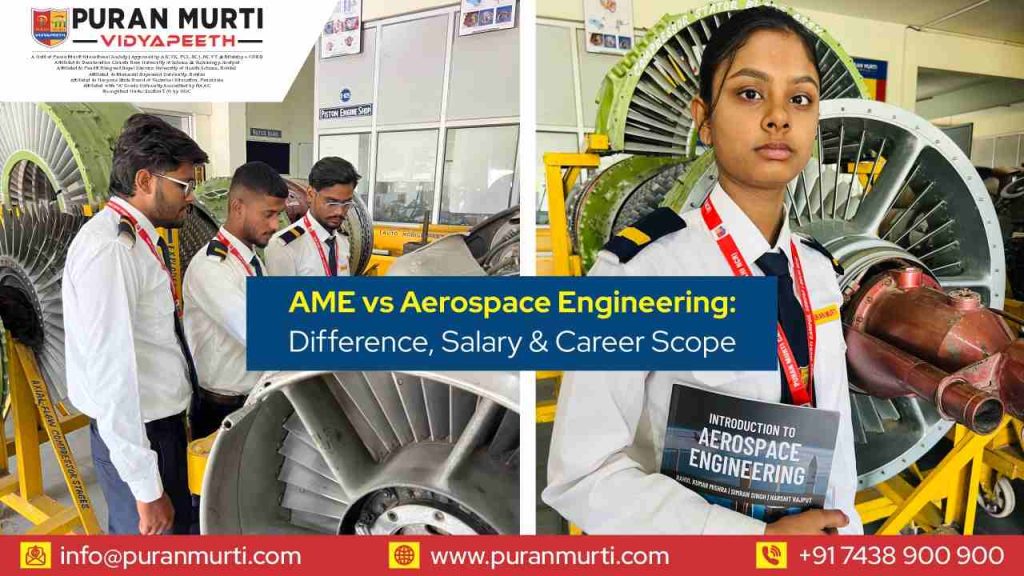
AME vs Aerospace Engineering: Difference, Salary & Career Scope
Posted on : 23 September, 2026 5:09 pm
Choosing a career in aviation and aerospace can be exciting, especially for students who enjoy aircraft, technology, machines, and engineering. Two popular options are Aircraft Maintenance Engineering (AME) and Aerospace Engineering. Although both are connected to the aviation industry, they prepare students for very different types of careers. If you are confused between AME vs Aerospace Engineering: Difference, Salary & Career Scope, this guide will help you understand the difference in eligibility, course structure, career opportunities, salary, skills, and future scope. Apply Now
What Is AME?
Aircraft Maintenance Engineering (AME) is a specialized aviation program focused on the maintenance, inspection, servicing, and airworthiness of aircraft. An AME professional works with aircraft systems and components and helps ensure that an aircraft is safe and technically fit for operation. The work can involve engines, electrical systems, avionics, mechanical systems, and regular maintenance procedures.
AME is suitable for students who are interested in aircraft maintenance and hands-on technical work rather than designing aircraft.
What Does an AME Professional Do?
- Aircraft inspection and maintenance
- Engine and mechanical systems
- Avionics and electrical systems
- Troubleshooting aircraft components
- Scheduled maintenance
- Safety and technical documentation
- Aircraft servicing and repairs
- Supporting aircraft airworthiness requirements
What Is Aerospace Engineering?
- Aerospace Engineering is a broader engineering field related to the design, development, testing, manufacturing, and operation of aircraft and spacecraft.
- It combines subjects such as mathematics, physics, mechanics, electronics, materials, aerodynamics, propulsion, and control systems.
- Aerospace Engineering can be a good option for students who are interested in how aircraft are designed, developed, tested, and improved. Apply Now
What Does an Aerospace Engineer Do?
An aerospace engineer may work in areas such as:
- Aircraft design
- Aerodynamics
- Propulsion systems
- Aircraft structures
- Avionics
- Flight testing
- Manufacturing
- Research and development
- Spacecraft and satellite technology
- Unmanned aerial systems
AME vs Aerospace Engineering: Key Difference
The simplest way to understand the difference is: Apply Now
| Factor | AME | Aerospace Engineering |
|---|---|---|
| Full Form | Aircraft Maintenance Engineering | Aerospace Engineering |
| Main Focus | Aircraft maintenance and safety | Aircraft and aerospace design/development |
| Nature of Work | Practical and maintenance-oriented | Engineering, design and technical development |
| Major Areas | Aircraft systems, engines, avionics | Aerodynamics, propulsion, structures, design |
| Work Environment | Airports, MRO facilities, hangars | Aerospace companies, R&D, manufacturing |
| Career Direction | Aircraft maintenance | Aerospace and engineering |
| Practical Work | High | High, depending on specialization |
| Design Focus | Limited | Strong |
| Research Opportunities | More specialized | Wider |
| Suitable For | Students interested in aircraft maintenance | Students interested in aircraft/aerospace engineering |

AME vs Aerospace Engineering Eligibility
Eligibility can vary depending on the institution, course structure, and applicable aviation or university regulations.
AME Eligibility
- Students generally need a 10+2 qualification with Physics and Mathematics, along with other prescribed requirements of the particular AME program or institute.
- Some programs may also have specific age, medical, or regulatory requirements.
Aerospace Engineering Eligibility
- For a bachelor’s degree in Aerospace Engineering, students generally need to complete Class 12 with Physics and Mathematics, usually along with a third subject such as Chemistry, Computer Science, or another approved subject depending on the institution.
- Admission may be based on entrance examinations, merit, or institute-specific criteria.
Always check the latest eligibility requirements of the institution before applying. Apply Now
AME vs Aerospace Engineering Course Focus
The subjects are different because the career objectives are different.
Common AME Areas
Depending on the category and program, students may study: Apply Now
- Aircraft systems
- Aircraft maintenance practices
- Aircraft structures
- Aviation safety
- Aviation regulations
- Aircraft engines
- Electrical systems
- Avionics
- Human factors
- Maintenance procedures
Common Aerospace Engineering Subjects
Students may study: Apply Now
- Engineering Mathematics
- Engineering Physics
- Thermodynamics
- Fluid Mechanics
- Aerodynamics
- Aircraft Structures
- Propulsion
- Flight Mechanics
- Control Systems
- Aerospace Materials
- Aircraft Design
- Manufacturing Processes
AME vs Aerospace Engineering Salary in India
| Career Stage | AME Salary Range* | Aerospace Engineering Salary Range* |
|---|---|---|
| Entry Level | ₹2.5–5 LPA | ₹3–6 LPA |
| 2–5 Years | ₹4–8 LPA | ₹5–10 LPA |
| Experienced | ₹6–12+ LPA | ₹8–15+ LPA |
| Specialized/Senior Roles | Can be higher | Can be higher |
Career Scope After AME
Possible work areas include:
- Airlines
- Maintenance, Repair and Overhaul (MRO) organizations
- Airports
- Aircraft maintenance companies
- Aviation service providers
- Aircraft component organizations
- Ground engineering services
Some professionals may progress toward more responsible maintenance and supervisory roles as they gain experience and meet applicable regulatory requirements. Apply Now
Career Scope After Aerospace Engineering
Aerospace Engineering provides a broader engineering pathway. Apply Now
- Aircraft manufacturing
- Aerospace companies
- Defense organizations
- Research and development
- Aviation technology
- Space-sector organizations
- Drone and UAV companies
- Aircraft component manufacturing
- Engineering design companies
- Simulation and testing
Which Skills Are Important?
Skills for AME
Students interested in AME can develop:
- Mechanical understanding
- Practical problem-solving
- Attention to detail
- Safety awareness
- Technical documentation skills
- Knowledge of aircraft systems
- Teamwork
- Discipline
Aircraft maintenance is safety-sensitive work, so accuracy and following approved procedures are particularly important.
Skills for Aerospace Engineering
Aerospace engineering students can benefit from: Apply Now
- Strong mathematics
- Physics fundamentals
- CAD and design skills
- Programming
- Problem-solving
- Analytical thinking
- Engineering simulation
- Technical communication
- Research skills
AME vs Aerospace Engineering: Which Career Path Matches Your Interest?
Instead of looking only at salary, students should consider the type of work they want to perform. Apply Now
Choose the AME pathway if you are more interested in:
- Aircraft maintenance
- Hands-on technical work
- Aircraft engines and systems
- Inspection and troubleshooting
- Aviation safety
- Working around operational aircraft
Aerospace Engineering may suit you if you are more interested in:
- Aircraft design
- Aerodynamics
- Engineering research
- Propulsion
- Aircraft structures
- Testing and development
- Aerospace technology
Neither path is automatically right for every student. The better choice depends on your interests, academic strengths, career goals, and preferred work environment. Apply Now

Why Consider Puran Murti Vidyapeeth?
For students exploring engineering and technology education, Puran Murti Vidyapeeth can be considered as part of the college-selection process.
- Course curriculum
- Laboratory facilities
- Practical training
- Faculty expertise
- Industry exposure
- Internship opportunities
- Placement support
- Infrastructure
- Location and accessibility
- Eligibility and fee structure
Students should also verify whether the specific course and program approvals meet their requirements before taking admission.
AME, Aerospace, Aeronautical or CSE: Which Course Should You Choose?
AME vs Aerospace Engineering
| Parameter | AME | Aerospace Engineering |
|---|---|---|
| Main Objective | Maintain aircraft | Design and develop aerospace systems |
| Work Type | Maintenance and inspection | Engineering and development |
| Design Work | Limited | Significant |
| Aircraft Maintenance | Core area | Supporting/related knowledge |
| Research Scope | Specialized | Broad |
| Industry | Airlines, MRO, aviation | Aerospace, aviation, defense, research |
| Practical Exposure | Very important | Important |
| Higher Studies | Possible | Wide range of options |
| Career Flexibility | Specialized aviation pathway | Broader engineering pathway |
Final Thoughts
The choice between AME vs Aerospace Engineering becomes easier when you understand the difference in their career direction. AME is centered around aircraft maintenance, inspection, servicing, and airworthiness-related work, while Aerospace Engineering focuses more broadly on the design, development, testing, and improvement of aircraft and aerospace systems. If you enjoy working directly with aircraft and prefer practical maintenance-oriented responsibilities, AME may align more closely with your interests. If you enjoy engineering design, mathematics, aerodynamics, research, and developing aerospace technology, Aerospace Engineering may offer a more suitable direction. Apply Now
FAQs
1. Is AME the same as Aerospace Engineering?
No. AME primarily focuses on aircraft maintenance and technical safety, while Aerospace Engineering focuses on the engineering, design, development, and testing of aerospace systems.
2. Which is better for aircraft maintenance?
AME is specifically designed around aircraft maintenance and related technical responsibilities.
3. Can Aerospace Engineers work in aviation?
Yes. Aerospace engineers can work in aircraft design, manufacturing, testing, aviation technology, research, and several related areas.
4. Is AME a degree course?
AME is a specialized aviation education pathway and should not automatically be treated as equivalent to a conventional engineering degree. Students should check the exact program structure and regulatory status.
5. What subjects are important for Aerospace Engineering?
Physics and Mathematics are particularly important, along with subjects such as aerodynamics, mechanics, thermodynamics, propulsion, structures, and control systems during the degree. Apply Now
6. What is the salary of an AME in India?
Salary varies by experience, organization, qualifications, aircraft type, and applicable authorizations. Entry-level compensation can differ significantly between employers.
7. What is the salary of an Aerospace Engineer in India?
It varies according to experience, specialization, employer, location, and technical skills. Specialized engineering roles can offer higher compensation with experience.
8. Can I pursue higher studies after Aerospace Engineering?
Yes. Graduates can pursue postgraduate studies and specialization in aerospace and related engineering fields.
9. Which field has more design work?
Aerospace Engineering generally has significantly more design and development-oriented work than AME.
10. How should I choose between AME and Aerospace Engineering?
Think about the work you enjoy. If you prefer aircraft maintenance and hands-on technical responsibilities, explore AME. If you prefer engineering design, development, testing, and aerospace technology, explore Aerospace Engineering. Apply Now