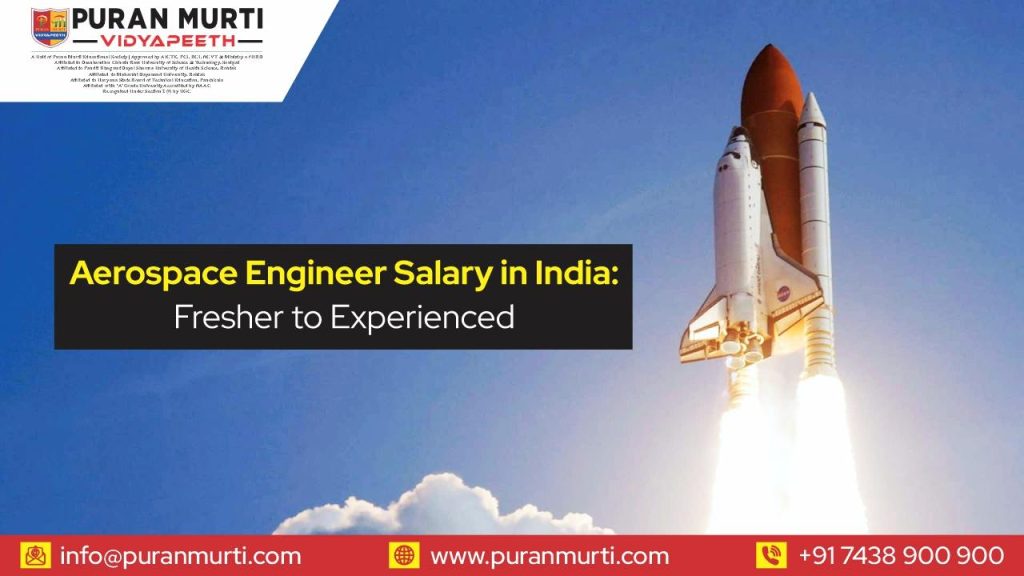
Aerospace Engineer Salary in India: Fresher to Experienced
Posted on : 5 October, 2026 9:15 pm
Aerospace Engineering is one of the most specialised engineering fields for students interested in aircraft, spacecraft, aviation, defence, drones and space technology. One of the most common questions students have before choosing this career is: “What is the Aerospace Engineer Salary in India?” In 2026, an aerospace engineer salary can vary significantly depending on experience, job role, technical skills, company, location, education and specialisation. Fresh graduates generally start at an entry-level package, while professionals with specialised skills and several years of experience can move into senior engineering, technical leadership, R&D and management roles. Here is the Aerospace Engineer Salary in India: Fresher to Experienced
According to recent Puran Murti Vidyapeeth career information, indicative aerospace engineering salaries can range from around ₹3–6 LPA for many entry-level roles, with experienced professionals moving into significantly higher salary brackets depending on their role and employer. Apply Now
What Does an Aerospace Engineer Do?
An aerospace engineer works on the design, development, testing and improvement of aircraft, spacecraft and aerospace systems.
| Work Area | Major Responsibilities |
|---|---|
| Aircraft Design | Designing aircraft components and systems |
| Aerodynamics | Studying airflow, lift, drag and aircraft performance |
| Propulsion | Working with engines and propulsion systems |
| Aircraft Structures | Designing and analysing aircraft structures |
| Avionics | Working with electronic and navigation systems |
| Testing | Testing aircraft components and systems |
| Manufacturing | Supporting aerospace production processes |
| Quality | Inspecting components and maintaining quality standards |
| Simulation | Using software for modelling and analysis |
| Research & Development | Developing new aerospace technologies |
Puran Murti Vidyapeeth B.Tech Aerospace Engineering curriculum includes areas such as aerodynamics, thermodynamics, gas dynamics, aerospace engineering, programming, engineering graphics and related engineering subjects, providing a foundation for technical aerospace careers. Apply Now
Aerospace Engineer Salary in India 2026
There is no single fixed salary for an aerospace engineer.
| Experience Level | Approx. Annual Salary | Approx. Monthly Gross Equivalent |
|---|---|---|
| Fresher / 0–2 Years | ₹3–6 LPA | ₹25,000–₹50,000 |
| 2–5 Years | ₹6–12 LPA | ₹50,000–₹1 Lakh |
| 5–8 Years | ₹10–18 LPA | ₹83,000–₹1.50 Lakh |
| 8–10 Years | ₹15–25 LPA | ₹1.25–₹2.08 Lakh |
| 10+ Years | ₹20–40+ LPA | ₹1.67–₹3.33+ Lakh |
Aerospace Engineer Salary for Freshers in India
| Fresher Profile | Approx. Annual Salary | Approx. Monthly Gross Salary |
|---|---|---|
| Entry-Level Fresher | ₹3–4 LPA | ₹25,000–₹33,000 |
| Typical Aerospace Fresher | ₹4–6 LPA | ₹33,000–₹50,000 |
| Skilled Fresher | ₹6–8 LPA | ₹50,000–₹67,000 |
| Highly Skilled/Relevant Experience | ₹8–10+ LPA | ₹67,000–₹83,000+ |
Puran Murti Vidyapeeth recent aerospace salary information also notes that fresher compensation varies by skills, employer, role and programme, so students should not assume one fixed starting package. Apply Now
Aerospace Engineer Salary After 2–5 Years
After gaining 2–5 years of professional experience, engineers generally become more independent in their work.
| Experience | Position | Approx. Salary |
|---|---|---|
| 2–3 Years | Aerospace Engineer | ₹6–9 LPA |
| 3–5 Years | Design/System Engineer | ₹7–12 LPA |
| 3–5 Years | Specialist Engineer | ₹8–14 LPA |
Aerospace Engineer Salary After 5–8 Years
With 5–8 years of experience, professionals can move into Senior Engineer, Technical Specialist or Team Lead positions.
| Experience | Career Level | Approx. Salary |
|---|---|---|
| 5–6 Years | Senior Aerospace Engineer | ₹10–15 LPA |
| 6–8 Years | Senior Specialist | ₹12–18 LPA |
| 7–8 Years | Technical Lead | ₹15–20 LPA |
Professionals with specialised skills in aerodynamics, propulsion, avionics, CFD, aircraft structures and aerospace systems may have access to different salary opportunities. Apply Now
Aerospace Engineer Salary After 10 Years
After 10 or more years, aerospace engineers may progress into:
| Experience | Position | Indicative Salary |
|---|---|---|
| 10–12 Years | Senior/Lead Engineer | ₹20–30 LPA |
| 12–15 Years | Principal/Technical Specialist | ₹25–35 LPA |
| 15+ Years | Engineering Manager/Expert | ₹30–40+ LPA |
Aerospace Engineer Salary by Job Role
| Job Role | Entry-Level Salary | Experienced Salary |
|---|---|---|
| Junior Aerospace Engineer | ₹3–6 LPA | ₹8–15 LPA |
| Aerospace Design Engineer | ₹4–10 LPA | ₹12–20 LPA |
| Aerodynamics Engineer | ₹6–8 LPA | ₹12–18+ LPA |
| Propulsion Engineer | ₹5–8 LPA | ₹15–25 LPA |
| Avionics Engineer | ₹5–8 LPA | ₹14–22 LPA |
| Aerospace Systems Engineer | ₹6–8 LPA | ₹12–20 LPA |
| Flight Test Engineer | ₹6–8 LPA | ₹12–20 LPA |
| Quality Engineer | ₹4–7 LPA | ₹10–15 LPA |
| R&D Engineer | ₹6–10 LPA | ₹15–30 LPA |
| Project Manager | ₹10–15 LPA | ₹20–30+ LPA |
Aerospace Engineer Salary by Specialisation
Specialisation is another important factor in career development. Apply Now
| Specialisation | Main Work | Career Scope |
|---|---|---|
| Aerodynamics | Airflow and aircraft performance | Aircraft design, CFD, testing |
| Propulsion | Engines and propulsion | Engine design, testing, R&D |
| Avionics | Electronics and control systems | Navigation, communication, aircraft systems |
| Aerospace Structures | Aircraft structures | Structural design and analysis |
| Flight Mechanics | Aircraft movement and stability | Flight analysis and testing |
| CFD | Computer-based fluid analysis | Simulation and R&D |
| Space Technology | Spacecraft and systems | Space research and private space sector |
| Manufacturing | Aerospace production | Production and quality |
| Defence Technology | Military aerospace systems | Defence R&D and manufacturing |
Factors Affecting Aerospace Engineer Salary in India
Aerospace engineering salary is influenced by several factors. Apply Now
1. Educational Qualification
A B.Tech/B.E. degree can provide entry into many engineering roles. Higher qualifications such as M.Tech, MS or specialised postgraduate education can be useful for advanced technical and research-oriented careers.
2. Technical Skills
Employers may look for knowledge of:
- CATIA
- SolidWorks
- AutoCAD
- ANSYS
- MATLAB
- Python
- CFD
- CAD/CAM
- Structural analysis
- Simulation tools
3. Internship Experience
- Internships provide students with exposure to practical engineering environments. A strong internship can help students understand industrial processes and improve their resumes.
4. Project Experience
- Academic projects involving aircraft design, drones, propulsion, aerodynamics, robotics or simulation can demonstrate practical knowledge.
5. Specialisation
- An engineer with specialised knowledge may qualify for different technical positions compared with a general engineering graduate.
6. Employer
- Salary structures differ between startups, private companies, MNCs, aerospace manufacturers, defence organisations, research institutions and government organisations.
7. Location
- Aerospace engineering opportunities are concentrated in cities and regions with aerospace, defence, aviation and research activity.
Skills Required to Earn a Good Aerospace Engineering Salary
A degree is only the starting point. Students should also develop practical and technical skills. Apply Now
| Skill | Why It Matters |
|---|---|
| CAD Design | Useful for aircraft and component design |
| CFD | Helps analyse fluid flow and aerodynamics |
| MATLAB | Engineering calculations and simulations |
| Python | Data analysis, automation and engineering applications |
| ANSYS | Simulation and engineering analysis |
| Aerodynamics | Essential for aircraft performance |
| Propulsion | Important for aircraft engine-related roles |
| Structural Analysis | Helps evaluate aircraft structures |
| Communication | Important for teamwork and documentation |
| Problem Solving | Required for technical engineering challenges |
Aerospace Engineering Career Options in India
After completing Aerospace Engineering, graduates can explore different sectors.
Aviation Industry
- Graduates can work in aircraft design, systems, engineering support, testing and related technical positions.
Defence Sector
- Aerospace engineers can explore opportunities connected with aircraft, defence systems, R&D and manufacturing.
Space Industry
- The growth of India’s space ecosystem is creating opportunities related to spacecraft, propulsion, satellite systems and engineering research.
Drone Industry
- Drone technology has created additional applications for aerospace and mechanical engineering skills.
Aerospace Manufacturing
- Engineers can work in production, quality, design, testing and manufacturing.
Research & Development
- Students interested in innovation can pursue technical and research-oriented careers after gaining suitable qualifications.
Government vs Private Colleges: Fees, Placements and Facilities
How to Increase Your Aerospace Engineer Salary
Students can take several practical steps to improve their career prospects.
- Build strong fundamentals in mathematics and physics.
- Learn CAD and engineering design software.
- Develop CFD and simulation skills.
- Learn programming languages such as Python or MATLAB.
- Complete internships during college.
- Work on practical aerospace projects.
- Choose a technical specialisation.
- Improve communication and teamwork skills.
- Create a strong technical portfolio.
- Consider M.Tech/MS for specialised careers.
- Stay updated with aerospace and space technology.
- Gain industry experience before targeting senior positions.
Aerospace Engineering at Puran Murti Vidyapeeth
For students planning to pursue Aerospace Engineering, Puran Murti Vidyapeeth can be considered as part of their college search. Its B.Tech Aerospace Engineering programme is a four-year engineering programme covering fundamental and specialised engineering subjects. The published curriculum includes subjects such as mathematics, physics, programming, thermodynamics, aerodynamics, gas dynamics and aerospace engineering.
Students should focus not only on completing the degree but also on developing practical skills, projects, internships, software knowledge and industry exposure, as these factors can influence career opportunities after graduation. Apply Now
Aerospace Engineer Salary
| Parameter | Details |
|---|---|
| Course | B.Tech/B.E. Aerospace Engineering |
| Course Duration | Generally 4 Years |
| Fresher Salary | Approx. ₹3–6 LPA |
| 2–5 Years | Approx. ₹6–12 LPA |
| 5–8 Years | Approx. ₹10–18 LPA |
| 8–10 Years | Approx. ₹15–25 LPA |
| 10+ Years | Approx. ₹20–40+ LPA |
| Important Skills | CAD, CFD, MATLAB, Python, simulation |
| Major Industries | Aerospace, aviation, defence, space, drones |
| Higher Studies | M.Tech, MS, research/specialisation |
| Career Growth | Engineer → Senior Engineer → Specialist/Lead → Manager |
Aerospace Engineer Salary vs Aeronautical Engineer Salary
| Point | Aerospace Engineering | Aeronautical Engineering |
|---|---|---|
| Main Focus | Aircraft + spacecraft | Aircraft |
| Scope | Aviation + space | Mainly aviation |
| Core Areas | Aerodynamics, propulsion, structures, spacecraft | Aerodynamics, aircraft structures, propulsion |
| Career Areas | Aerospace, space, defence, drones | Aviation, aircraft manufacturing, defence |
| Typical Starting Salary | ₹3–6 LPA* | ₹3–6 LPA* |
| Higher-Level Salary | Can reach ₹20–40+ LPA* | Can reach ₹20 LPA+ in specialised roles* |
Is Aerospace Engineering a Good Career?
Aerospace Engineering can provide career opportunities for students who are interested in aircraft, space technology, defence, engineering design, research and advanced technology. However, salary should not be the only factor when selecting this course. Students should also consider their interest in physics and mathematics, technical aptitude, preferred career sector, willingness to develop specialised skills and long-term career goals. Apply Now
With the right combination of education + technical skills + internships + projects + experience, an aerospace engineering graduate can progress from an entry-level engineering position to specialised and leadership roles.
Conclusion
The Aerospace Engineer Salary in India varies considerably according to experience, specialisation, employer and technical expertise. A fresher may start around ₹3–6 LPA, while professionals with 5–10 years of experience can move into higher salary brackets. Senior engineers and specialists with extensive experience can potentially earn ₹20–40+ LPA, depending on their role and organisation.
For students planning to enter this field, the most important step is to build a strong foundation in aerospace engineering while developing practical skills in CAD, CFD, programming, simulation, aerodynamics, propulsion and structural analysis. Puran Murti Vidyapeeth Aerospace Engineering programme covers several relevant engineering fundamentals and specialised subjects that can help students build an academic foundation for aerospace-related careers. Apply Now
FAQs
1. What is the starting salary of an aerospace engineer in India?
A fresher may earn around ₹3–6 LPA in many entry-level roles, although actual packages vary by company, skills, location and job profile.
2. What is the Aerospace Engineer Salary after 5 years?
A professional with around five years of experience may earn approximately ₹10–18 LPA, depending on specialisation and employer.
3. Can an aerospace engineer earn ₹20 LPA?
Yes. Experienced engineers, technical specialists, leads and professionals in specialised roles can reach or exceed ₹20 LPA, depending on their skills and employer.
4. What is the monthly salary of an aerospace engineer?
A salary of ₹3–6 LPA corresponds to approximately ₹25,000–₹50,000 per month gross before deductions. Actual in-hand salary will be different. Apply Now
5. Which aerospace specialisation can provide good career opportunities?
Aerodynamics, propulsion, avionics, aerospace structures, CFD, systems engineering, testing and R&D are among the specialised areas students can explore.
6. Does an aerospace engineer need programming skills?
Programming is not required for every aerospace role, but Python, MATLAB and other programming skills can be useful in simulation, data analysis, automation and engineering applications.
7. Is B.Tech Aerospace Engineering enough for a job?
A B.Tech can provide entry-level opportunities. However, internships, projects, software skills and practical knowledge can strengthen a candidate’s profile.
8. What companies hire aerospace engineers?
Opportunities may exist across aerospace manufacturers, defence companies, aviation organisations, research institutions, space companies, engineering-service firms and drone companies. Apply Now