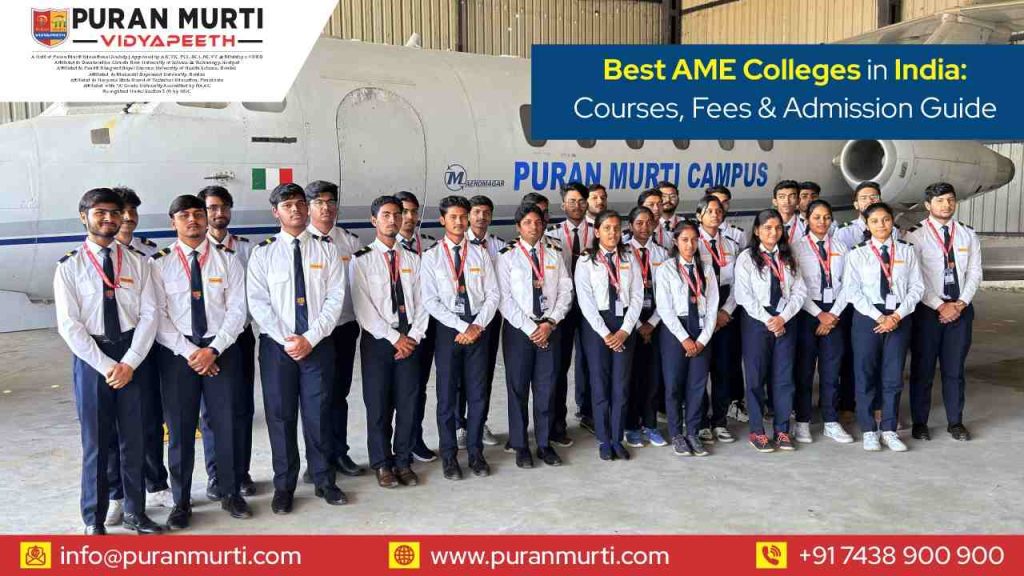
Best AME Colleges in India: Courses, Fees & Admission Guide
Posted on : 30 September, 2026 11:14 pm
Aircraft Maintenance Engineering (AME) is a specialized aviation field for students who are interested in aircraft, engineering, maintenance, and aviation safety. AME professionals work on aircraft maintenance, inspection, troubleshooting, and certification-related activities. Unlike a conventional engineering degree, AME follows aviation-specific training and licensing requirements under the Directorate General of Civil Aviation (DGCA). If you are searching for the Best AME Colleges in India: Courses, Fees & Admission Guide, it is important to look beyond campus facilities and fees. Students should check the institute’s applicable DGCA approval, training structure, practical exposure, aircraft/workshop facilities, and progression toward the AME licence. Apply Now
What is Aircraft Maintenance Engineering?
Aircraft Maintenance Engineering is a professional aviation program focused on maintaining aircraft in safe and serviceable condition. AME students learn about aircraft systems, engines, electrical systems, avionics, maintenance practices, safety procedures, and aviation regulations.
- The DGCA conducts examinations for AME licensing under the CAR-66 framework, and its Pariksha portal provides information related to AME examinations and candidate registration.
| Particular | Details |
|---|---|
| Course | Aircraft Maintenance Engineering |
| Field | Aviation & Aircraft Maintenance |
| Eligibility | Generally 10+2 with Physics, Chemistry & Mathematics |
| Regulator | DGCA |
| Major Areas | Mechanical, Avionics |
| Training | Theory + Practical/OJT |
| Career Areas | Airlines, MROs, aviation maintenance organizations |
| Key Skills | Aircraft systems, troubleshooting, inspection, safety |
Best AME Colleges in India: What Should You Check?
There is no single factor that makes an AME institute suitable for every student. Before admission, compare institutes on practical and regulatory aspects. Apply Now
| Factor | Why It Matters |
|---|---|
| DGCA-related approval/status | Important for aviation training |
| Practical training | Helps students understand real maintenance work |
| Workshops and laboratories | Supports hands-on learning |
| Aircraft/equipment exposure | Connects theory with practical applications |
| Faculty | Experienced instructors can improve technical understanding |
| OJT/industry exposure | Helps students gain workplace experience |
| Course structure | Should match the intended AME category/pathway |
| Fees | Should fit your overall education budget |
| Location | Can affect travel, accommodation and expenses |
| Placement/industry support | Useful when planning post-training opportunities |
Popular AME Course Options
1. Mechanical / B1 Stream
- This area is suitable for students interested in aircraft mechanical systems, engines, structures and related maintenance activities.
Students may study subjects such as: Apply Now
- Aircraft structures
- Aerodynamics
- Aircraft engines
- Gas turbine engines
- Piston engines
- Aircraft systems
- Maintenance practices
- Aviation legislation
2. Avionics / B2 Stream
Avionics focuses more on the electrical, electronic and instrument systems used in aircraft.
- Electrical systems
- Electronic fundamentals
- Digital techniques
- Instrumentation
- Communication systems
- Navigation systems
- Aircraft electrical systems
- Avionics maintenance
AME Eligibility Criteria
| Requirement | Typical Criteria |
|---|---|
| Education | 10+2/equivalent |
| Subjects | Physics, Chemistry & Mathematics |
| Diploma route | May be available depending on institute/regulations |
| Medical fitness | Students should meet applicable requirements |
| Age | Check the current institute/DGCA requirements |
Always check the latest eligibility conditions before submitting an application because aviation regulations and institutional admission rules can change. Apply Now
AME Course Fees in India
AME fees vary considerably depending on the institute, course structure, practical training, accommodation and other facilities.
| Institute/Program Type | Approximate Fee Range |
|---|---|
| Government/Supported Training | ₹2–4 lakh |
| Private AME Training Institute | ₹4–8 lakh |
| Integrated AME + Engineering Programs | ₹6–12 lakh |
| Hostel & living expenses | Additional |
Puran Murti Vidyapeeth for AME
Puran Murti Vidyapeeth offers aviation and engineering-oriented programs, including B.Tech Aeronautical Engineering + AME (DGCA), B.Tech Aerospace Engineering + AME (DGCA), B.Tech Electrical Engineering + AME (DGCA), B.Tech Mechanical Engineering + AME (DGCA), and B.Tech ECE + AME (DGCA) as listed on its admission page. For students interested in combining engineering education with aircraft maintenance training, these integrated options can provide an alternative to studying a conventional engineering program alone.

AME Admission Process
The admission process can differ from one institute to another. A typical process is: Apply Now
Step 1: Check Eligibility
- Confirm that you meet the academic requirements, particularly the PCM requirement.
Step 2: Select the AME Course
- Choose the appropriate AME pathway and understand its duration, training pattern and licence-related requirements.
III Step: Apply Online
- Complete the institute application form and submit the required documents.
Step 4: Entrance/Merit Selection
- Depending on the institute, admission may be based on an entrance examination, merit or another permitted admission route.
Step 5: Counselling & Document Verification
- Submit educational certificates, identity documents, photographs and other required records.
VI Step: Fee Payment & Admission Confirmation
- Pay the applicable fees and complete the joining formalities.
Puran Murti Vidyapeeth current admission page lists national-level entrance examinations such as AME CET along with direct admission through academic merit/other listed routes. Apply Now
Documents Required for AME Admission
Students should generally keep these documents ready:
- 10th mark sheet and certificate
- 12th mark sheet and certificate
- PCM marks/details
- Passport-size photographs
- Government-issued ID
- Transfer/migration certificate, where applicable
- Medical/fitness documents, if required
- Entrance examination documents, if applicable
Career Opportunities After AME
AME graduates/trained candidates can explore opportunities in areas connected with aircraft maintenance and aviation operations. Apply Now
| Career Area | Typical Work |
|---|---|
| Airlines | Aircraft maintenance support |
| MRO Organizations | Maintenance, repair & overhaul |
| Aviation Maintenance | Inspection and troubleshooting |
| Aircraft Manufacturing | Technical support |
| Airport Organizations | Maintenance-related roles |
| Aviation Companies | Technical and maintenance operations |
| Defence Aviation | Opportunities subject to applicable recruitment rules |
Why Choose AME as a Career?
AME can be a suitable option for students who:
- Have a strong interest in aircraft
- Enjoy mechanical or electronic systems
- Prefer practical technical work
- Want to work in the aviation industry
- Are comfortable following strict safety procedures
- Like troubleshooting and technical problem-solving
- Want a specialized aviation career
Aircraft maintenance is a safety-sensitive field, so attention to detail, discipline and technical accuracy are important qualities.
Why Consider Puran Murti Vidyapeeth?
For students exploring AME and engineering together, Puran Murti Vidyapeeth provides multiple aviation-oriented academic options. Its listed programs combine AME with disciplines such as aeronautical, aerospace, mechanical, electrical and ECE engineering.
Students should still verify the current regulatory approval/status, exact course structure, fees, practical training arrangements and admission conditions directly with the institute before enrolling. Apply Now
Frequently Asked Questions
1. What is AME?
AME stands for Aircraft Maintenance Engineering. It is an aviation field focused on aircraft maintenance, inspection and related technical activities.
2. Can I pursue AME after 12th?
Yes. Students who meet the applicable eligibility requirements can pursue AME-related training after 10+2. DGCA’s AME registration FAQ specifies Physics, Chemistry and Mathematics at 10+2 level.
3. Is AME a degree course?
AME training and an engineering degree are not automatically the same qualification. Students should carefully check whether a program is an AME training/licensing pathway, an engineering degree, or an integrated program.
4. What are the main AME streams?
The major areas commonly discussed are Mechanical/B1 and Avionics/B2.
5. How much does AME cost in India?
Fees vary by institute and program. Private AME programs can commonly fall in the several-lakh range, while integrated programs can cost more. Apply Now
6. Is DGCA approval important for AME?
Yes. Students should verify the applicable DGCA approval/status of the training organization and understand how the program connects with the relevant licensing requirements.
7. Can PCM students apply for AME?
Yes. Physics, Chemistry and Mathematics are specified in the DGCA AME registration eligibility information.
8. What jobs can I get after AME?
Career opportunities can be available with airlines, MRO organizations and other aviation maintenance-related employers, subject to the required qualifications and licensing conditions. Apply Now
Final Thoughts
Choosing among the best AME colleges in India requires more than comparing fees or campus photographs. Students should understand the difference between AME training, engineering degrees and integrated programs and should verify the current DGCA-related status and licensing pathway before admission.
For students interested in an aviation-focused education, Puran Murti Vidyapeeth offers multiple AME-integrated engineering options. The right choice ultimately depends on your academic background, preferred technical area, budget and long-term aviation career plans. Apply Now
https://blog.puranmurti.com/ugc-net-december-2027-exam-dates/