Aerospace Engineering After 12th: Eligibility, Admission & Career
Posted on : 30 September, 2026 11:15 pm
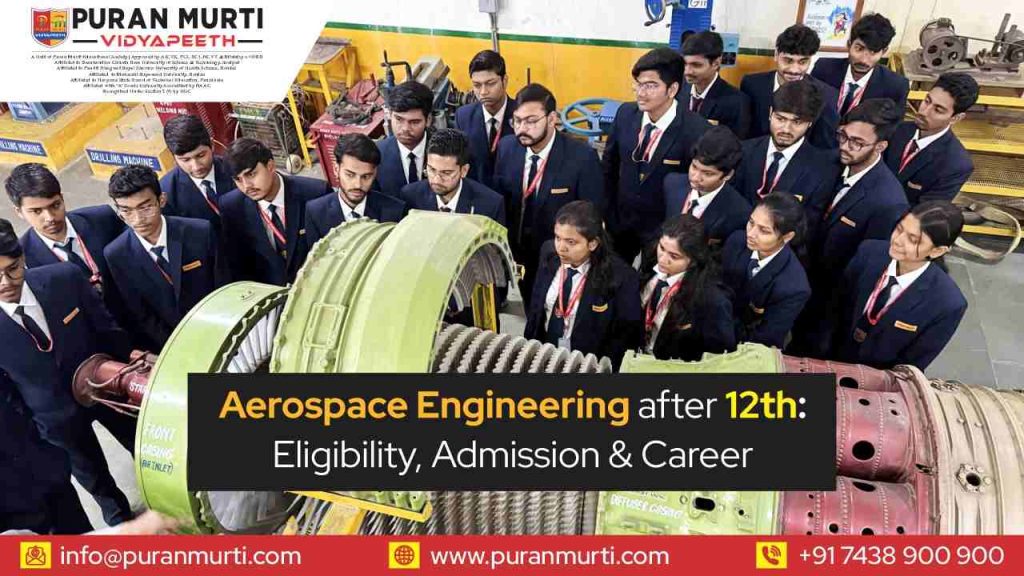
If you are a Class 12 student interested in aircraft, rockets, satellites, drones, and space technology, Aerospace Engineering can be an exciting career option. It is a technical field that combines physics, mathematics, engineering, computer technology, and materials science to develop systems used in air and space. For students planning to pursue Aerospace Engineering After 12th: Eligibility, Admission & Career, the most common undergraduate route is a B.Tech in Aerospace Engineering, generally completed in 4 years. Puran Murti Vidyapeeth also lists Aerospace Engineering among its engineering programmes and offers an aerospace engineering + AME pathway.
we will cover Aerospace Engineering eligibility, admission process, subjects, fees, career scope, job opportunities, salary, and why Puran Murti Vidyapeeth can be considered for aerospace education. Apply Now
What Is Aerospace Engineering?
Aerospace Engineering is a branch of engineering concerned with the design, development, testing, operation, and improvement of aircraft and spacecraft.
- Aeronautical Engineering – focuses mainly on aircraft operating within Earth’s atmosphere.
- Astronautical Engineering – focuses on spacecraft, satellites, launch vehicles, and space systems.
Students learn how aircraft fly, how propulsion systems work, how aerospace structures are designed, and how electronic and control systems operate. Apply Now
Why Choose Aerospace Engineering After 12th?
Aerospace Engineering may be suitable for students who enjoy Physics, Mathematics, technology, design, and problem-solving.
- Interest in aircraft and spacecraft
- Opportunities in aviation and aerospace industries
- Growing use of drones and UAV technology
- Opportunities in defence and space-related organisations
- Scope for research and innovation
- Career opportunities in design, manufacturing, testing, and engineering services
- Higher-study options in India and abroad
The aerospace sector also includes areas such as propulsion, avionics, aerospace materials, flight systems, UAVs, and computational engineering. Apply Now
Aerospace Engineering Eligibility After 12th
For a B.Tech Aerospace Engineering programme, eligibility can vary between universities and institutions. Students should always check the latest admission notification before applying.
| Eligibility Criteria | General Requirement |
|---|---|
| Qualification | Class 12 / 10+2 from a recognised board |
| Stream | Science |
| Important Subjects | Physics, Chemistry & Mathematics (PCM) |
| Course | B.Tech Aerospace Engineering |
| Duration | Generally 4 years |
| Admission | Entrance exam or merit, depending on institution |
Is PCM compulsory for Aerospace Engineering?
For many B.Tech Aerospace Engineering programmes, Physics and Mathematics are important eligibility subjects, while exact subject and percentage requirements can differ by institution. Therefore, students should verify the requirements of the college they want to join. Apply Now
Aerospace Engineering Admission Process After 12th
The admission process depends on the college and its applicable rules. Apply Now
Step 1: Complete Class 12
- Students should complete 10+2 with the required subjects and minimum marks prescribed by the institution.
Step 2: Check Entrance Exam Requirements
- Some institutions consider national or state-level engineering entrance examinations, while others may offer merit-based admission.
Puran Murti Vidyapeeth currently lists AME CET, IIT JEE and merit-based routes for B.Tech programmes including Aerospace Engineering, subject to applicable programme requirements.
Step 3: Fill Out the Application Form
- Complete the college application form and provide the required academic and personal details.
Step 4: Submit Documents
- Class 10 marksheet
- Class 12 marksheet/certificate
- Identity proof
- Passport-size photographs
- Transfer or migration certificate, where applicable
- Entrance examination documents, if applicable
V Step: Counselling or Selection
- Depending on the admission route, students may participate in counselling, merit-based selection, or another institutional admission process.
Step 6: Fee Payment and Admission Confirmation
- After selection, complete the required documentation and fee payment to confirm your seat. Apply Now

Aerospace Engineering Course Duration
- A B.Tech in Aerospace Engineering is generally a 4-year undergraduate programme divided into 8 semesters.
The course usually combines classroom learning with laboratory work, projects, practical training, workshops, and industry exposure. Puran Murti Vidyapeeth’s published course information also describes the B.Tech Aerospace programme as a four-year course.
Aerospace Engineering Subjects
During the course, students study fundamental engineering concepts along with specialised aerospace subjects.
| Subject | What Students Learn |
|---|---|
| Engineering Mathematics | Mathematical concepts used in engineering |
| Engineering Physics | Principles behind aerospace systems |
| Thermodynamics | Heat, energy and thermal systems |
| Fluid Mechanics | Behaviour of fluids and air |
| Aerodynamics | Airflow around aircraft |
| Aircraft Structures | Design and strength of aircraft structures |
| Propulsion | Aircraft and rocket propulsion systems |
| Avionics | Electronic systems used in aircraft |
| Flight Mechanics | Aircraft movement and performance |
| Aerospace Materials | Materials used in aerospace systems |
| CAD & Design | Computer-aided engineering design |
| UAV Technology | Drone and unmanned aircraft systems |
Skills Required for Aerospace Engineering
- Strong understanding of Physics and Mathematics
- Problem-solving ability
- Analytical thinking
- CAD and design skills
- Computer and programming knowledge
- Communication skills
- Teamwork
- Technical drawing skills
- Interest in research and innovation
- Ability to work with engineering software
Learning through projects and internships can also help students understand how engineering concepts are applied in real situations.
Why Consider Puran Murti Vidyapeeth for Aerospace Engineering?
- Students looking for an aerospace-focused engineering programme can explore Puran Murti Vidyapeeth as one of their college options.
- The institute lists B.Tech Aerospace Engineering among its programmes and also lists an integrated B.Tech Aerospace Engineering + AME (DGCA) option.
According to its published programme information, the institution focuses on:
- Practical and project-based learning
- Engineering laboratories
- Workshops and simulation-based learning
- Industrial visits
- Internship opportunities
- Experienced faculty
- Career and placement support
Its aerospace programme information also highlights areas such as aerodynamics, propulsion, aircraft and spacecraft structures, avionics, aerospace materials, UAV technology, and computational fluid dynamics. Apply Now
Career Options After Aerospace Engineering
After completing B.Tech Aerospace Engineering, graduates can explore different technical and engineering roles.
- Aerospace Engineer
- Aerospace Design Engineer
- Aerodynamics Engineer
- Propulsion Engineer
- Aircraft Design Engineer
- Structural Design Engineer
- Avionics Engineer
- Flight Test Engineer
- Manufacturing Engineer
- CAD Design Engineer
- Quality Engineer
- UAV/Drone Engineer
- Research Associate
- Aerospace Systems Engineer
Career opportunities can exist across aviation, aerospace manufacturing, defence, research, drones, engineering services, and space-related industries. Apply Now
Aerospace Engineering Salary in India
| Experience | Possible Career Stage |
|---|---|
| 0–2 Years | Graduate/Fresher Engineer |
| 2–5 Years | Design/Production/Test Engineer |
| 5–8 Years | Senior Engineer/Specialist |
| 8+ Years | Technical Lead/Project/Management Roles |
Students should not select aerospace engineering only because of salary. Technical skills, internships, projects, and industry knowledge can have a significant impact on career development. Apply Now
Higher Studies After Aerospace Engineering
After completing B.Tech, students can continue their education through:
- M.Tech in Aerospace Engineering
- M.Tech in Aeronautical Engineering
- M.Tech in Propulsion
- M.Tech in Avionics
- MS in Aerospace Engineering
- MBA
- PhD and research programmes
Higher education can be useful for students interested in specialisation, research, teaching, advanced engineering, or management. Apply Now

Aerospace Engineering vs Aeronautical Engineering
| Aerospace Engineering | Aeronautical Engineering |
|---|---|
| Covers aircraft and spacecraft | Primarily focuses on aircraft |
| Includes aviation and space systems | Mainly aviation and atmospheric flight |
| Can include spacecraft and satellites | Focuses more strongly on aircraft |
| Broader aerospace scope | More specialised toward aircraft |
FAQs
1. Can I do Aerospace Engineering after 12th?
Yes. Students who meet the eligibility requirements can apply for B.Tech Aerospace Engineering after Class 12.
2. Which stream is required for Aerospace Engineering?
Science with the required engineering subjects, commonly Physics, Chemistry and Mathematics, is generally expected.
3. What is the duration of B.Tech Aerospace Engineering?
B.Tech Aerospace Engineering is generally a 4-year undergraduate programme.
4. Is JEE required for Aerospace Engineering?
It depends on the institution. Some colleges consider JEE or other entrance examinations, while some institutions may have merit-based admission routes.
5. What do Aerospace Engineers do?
They may work in areas such as aircraft design, aerodynamics, propulsion, structures, avionics, testing, manufacturing, UAVs, and aerospace systems. Apply Now
6. Is Aerospace Engineering difficult?
It involves Mathematics, Physics, engineering concepts, design, and technical subjects. Regular study and practical learning can help students build a strong foundation.
7. Can Aerospace Engineers work in the space sector?
Yes. Depending on qualifications, skills, recruitment requirements, and job openings, graduates can explore opportunities related to spacecraft, satellites, launch systems, research, and space technology.
8. Can I pursue higher studies after B.Tech Aerospace Engineering?
Yes. Students can pursue M.Tech, MS, MBA, PhD, and other specialised programmes.
9. What are the career options after Aerospace Engineering?
Career options include aerospace design, aerodynamics, propulsion, structures, avionics, manufacturing, testing, UAV technology, quality, research, and engineering services.
10. Does Puran Murti Vidyapeeth offer Aerospace Engineering?
Yes. Puran Murti Vidyapeeth lists Aerospace Engineering among its B.Tech programmes and also lists a B.Tech Aerospace Engineering + AME (DGCA) pathway. Apply Now
Conclusion
Choosing Aerospace Engineering after 12th can open the door to a technical career connected with aircraft, spacecraft, drones, defence, and advanced engineering systems. Students interested in this field should focus on Physics and Mathematics, develop practical and computer-based skills, and gain exposure through projects and internships.
Before taking admission, compare eligibility, curriculum, fees, infrastructure, practical training, admission route, approvals, internships, and career support.
For students exploring aerospace education in the Delhi-NCR region, Puran Murti Vidyapeeth offers Aerospace Engineering programmes along with aviation-related study options. Its published programme information highlights practical learning, laboratories, projects, industrial exposure, and career development. Apply Now