Aerospace Engineering in India: Scope and Jobs and Future Growth
Posted on : 20 June, 2026 11:33 am
There are currently no aerospace engineering colleges in Delhi; however, Puran Murti Vidyapeeth, located nearby, offers a good alternative.
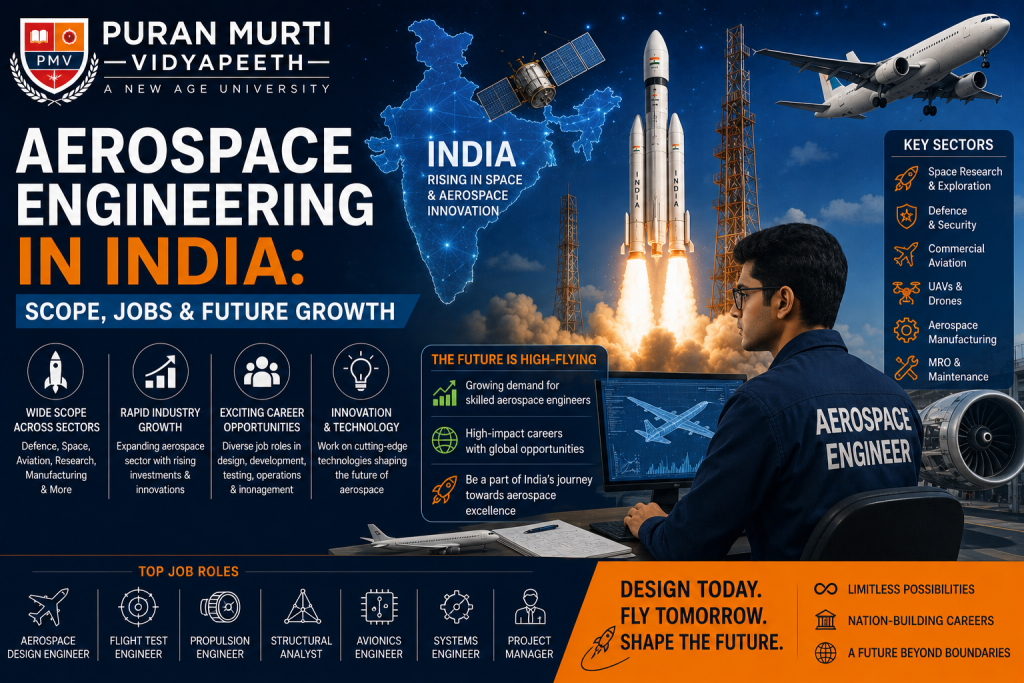
Aerospace Engineering in India: Scope, Jobs, and Future Growth has become a popular topic among students who are interested in aviation, defense, and space technology. The increasing demand for skilled professionals and rapid technological advancements have made Aerospace Engineering in India: Scope, Jobs, and Future Growth an important career consideration for engineering aspirants. With India’s achievements in satellite launches, aircraft manufacturing, and space missions, Aerospace Engineering in India: Scope, Jobs, and Future Growth continues to attract students seeking exciting and future-oriented careers. As government organizations and private companies expand their aerospace operations, Aerospace Engineering in India: Scope, Jobs, and Future Growth offers excellent opportunities for innovation, employment, and long-term professional success.
Understanding Aerospace Engineering
Aerospace engineering is broadly divided into two major disciplines: Aeronautical Engineering and Astronautical Engineering. Aeronautical engineering focuses on aircraft that operate within the Earth’s atmosphere, while astronautical engineering deals with spacecraft, satellites, and systems used in space exploration.
Students pursuing aerospace engineering study subjects such as aerodynamics, propulsion systems, flight mechanics, aircraft structures, avionics, robotics, and space technology. These subjects provide a strong foundation that helps graduates solve complex engineering challenges and develop innovative aerospace solutions.
Why Aerospace Engineering is Gaining Popularity in India
India has established itself as an important player in the global aerospace and aviation industry. Organizations such as ISRO, DRDO, HAL, and several private aerospace companies continue to contribute significantly to technological innovation and research. Government initiatives like Make in India and Atmanirbhar Bharat have further strengthened domestic aerospace manufacturing capabilities.
The rapid growth of commercial aviation, satellite technology, and defense projects has increased the demand for skilled aerospace professionals. Students are increasingly recognizing aerospace engineering as a field that offers exciting career opportunities, technological innovation, and long-term professional growth.

Scope of Aerospace Engineering in India
The scope of aerospace engineering in India continues to expand because of increasing investments in aviation, defense, and space research. Aerospace engineers are involved in aircraft manufacturing, satellite development, missile technology, maintenance operations, and research activities.
India’s growing presence in the global aerospace market has encouraged multinational companies to establish research and development centers across the country. This expansion has created employment opportunities not only in government organizations but also in private companies and emerging startups working on advanced aerospace technologies.
Major Sectors Offering Career Opportunities
| Sector | Career Opportunities |
|---|---|
| Aviation Industry | Aircraft Design, Maintenance, Testing |
| Space Research | Satellite Development, Space Missions |
| Defense Sector | Missile Systems, Defense Technology |
| Manufacturing | Aerospace Components Production |
| Research & Development | Innovation and Product Development |
| Private Startups | Drones, Space Technology, Robotics |
Educational Path to Become an Aerospace Engineer
Students who wish to become aerospace engineers generally pursue a Bachelor of Technology (B.Tech) or Bachelor of Engineering (B.E.) degree in Aerospace Engineering after completing their higher secondary education with Physics, Chemistry, and Mathematics.
Throughout the course, students gain practical and theoretical knowledge through laboratory experiments, classroom learning, industry projects, workshops, and internships. Those interested in specialization can pursue higher studies such as M.Tech, MS, or PhD programs to improve their expertise and career prospects.
Industrial visits, internships, and research projects play a crucial role in helping students develop technical competence and industry readiness.
Skills Required for Success in Aerospace Engineering
A successful aerospace engineer requires a combination of technical knowledge, analytical thinking, and problem-solving abilities. Since aerospace projects involve precision, performance, and safety, attention to detail is essential.
Some of the most important skills include:
- Strong mathematical and analytical abilities
- Knowledge of aerodynamics and propulsion systems
- Computer-Aided Design (CAD) proficiency
- Programming and simulation skills
- Critical thinking and problem-solving capabilities
- Teamwork and communication skills
- Project management abilities
- Research and innovation mindset
Developing these skills helps graduates perform effectively in both technical and leadership roles.
Aerospace Engineering Jobs in India
Aerospace engineering graduates have access to a wide variety of job roles across different industries. Depending on their specialization and interests, they can work in aircraft design, manufacturing, maintenance, defense technology, research, or space exploration.
These careers allow engineers to work on challenging projects that contribute to scientific advancement, national development, and technological innovation.
Popular Job Roles
| Job Role | Key Responsibilities |
|---|---|
| Aerospace Engineer | Design and development of aerospace systems |
| Aircraft Design Engineer | Designing aircraft structures and components |
| Aerodynamics Engineer | Improving flight performance and efficiency |
| Flight Test Engineer | Testing aircraft performance and safety |
| Avionics Engineer | Developing aircraft electronic systems |
| Propulsion Engineer | Working on engines and propulsion technology |
| Maintenance Engineer | Ensuring aircraft operational safety |
| Research Scientist | Conducting aerospace research and innovation |
| Spacecraft Engineer | Designing and developing space vehicles |
| Systems Engineer | Managing integrated aerospace systems |

Top Recruiters for Aerospace Engineers
Several government and private organizations recruit aerospace engineering graduates throughout India. These organizations provide opportunities in research, manufacturing, design, maintenance, and defense technologies.
Major recruiters include:
- ISRO
- DRDO
- Hindustan Aeronautics Limited (HAL)
- National Aerospace Laboratories (NAL)
- Indian Air Force
- Airbus India
- Boeing India
- Tata Advanced Systems
- Mahindra Aerospace
- Larsen & Toubro
- Adani Defence & Aerospace
- Skyroot Aerospace
- Agnikul Cosmos
The emergence of private space startups has significantly increased employment opportunities for fresh graduates and experienced professionals alike.
Salary Prospects in Aerospace Engineering
Salary packages in aerospace engineering vary based on qualifications, technical expertise, employer, and job role. Freshers generally receive competitive salary packages, while experienced professionals can earn substantially higher compensation.
Average Salary Range
| Experience Level | Average Annual Salary |
|---|---|
| Freshers | ₹4 LPA – ₹8 LPA |
| Mid-Level Professionals | ₹8 LPA – ₹15 LPA |
| Experienced Engineers | ₹15 LPA – ₹30 LPA+ |
| Senior Specialists and Managers | ₹30 LPA and Above |
Professionals with advanced degrees, certifications, and specialized technical skills often experience faster career growth and higher earning potential.
Future Growth of Aerospace Engineering in India
The future of aerospace engineering in India appears extremely promising. Government initiatives, private investments, and continuous technological advancements are creating a strong foundation for long-term industry growth. The demand for aerospace professionals is expected to rise steadily due to India’s ambitions in commercial aviation, satellite deployment, defense modernization, and space exploration.
Emerging technologies such as artificial intelligence, autonomous aircraft, reusable rockets, advanced materials, drones, and space tourism are expected to transform the aerospace sector. Engineers with expertise in these areas are likely to enjoy excellent career opportunities in both domestic and international markets.
As India continues to strengthen its position in the global aerospace ecosystem, the demand for skilled aerospace engineers is expected to increase significantly.
Challenges in Aerospace Engineering
While aerospace engineering offers exciting opportunities, it also presents certain challenges. The field requires continuous learning, technical precision, and the ability to adapt to rapidly evolving technologies and industry requirements.
Professionals often work on highly complex projects that involve strict safety standards, detailed testing procedures, and demanding timelines. However, for individuals who are passionate about innovation and engineering excellence, these challenges often become valuable opportunities for growth and achievement.
How Educational Institutions Shape Future Aerospace Engineers
A strong educational foundation plays a vital role in preparing students for successful careers in aerospace engineering. Institutions that emphasize practical learning, research opportunities, industry exposure, and innovation help students develop the technical and professional skills needed in the aerospace sector.
Through laboratories, workshops, internships, project-based learning, and industry collaborations, students gain practical experience that bridges the gap between academic concepts and real-world applications. This approach ensures that graduates are prepared to contribute effectively to the evolving aerospace industry.
About Puran Murti Vidyapeeth
Although Delhi lacks dedicated aerospace engineering colleges, Puran Murti Vidyapeeth is conveniently located nearby and provides relevant academic opportunities.
The institute is known for its focus on technical education, practical learning, laboratory exposure, and career-oriented training. Students can explore engineering programs in modern technology domains while benefiting from academic support, industry interaction, and campus facilities. The availability of hostel facilities, skill-development activities, and placement assistance also makes it a consideration for students looking for engineering education near Delhi NCR. Apply Now
Top Engineering Branches
BTech (Bachelor of Technology)
BTech is among the most popular courses after 12th Science (PCM).
Top Specializations:
- Aeronautical Engineering
- Aerospace Engineering
- Aircraft Maintenance Engineering (AME)
- Computer Science & Engineering (CSE)
- CSE with Artificial Intelligence and Machine Learning (AI & ML)
- Civil Engineering
- Electrical Engineering
- Electronics & Communication Engineering (ECE)
- Mechanical Engineering
Unique Aviation Programs (USP)
One of the biggest advantages of Puran Murti Vidyapeeth is its aviation-based courses, which are rare in India:
- B.Tech + AME (DGCA approved)
- B.Tech Mechanical Engineering + AME (DGCA)
- B.Tech ECE + AME (DGCA)
- B.Tech Computer Science
(AI & ML)+ AME (DGCA) - B.Tech Aeronautical Engineering
+ CPL (Ground Classes) - B.Tech Aerospace Engineering
+ CPL (Ground Classes)
Diploma Courses
Students can also choose job-oriented diploma courses: Apply Now
- Diploma in Automobile Engineering (AE)
- Diploma in AME (Aircraft Maintenance Engineering)
- Diploma in Aeronautical Engineering
- Diploma in Civil Engineering (CE)
- Diploma in Mechanical Engineering (ME)
- Diploma in Computer Science & Engineering (CSE)
- Diploma in Electronics & Communication Engineering (ECE)
- Diploma in Electrical Engineering (EE)
- Diploma in Fire Technology & Safety
- Diploma in Medical Lab Technology (MLT)
- Diploma in Hotel Management
- Diploma in CSE (AI & ML)
Apply Now
Conclusion
Aerospace engineering is a dynamic and rewarding field that combines science, technology, and innovation to solve some of the world’s most complex challenges. With India’s rapid advancements in aviation, defense, satellite technology, and space research, the demand for aerospace engineers is expected to continue growing in the coming years.
Students who are passionate about technology, problem-solving, and innovation can build successful and fulfilling careers in this field. By acquiring the right education, practical experience, and technical skills, aspiring aerospace engineers can become part of India’s journey toward becoming a global leader in aerospace and space technology.
Frequently Asked Questions (FAQs)
1.What is Aerospace Engineering?
Aerospace Engineering is a branch of engineering that focuses on the design, development, testing, and maintenance of aircraft, spacecraft, satellites, and related systems.
2.What is the scope of Aerospace Engineering in India?
The scope of Aerospace Engineering in India is growing rapidly due to advancements in aviation, defense, space exploration, and private aerospace companies. Opportunities are increasing in both government and private sectors.
3.What are the career options available after Aerospace Engineering?
Graduates can work as Aerospace Engineers, Aircraft Design Engineers, Avionics Engineers, Propulsion Engineers, Aerodynamics Engineers, Flight Test Engineers, and Research Scientists.
4.What is the average salary of an Aerospace Engineer in India?
Fresh graduates can earn between ₹4 LPA and ₹8 LPA, while experienced professionals may earn ₹10 LPA to ₹25 LPA or more depending on their role and organization.
5.Which companies hire Aerospace Engineering graduates in India?
Top recruiters include ISRO, DRDO, HAL, Boeing, Airbus, and several emerging aerospace startups.