
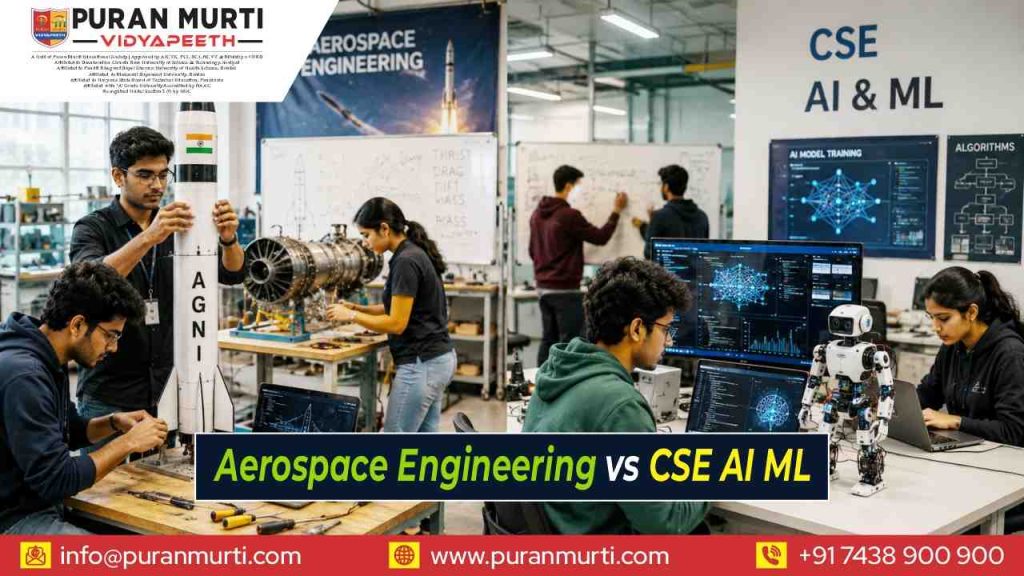
Aerospace Engineering vs CSE AI ML
Posted on : 8 June, 2026 12:47 pm
Choosing between Aerospace Engineering vs CSE (AI & ML Specialization) can be challenging for students who are interested in advanced technologies and future-focused careers. While Aerospace Engineering focuses on aircraft, spacecraft, and aviation systems, CSE with AI & ML specialization concentrates on artificial intelligence, machine learning, automation, and intelligent software solutions. Therefore, understanding the differences between Aerospace Engineering vs CSE (AI & ML Specialization) is essential before making a career decision. Moreover, as technology continues to transform industries worldwide, both fields are creating exciting opportunities for skilled professionals. Consequently, students should carefully evaluate their interests, strengths, and long-term goals before selecting either path.
Understanding Aerospace Engineering
Aerospace Engineering is a specialized engineering discipline that deals with the design, development, testing, and maintenance of aircraft, spacecraft, satellites, missiles, and related systems.
Furthermore, aerospace engineers work on technologies that drive advancements in aviation, defense, and space exploration. As a result, the field remains one of the most prestigious engineering domains globally.
Core Areas in Aerospace Engineering
| Area | Description |
|---|---|
| Aerodynamics | Study of airflow around aircraft |
| Propulsion Systems | Jet and rocket engine technology |
| Aircraft Structures | Design and analysis of aerospace structures |
| Flight Mechanics | Aircraft performance and stability |
| Space Engineering | Spacecraft and satellite development |
Understanding CSE (AI & ML Specialization)
CSE with AI & ML Specialization combines traditional computer science concepts with artificial intelligence and machine learning technologies.
Additionally, students learn how to build intelligent systems capable of analyzing data, recognizing patterns, automating tasks, and making predictions. Consequently, graduates are prepared for careers in some of the fastest-growing technology sectors.
Core Areas in AI & ML
| Area | Description |
|---|---|
| Artificial Intelligence | Intelligent decision-making systems |
| Machine Learning | Data-driven predictive models |
| Deep Learning | Advanced neural network systems |
| Data Science | Large-scale data analysis |
| Natural Language Processing | Human-computer language interaction |
Aerospace Engineering vs CSE (AI & ML): Quick Comparison
| Parameter | Aerospace Engineering | CSE (AI & ML) |
|---|---|---|
| Core Focus | Aviation and space systems | Artificial intelligence and software |
| Industry | Aerospace and defense | Technology and digital industries |
| Programming Requirement | Moderate | Extensive |
| Mathematics Requirement | High | High |
| Global Demand | Strong | Extremely High |
| Remote Work Opportunities | Limited | Extensive |
| Startup Potential | Moderate | Very High |
| Industry Diversity | Moderate | Very High |
Course Curriculum Comparison
Although both programs require analytical thinking and strong mathematical skills, their academic content differs significantly.
Aerospace Engineering Subjects
| Subjects |
|---|
| Aerodynamics |
| Aircraft Structures |
| Flight Dynamics |
| Propulsion Systems |
| Space Technology |
| Aerospace Materials |
CSE (AI & ML) Subjects
| Subjects |
|---|
| Python Programming |
| Machine Learning |
| Deep Learning |
| Artificial Intelligence |
| Data Structures |
| Neural Networks |
Skill Requirements
Skills Required for Aerospace Engineering
- Advanced mathematical skills
- Engineering design capability
- Problem-solving ability
- Physics knowledge
- Technical analysis
- Research aptitude
Skills Required for CSE (AI & ML)
- Programming expertise
- Logical reasoning
- Data analysis skills
- Algorithm development
- Machine learning model building
- Continuous technology learning
Aerospace Engineering vs CSE (AI & ML): Which Course Is More Difficult?
The difficulty level largely depends on a student’s interests and strengths.
Generally, Aerospace Engineering is considered challenging because it involves advanced concepts in aerodynamics, thermodynamics, structural analysis, and flight mechanics. However, CSE (AI & ML) can also be demanding because students must master programming, algorithms, statistics, artificial intelligence models, and rapidly evolving technologies.
Therefore, students who enjoy physics may prefer Aerospace Engineering, whereas those interested in coding and data-driven technologies may find AI & ML more engaging.
Career Opportunities in Aerospace Engineering
Aerospace Engineering graduates can pursue careers in aviation, defense, satellite technology, and space exploration.
Furthermore, the growing investment in commercial space programs has created additional opportunities for aerospace professionals.
Popular Job Roles
| Job Role | Description |
|---|---|
| Aerospace Engineer | Design aerospace systems |
| Flight Test Engineer | Conduct aircraft testing |
| Propulsion Engineer | Develop engine systems |
| Satellite Engineer | Work on satellite technologies |
| Aircraft Design Engineer | Design aircraft components |
Career Opportunities in CSE (AI & ML)
CSE (AI & ML) graduates enjoy diverse career opportunities because intelligent software solutions are becoming essential across industries. Moreover, organizations increasingly rely on automation and data-driven decision-making. As a result, demand for AI and ML professionals continues to rise worldwide.
Popular Job Roles
| Job Role | Description |
|---|---|
| AI Engineer | Develop intelligent systems |
| Machine Learning Engineer | Build predictive models |
| Data Scientist | Analyze complex datasets |
| AI Research Scientist | Conduct advanced AI research |
| NLP Engineer | Develop language-based AI systems |
Aerospace Engineering vs CSE (AI & ML): Salary Comparison
| Experience Level | Aerospace Engineering | CSE (AI & ML) |
|---|---|---|
| Freshers | Moderate to High | High |
| Mid-Level | High | Very High |
| Senior Level | Very High | Extremely High |
| International Scope | Strong | Very Strong |
Generally, AI & ML professionals often receive higher starting salaries because of strong demand from technology companies. However, experienced aerospace engineers working on specialized projects can also earn highly competitive compensation.

Industry Demand and Growth
Aerospace Industry Growth
The aerospace sector continues to expand because of:
- Commercial aviation growth
- Space exploration initiatives
- Satellite deployment programs
- Defense modernization
- Drone technology development
AI & ML Industry Growth
Meanwhile, AI & ML continue to transform global industries through:
- Artificial Intelligence
- Predictive Analytics
- Robotics
- Autonomous Systems
- Generative AI
- Smart Automation
Consequently, AI & ML currently offer one of the fastest-growing career markets worldwide.
Government Sector Opportunities
Aerospace Engineering
Government opportunities include organizations involved in aviation, defense, and space research.
Examples include:
- Indian Space Research Organisation
- Defence Research and Development Organisation
- National Aeronautics and Space Administration
CSE (AI & ML)
Government opportunities include:
- AI policy projects
- Defense technology programs
- Cybersecurity initiatives
- Smart governance systems
- Data analytics departments
Private Sector Opportunities
| Factor | Aerospace Engineering | CSE (AI & ML) |
|---|---|---|
| Number of Employers | Moderate | Very High |
| Startup Opportunities | Moderate | Excellent |
| Remote Work | Limited | Extensive |
| Freelancing Potential | Low | High |
| Global Hiring | Strong | Very Strong |
Therefore, students seeking maximum flexibility often prefer AI & ML careers.
Research and Innovation Opportunities
Both fields provide excellent research opportunities. Furthermore, both disciplines contribute to technologies that shape the future. However, the focus areas differ considerably. Therefore, students should choose based on their interests and long-term goals.
Aerospace Research Areas
- Sustainable aviation
- Hypersonic aircraft
- Advanced propulsion
- Satellite technology
- Deep-space missions
AI & ML Research Areas
- Generative AI
- Deep Learning
- Computer Vision
- Natural Language Processing
- Autonomous Systems
Higher Education Options
Aerospace Engineering Graduates
Popular higher education choices include:
- M.Tech Aerospace Engineering
- Space Engineering
- Aerodynamics
- Propulsion Engineering
- Aviation Management
CSE (AI & ML) Graduates
Popular options include:
- M.Tech Artificial Intelligence
- Machine Learning
- Data Science
- Robotics
- Computational Intelligence
Work Environment Comparison
| Factor | Aerospace Engineering | CSE (AI & ML) |
|---|---|---|
| Office Work | Moderate | High |
| Laboratory Work | Extensive | Moderate |
| Remote Work | Limited | Common |
| Field Work | Frequent | Rare |
| Team Collaboration | High | High |
As a result, AI & ML professionals generally enjoy greater work flexibility than aerospace engineers.
Future Scope of Aerospace Engineering
The future of Aerospace Engineering remains promising because of growing investments in aviation and space exploration.
Furthermore, advancements in reusable rockets, satellite communication, and sustainable aircraft technology are expected to generate new opportunities.
Future Scope of CSE (AI & ML)
The future of AI & ML appears exceptionally strong.
Moreover, businesses worldwide are increasingly adopting AI-driven solutions. Consequently, professionals with expertise in machine learning, automation, and artificial intelligence are expected to remain in high demand for years to come.
Entrepreneurship Opportunities
| Area | Aerospace Engineering | CSE (AI & ML) |
|---|---|---|
| Startup Cost | High | Lower |
| Market Entry | Difficult | Easier |
| Scalability | Moderate | Very High |
| Innovation Potential | High | Extremely High |
Therefore, AI & ML graduates often find it easier to launch technology startups and scalable software products.
Which Field Offers Better International Opportunities?
Both fields offer international career opportunities. However, CSE (AI & ML) generally provides easier global mobility because software and AI skills are transferable across countries and industries. Additionally, multinational technology companies frequently hire AI professionals from around the world.
In contrast, aerospace positions may involve regulatory restrictions and security requirements. As a result, international mobility can sometimes be more limited. Nevertheless, Aerospace Engineering still offers strong global opportunities in aviation, defense, and space research.
Aerospace Engineering vs CSE (AI & ML): Pros and Cons
Aerospace Engineering Pros
- Prestigious engineering field
- Strong research opportunities
- Direct contribution to aviation and space technology
- Exciting innovation-driven projects
Aerospace Engineering Cons
- Specialized job market
- Limited remote work options
- Fewer employers compared to technology sectors
CSE (AI & ML) Pros
- Extremely high demand
- Excellent salary potential
- Flexible career options
- Strong startup ecosystem
- Global employment opportunities
CSE (AI & ML) Cons
- Highly competitive industry
- Continuous learning required
- Rapid technology changes
Who Should Choose Aerospace Engineering?
You should consider Aerospace Engineering if you:
- Love aviation and spacecraft technology
- Enjoy physics and engineering design
- Want to work on aerospace innovations
- Prefer engineering-focused careers
Who Should Choose CSE (AI & ML)?
You should consider CSE (AI & ML) if you:
- Enjoy coding and software development
- Like working with data and algorithms
- Want broad career opportunities
- Are interested in artificial intelligence technologies
Final Verdict: Aerospace Engineering vs CSE (AI & ML)
The choice between Aerospace Engineering vs CSE (AI & ML) depends primarily on your interests, strengths, and career ambitions. If you are fascinated by aircraft, spacecraft, flight systems, and engineering design, then Aerospace Engineering can provide a highly rewarding and prestigious career path. On the other hand, if you are passionate about artificial intelligence, machine learning, automation, and software development, then CSE (AI & ML) may be the better option.
Furthermore, while Aerospace Engineering offers exciting opportunities in aviation and space exploration, AI & ML currently provide broader career prospects across multiple industries. As a result, CSE (AI & ML) graduates often benefit from higher demand, greater flexibility, and wider employment opportunities. Ultimately, the best choice is the one that aligns with your interests, skills, and long-term career goals.
About Puran Murti Vidyapeeth
The institute is known for its focus on technical education, practical learning, laboratory exposure, and career-oriented training. Students can explore engineering programs in modern technology domains while benefiting from academic support, industry interaction, and campus facilities. The availability of hostel facilities, skill-development activities, and placement assistance also makes it a consideration for students looking for engineering education near Delhi NCR. Apply Now
Top Engineering Branches
BTech (Bachelor of Technology)
BTech is among the most popular courses after 12th Science (PCM).
Top Specializations:
- Aeronautical Engineering
- Aerospace Engineering
- Aircraft Maintenance Engineering (AME)
- Computer Science & Engineering (CSE)
- CSE with Artificial Intelligence and Machine Learning (AI & ML)
- Civil Engineering
- Electrical Engineering
- Electronics & Communication Engineering (ECE)
- Mechanical Engineering
Unique Aviation Programs (USP)
One of the biggest advantages of Puran Murti Vidyapeeth is its aviation-based courses, which are rare in India:
- B.Tech + AME (DGCA approved)
- B.Tech Mechanical Engineering + AME (DGCA)
- B.Tech ECE + AME (DGCA)
- B.Tech Computer Science
(AI & ML)+ AME (DGCA) - B.Tech Aeronautical Engineering
+ CPL (Ground Classes) - B.Tech Aerospace Engineering
+ CPL (Ground Classes)
Diploma Courses
Students can also choose job-oriented diploma courses: Apply Now
- Diploma in Automobile Engineering (AE)
- Diploma in AME (Aircraft Maintenance Engineering)
- Diploma in Aeronautical Engineering
- Diploma in Civil Engineering (CE)
- Diploma in Mechanical Engineering (ME)
- Diploma in Computer Science & Engineering (CSE)
- Diploma in Electronics & Communication Engineering (ECE)
- Diploma in Electrical Engineering (EE)
- Diploma in Fire Technology & Safety
- Diploma in Medical Lab Technology (MLT)
- Diploma in Hotel Management
- Diploma in CSE (AI & ML)
Frequently Asked Questions
Is Aerospace Engineering better than CSE (AI & ML)?
No, neither field is universally better. Instead, the right choice depends on your interests and career goals. While Aerospace Engineering focuses on aviation and space systems, CSE (AI & ML) emphasizes artificial intelligence and software technologies.
Which has a higher salary, Aerospace Engineering or CSE (AI & ML)?
Generally, AI & ML professionals tend to receive higher starting salaries because of strong industry demand. However, experienced aerospace engineers can also earn highly competitive compensation.
Is CSE (AI & ML) easier than Aerospace Engineering?
Not necessarily. While Aerospace Engineering involves advanced physics and engineering concepts, AI & ML requires strong programming, mathematics, and data analysis skills. Therefore, difficulty depends on individual interests and strengths.
Can Aerospace Engineers work in AI?
Yes. In fact, many aerospace projects use artificial intelligence, machine learning, and data analytics. Therefore, aerospace engineers can transition into AI-related roles with additional training.
Which field has better future scope in 2026?
Both fields have excellent future prospects. However, CSE (AI & ML) currently offers broader opportunities because of increasing demand for artificial intelligence, automation, and data-driven technologies.