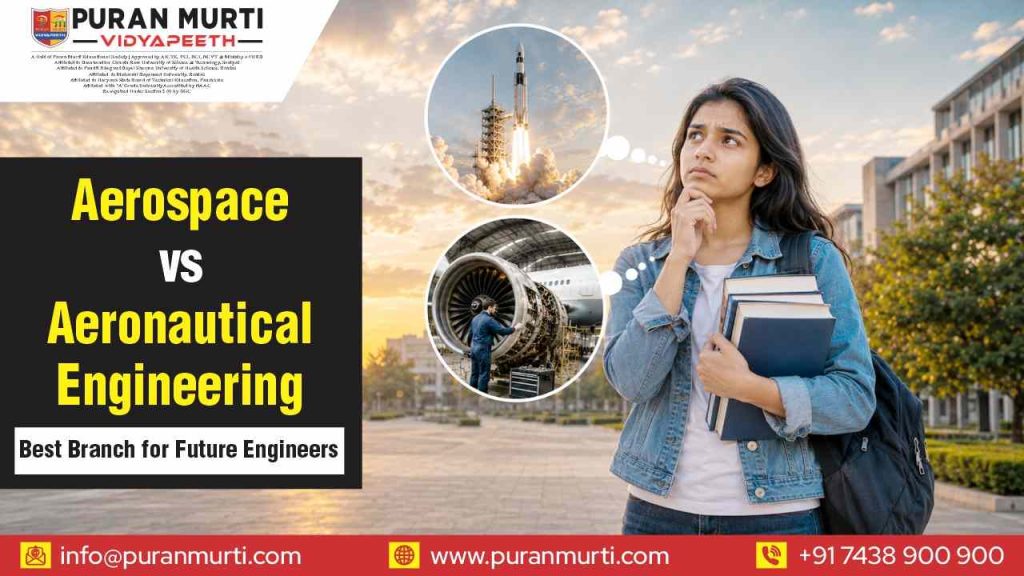
Aerospace vs Aeronautical Engineering: Best Branch for Future Engineers
Posted on : 4 August, 2026 12:55 pm
Choosing the right engineering branch after Class 12 is one of the biggest decisions for students who dream of building a career in the aviation and space industry. Today, Aerospace vs Aeronautical Engineering: Best Branch for Future Engineers is one of the most searched comparisons because both fields offer exciting opportunities in aircraft design, space technology, defence, and research. Moreover, the aviation and aerospace sectors are expanding rapidly due to increasing investments in commercial aviation, satellite technology, defence systems, and space exploration. As a result, many students compare Aerospace vs Aeronautical Engineering: Best Branch for Future Engineers to identify the branch that offers better career growth and long-term opportunities.
If you are exploring Aerospace vs Aeronautical Engineering: Best Branch for Future Engineers, it is important to understand the differences in course curriculum, eligibility, career opportunities, salary, and future scope. Furthermore, both branches focus on advanced engineering concepts but differ in their areas of specialization. Additionally, choosing the right college with experienced faculty, modern laboratories, practical training, internships, and placement support can play a major role in career success. This complete guide on Aerospace vs Aeronautical Engineering: Best Branch for Future Engineers will help you compare both branches and choose the one that best matches your interests, skills, and future career goals.
“The sky is not the limit anymore—modern engineers are building the future beyond Earth’s atmosphere.”
Apply Now
What is Aerospace Engineering?
Aerospace Engineering is a broad branch of engineering that deals with the design, development, testing, and maintenance of aircraft, spacecraft, satellites, missiles, and space vehicles. Moreover, it combines Aeronautical Engineering and Astronautical Engineering into one discipline. Aerospace engineers work on technologies used both inside the Earth’s atmosphere and in outer space.
Apply Now
What is Aeronautical Engineering?
Aeronautical Engineering is a specialized branch of engineering that focuses only on aircraft operating within the Earth’s atmosphere. Additionally, students learn about aircraft structures, aerodynamics, propulsion systems, flight mechanics, aircraft maintenance, and aviation safety. Aeronautical engineers mainly work on commercial airplanes, helicopters, fighter jets, drones, and other flying vehicles.
Apply Now
Aerospace vs Aeronautical Engineering: Quick Comparison
| Particular | Aerospace Engineering | Aeronautical Engineering |
|---|---|---|
| Focus Area | Aircraft + Spacecraft | Aircraft Only |
| Work Environment | Aviation & Space Industry | Aviation Industry |
| Scope | Wider | Specialized |
| Space Technology | Yes | No |
| Satellites | Yes | No |
| Aircraft Design | Yes | Yes |
| Defence Applications | Yes | Yes |
| Higher Career Flexibility | High | Moderate |
Why Choose Aerospace Engineering?
Many students prefer Aerospace Engineering because it offers a broader career scope.
Advantages
- Covers aircraft and spacecraft
- Opportunities in ISRO and DRDO
- Satellite and missile technology
- Global career opportunities
- Research and innovation
- High demand in defence sector
- Opportunities in private space companies
- Better international exposure
Why Choose Aeronautical Engineering?
Aeronautical Engineering is suitable for students who are passionate about aviation.
Advantages
- Specialized aviation knowledge
- Strong opportunities in airline industry
- Aircraft manufacturing
- Aircraft maintenance
- Defence aviation
- Airline operations
- Practical flight technology
- Growing drone industry
Apply Now
Course Overview
| Particular | Details |
|---|---|
| Course Name | B.Tech Aerospace / Aeronautical Engineering |
| Duration | 4 Years |
| Mode | Full-Time |
| Eligibility | 10+2 with PCM |
| Admission | Merit / Entrance Exam |
| Internship | Available |
| Higher Studies | M.Tech, MS, MBA |
Eligibility Criteria
Students seeking admission generally require:
| Requirement | Details |
|---|---|
| Qualification | 10+2 |
| Subjects | Physics, Chemistry & Mathematics |
| Minimum Marks | As per College Norms |
| Entrance Exam | JEE / State Level (if applicable) |
Admission Process
| Step | Process |
|---|---|
| Step 1 | Check Eligibility |
| Step 2 | Fill Application Form |
| Step 3 | Submit Documents |
| Step 4 | Merit/Entrance Process |
| Step 5 | Document Verification |
| Step 6 | Fee Payment |
| Step 7 | Admission Confirmation |
Subjects Covered
Aerospace Engineering
- Aerodynamics
- Flight Mechanics
- Aircraft Structures
- Spacecraft Systems
- Rocket Propulsion
- Satellite Technology
- Computational Fluid Dynamics
- Avionics
Apply Now
https://blog.puranmurti.com/pharmacy-admission-2027-eligibility-fees-and-admission-process/
Aeronautical Engineering
- Aircraft Design
- Aircraft Propulsion
- Aerodynamics
- Flight Dynamics
- Aircraft Maintenance
- Aviation Safety
- Avionics
- Aircraft Manufacturing
Apply Now
Why Choose Puran Murti Vidyapeeth?
Among the institutions offering Aerospace Engineering, Puran Murti Vidyapeeth, Delhi NCR, is known for its practical learning approach and industry-focused education. Students benefit from experienced faculty, modern laboratories, aircraft training exposure, workshops, internships, hostel facilities, personality development programs, and placement assistance. Moreover, the institution focuses on developing technical knowledge along with practical skills required by the aviation and aerospace industries.
Skills Required
Success in both Aerospace and Aeronautical Engineering depends on technical knowledge and practical skills. Moreover, students should continuously improve their problem-solving abilities and analytical thinking. Additionally, communication and teamwork are equally important because engineers often work on large projects with multidisciplinary teams.
| Skill | Importance |
|---|---|
| Analytical Thinking | High |
| Problem-Solving | High |
| Mathematics | High |
| Physics Knowledge | High |
| Computer Programming | High |
| CAD Software | High |
| Communication Skills | High |
| Teamwork | High |
| Innovation | High |
| Time Management | High |
Practical Training
Practical learning is an essential part of engineering education. Furthermore, students gain hands-on experience through laboratory sessions, workshops, internships, and industrial visits. As a result, they become familiar with real-world engineering applications.
Apply Now
https://blog.puranmurti.com/dmlt-full-form-course-details-eligibility-scope-career-2027/
| Practical Activity | Learning Outcome |
|---|---|
| Aircraft Workshops | Aircraft Components |
| Wind Tunnel Experiments | Aerodynamics |
| CAD & Simulation | Aircraft Design |
| Industrial Visits | Industry Exposure |
| Internship Programs | Professional Experience |
| Project Work | Technical Skills |
| Technical Seminars | Industry Knowledge |
Career Opportunities
Graduates from both branches have excellent career opportunities in India and abroad. However, Aerospace Engineering offers wider career options because it includes both aviation and space technology, whereas Aeronautical Engineering mainly focuses on aircraft.
Apply Now
| Job Role | Aerospace | Aeronautical |
|---|---|---|
| Aerospace Engineer | ✔ | — |
| Aeronautical Engineer | ✔ | ✔ |
| Aircraft Design Engineer | ✔ | ✔ |
| Aircraft Maintenance Engineer | — | ✔ |
| Flight Test Engineer | ✔ | ✔ |
| Avionics Engineer | ✔ | ✔ |
| Satellite Engineer | ✔ | — |
| Space Research Engineer | ✔ | — |
| Defence Engineer | ✔ | ✔ |
| UAV/Drone Engineer | ✔ | ✔ |
Top Recruiters
Graduates may find opportunities with leading organizations such as:
- ISRO
- DRDO
- HAL
- NAL
- Boeing
- Airbus
- Tata Advanced Systems
- Mahindra Aerospace
- Indigo
- Air India
- SpiceJet
- Hindustan Aeronautics Limited
- Collins Aerospace
- Rolls-Royce
- Safran
Apply Now
Salary Comparison
Salary depends on qualifications, skills, employer, location, and experience. Initially, fresh graduates receive competitive salary packages. Moreover, professionals with experience and advanced technical skills earn significantly higher salaries.
| Job Role | Average Starting Salary | Experienced Salary |
|---|---|---|
| Aerospace Engineer | ₹5–9 LPA | ₹12–25 LPA |
| Aeronautical Engineer | ₹4–8 LPA | ₹10–20 LPA |
| Aircraft Design Engineer | ₹5–10 LPA | ₹15–25 LPA |
| Avionics Engineer | ₹5–9 LPA | ₹12–22 LPA |
| Defence Engineer | ₹6–10 LPA | ₹15–30 LPA |
Salary packages vary depending on the employer, location, specialization, and professional experience.
Apply Now
Higher Education Options
Students can continue their education to improve technical expertise and career opportunities.
| Course | Career Benefit |
|---|---|
| M.Tech Aerospace Engineering | Advanced Technical Knowledge |
| M.Tech Aeronautical Engineering | Specialized Aviation Career |
| MS Abroad | Global Career Opportunities |
| MBA | Management Roles |
| Ph.D. | Research & Teaching |
| Aircraft Maintenance Certifications | Aviation Industry Growth |
Future Scope
The future of both Aerospace and Aeronautical Engineering is highly promising because aviation, defence, and space technology continue to expand worldwide. Moreover, increasing investments in satellite technology, commercial aviation, defence systems, drones, and space exploration are creating new employment opportunities. Furthermore, India’s growing space missions and private aerospace companies are increasing the demand for skilled engineers. Consequently, students graduating from these branches can expect rewarding careers in both India and abroad.
Growing employment sectors include:
- Space Research
- Commercial Aviation
- Defence Manufacturing
- Drone Technology
- Satellite Development
- Aircraft Manufacturing
- Aviation Maintenance
- Research & Development
- Artificial Intelligence in Aviation
- Private Space Companies
Apply Now
Conclusion
Choosing between Aerospace vs Aeronautical Engineering: Best Branch for Future Engineers depends on your career interests and long-term goals. If you are interested in aircraft as well as spacecraft, satellites, and space exploration, Aerospace Engineering is the better choice. On the other hand, if your passion lies mainly in aircraft design, aviation technology, and airline operations, Aeronautical Engineering is an excellent option. Moreover, selecting a reputed institution with practical training and placement support is equally important. Therefore, students may consider Puran Murti Vidyapeeth, Delhi NCR, which provides quality education, experienced faculty, modern laboratories, industry exposure, internships, hostel facilities, and placement assistance for aspiring aerospace engineers.
Government Jobs After LLB: Opportunities and Eligibility Guide
Apply Now
About Puran Murti Vidyapeeth Apply Now
The institute is known for its focus on technical education, practical learning, laboratory exposure, and career-oriented training. Students can explore engineering programs in modern technology domains while benefiting from academic support, industry interaction, and campus facilities. The availability of hostel facilities, skill-development activities, and placement assistance also makes it a consideration for students looking for engineering education near Delhi NCR. Apply Now
Top Engineering Branches
BTech (Bachelor of Technology)
BTech is among the most popular courses after 12th Science (PCM).
Top Specializations:
- Aeronautical Engineering
- Aerospace Engineering
- Aircraft Maintenance Engineering (AME)
- Computer Science & Engineering (CSE)
- CSE with Artificial Intelligence and Machine Learning (AI & ML)
- Civil Engineering
- Electrical Engineering
- Electronics & Communication Engineering (ECE)
- Mechanical Engineering
Unique Aviation Programs (USP)
One of the biggest advantages of Puran Murti Vidyapeeth is its aviation-based courses, which are rare in India:
- B.Tech + AME (DGCA approved)
- B.Tech Mechanical Engineering + AME (DGCA)
- B.Tech ECE + AME (DGCA)
- B.Tech Computer Science
(AI & ML)+ AME (DGCA) - B.Tech Aeronautical Engineering
+ CPL (Ground Classes) - B.Tech Aerospace Engineering
+ CPL (Ground Classes)
Diploma Courses
Students can also choose job-oriented diploma courses: Apply Now
- Diploma in Automobile Engineering (AE)
- Diploma in AME (Aircraft Maintenance Engineering)
- Diploma in Aeronautical Engineering
- Diploma in Civil Engineering (CE)
- Diploma in Mechanical Engineering (ME)
- Diploma in Computer Science & Engineering (CSE)
- Diploma in Electronics & Communication Engineering (ECE)
- Diploma in Electrical Engineering (EE)
- Diploma in Fire Technology & Safety
- Diploma in Medical Lab Technology (MLT)
- Diploma in Hotel Management
- Diploma in CSE (AI & ML
Frequently Asked Questions (FAQs)
1. Which is better: Aerospace or Aeronautical Engineering?
Both branches offer excellent career opportunities. However, Aerospace Engineering provides a wider scope by covering aircraft, spacecraft, satellites, and space technology, while Aeronautical Engineering focuses mainly on aircraft.
2. Which branch has a better salary?
Generally, Aerospace Engineering offers slightly higher salary potential because graduates can work in both aviation and space sectors. However, salaries depend on skills, employer, and experience.
3. Can Aerospace Engineers work in the aviation industry?
Yes. Aerospace engineers can work in aviation, defence, aircraft manufacturing, satellite technology, and space research organizations.
4. Is Aeronautical Engineering still a good career?
Yes. Moreover, Aeronautical Engineering remains an excellent career option due to the continuous growth of commercial aviation, defence aviation, and aircraft manufacturing.
5. Why choose Puran Murti Vidyapeeth for Aerospace Engineering?
Puran Murti Vidyapeeth, Delhi NCR, offers experienced faculty, modern laboratories, practical training, aircraft workshops, internship opportunities, hostel facilities, personality development programs, and placement assistance to prepare students for successful careers in the aerospace industry.