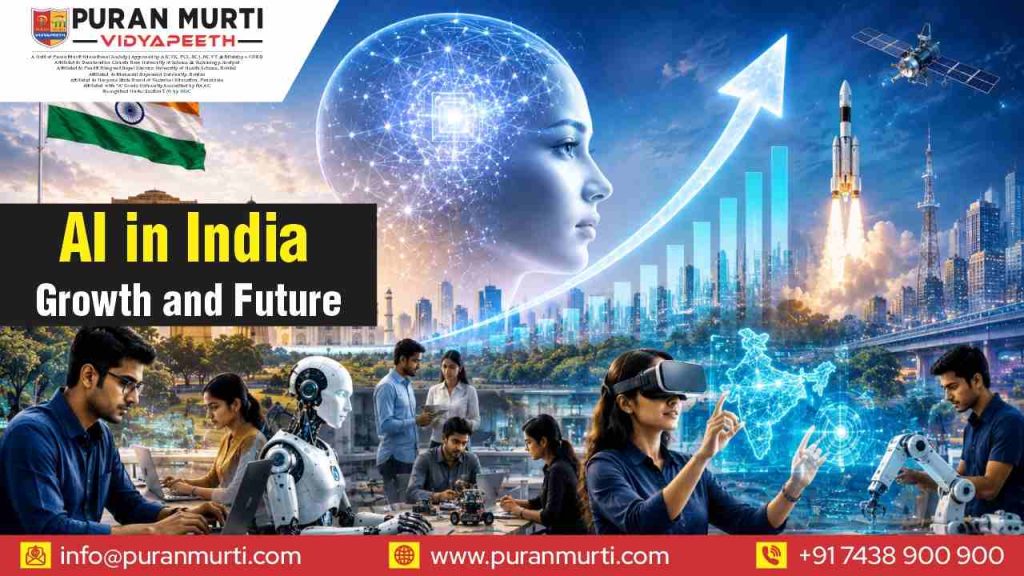
AI in India: Growth and Future
Posted on : 20 June, 2026 3:03 pm
Over the past decade, AI in India growth and future has been strongly influenced by rapid digital adoption, expanding internet access, and a thriving startup ecosystem. As a result, AI in India growth and future has become deeply connected to how technology is embedded in everyday life, influencing how businesses operate, how students learn, and how citizens access services. This shift has created a strong foundation for advanced computational systems that can analyze data, identify patterns, and support decision-making processes more effectively, which further strengthens AI in India growth and future.
In recent years, intelligent digital systems have evolved from experimental tools into practical, industry-specific solutions, further shaping AI in India growth and future. For example, from personalized recommendations on streaming platforms to fraud detection systems in banking, these technologies are quietly reshaping outcomes at scale. Apply Now
Top AI / Engineering Colleges in India (AI Focus)
| Rank | College Name | Location |
|---|---|---|
| 1 | Indian Institute of Technology (IIT) Delhi | New Delhi |
| 2 | Indian Institute of Technology (IIT) Bombay | Mumbai, Maharashtra |
| 3 | Indian Institute of Technology (IIT) Madras | Chennai, Tamil Nadu |
| 4 | Indian Institute of Technology (IIT) Kanpur | Kanpur, Uttar Pradesh |
| 5 | Indian Institute of Technology (IIT) Kharagpur | Kharagpur, West Bengal |
| 6 | Delhi Technological University (DTU) | Delhi |
| 7 | Puran Murti Vidyapeeth | Sonepat, Haryana (Delhi NCR) |
| 8 | Netaji Subhas University of Technology (NSUT) | Delhi |
| 9 | Indian Institute of Information Technology (IIIT) Delhi | New Delhi |
| 10 | Birla Institute of Technology & Science (BITS) Pilani | Pilani, Rajasthan |
| 11 | Vellore Institute of Technology (VIT) | Vellore, Tamil Nadu |
| 12 | Shiv Nadar University | Greater Noida, Uttar Pradesh |
| 13 | Amity University | Noida, Uttar Pradesh |
| 14 | Bennett University | Greater Noida, Uttar Pradesh |
| 15 | Galgotias University | Greater Noida, Uttar Pradesh |
| 16 | Chandigarh University | Mohali, Punjab |
| 17 | SRM Institute of Science and Technology | Chennai, Tamil Nadu |
| 18 | Manipal Institute of Technology | Manipal, Karnataka |
| 19 | Jamia Millia Islamia (Engineering) | New Delhi |
| 20 | Indian Institute of Technology (IIT) Roorkee | Roorkee, Uttarakhand |
Growth of Intelligent Systems in India
India’s growth in this domain is strongly connected to its expanding digital infrastructure. On one hand, affordable smartphones and widespread mobile internet access have increased connectivity across urban and rural regions. On the other hand, initiatives like Digital India have created an environment where data generation is massive, continuous, and highly valuable for technological development. As a result, this data has become the backbone for building systems that can learn, adapt, and improve over time.
In addition, the rise of startups focusing on automation, analytics, and predictive technologies has significantly accelerated innovation. Cities such as Bengaluru, Hyderabad, and Pune have emerged as major innovation hubs where engineers and researchers are developing solutions for both domestic and global markets. Not only are these companies serving large enterprises, but they are also addressing grassroots challenges in sectors such as agriculture, healthcare, and education. Apply Now
Implications for Major Industries
Healthcare
One of the most promising areas of transformation is healthcare. Hospitals and medical startups are increasingly using data-driven systems to improve diagnostics, predict disease risks, and streamline patient care. In rural areas, where access to healthcare professionals is limited, digital platforms are helping bridge the gap by enabling remote consultations and early detection of illnesses. As a result, healthcare accessibility and efficiency have significantly improved.
Education
Similarly, education has experienced a major shift. Personalized learning platforms are helping students learn at their own pace by analyzing performance data and identifying strengths and weaknesses. In parallel, teachers are using digital dashboards to monitor student progress and provide targeted support. Consequently, learning has become more inclusive, especially for students in remote regions who previously lacked access to quality educational resources.
Agriculture
Agriculture, which remains a backbone of the Indian economy, is also undergoing significant transformation. Predictive systems are being used to analyze weather patterns, soil conditions, and crop health. As a result, farmers are receiving timely recommendations regarding irrigation, fertilizer usage, and pest control. Furthermore, mobile-based advisory services have made these innovations accessible even in rural and semi-urban areas, leading to improved yields and reduced crop losses.
Finance
The financial sector has also seen rapid advancement. Banks and fintech companies are using advanced analytics to detect fraud, assess credit risk, and offer personalized financial products. In addition, digital payment platforms have become widely adopted, enabling secure and fast transactions for millions of users. Consequently, this shift has also contributed to bringing a large unbanked population into the formal financial system. Apply Now
Manufacturing and Industry
Industrial operations are becoming increasingly efficient due to automation and predictive maintenance systems. Smart sensors now allow machines to detect potential faults before they occur, thereby reducing downtime and operational costs. Moreover, supply chain optimization tools are helping organizations manage logistics and inventory more effectively, ultimately improving overall productivity.
Challenges in Adoption
Despite significant progress, several challenges continue to exist. First, there is a shortage of highly skilled professionals capable of designing and managing advanced systems. Although India produces a large number of engineers each year, specialized expertise remains limited in certain emerging domains.
Second, concerns regarding data privacy and security are becoming increasingly important. As more personal and sensitive data is collected, protecting it from misuse and breaches becomes critical. Therefore, strong regulatory frameworks and effective enforcement mechanisms are essential.
Finally, ethical concerns such as algorithmic bias must also be addressed. If systems are not designed carefully, they may unintentionally reinforce existing social inequalities, which makes fairness and transparency extremely important. Apply Now
Future Outlook
The future of intelligent technologies in India appears highly promising. With continued investment in research and development, India is expected to emerge as a global leader in innovation. In particular, emerging fields such as natural language processing, robotics, and autonomous systems are likely to experience rapid growth.
At the same time, education and skill development will play a crucial role in shaping this future. As academic institutions expand their focus on advanced computational subjects, a new generation of professionals will be better equipped to meet evolving industry demands.
Furthermore, startups are expected to remain a strong driving force behind innovation by introducing disruptive solutions across multiple sectors. In addition, government initiatives focusing on digital infrastructure, data governance, and research funding will further strengthen the ecosystem.
Looking ahead, integration with technologies such as 5G, cloud computing, and edge devices will make intelligent systems faster, more reliable, and more accessible. Consequently, this will open new opportunities in areas such as smart cities, autonomous transportation, and precision healthcare. Apply Now

About Puran Murti Vidyapeeth
The institute is known for its focus on technical education, practical learning, laboratory exposure, and career-oriented training. Students can explore engineering programs in modern technology domains while benefiting from academic support, industry interaction, and campus facilities. The availability of hostel facilities, skill-development activities, and placement assistance also makes it a consideration for students looking for engineering education near Delhi NCR. Apply Now
Top Engineering Branches
BTech (Bachelor of Technology)
BTech is among the most popular courses after 12th Science (PCM).
Top Specializations:
- Aeronautical Engineering
- Aerospace Engineering
- Aircraft Maintenance Engineering (AME)
- Computer Science & Engineering (CSE)
- CSE with Artificial Intelligence and Machine Learning (AI & ML)
- Civil Engineering
- Electrical Engineering
- Electronics & Communication Engineering (ECE)
- Mechanical Engineering
Unique Aviation Programs (USP)
One of the biggest advantages of Puran Murti Vidyapeeth is its aviation-based courses, which are rare in India:
- B.Tech + AME (DGCA approved)
- B.Tech Mechanical Engineering + AME (DGCA)
- B.Tech ECE + AME (DGCA)
- B.Tech Computer Science
(AI & ML)+ AME (DGCA) - B.Tech Aeronautical Engineering
+ CPL (Ground Classes) - B.Tech Aerospace Engineering
+ CPL (Ground Classes)
Diploma Courses
Students can also choose job-oriented diploma courses: Apply Now
- Diploma in Automobile Engineering (AE)
- Diploma in AME (Aircraft Maintenance Engineering)
- Diploma in Aeronautical Engineering
- Diploma in Civil Engineering (CE)
- Diploma in Mechanical Engineering (ME)
- Diploma in Computer Science & Engineering (CSE)
- Diploma in Electronics & Communication Engineering (ECE)
- Diploma in Electrical Engineering (EE)
- Diploma in Fire Technology & Safety
- Diploma in Medical Lab Technology (MLT)
- Diploma in Hotel Management
- Diploma in CSE (AI & ML)
Conclusion
India stands at a crucial turning point in its technological journey, and AI in India growth and future is becoming a key driver of this transformation. The rapid adoption of advanced digital systems is not only transforming industries but also improving public services and creating new economic opportunities. While challenges such as skill shortages, data privacy concerns, and unequal access still exist, the overall direction remains strongly positive
