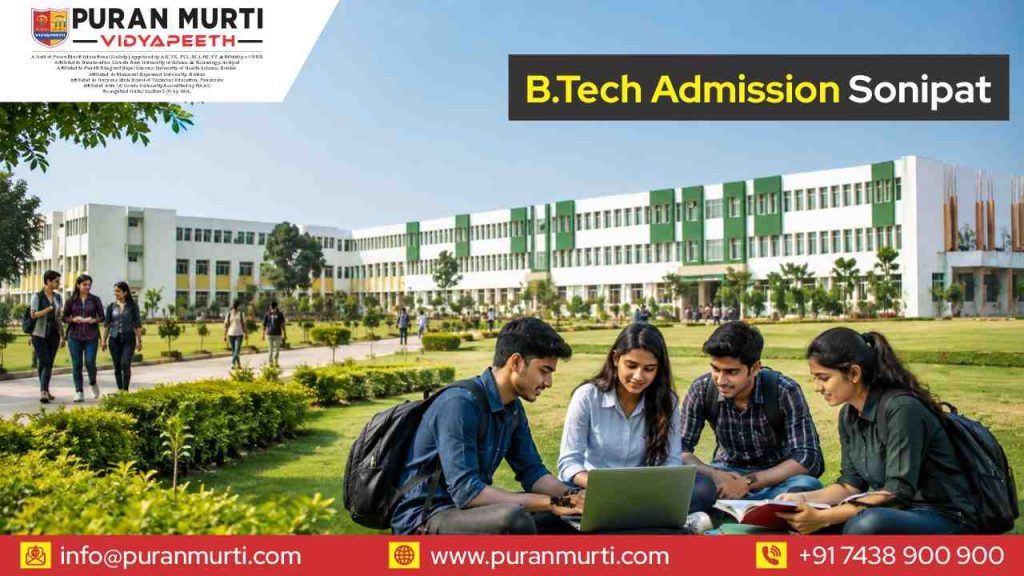
B.Tech Admission in Sonipat 2026: Guide & Process
Posted on : 1 September, 2026 1:05 am
Choosing an engineering college is more than comparing course names or searching for the lowest fee. For students planning B.Tech admission in Sonipat, the real question is whether the college can provide the right combination of academics, practical learning, industry exposure, career guidance and opportunities for future growth.
Sonipat has become an attractive education destination for students from Haryana and the wider Delhi NCR region. Its location gives students access to a growing education and employment ecosystem while allowing them to study away from some of the higher living costs associated with central Delhi.
For the 2026-27 academic session, students can explore B.Tech options at Puran Murti Vidyapeeth, located on Kami Road, Sonipat, Haryana. The institution lists B.Tech programmes across areas including Computer Science and Engineering, CSE with AI & ML, Aerospace Engineering, Aeronautical Engineering, Civil Engineering, Electrical Engineering, Electronics and Communication Engineering and Mechanical Engineering.
If you are currently comparing engineering colleges in Sonipat, this guide explains the admission process, course options, career opportunities, practical considerations and questions students should ask before taking admission.
B.Tech Admission in Sonipat 2026
| Factor | Key Information |
|---|---|
| Course | Bachelor of Technology (B.Tech) |
| Typical duration | 4 years |
| Study level | Undergraduate engineering |
| Location | Sonipat, Haryana, Delhi NCR |
| Popular branches | CSE, CSE AI & ML, Civil, Mechanical, ECE, Electrical, Aerospace and Aeronautical Engineering |
| Admission routes | Entrance-based and merit-based routes may apply depending on programme and applicable rules |
| Target students | Class 12 science students and eligible diploma holders for lateral entry |
| Career options | Software, engineering, manufacturing, construction, electronics, aerospace, energy and other technical sectors |
| 2026-27 status at PMV | Admissions are being accepted for the academic session, according to the institution’s official admission page |
Admission requirements and applicable counselling or regulatory procedures can change. Students should therefore confirm the latest requirements with the institution and relevant authorities before submitting documents or fees.
What Is B.Tech?
B.Tech, or Bachelor of Technology, is a four-year undergraduate engineering degree that combines theoretical concepts with practical and technical learning. Students specialise in a particular engineering discipline and develop skills needed for employment, entrepreneurship or higher education.
Depending on the branch, students study subjects such as programming, mathematics, electronics, mechanics, design, structures, electrical systems, artificial intelligence or aerospace technology.
A B.Tech degree can subsequently lead to:
- Technical employment
- Software and IT careers
- Core engineering jobs
- Government and public-sector opportunities
- Entrepreneurship
- M.Tech and other postgraduate programmes
- Management education such as MBA
- Research and specialised technical careers
Why Choose B.Tech Admission in Sonipat?
Sonipat offers an important advantage for students who want access to the Delhi NCR education and employment ecosystem without necessarily studying in central Delhi.
1. Delhi NCR connectivity
Sonipat’s location in the National Capital Region can make it convenient for students from Delhi, Haryana and nearby areas.
Students may therefore consider colleges in Sonipat if they want a combination of campus-based education and access to the wider NCR region.
2. Multiple engineering specialisations
Engineering is no longer limited to traditional branches.
Today’s students can choose from conventional disciplines such as Mechanical, Civil and Electrical Engineering as well as technology-focused areas such as Computer Science, Artificial Intelligence and Machine Learning.
3. Growing importance of practical skills
Employers increasingly look for graduates who can apply what they learn.
Consequently, students should evaluate:
- Laboratories
- Workshops
- Projects
- Internships
- Technical competitions
- Industrial visits
- Coding activities
- Design and prototyping
- Communication training
4. Career flexibility
A B.Tech degree does not lock a student into a single job.
For example, a Computer Science graduate may work in software development, data, cloud computing or cybersecurity. Similarly, a Mechanical Engineering graduate may explore manufacturing, design, automation, robotics or quality roles.
B.Tech Courses Available at Puran Murti Vidyapeeth
Puran Murti Vidyapeeth lists several B.Tech disciplines for students considering engineering education in Sonipat. Its official programme information includes both conventional and emerging engineering fields.
Top Engineering Courses in 2026
Popular Engineering Courses
- Aeronautical Engineering
- Aerospace Engineering
- Aircraft Maintenance Engineering (AME)
- Computer Science & Engineering (CSE)
- CSE with Artificial Intelligence and Machine Learning (AI & ML)
- Civil Engineering
- Electrical Engineering
- Electronics & Communication Engineering (ECE)
- Mechanical Engineering
Unique Aviation Programs (USP)
One of the biggest advantages of Puran Murti Vidyapeeth is its aviation-based courses, which are rare in India:
- B.Tech + AME (DGCA approved)
- B.Tech Mechanical Engineering + AME (DGCA)
- B.Tech ECE + AME (DGCA)
- B.Tech Computer Science
(AI & ML)+ AME (DGCA) - B.Tech Aeronautical Engineering
+ CPL (Ground Classes) - B.Tech Aerospace Engineering
+ CPL (Ground Classes)
Diploma Courses
Students can also choose job-oriented diploma courses: Apply Now
- Diploma in Automobile Engineering (AE)
- Diploma in AME (Aircraft Maintenance Engineering)
- Diploma in Aeronautical Engineering
- Diploma in Civil Engineering (CE)
- Diploma in Mechanical Engineering (ME)
- Diploma in Computer Science & Engineering (CSE)
- Diploma in Electronics & Communication Engineering (ECE)
- Diploma in Electrical Engineering (EE)
- Diploma in Medical Lab Technology (MLT)
- Diploma in Hotel Management
- Diploma in CSE (AI & ML)
Computer Science and Engineering
B.Tech CSE is one of the most popular choices for students interested in software and digital technology.
Potential career areas include:
- Software development
- Web development
- Application development
- Cloud computing
- Database management
- Cybersecurity
- Data-related roles
- IT consulting
Students who enjoy programming, logical reasoning and technology may find CSE particularly suitable.
CSE with Artificial Intelligence and Machine Learning
AI and ML have become important areas across technology, finance, healthcare, manufacturing, education and other industries.
Students can build foundations in:
- Programming
- Data structures
- Machine learning
- Artificial intelligence
- Data analysis
- Algorithms
- Computational problem-solving
This specialisation may suit students who want to build careers around emerging technologies.
Aerospace Engineering
Aerospace Engineering focuses on technologies associated with aircraft and space-related systems.
Students may explore areas such as:
- Aircraft design
- Aerodynamics
- Propulsion
- Materials
- Flight systems
- Aerospace manufacturing
Aeronautical Engineering
Aeronautical Engineering concentrates primarily on aircraft and aviation technology.
It can be relevant for students interested in aircraft systems, aviation manufacturing, maintenance-related ecosystems and aerospace organisations.
Civil Engineering
Civil Engineering covers the planning, design, construction and maintenance of infrastructure.
Career areas can include:
- Construction
- Structural engineering
- Transportation
- Infrastructure development
- Environmental engineering
- Site management
- Government engineering departments
Mechanical Engineering
Mechanical Engineering remains relevant across manufacturing, automotive, industrial equipment, energy and automation.
Students can develop skills related to:
- Machine design
- Manufacturing
- Thermodynamics
- Production
- CAD
- Automation
- Maintenance
Electrical Engineering
Electrical Engineering deals with electrical systems, power, control and related technologies.
Career opportunities may exist in:
- Power systems
- Electrical design
- Automation
- Manufacturing
- Renewable energy
- Infrastructure
- Electronics-related industries
Electronics and Communication Engineering
ECE combines electronics, communication and technology.
Students can explore:
- Embedded systems
- Communication systems
- Electronics design
- IoT
- Signal processing
- Semiconductor-related technologies
B.Tech Eligibility: Who Can Apply?
Students who have completed the required Class 12 qualification with the prescribed subjects and meet the applicable eligibility criteria can seek admission to B.Tech programmes. Eligibility, subject requirements, minimum marks and admission routes can vary by programme and regulatory rules.
Students should check the latest eligibility criteria before applying because admission requirements can differ according to the branch, category and admission route.
For lateral entry, eligible diploma holders may have a separate route into B.Tech programmes. Puran Murti Vidyapeeth also lists B.Tech lateral-entry programmes in its programme information.
B.Tech Admission Process in Sonipat
The admission process generally involves several important steps.
Step 1: Select your engineering branch
Start by identifying your interests.
Do not choose CSE simply because it is popular. Likewise, do not select Mechanical, Civil or Aerospace Engineering without understanding what the course involves.
Ask yourself:
- Do I enjoy coding?
- Do I prefer machines and manufacturing?
- Am I interested in aircraft?
- Do I enjoy mathematics and design?
- Do I want to work with electronics?
- Do I prefer infrastructure and construction?
Your answers can help narrow down the right branch.
Step 2: Check eligibility
Review:
- Class 12 qualification
- Required subjects
- Minimum marks
- Entrance examination requirements, where applicable
- Category requirements
- Lateral-entry eligibility, if relevant
Step 3: Check the admission route
Puran Murti Vidyapeeth states that B.Tech admissions can involve entrance examination and merit-based routes depending on the programme. Its published admission information references examinations including JEE and AME CET for specified B.Tech categories.
Because admission rules can change, students should confirm the applicable route for their selected branch before applying.
Step 4: Submit the application
Students can apply through the applicable admission channel and provide the required academic and identity documents.
Step 5: Complete counselling or admission formalities
Depending on the admission route, students may need to complete counselling, seat confirmation, document verification and fee-related formalities.
Step 6: Begin the academic journey
After admission, students should focus on building a strong foundation in academics, communication, technical skills and project-based learning from the first semester.
Documents Required for B.Tech Admission
The exact list may vary. However, students are generally advised to keep commonly requested documents ready, such as:
- Class 10 certificate
- Class 12 marksheet/certificate
- Entrance examination scorecard, where applicable
- Transfer or migration certificate, if required
- Character certificate
- Passport-size photographs
- Government-issued identification
- Category certificate, if applicable
- Domicile certificate, where applicable
- Medical or other documents required by the institution
Tip: Keep both original documents and several photocopies available during admission.
How to Choose the Best B.Tech College in Sonipat?
Searching for the best engineering college in Sonipat should involve more than checking a ranking position.
Use the following checklist.
| Factor | What Students Should Check |
|---|---|
| Accreditation/approval | Verify current institutional and programme status |
| Affiliation | Check the current affiliating university |
| Faculty | Look for qualified and accessible teachers |
| Laboratories | Check whether labs support practical learning |
| Placements | Review available placement information and recruiter participation |
| Industry exposure | Look for internships, projects and industrial visits |
| Course options | Compare branches and emerging specialisations |
| Campus | Consider infrastructure, library, labs and student facilities |
| Location | Evaluate connectivity and commute |
| Fees | Compare total academic and living costs |
| Student support | Check mentoring and career guidance |
| Campus visit | Experience the environment before deciding |
Why Consider Puran Murti Vidyapeeth for B.Tech?
Puran Murti Vidyapeeth presents itself as a Delhi NCR campus offering multiple engineering and professional programmes. Its official website lists B.Tech programmes, laboratories, faculty resources, campus infrastructure and career support.
The institution currently reports 8,000+ students, 143+ faculty members, 72+ technical facilities/laboratories and a 25-acre campus on its website. These are institutional figures and should be treated as self-reported information.
The college also highlights industry and placement support as part of its student-development approach.
Placements and Career Support
A good B.Tech college should prepare students for employment rather than focusing only on examinations. Placement preparation should ideally include technical training, communication skills, interviews, resume development, internships and interaction with employers.
Puran Murti Vidyapeeth states that its placement ecosystem works with employers and provides career guidance and placement support. The institution’s placement pages also show examples of B.Tech alumni associated with organisations including Indigo Airlines, DMRC, North Central Railway, Atlas Copco and other employers.
However, students should evaluate placement information carefully. Ask about:
- Number of eligible students
- Number of students placed
- Median or average package
- Highest package
- Branch-wise placement performance
- Internship opportunities
- Recruiter list
- Job roles offered
- Placement year
- Whether figures are institution-wide or programme-specific
This approach gives families a clearer picture than relying on a single “highest package” number.
Industry Exposure: Why It Matters
A degree gives you academic knowledge. Industry exposure helps you understand how that knowledge is used.
For engineering students, practical exposure can include:
- Industrial visits
- Internships
- Live projects
- Technical workshops
- Hackathons
- Laboratory work
- Design projects
- Expert sessions
- Technical competitions
- Industry-oriented certification
For example, a CSE student could develop a working software project instead of only studying programming concepts. Similarly, a Mechanical Engineering student could gain practical experience through CAD, manufacturing or machine-design projects.
B.Tech Career Scope After Graduation
A B.Tech degree can open several career pathways.
Technology Careers
CSE and AI/ML graduates may explore:
- Software Developer
- Full Stack Developer
- Data Analyst
- AI/ML Engineer
- Cloud Engineer
- Cybersecurity Analyst
- Database Professional
Core Engineering Careers
Mechanical, Civil, Electrical and ECE graduates may explore:
- Design Engineer
- Production Engineer
- Site Engineer
- Quality Engineer
- Maintenance Engineer
- Electrical Engineer
- Electronics Engineer
- Project Engineer
Aerospace and Aviation Careers
Students specialising in Aerospace or Aeronautical Engineering can explore opportunities related to:
- Aircraft systems
- Aerospace manufacturing
- Design
- Testing
- Maintenance ecosystem
- Aviation technology
Career outcomes depend on individual skills, academic performance, internships, market conditions and employer requirements.
What Skills Should B.Tech Students Build?
A degree alone is no longer enough to stand out in a competitive graduate market.
Students should build a combination of technical and professional skills.
Technical Skills
Depending on the branch, these could include:
- Programming
- CAD
- Data analysis
- AI and ML
- Electronics
- Simulation
- Automation
- Engineering design
- Project management
Soft Skills
Employers also value:
- Communication
- Teamwork
- Problem-solving
- Presentation skills
- Time management
- Leadership
- Professional writing
Career Skills
Students should additionally learn:
- Resume writing
- Interview preparation
- LinkedIn networking
- Portfolio development
- Internship searching
- Aptitude preparation
Starting these activities during the first year can create a significant advantage by graduation.
B.Tech vs Diploma in Engineering
| Feature | B.Tech | Diploma |
|---|---|---|
| Level | Undergraduate degree | Diploma-level technical qualification |
| Typical duration | 4 years | Usually 3 years after Class 10 |
| Academic depth | Higher | More focused technical foundation |
| Career scope | Broad graduate-level opportunities | Technical and technician-level opportunities |
| Higher studies | M.Tech, MBA and other options | Can pursue B.Tech through eligible routes |
| Suitable for | Students seeking a full engineering degree | Students seeking an earlier technical pathway |
The right option depends on your academic background, career objectives and preferred learning pathway.
How to Prepare for B.Tech Admission in 2026
Students can follow a simple admission preparation plan.
1. Finalise your preferred branch
Shortlist two or three branches rather than applying randomly.
2. Research colleges
Compare:
- Course structure
- Fees
- Faculty
- Infrastructure
- Placements
- Industry exposure
- Location
- Student support
3. Track entrance requirements
If your selected programme requires an entrance examination, follow the official examination schedule and eligibility requirements.
4. Prepare your documents early
Do not wait until the last admission date.
5. Visit the campus
A campus visit can help students and parents evaluate classrooms, laboratories, accommodation, facilities and the overall learning environment.
6. Speak to the admissions team
Ask specific questions about fees, scholarships, eligibility, hostel, transportation, placements and the curriculum.
Common Mistakes Students Should Avoid
Choosing a B.Tech college is an important financial and career decision. Avoid these mistakes:
- Selecting a branch only because friends selected it
- Looking only at the highest salary figure
- Ignoring accreditation or affiliation information
- Not checking the curriculum
- Choosing a college without visiting the campus
- Waiting until the final admission deadline
- Ignoring internship opportunities
- Focusing entirely on marks and neglecting practical skills
Most importantly, compare colleges using multiple factors rather than one promotional claim.
Frequently Asked Questions About B.Tech Admission in Sonipat
What is the eligibility for B.Tech admission in Sonipat?
Students who meet the prescribed Class 12 subject and marks requirements can apply for B.Tech programmes, subject to the eligibility rules of the relevant programme and admission authority. Entrance examination requirements may also apply. Students should verify the latest criteria before applying.
How can I get B.Tech admission in Sonipat in 2026?
Students should first select a B.Tech branch, check eligibility, identify the applicable entrance or merit-based admission route, submit the application and complete document verification and admission formalities. Requirements can vary by institution and programme, so candidates should confirm the latest 2026-27 rules.
Which B.Tech branches are available at Puran Murti Vidyapeeth?
Puran Murti Vidyapeeth lists B.Tech programmes in areas including Computer Science and Engineering, CSE with AI & ML, Civil Engineering, Mechanical Engineering, Electrical Engineering, Electronics and Communication Engineering, Aerospace Engineering and Aeronautical Engineering.
Is B.Tech CSE available in Sonipat?
Yes. B.Tech Computer Science and Engineering is available among the engineering programmes listed by Puran Murti Vidyapeeth in Sonipat. The institution also lists CSE with Artificial Intelligence and Machine Learning for students interested in emerging technology fields.
Why choose Sonipat for B.Tech?
Sonipat can be an attractive option for engineering students because of its location within the Delhi NCR region, access to educational institutions and connectivity with nearby employment and industrial centres. Students should nevertheless compare individual colleges based on academics, infrastructure, placements and industry exposure.
Is B.Tech a good career option after Class 12?
B.Tech can be a strong career option for students interested in technology, engineering, design and problem-solving. However, career outcomes depend on the chosen specialisation, academic performance, technical skills, internships, projects and overall employability.
Final Thoughts
Choosing the right college for B.Tech admission in Sonipat can shape the next four years of your academic and professional journey. Therefore, students should look beyond a college name and evaluate the complete learning ecosystem.
The right environment should help you develop technical knowledge, practical confidence, communication ability and career readiness.
For students exploring engineering education in Sonipat and Delhi NCR, Puran Murti Vidyapeeth offers multiple B.Tech specialisations along with laboratories, campus facilities and placement-oriented career support. The institution’s official website currently lists admissions for the 2026-27 academic session.
If you are planning B.Tech admission in Sonipat in 2026, do not wait until the last moment to make your decision.
Shortlist your preferred B.Tech branch, check your eligibility, compare your options and speak with the admissions team.