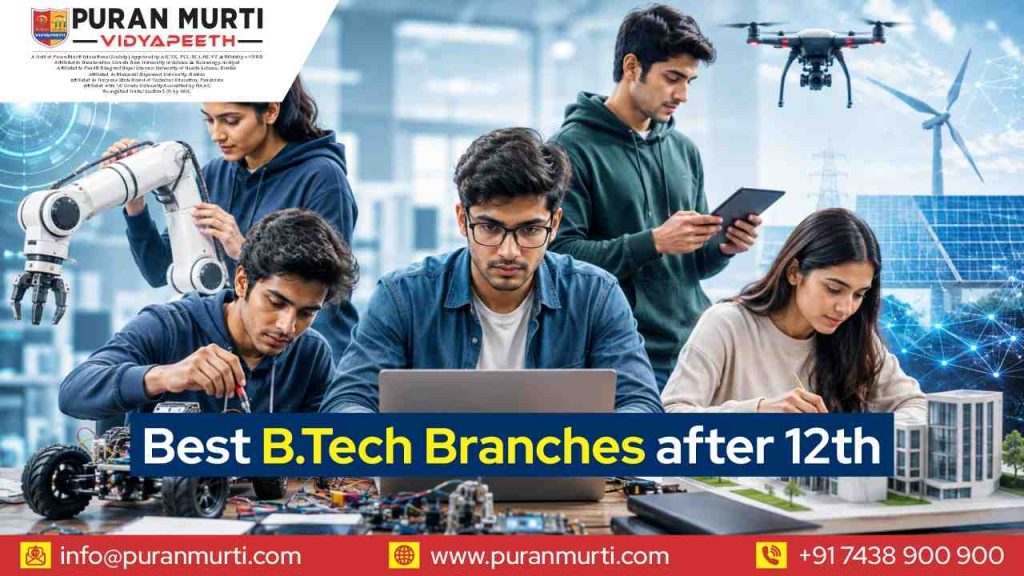
Best B.Tech Branches After 12th in 2026
Posted on : 21 August, 2026 12:17 am
Choosing a B.Tech branch after Class 12 is more than selecting a popular course. It is a decision that can influence your skills, internships, career opportunities and higher-study options for years.
For students in Sonipat, Delhi NCR and across India, the choice has become even more important because engineering careers are changing rapidly. Artificial intelligence, cybersecurity, semiconductor technology, electric mobility, automation, aerospace and renewable energy are creating new opportunities alongside traditional engineering careers.
That means the best B.Tech branch after 12th is not necessarily the same for every student. The right choice depends on your interests, strengths, aptitude and career goals.
What Are the Best B.Tech Branches After 12th?
The best B.Tech branches after 12th include Computer Science and Engineering, CSE with Artificial Intelligence and Machine Learning, Electronics and Communication Engineering, Electrical Engineering, Mechanical Engineering, Civil Engineering, Aerospace Engineering and Aeronautical Engineering.
Each branch leads to different career paths. Students should compare curriculum, future demand, practical exposure, internships, placement support and opportunities for specialization before making a decision.
Quick Comparison of Top B.Tech Branch
Popular Engineering Courses
- Aeronautical Engineering
- Aerospace Engineering
- Aircraft Maintenance Engineering (AME)
- Computer Science & Engineering (CSE)
- CSE with Artificial Intelligence and Machine Learning (AI & ML)
- Civil Engineering
- Electrical Engineering
- Electronics & Communication Engineering (ECE)
- Mechanical Engineering
Unique Aviation Programs (USP)
One of the biggest advantages of Puran Murti Vidyapeeth is its aviation-based courses, which are rare in India:
- B.Tech + AME (DGCA approved)
- B.Tech Mechanical Engineering + AME (DGCA)
- B.Tech ECE + AME (DGCA)
- B.Tech Computer Science
(AI & ML)+ AME (DGCA) - B.Tech Aeronautical Engineering
+ CPL (Ground Classes) - B.Tech Aerospace Engineering
+ CPL (Ground Classes)
Diploma Courses
Students can also choose job-oriented diploma courses: Apply Now
- Diploma in Automobile Engineering (AE)
- Diploma in AME (Aircraft Maintenance Engineering)
- Diploma in Aeronautical Engineering
- Diploma in Civil Engineering (CE)
- Diploma in Mechanical Engineering (ME)
- Diploma in Computer Science & Engineering (CSE)
- Diploma in Electronics & Communication Engineering (ECE)
- Diploma in Electrical Engineering (EE)
- Diploma in Medical Lab Technology (MLT)
- Diploma in Hotel Management
- Diploma in CSE (AI & ML)
1. Computer Science and Engineering
Computer Science and Engineering (CSE) remains one of the most versatile B.Tech branches for students interested in software, computing and digital technologies.
The curriculum generally covers programming, data structures, algorithms, databases, computer networks, operating systems and software development. Students can later specialize in areas such as cloud computing, cybersecurity, data science or artificial intelligence.
Career Options After CSE
Graduates can explore roles such as:
- Software Developer
- Full-Stack Developer
- Cloud Engineer
- Data Analyst
- DevOps Engineer
- Cybersecurity Professional
- Database Engineer
- Application Developer
- Product Engineer
Why Choose CSE?
CSE offers flexibility. A student can move between software development, data, cloud, cybersecurity, AI and technology management by building relevant skills through projects and certifications.
The World Economic Forum lists software and application developers among the fastest-growing roles through 2030, reinforcing the importance of strong computing and digital skills.
2. CSE with Artificial Intelligence and Machine Learning
If you are asking which B.Tech branch is best for the future, AI and Machine Learning deserves serious consideration.
AI and ML programs combine core computer science with subjects such as machine learning, artificial intelligence, data analysis, neural networks and intelligent systems.
The global employment outlook also supports the growing importance of these skills. The World Economic Forum reports that AI and Machine Learning Specialists are among the fastest-growing job roles, while AI and big data are projected to be the fastest-growing skill area.
Career Opportunities in AI and ML
Students can target careers such as:
- AI Engineer
- Machine Learning Engineer
- Data Scientist
- Computer Vision Engineer
- NLP Engineer
- AI Product Specialist
- Robotics Engineer
- Data Analyst
Skills to Build Alongside the Degree
A B.Tech degree alone should not be the finish line. Students should gradually develop:
- Python or another programming language
- Statistics and mathematics
- Data handling
- Machine learning fundamentals
- SQL and databases
- Cloud and AI tools
- Project-building skills
This combination can make an AI-focused graduate more competitive in a rapidly changing technology market.
3. Electronics and Communication Engineering
Electronics and Communication Engineering (ECE) is an excellent choice for students who enjoy electronics, communication systems, hardware and technology.
ECE provides a bridge between hardware and software. Students may study digital electronics, communication systems, microprocessors, embedded systems, signal processing and related technologies.
Career Options After ECE
Common career directions include:
- Embedded Systems Engineer
- VLSI Engineer
- Electronics Engineer
- IoT Developer
- Telecom Engineer
- Hardware Design Engineer
- Network Engineer
- Semiconductor Professional
ECE can also provide flexibility for students who later want to move toward software, embedded AI, robotics or IoT.
At Puran Murti Vidyapeeth, the ECE program highlights hands-on electronics and telecom laboratory work and industrial training. Its published placement information also lists pathways in embedded systems, IoT, VLSI and telecommunications.
4. Electrical Engineering
Electrical Engineering is a strong option for students interested in electricity, power systems, automation, electrical machines and emerging energy technologies.
The branch has applications across power generation, transmission, manufacturing, electric vehicles, automation, renewable energy and industrial systems.
Career Options After Electrical Engineering
Graduates can explore:
- Electrical Design Engineer
- Power Systems Engineer
- Control Engineer
- Automation Engineer
- Electrical Maintenance Engineer
- EV Systems Professional
- Renewable Energy Engineer
- Government and PSU-related opportunities
The growth of clean energy and electrification is also increasing the importance of engineering skills related to energy systems. The World Economic Forum expects energy generation, storage and distribution trends to contribute significantly to job creation through 2030.
5. Mechanical Engineering
Mechanical Engineering remains a valuable choice because machines and physical products continue to require engineers.
The field has expanded beyond conventional manufacturing. Modern mechanical engineers can work in robotics, automation, electric vehicles, product design, aerospace, manufacturing and industrial engineering.
Career Opportunities in Mechanical Engineering
Potential roles include:
- Mechanical Design Engineer
- Production Engineer
- Automotive Engineer
- Manufacturing Engineer
- Quality Engineer
- Robotics Engineer
- CAD/CAM Professional
- Maintenance Engineer
Who Should Choose Mechanical Engineering?
Mechanical Engineering can suit students who enjoy:
- Physics
- Machines
- Design
- Manufacturing
- Problem-solving
- Practical projects
- Automotive technology
A student interested in mechanical systems should look for a college offering laboratories, workshops, industrial visits, projects and internships rather than choosing a program based only on its name.
6. Civil Engineering
Civil Engineering is one of the oldest engineering disciplines, but its relevance remains strong because cities, transport networks, buildings and infrastructure require continuous development and maintenance.
Students learn about structural engineering, construction, surveying, transportation, geotechnical engineering, environmental engineering and related areas.
Career Options After Civil Engineering
Graduates can work as:
- Civil Engineer
- Structural Engineer
- Site Engineer
- Construction Engineer
- Transportation Engineer
- Quantity Surveyor
- Project Engineer
- Environmental Engineer
Infrastructure development, urbanization and sustainability are also creating opportunities for engineers with modern digital and environmental skills.
7. Aerospace Engineering
For students fascinated by aircraft, spacecraft, propulsion and advanced engineering systems, Aerospace Engineering can be an exciting career option.
The field covers aircraft and spacecraft design, aerodynamics, propulsion, materials, structures and related engineering systems.
Career Paths After Aerospace Engineering
Possible areas include:
- Aerospace Design
- Aircraft Systems
- Defence Technology
- Propulsion
- Manufacturing
- Research and Development
- Unmanned Aerial Systems
- Space Technology
Aerospace is particularly suitable for students who enjoy mathematics, physics and complex engineering systems.
Puran Murti Vidyapeeth lists Aerospace Engineering among its B.Tech programs and also offers integrated aviation-oriented options.
8. Aeronautical Engineering
Aeronautical Engineering focuses primarily on aircraft and aviation-related technology.
It can be a suitable choice for students who want to build a career around aircraft design, aviation engineering, aircraft systems and related technical areas.
Career Opportunities
Students may explore:
- Aircraft Design
- Aeronautical Engineering
- Aircraft Systems
- Aviation Manufacturing
- Maintenance-related technical roles
- Defence and aerospace organizations
- Research and development
Puran Murti Vidyapeeth offers B.Tech Aeronautical Engineering along with integrated aviation-oriented programs, providing students with options to combine engineering education with specialized aviation training.
How to Choose the Right B.Tech Branch After 12th?
Choosing a branch becomes easier when you compare your interests with the actual work involved in each field.
Follow These 7 Steps
1. Identify your strongest subjects.
If you enjoy mathematics and coding, CSE or AI/ML may suit you. Students who enjoy physics, machines or electronics may prefer Mechanical, Electrical or ECE.
2. Think about the work you want to do.
Do you imagine yourself writing software, designing machines, developing aircraft or working on infrastructure? Your preferred work environment matters.
3. Check future skills, not just current popularity.
AI, cybersecurity, data, automation, electronics and clean-energy technologies are changing engineering careers.
4. Compare the curriculum.
Look beyond the branch name. Check laboratories, electives, projects, internships and opportunities for specialization.
5. Investigate practical exposure.
Engineering is easier to understand when students work on real projects, participate in workshops and experience industry environments.
6. Compare placement support.
Look for training in aptitude, communication, technical interviews, coding, resume building and internships.
7. Consider higher studies.
Your branch can also influence M.Tech, MBA, MS, research and specialized certification options.
Best B.Tech Branch for Future: Which One Should You Choose?
There is no single best B.Tech branch for every student.
However, branches connected with AI, software, data, cybersecurity, electronics, automation, renewable energy and advanced manufacturing are particularly relevant to future technology trends.
The smarter strategy is to select a branch that matches your interests and then continuously build industry-relevant skills. The World Economic Forum expects technological literacy, AI and big data, and networks and cybersecurity to be among the fastest-growing skill areas through 2030.
B.Tech Branch vs Career: Why Your Skills Matter
A common mistake is assuming that a branch automatically guarantees a particular job.
For example, a CSE student who graduates without programming projects may struggle against another graduate with strong coding, Git, cloud and internship experience.
Similarly, a Mechanical Engineering student with CAD, simulation, robotics and manufacturing experience can create a stronger profile than someone who relies only on classroom theory.
A Strong Engineering Profile Usually Includes:
- Good academic fundamentals
- Technical projects
- Internships
- Industry exposure
- Communication skills
- Problem-solving ability
- Relevant certifications
- A professional resume
- Interview preparation
- Continuous learning
This matters because employers increasingly value both technical and human skills. The World Economic Forum reports that analytical thinking remains a major core skill, while creative thinking, resilience, flexibility and collaboration are also expected to remain important.
Why Choose Puran Murti Vidyapeeth for B.Tech in Sonipat?
Students searching for B.Tech colleges in Sonipat or Delhi NCR should evaluate more than fees and branch availability.
Puran Murti Vidyapeeth, located on Kami Road, Sonepat, lists B.Tech programs in areas including Computer Science and Engineering, CSE with AI & ML, Civil Engineering, Electrical Engineering, Electronics & Communication Engineering, Mechanical Engineering, Aerospace Engineering and Aeronautical Engineering.
The institution also highlights technical laboratories, industry-oriented learning and placement support. Its published placement page showcases alumni and graduates associated with organizations across engineering, technology, manufacturing, aviation and other sectors.
Industry Exposure and Practical Learning
For engineering students, classroom learning is only one part of preparation.
Workshops, laboratory sessions, industrial visits, projects and internships can help students understand how engineering concepts are applied in professional environments.
Puran Murti’s published ECE information, for example, highlights electronics and telecom labs, industrial training and specialization opportunities.
Placement Preparation
A good placement ecosystem should prepare students before recruitment season begins.
Puran Murti Vidyapeeth states that its placement support includes career guidance and industry interaction, while its published placement records list graduates working with organizations such as Honda Group, DMRC, Jindal Stainless Steel, Indigo Airlines and others.
Students and parents should still evaluate placement information carefully by asking about branch-wise placement data, eligible students, median/average packages, internships and the number of students actually placed before making a final admission decision.
Emerging Engineering Trends Students Should Watch in 2026
Engineering education is moving toward interdisciplinary skills.
Some important trends include:
- Artificial Intelligence and Machine Learning – influencing software, manufacturing, healthcare, finance and other industries.
- Cybersecurity – becoming increasingly important as organizations digitize operations.
- Semiconductors and VLSI – creating opportunities across electronics and chip-related ecosystems.
- Electric Vehicles – increasing demand for electrical, electronics, mechanical and software expertise.
- Robotics and Automation – combining mechanical, electrical and computer engineering.
- Renewable Energy – creating opportunities for electrical and energy-focused engineers.
- Aerospace and Advanced Aviation – supporting specialized engineering careers.
The global trend is clear: technology is changing not only CSE but almost every engineering discipline.
What Skills Should a B.Tech Student Learn in College?
Regardless of your branch, develop a combination of technical and professional skills.
Technical Skills
- Programming fundamentals
- Data analysis
- CAD or engineering design tools where relevant
- Simulation tools
- Technical documentation
- Industry software
- AI-assisted productivity
- Digital collaboration tools
Professional Skills
- Communication
- Teamwork
- Presentation
- Analytical thinking
- Problem-solving
- Time management
- Leadership
- Adaptability
A future-ready engineer is not simply someone who knows textbook concepts. It is someone who can apply those concepts to solve practical problems.
B.Tech Admission Checklist for Students and Parents
Before taking admission, ask these questions:
- Is the institution properly approved/affiliated for the program?
- Which B.Tech branches are available?
- What subjects are taught in each branch?
- Are laboratories well equipped?
- Are internships and industrial visits available?
- What placement support is provided?
- Is branch-wise placement data available?
- What higher-study options are available?
- What scholarships or financial assistance may apply?
- What are the hostel and transport facilities?
- Can you visit the campus before admission?
A campus visit can be especially useful. It gives students and parents an opportunity to see laboratories, classrooms, workshops and student facilities rather than making a decision based only on online advertisements.
Frequently Asked Questions
What is the best B.Tech branch after 12th?
The best B.Tech branch depends on your interests and career goals. CSE and AI/ML are strong options for technology-focused students, while ECE, Electrical, Mechanical, Civil, Aerospace and Aeronautical Engineering can be excellent choices for students interested in electronics, energy, machines, infrastructure or aviation.
Which B.Tech branch has the best future scope?
Branches connected with AI, software, cybersecurity, data, electronics, automation, renewable energy and advanced engineering have strong future relevance. However, career growth depends on skills, internships, academic performance and practical experience—not the branch name alone.
Is CSE better than Mechanical Engineering?
Neither branch is universally better. CSE may suit students who enjoy programming and computing, while Mechanical Engineering may be better for students interested in machines, design, manufacturing and physical systems. Your aptitude and preferred career should guide the decision.
Which B.Tech branch is best for AI and Machine Learning?
CSE with Artificial Intelligence and Machine Learning is a direct option. A conventional CSE degree can also lead to AI/ML careers through electives, projects, certifications and higher studies. Strong mathematics, programming and data skills are important in either pathway.
Which engineering branch is best for government jobs?
Engineering graduates from several branches can pursue government and public-sector opportunities, depending on the recruitment examination and eligibility requirements. Students should check the official notification for each position because branch eligibility varies.
Which B.Tech branch is best for high salary?
Technology-related careers can offer strong earning potential, particularly in software, AI, data and cybersecurity. However, salary depends on skills, experience, employer, location, role and performance. No B.Tech branch guarantees a particular salary.
Is B.Tech still a good career option in 2026?
Yes. B.Tech remains relevant because engineering skills are needed across software, electronics, manufacturing, infrastructure, energy, automotive and aerospace sectors. The important change is that students now need continuous upskilling alongside their engineering degree.
Which B.Tech branches are available at Puran Murti Vidyapeeth?
Puran Murti Vidyapeeth lists B.Tech options including Computer Science and Engineering, CSE with AI & ML, Electronics & Communication Engineering, Electrical Engineering, Mechanical Engineering, Civil Engineering, Aerospace Engineering and Aeronautical Engineering, among other specialized programs.
Final Takeaway: Choose a Branch, Build a Career
Choosing among the best B.Tech branches after 12th should not be a race to select the most popular course. It should be a thoughtful decision based on your interests, academic strengths, preferred career, future industry trends and willingness to build practical skills.
For students looking for B.Tech admission in Sonipat and Delhi NCR, Puran Murti Vidyapeeth offers multiple engineering pathways and highlights practical learning, laboratories, industry exposure and placement support.
Ready to choose your engineering path? Explore the available B.Tech programs at Puran Murti Vidyapeeth, compare the branches that match your interests, and speak with the admissions team before making your decision. A campus visit can help you understand the learning environment, facilities and career opportunities more clearly.