Best Engineering Branches After Class 12
Posted on : 4 October, 2026 1:57 am
Choosing an engineering branch after Class 12 is more than selecting a course from a list. It is an early career decision that can influence the subjects you study, the skills you develop, the internships you pursue, and the industries you can enter.
For students who have completed Class 12 with Physics, Chemistry and Mathematics (PCM), the options are wider than ever. Computer Science and Engineering, Artificial Intelligence and Machine Learning, Electronics and Communication, Electrical, Mechanical, Civil, Aerospace and Aeronautical Engineering can all lead to different career paths.
So, which engineering branch is best after Class 12?
There is no single best branch for every student. The right choice depends on your interests, academic strengths, preferred work environment, career goals, and willingness to continuously develop new skills.
This guide explains the major engineering branches, their career opportunities, skills required, future relevance, and practical factors students in Sonipat, Delhi NCR and across India should consider before choosing a B.Tech programme.
What Are the Best Engineering Branches After Class 12?
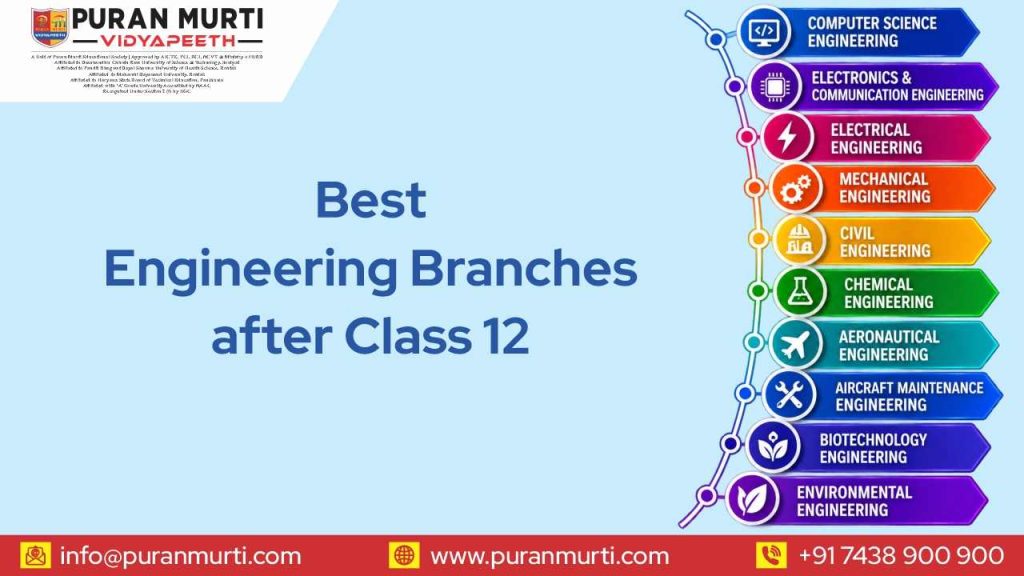
The best engineering branch after Class 12 is the one that matches a student’s interests, aptitude and long-term career goals. Popular choices include Computer Science and Engineering, CSE with AI & ML, Electronics and Communication Engineering, Electrical Engineering, Mechanical Engineering, Civil Engineering, Aerospace Engineering and Aeronautical Engineering.
Instead of choosing a branch only because it is popular, students should examine:
- What subjects they enjoy
- Whether they prefer software, hardware or physical systems
- Career opportunities associated with the branch
- Industry skills they will need
- Internship and practical-learning opportunities
- Higher education possibilities
- College infrastructure and laboratories
- Placement support and industry exposure
- Location, fees and overall affordability
https://blog.puranmurti.com/engineering-college-admission-2027-last-date-eligibility/
Why Is Choosing the Right Engineering Branch Important?
Your engineering branch provides the academic foundation for your first professional opportunities. However, it does not permanently determine your career.
For example, a Mechanical Engineering student can develop skills in robotics, manufacturing, automotive technology or data analysis. Similarly, an Electronics student may move into embedded systems, telecommunications, semiconductor technology or software.
Therefore, think of your branch as a foundation rather than a fixed career boundary.
The modern engineering workplace is also changing quickly. The World Economic Forum’s Future of Jobs Report 2025 identified AI and big data, networks and cybersecurity, and technological literacy among the fastest-growing skill areas for 2025–2030. The report also found that around 39% of workers’ existing skill sets are expected to change by 2030.
That makes one lesson especially important: choose a branch you can learn deeply while continuing to build modern technical and professional skills.
Top Engineering Branches After 12th PCM
| Engineering Branch | Suitable For Students Interested In | Common Career Areas |
|---|---|---|
| Computer Science & Engineering | Programming, software, technology | Software, cloud, AI, web, applications |
| CSE – AI & ML | AI, mathematics, data, programming | AI, ML, data science, automation |
| Electronics & Communication | Electronics, communication, hardware | Embedded systems, telecom, VLSI, electronics |
| Electrical Engineering | Electricity, power systems, machines | Power, automation, electrical systems |
| Mechanical Engineering | Machines, manufacturing, design | Automotive, manufacturing, robotics |
| Civil Engineering | Construction, infrastructure, design | Construction, structural, transportation |
| Aerospace Engineering | Aircraft, spacecraft, aviation technology | Aerospace, design, manufacturing, research |
| Aeronautical Engineering | Aircraft and aviation systems | Aviation, aircraft systems, aerospace |
Top Engineering Courses in 2027
Popular Engineering Courses
- Aeronautical Engineering
- Aerospace Engineering
- Aircraft Maintenance Engineering (AME)
- Computer Science & Engineering (CSE)
- CSE with Artificial Intelligence and Machine Learning (AI & ML)
- Civil Engineering
- Electrical Engineering
- Electronics & Communication Engineering (ECE)
- Mechanical Engineering
Unique Aviation Programs (USP)
One of the biggest advantages of Puran Murti Vidyapeeth is its aviation-based courses, which are rare in India:
- B.Tech + AME (DGCA approved)
- B.Tech Mechanical Engineering + AME (DGCA)
- B.Tech ECE + AME (DGCA)
- B.Tech Computer Science
(AI & ML)+ AME (DGCA) - B.Tech Aeronautical Engineering
+ CPL (Ground Classes) - B.Tech Aerospace Engineering
+ CPL (Ground Classes)
Diploma Courses
Students can also choose job-oriented diploma courses: Apply Now
- Diploma in Automobile Engineering (AE)
- Diploma in AME (Aircraft Maintenance Engineering)
- Diploma in Aeronautical Engineering
- Diploma in Civil Engineering (CE)
- Diploma in Mechanical Engineering (ME)
- Diploma in Computer Science & Engineering (CSE)
- Diploma in Electronics & Communication Engineering (ECE)
- Diploma in Electrical Engineering (EE)
- Diploma in Medical Lab Technology (MLT)
- Diploma in Hotel Management
- Diploma in CSE (AI & ML)
1. Computer Science and Engineering (CSE)
Computer Science and Engineering is a strong option for students interested in programming, software development, algorithms, databases, cloud technologies and digital products.
CSE has applications across almost every industry because businesses increasingly depend on software and digital systems.
Career Options After CSE
Graduates can explore roles such as:
- Software Developer
- Web Developer
- Application Developer
- Cloud Engineer
- DevOps Engineer
- Data Analyst
- Database Professional
- Systems Engineer
- Software Testing Professional
- Technology Consultant
Students can strengthen their profile by learning programming languages, data structures, databases, Git, cloud platforms and software development practices.
Who Should Choose CSE?
CSE may suit you if you:
- Enjoy solving logical problems
- Like computers and technology
- Want to learn programming
- Enjoy building digital products
- Are comfortable learning continuously
Importantly, choosing CSE does not mean you should ignore communication, teamwork or problem-solving skills. Modern technology careers increasingly combine technical and human capabilities.
2. Computer Science with Artificial Intelligence and Machine Learning
CSE with AI and ML combines core computer science with technologies used to build intelligent systems, analyse data and automate tasks.
AI and machine learning have become important across sectors including technology, finance, healthcare, manufacturing, transportation and cybersecurity.
The World Economic Forum identifies AI and big data as the fastest-growing skill category in its 2025–2030 outlook. It also reports that 86% of surveyed employers expect AI and information-processing technologies to transform their businesses by 2030.
Career Opportunities
Depending on skills and specialization, graduates can work toward roles such as:
- AI Engineer
- Machine Learning Engineer
- Data Scientist
- Data Analyst
- Computer Vision Engineer
- NLP Engineer
- AI Software Developer
- Automation Engineer
Skills to Develop
Students should consider building skills in:
- Python
- Statistics
- Linear algebra
- Machine learning
- Data structures
- SQL
- Deep learning
- Data visualization
- Generative AI concepts
A degree alone is not enough in a rapidly changing technology field. Projects, internships and a strong portfolio can help students demonstrate practical ability.
3. Electronics and Communication Engineering (ECE)
Electronics and Communication Engineering is suitable for students interested in electronics, communication systems, embedded technology, hardware and digital systems.
ECE can provide exposure to both hardware and software, which gives students flexibility when developing their career.
Career Areas
ECE graduates may explore:
- Embedded Systems
- VLSI
- Semiconductor Technology
- Telecommunications
- Electronics Manufacturing
- IoT
- Robotics
- Control Systems
- Signal Processing
India’s electronics ecosystem is also receiving policy attention, including initiatives designed to strengthen domestic electronics and semiconductor manufacturing capabilities.
Why Consider ECE?
ECE can be particularly interesting for students who do not want to limit themselves exclusively to software.
It can provide a bridge between hardware, electronics, communication and computing.
4. Electrical Engineering
Electrical Engineering focuses on electrical systems, power, machines, control systems, electronics-related applications and automation.
It is one of the traditional engineering disciplines and continues to connect with emerging areas such as renewable energy, electric mobility, industrial automation and smart systems.
Career Opportunities
Potential career areas include:
- Power Systems
- Electrical Design
- Industrial Automation
- Control Systems
- Renewable Energy
- Electrical Equipment
- Manufacturing
- Infrastructure
- Government and public-sector technical roles
Students can increase their employability by learning simulation tools, automation concepts, programming, data analysis and modern energy technologies alongside their core subjects.
5. Mechanical Engineering
Mechanical Engineering is a broad engineering discipline covering machines, manufacturing, mechanics, thermal systems, materials, design and production.
It remains relevant across automotive, manufacturing, energy, industrial equipment, robotics and other engineering-intensive sectors.
Career Options
Mechanical engineering graduates can explore:
- Mechanical Design
- Manufacturing
- Production
- Automotive Engineering
- Quality Engineering
- Maintenance
- Robotics
- Industrial Engineering
- Product Development
Modern mechanical engineering is increasingly connected with automation, computer-aided design, robotics, simulation, electric vehicles and smart manufacturing.
Therefore, students should not view Mechanical Engineering only through the lens of traditional manufacturing.
6. Civil Engineering
Civil Engineering focuses on the planning, design, construction and maintenance of infrastructure such as buildings, roads, bridges, water systems and transportation networks.
Civil engineering can suit students who enjoy physics, mathematics, construction, infrastructure and practical projects.
Career Areas
Graduates may work in:
- Construction
- Structural Engineering
- Transportation
- Infrastructure Development
- Geotechnical Engineering
- Environmental Engineering
- Water Resources
- Urban Development
- Project Management
Civil Engineering can also lead to careers in government organisations, construction companies, infrastructure firms and consultancy.

7. Aerospace Engineering
Aerospace Engineering deals with the design, development and analysis of aircraft and spacecraft systems.
It can appeal to students fascinated by aviation, aircraft design, propulsion, aerodynamics and advanced engineering systems.
Career Areas
Students can explore:
- Aerospace Design
- Aircraft Systems
- Aerodynamics
- Propulsion
- Manufacturing
- Testing
- Research
- Defence and Aviation-related industries
Because aerospace is highly specialized, students should carefully evaluate laboratories, faculty expertise, practical training and industry exposure before selecting a programme.
8. Aeronautical Engineering
Aeronautical Engineering focuses primarily on aircraft and aviation systems, including areas such as aerodynamics, aircraft structures, propulsion and aircraft maintenance-related technologies.
It may be suitable for students who specifically want to build a career connected with aircraft and aviation.
Students should compare programme curriculum, approvals, practical facilities, training opportunities and career pathways before enrolling.
Which Engineering Branch Has the Best Future?
There is no universally best engineering branch for the future.
However, several technology and engineering areas are being influenced by major trends such as:
- Artificial Intelligence
- Big Data
- Cybersecurity
- Cloud Computing
- Robotics
- Semiconductor Technology
- Electric Vehicles
- Renewable Energy
- Automation
- Aerospace Technology
- Smart Infrastructure
The key point is that future employability will depend increasingly on the combination of engineering fundamentals and current industry skills.
For example, a Mechanical Engineering student who understands robotics and automation can create a different career profile from someone who studies only traditional mechanical concepts.
Likewise, an ECE student with embedded systems and programming skills may access opportunities beyond conventional electronics roles.
How to Choose the Right Engineering Branch After Class 12
Use this five-step process before filling out your admission form.
Step 1: Identify Your Strongest Subjects
Ask yourself:
- Do I enjoy mathematics?
- Do I enjoy physics?
- Do I like programming?
- Do I enjoy machines and practical systems?
- Am I interested in electronics?
- Do I enjoy construction and infrastructure?
Your answers can reveal which branches deserve closer attention.
Step 2: Identify Your Preferred Work Style
Think about the environment in which you would enjoy working.
Do you prefer:
- A computer-based environment?
- Laboratory work?
- Manufacturing?
- Field projects?
- Aircraft and aviation?
- Electronics and hardware?
- Infrastructure projects?
This question is often overlooked when students compare engineering branches.
Step 3: Compare Curriculum, Not Just Course Names
Two programmes with similar names can offer different learning experiences.
Check:
- Core subjects
- Electives
- Laboratories
- Software/tools taught
- Project opportunities
- Internship support
- Industry interaction
- Certification opportunities
Step 4: Check College Infrastructure and Exposure
Before taking admission, examine the actual facilities.
Look for:
- Engineering laboratories
- Workshops
- Computer labs
- Library resources
- Project facilities
- Industry interaction
- Internship opportunities
- Technical events
- Placement support
Step 5: Think Beyond the First Job
Ask yourself where the branch could take you after five to ten years.
Possible paths include:
B.Tech → Internship → First Job → Specialisation → Higher Education/Advanced Role
You may also pursue M.Tech, MBA, research, entrepreneurship, professional certifications or specialised technical training.
Engineering at Puran Murti Vidyapeeth, Sonipat
Students searching for engineering colleges in Sonipat and Delhi NCR can also explore the engineering programmes offered by Puran Murti Vidyapeeth.
According to the institution’s current academic information, its engineering offerings include B.Tech programmes in Computer Science & Engineering, CSE with AI & ML, Electronics & Communication Engineering, Electrical Engineering, Mechanical Engineering, Civil Engineering, Aerospace Engineering and Aeronautical Engineering, among other programme combinations.
Practical Learning and Infrastructure
Engineering education becomes more meaningful when students can connect classroom concepts with practical work.
Puran Murti Vidyapeeth lists engineering laboratories, technical infrastructure, aircraft facilities, workshops, e-library and other campus resources among its facilities.
For students, however, placement statistics should always be examined carefully by branch, graduating year, number of students placed, median/average package, highest package and recruiting organisations rather than relying on a single headline figure.
CSE vs ECE vs Mechanical vs Civil: Which Should You Choose?
| Factor | CSE | ECE | Mechanical | Civil |
|---|---|---|---|---|
| Main focus | Computing & software | Electronics & communication | Machines & manufacturing | Infrastructure |
| Programming | High | Moderate–High | Useful | Useful |
| Hardware | Low–Moderate | High | High | Moderate |
| Field work | Lower | Moderate | Moderate–High | High |
| AI/Data connection | High | Growing | Growing | Growing |
| Suitable for | Tech-oriented students | Hardware + software students | Machine-oriented students | Infrastructure-oriented students |
The table should be treated as a starting point, not a ranking. Your interests and the quality of the programme matter more than choosing a branch simply because it appears popular.
Top Benefits of Studying Engineering
A good engineering programme can help students develop:
- Problem-solving ability through technical challenges.
- Analytical thinking through mathematics, science and engineering concepts.
- Technical expertise in a specific engineering discipline.
- Project experience through practical assignments and final-year projects.
- Career flexibility through specialisations and interdisciplinary skills.
- Professional skills such as communication, teamwork and project management.
- Industry readiness through internships, training and practical exposure.
Engineering Skills Students Should Start Building After Class 12
Do not wait until the final year to become career-ready.
Start developing:
Technical Skills
- Programming
- Data analysis
- CAD/design tools
- Basic electronics
- Engineering software
- Cloud fundamentals
- AI and machine learning basics
- Cybersecurity awareness
Professional Skills
- Communication
- Presentation
- Teamwork
- Problem-solving
- Time management
- Critical thinking
- Leadership
- Interview preparation
Portfolio Skills
Try building something tangible.
Examples include:
- A mobile application
- Website
- IoT prototype
- Robotics project
- CAD model
- Solar-energy project
- AI-based mini project
- Electronics circuit
- Engineering design project
A project gives students an opportunity to demonstrate what they can actually build, analyse or solve.
Frequently Asked Questions
What is the best engineering branch after Class 12?
There is no single best engineering branch for every student. CSE, AI & ML, ECE, Electrical, Mechanical, Civil, Aerospace and Aeronautical Engineering can all offer different career pathways. The right choice depends on your interests, academic strengths, preferred work environment and long-term career goals.
Which engineering branch has the highest demand?
Demand varies by industry, location, economic conditions and skill level. Technology-related skills such as AI, big data, cybersecurity and technological literacy are currently showing strong growth in global employer projections, but traditional engineering disciplines continue to support important industries.
Is CSE better than Mechanical Engineering?
CSE and Mechanical Engineering prepare students for different career areas. CSE focuses heavily on computing and software, while Mechanical Engineering focuses on machines, manufacturing and physical systems. Students should choose according to their interests rather than comparing branches using a single “better” label.
Which engineering branch is best for AI and machine learning?
Computer Science and Engineering with AI & ML is a direct option for students interested in artificial intelligence. However, students from CSE, ECE, Electrical and other technical disciplines can also move into AI-related work by developing programming, mathematics, statistics and machine-learning skills.
Is ECE a good engineering branch for the future?
ECE can provide pathways into electronics, embedded systems, telecommunications, semiconductor technology, IoT, VLSI and related areas. Its combination of hardware and computing knowledge can also support interdisciplinary career development.
Final Thoughts: Choose a Branch, Then Build Your Expertise
Selecting an engineering branch after Class 12 can feel overwhelming because there are so many choices. However, the decision becomes easier when you stop asking only, “Which branch is best?” and start asking, “Which branch matches the kind of engineer I want to become?”
CSE may appeal to students fascinated by software and computing. AI & ML may attract students interested in intelligent systems and data. ECE can suit students who enjoy electronics and communication. Mechanical and Civil Engineering can lead toward machines, manufacturing and infrastructure, while Aerospace and Aeronautical Engineering can open specialised aviation-related pathways.
Most importantly, your degree is only the beginning.
Build projects. Take internships seriously. Learn industry tools. Improve communication. Follow technological developments. Develop a portfolio. Keep upgrading your skills.
For students and parents exploring B.Tech courses in Sonipat and Delhi NCR, Puran Murti Vidyapeeth can be explored as one of the available options for engineering education. Review the available branches, curriculum, facilities, admission requirements and current placement information before making a decision.