
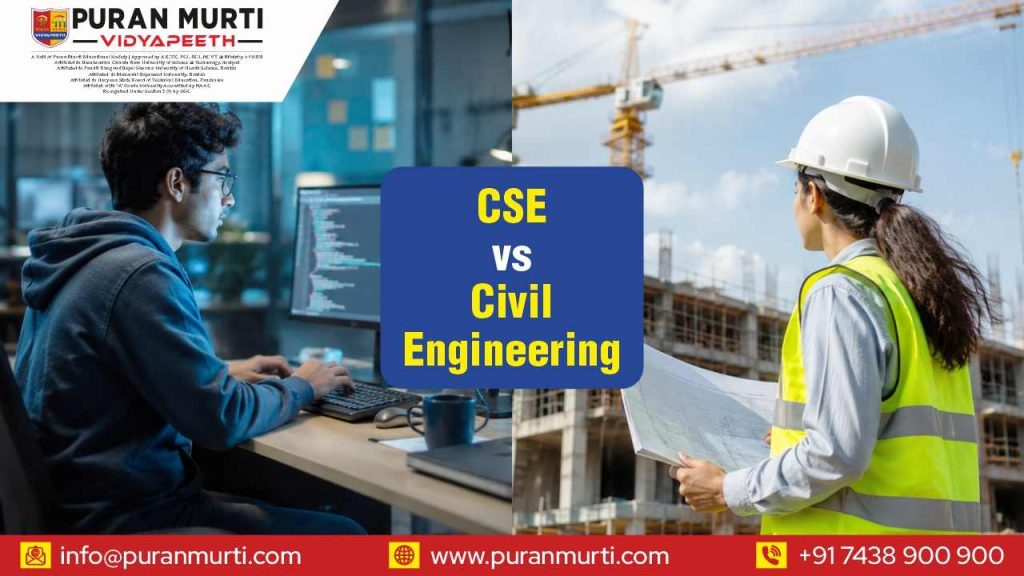
CSE vs Civil Engineering
Posted on : 5 June, 2026 2:16 pm
When students start exploring engineering careers, the comparison between CSE vs Civil Engineering is one of the most common discussions. Understanding CSE vs Civil Engineering becomes important because both branches offer very different career paths and learning experiences. While one focuses on software, coding, and emerging technologies, the other is centered on infrastructure, construction, and structural development. The debate around CSE vs Civil Engineering is not just about salaries or placements but also about personal interests and long-term goals. This detailed guide on CSE vs Civil Engineering will help you identify which branch aligns better with your future aspirations.
What is Computer Science Engineering?
Computer Science Engineering is a branch that combines computer technology, software development, algorithms, programming languages, networking, artificial intelligence, cloud computing, cybersecurity, and data science.
Students learn how software systems are built, how applications function, and how modern digital technologies are developed. The branch is highly connected with the rapidly growing technology sector and offers opportunities in various industries.
What is Civil Engineering?
Civil engineers work on highways, bridges, buildings, dams, airports, railway networks, water supply systems, and urban development projects. The branch plays a crucial role in economic development and public infrastructure.
Quick Comparison Between CSE and Civil Engineering
| Factor | CSE | Civil Engineering |
|---|---|---|
| Main Focus | Software & Technology | Infrastructure & Construction |
| Work Style | Computer-Based | Design & Site Work |
| Industry Demand | Very High | Stable |
| Starting Salary | Higher | Moderate |
| Global Opportunities | Excellent | Good |
| Remote Work Options | Available | Limited |
| Future Growth | Rapid | Consistent |
| Innovation Level | High | High |
Course Duration
The duration of both programs is generally four years under a B.Tech or BE degree.
| Course | Duration |
|---|---|
| B.Tech CSE | 4 Years |
| B.Tech Civil Engineering | 4 Years |

Subjects Studied in CSE
Students in CSE are exposed to various technology-oriented subjects.
| Major Subjects |
|---|
| Programming Languages |
| Data Structures |
| Artificial Intelligence |
| Machine Learning |
| Database Management |
| Cloud Computing |
| Cybersecurity |
| Software Engineering |
These subjects help students build strong technical and analytical skills.
Subjects Studied in Civil Engineering
Civil Engineering focuses on infrastructure planning and construction-related concepts.
| Major Subjects |
|---|
| Structural Engineering |
| Surveying |
| Transportation Engineering |
| Geotechnical Engineering |
| Environmental Engineering |
| Construction Management |
| Fluid Mechanics |
| Concrete Technology |
These subjects prepare students for infrastructure development projects.
Which Branch Has More Demand?
Technology continues to influence every industry. Companies are investing heavily in software, automation, cloud infrastructure, and artificial intelligence.
As a result, CSE currently experiences stronger demand across both domestic and international job markets.
Civil Engineering remains important because infrastructure development never stops. Governments and private organizations continuously invest in construction and urban development projects.
Salary Comparison
One of the biggest factors students consider is salary potential.
| Experience Level | CSE Salary | Civil Engineering Salary |
|---|---|---|
| Freshers | ₹4–10 LPA | ₹3–6 LPA |
| 3–5 Years | ₹8–20 LPA | ₹5–12 LPA |
| Senior Level | ₹20+ LPA | ₹15+ LPA |
Actual salaries vary depending on skills, employer, location, and specialization.
Work Environment Comparison
The daily work environment differs significantly.
| Factor | CSE | Civil Engineering |
|---|---|---|
| Office Work | High | Moderate |
| Site Visits | Rare | Frequent |
| Remote Work | Common | Limited |
| Physical Work | Low | Moderate |
| Travel Requirements | Less | More |
Students should consider their preferred lifestyle before choosing a branch.
Government Job Opportunities
Both branches provide access to government sector careers.
| CSE Government Jobs | Civil Government Jobs |
|---|---|
| NIC | PWD |
| DRDO | NHAI |
| ISRO | Railways |
| PSU IT Roles | Irrigation Departments |
| Digital India Projects | CPWD |
Civil Engineering traditionally has a strong presence in government infrastructure projects.
Higher Education Options
Students may choose postgraduate studies to improve specialization and career prospects.
| After CSE | After Civil Engineering |
|---|---|
| M.Tech CSE | M.Tech Civil |
| MBA | MBA |
| MS Abroad | MS Abroad |
| Data Science | Structural Engineering |
| Artificial Intelligence | Transportation Engineering |
Future Scope of CSE
The future of Computer Science Engineering remains closely linked with technological advancement.
Emerging fields include:
- Artificial Intelligence
- Machine Learning
- Cybersecurity
- Data Science
- Cloud Computing
- Robotics
- Blockchain
- Software Development
These sectors are expected to create significant employment opportunities over the coming years.

Future Scope of Civil Engineering
Infrastructure development continues to drive demand for civil engineers.
Growing areas include:
- Smart Cities
- Sustainable Construction
- Transportation Systems
- Green Buildings
- Urban Planning
- Water Resource Management
- Environmental Projects
As cities expand, the need for skilled civil engineers remains important.
Which Branch Is Easier?
Difficulty depends largely on personal interest.
Students who enjoy mathematics, programming, and technology often find CSE more engaging. Students interested in construction, design, structures, and practical engineering applications may feel more comfortable in Civil Engineering. Neither branch is inherently easy or difficult for everyone.
Which Branch Offers Better Placement Opportunities?
In recent years, placement statistics at many engineering colleges have generally favored CSE due to the growth of the IT sector.
| Factor | CSE | Civil Engineering |
|---|---|---|
| Campus Placements | Excellent | Good |
| Private Sector Demand | Very High | Moderate |
| International Hiring | Strong | Good |
| Startup Opportunities | High | Limited |
Placement quality also depends on the college and individual skills.
Entrepreneurship Opportunities
Both branches can support entrepreneurial careers.
- Software startups
- SaaS companies
- Mobile applications
- Technology consulting firms
Civil engineers may establish:
- Construction companies
- Architecture support firms
- Infrastructure consultancies
- Project management businesses
Skills Required for CSE
Successful CSE professionals usually possess:
| Skills |
|---|
| Logical Thinking |
| Programming Ability |
| Problem Solving |
| Analytical Skills |
| Creativity |
| Communication Skills |
Skills Required for Civil Engineering
Successful civil engineers often develop:
| Skills |
|---|
| Structural Analysis |
| Planning Skills |
| Project Management |
| Technical Drawing |
| Site Management |
| Communication Skills |
About Puran Murti Vidyapeeth
The institute is known for its focus on technical education, practical learning, laboratory exposure, and career-oriented training. Students can explore engineering programs in modern technology domains while benefiting from academic support, industry interaction, and campus facilities. The availability of hostel facilities, skill-development activities, and placement assistance also makes it a consideration for students looking for engineering education near Delhi NCR. Apply Now
Top Engineering Branches
BTech (Bachelor of Technology)
BTech is among the most popular courses after 12th Science (PCM).
Top Specializations:
- Aeronautical Engineering
- Aerospace Engineering
- Aircraft Maintenance Engineering (AME)
- Computer Science & Engineering (CSE)
- CSE with Artificial Intelligence and Machine Learning (AI & ML)
- Civil Engineering
- Electrical Engineering
- Electronics & Communication Engineering (ECE)
- Mechanical Engineering
Unique Aviation Programs (USP)
One of the biggest advantages of Puran Murti Vidyapeeth is its aviation-based courses, which are rare in India:
- B.Tech + AME (DGCA approved)
- B.Tech Mechanical Engineering + AME (DGCA)
- B.Tech ECE + AME (DGCA)
- B.Tech Computer Science
(AI & ML)+ AME (DGCA) - B.Tech Aeronautical Engineering
+ CPL (Ground Classes) - B.Tech Aerospace Engineering
+ CPL (Ground Classes)
Diploma Courses
Students can also choose job-oriented diploma courses: Apply Now
- Diploma in Automobile Engineering (AE)
- Diploma in AME (Aircraft Maintenance Engineering)
- Diploma in Aeronautical Engineering
- Diploma in Civil Engineering (CE)
- Diploma in Mechanical Engineering (ME)
- Diploma in Computer Science & Engineering (CSE)
- Diploma in Electronics & Communication Engineering (ECE)
- Diploma in Electrical Engineering (EE)
- Diploma in Fire Technology & Safety
- Diploma in Medical Lab Technology (MLT)
- Diploma in Hotel Management
- Diploma in CSE (AI & ML)
Key Highlights
| Feature | Details |
|---|---|
| Location | Sonipat, Haryana |
| Region | Delhi NCR |
| Learning Approach | Industry-Oriented |
| Practical Training | Available |
| Hostel Facility | Available |
| Skill Development Focus | Strong |
Who Should Choose CSE?
CSE may be a suitable option for students who:
- Enjoy computers and technology
- Like coding and software development
- Want opportunities in AI and emerging technologies
- Prefer office-based or remote work environments
- Aim for higher salary potential
Who Should Choose Civil Engineering?
Civil Engineering may be a better choice for students who:
- Enjoy construction and infrastructure projects
- Like practical engineering applications
- Prefer working on real-world development projects
- Are interested in structural design and planning
- Want careers connected to public infrastructure
Final Verdict
The answer to the CSE vs Civil Engineering debate depends on your interests rather than popularity alone.
If your passion lies in technology, programming, software development, artificial intelligence, and digital innovation, Computer Science Engineering offers exceptional opportunities and strong salary growth.
If you are interested in designing buildings, transportation systems, bridges, smart cities, and infrastructure that shapes communities, Civil Engineering provides a rewarding and respected career path.
Both branches contribute significantly to society. The best choice is the one that aligns with your skills, interests, and long-term career goals.
FAQs
Which branch has a higher salary, CSE or Civil Engineering?
CSE generally offers higher average salaries, particularly in software development, AI, and technology-related roles.
Is Civil Engineering a good career in the future?
Yes. Infrastructure development, smart city projects, and sustainable construction continue to create opportunities for civil engineers.
Which branch has better placements?
At many colleges, CSE currently enjoys stronger placement rates because of high demand from IT companies.
Can Civil Engineers work abroad?
Yes. Civil engineers are employed worldwide in construction, transportation, urban development, and infrastructure projects.
Which is better for government jobs?
Civil Engineering traditionally offers more direct opportunities in government construction and infrastructure departments, while CSE also provides opportunities in technology-focused government organizations.