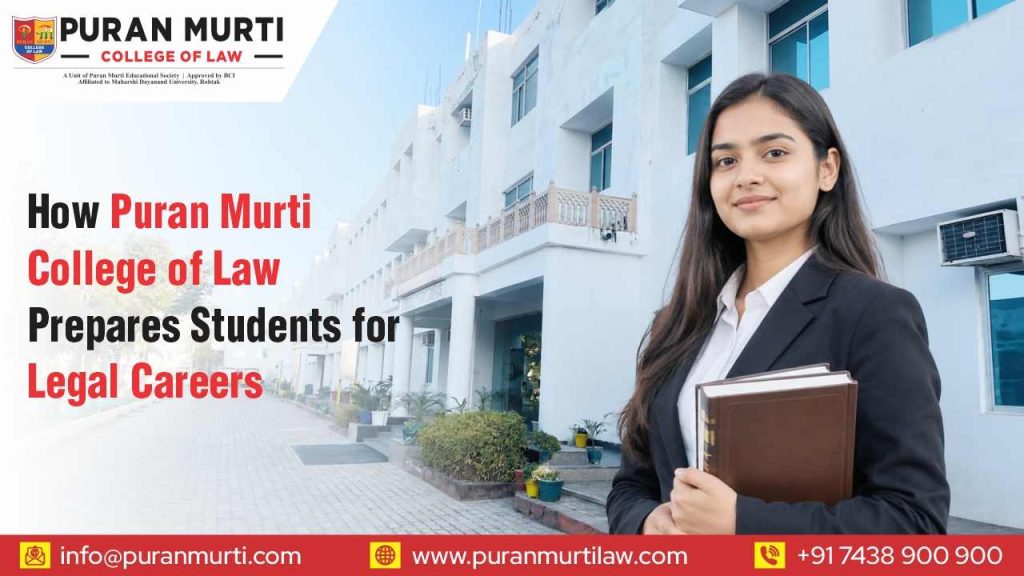
How Puran Murti College of Law Prepares Students for Legal Careers
Posted on : 28 June, 2026 3:23 pm
Legal education has evolved significantly, and aspiring lawyers now need much more than classroom learning. Puran Murti College of Law prepares students for legal careers by combining academic excellence with practical exposure, legal research, advocacy training, and professional skill development.
Puran Murti College of Law prepares students for legal careers through experienced faculty, modern infrastructure, internships, moot courts, and career-oriented learning that bridges theory with practice. This holistic approach helps students build confidence, critical thinking, and ethical values.
Whether students aspire to become advocates, judges, corporate legal advisors, or judicial officers, Puran Murti College of Law prepares students for legal careers by equipping them with industry-relevant knowledge and practical experience. With its student-centric approach, Puran Murti College of Law prepares students for legal careers and empowers graduates to succeed in the dynamic legal profession.
Understanding Modern Legal Education
Legal education today extends far beyond learning statutes and judicial precedents. Students must understand constitutional values, emerging legal technologies, international legal frameworks, commercial transactions, intellectual property, cyber laws, environmental regulations, and dispute resolution mechanisms.
A modern law college prepares students to adapt to these changing requirements while maintaining strong ethical foundations.
| Traditional Legal Education | Modern Legal Education |
|---|---|
| Theory-focused | Theory with practical application |
| Classroom lectures | Interactive learning methods |
| Limited courtroom exposure | Regular moot courts and simulations |
| Memorization-based | Analytical and research-oriented |
| Basic legal understanding | Professional skill development |
A Student-Centric Learning Environment
One of the strongest features of Puran Murti College of Law is its commitment to student-centered education. Faculty members encourage active participation, discussions, legal debates, presentations, and collaborative learning instead of relying solely on conventional teaching methods.
Students are encouraged to question legal principles, analyze judgments, evaluate legislation, and develop independent opinions on contemporary legal issues.
This approach strengthens confidence, communication skills, and legal reasoning abilities.
Aerospace vs Aeronautical Engineering: Which Has Better Job Opportunities?
Experienced Faculty Members
Quality legal education begins with knowledgeable and experienced educators.
The college emphasizes learning under faculty members who possess academic expertise along with practical legal experience. Their guidance helps students understand complex legal concepts through real-life examples, landmark judgments, and case studies.
Faculty members also mentor students regarding:
- Career planning
- Competitive examinations
- Moot court preparation
- Legal research
- Internship opportunities
- Professional ethics
Comprehensive Law Curriculum
The curriculum is carefully designed to provide students with a balanced understanding of both foundational and specialized areas of law.
Students study subjects covering constitutional law, criminal law, civil law, family law, contract law, property law, jurisprudence, administrative law, labour law, environmental law, corporate law, taxation law, international law, cyber law, intellectual property rights, and procedural laws.
| Core Subjects | Career Benefits |
|---|---|
| Constitutional Law | Foundation for litigation and judiciary |
| Criminal Law | Criminal litigation and prosecution |
| Contract Law | Corporate legal practice |
| Family Law | Civil litigation and legal consultancy |
| Corporate Law | Company legal departments |
| Intellectual Property Law | Patent, trademark, copyright practice |
| Cyber Law | Technology and digital compliance |
| Environmental Law | Public policy and sustainability roles |
Practical Learning Beyond the Classroom
Practical exposure remains one of the most important aspects of legal education.
Students regularly participate in activities that simulate real legal practice and develop courtroom confidence.
Some practical learning methods include:
- Moot court competitions
- Mock trials
- Legal drafting exercises
- Client counseling sessions
- Judgment analysis
- Legal aid activities
- Research projects
- Court visits
- Legal awareness campaigns
These activities transform theoretical knowledge into practical legal skills.
Moot Court Training
Moot court competitions help students understand courtroom procedures before entering actual legal practice.
Participants prepare written memorials, research legal issues, frame legal arguments, cite precedents, respond to judges’ questions, and present oral submissions.
This significantly improves:
- Public speaking
- Legal research
- Case analysis
- Drafting skills
- Courtroom etiquette
- Teamwork
- Time management
| Skills Developed Through Moot Courts | Professional Value |
|---|---|
| Legal Research | Strong case preparation |
| Advocacy | Effective courtroom arguments |
| Drafting | Better memorial preparation |
| Public Speaking | Confident legal presentation |
| Team Coordination | Collaborative litigation practice |
Legal Research Excellence
Research is an essential component of every successful legal career.
Students are encouraged to conduct research on constitutional developments, judicial trends, comparative legal systems, legislative reforms, and emerging legal challenges.
Research projects improve analytical thinking while preparing students for higher education, judicial examinations, publications, and policy-making roles.
Legal Drafting Skills
Every lawyer must know how to prepare legally valid documents.
Students receive practical exposure to drafting:
- Contracts
- Agreements
- Petitions
- Written statements
- Legal notices
- Affidavits
- Bail applications
- Writ petitions
- Memorandums
- Legal opinions
Drafting practice develops precision, legal language proficiency, and professional confidence.
Exposure to Real Court Proceedings
Court visits provide valuable opportunities to observe legal proceedings in real time.
Students learn about:
- Courtroom discipline
- Judicial functioning
- Lawyer-client interaction
- Cross-examination techniques
- Evidence presentation
- Judicial decision-making
- Court administration
Observing experienced advocates and judges helps bridge the gap between classroom education and legal practice.
Internship Opportunities
Internships provide first hand experience of the legal profession.
Students gain practical exposure by working under advocates, law firms, legal consultants, corporate legal departments, NGOs, government organizations, and judicial institutions.
Internships help students understand professional responsibilities while developing workplace skills.
| Internship Destination | Skills Acquired |
|---|---|
| Law Firms | Client handling and drafting |
| District Courts | Litigation practice |
| High Courts | Advanced legal research |
| Corporate Companies | Compliance and contracts |
| NGOs | Public interest litigation |
| Government Departments | Administrative procedures |
Building Strong Communication Skills
An effective lawyer must communicate clearly and persuasively.
The college emphasizes communication development through:
- Seminars
- Presentations
- Debates
- Group discussions
- Client counseling exercises
- Legal awareness programs
- Moot court advocacy
Strong communication skills enable graduates to perform confidently in courtrooms, boardrooms, arbitration proceedings, and public forums.

About Puran Murti Vidyapeeth Apply Now
The institute is known for its focus on technical education, practical learning, laboratory exposure, and career-oriented training. Students can explore engineering programs in modern technology domains while benefiting from academic support, industry interaction, and campus facilities. The availability of hostel facilities, skill-development activities, and placement assistance also makes it a consideration for students looking for engineering education near Delhi NCR. Apply Now
Top Engineering Branches
BTech (Bachelor of Technology)
BTech is among the most popular courses after 12th Science (PCM).
Top Specializations:
- Aeronautical Engineering
- Aerospace Engineering
- Aircraft Maintenance Engineering (AME)
- Computer Science & Engineering (CSE)
- CSE with Artificial Intelligence and Machine Learning (AI & ML)
- Civil Engineering
- Electrical Engineering
- Electronics & Communication Engineering (ECE)
- Mechanical Engineering
Unique Aviation Programs (USP)
One of the biggest advantages of Puran Murti Vidyapeeth is its aviation-based courses, which are rare in India:
- B.Tech + AME (DGCA approved)
- B.Tech Mechanical Engineering + AME (DGCA)
- B.Tech ECE + AME (DGCA)
- B.Tech Computer Science
(AI & ML)+ AME (DGCA) - B.Tech Aeronautical Engineering
+ CPL (Ground Classes) - B.Tech Aerospace Engineering
+ CPL (Ground Classes)
Diploma Courses
Students can also choose job-oriented diploma courses: Apply Now
- Diploma in Automobile Engineering (AE)
- Diploma in AME (Aircraft Maintenance Engineering)
- Diploma in Aeronautical Engineering
- Diploma in Civil Engineering (CE)
- Diploma in Mechanical Engineering (ME)
- Diploma in Computer Science & Engineering (CSE)
- Diploma in Electronics & Communication Engineering (ECE)
- Diploma in Electrical Engineering (EE)
- Diploma in Fire Technology & Safety
- Diploma in Medical Lab Technology (MLT)
- Diploma in Hotel Management
- Diploma in CSE (AI & ML)
Frequently Asked Questions
What legal courses are offered at Puran Murti College of Law?
Puran Murti College of Law offers undergraduate legal education designed to provide students with a strong foundation in legal principles, practical training, research, and professional ethics. The curriculum prepares students for diverse legal career opportunities.
Does the college provide practical legal training?
Yes, students gain practical exposure through moot court competitions, internships, legal drafting exercises, court visits, seminars, workshops, and legal aid activities. These experiences help bridge the gap between classroom learning and professional legal practice.
What career opportunities are available after completing a law degree?
Graduates can pursue careers as advocates, corporate legal advisors, judicial officers, legal consultants, compliance professionals, legal researchers, academicians, public prosecutors, and legal officers in government and private organizations.
How does the college prepare students for competitive examinations?
The college emphasizes strong conceptual learning, legal research, analytical thinking, and regular academic guidance. Students also benefit from mentorship, case law discussions, and practical exercises that strengthen preparation for judicial services and other competitive examinations.
Why should students choose Puran Murti College of Law for legal education?
The college focuses on a balanced approach that combines academic excellence with practical exposure, professional skill development, ethical values, and career-oriented learning. This holistic education equips students with the confidence and competence needed for successful legal careers.