

LLB Course: Eligibility, Duration, Fees & Career Opportunities
Posted on : 27 June, 2026 12:46 pm
Choosing the right law course is the first step toward building a successful legal career. Among the most popular law programs in India, the LLB Course: Eligibility, Duration, Fees & Career Opportunities is a topic that attracts students who wish to become advocates, legal advisors, corporate lawyers, or judicial officers. Understanding LLB Course: Eligibility, Duration, Fees & Career Opportunities helps students make informed decisions about admissions, course structure, career options, and future growth. This complete guide on LLB Course: Eligibility, Duration, Fees & Career Opportunities explains everything from eligibility criteria and course duration to fees, syllabus, salary, and job prospects. By exploring LLB Course: Eligibility, Duration, Fees & Career Opportunities, students can confidently plan their journey toward a rewarding career in law.
LLB Course Semester-Wise Syllabus
| Semester | Major Subjects | Key Topics Covered |
|---|---|---|
| Semester I | Legal Methods, Law of Contracts-I, Constitutional Law-I, Family Law-I, Legal English | Basics of legal system, contract principles, Constitution, family laws, legal language |
| Semester II | Law of Contracts-II, Constitutional Law-II, Family Law-II, Law of Torts, Environmental Law | Advanced contracts, fundamental rights, tort law, environmental regulations |
| Semester III | Criminal Law-I (IPC), Property Law, Jurisprudence, Public International Law, Company Law | Criminal offences, property rights, legal theories, international law, corporate law basics |
| Semester IV | Criminal Law-II (CrPC), Administrative Law, Labour Law-I, Intellectual Property Rights, Human Rights Law | Criminal procedure, government powers, labour laws, patents, copyrights, human rights |
| Semester V | Civil Procedure Code (CPC), Labour Law-II, Taxation Law, Banking Law, Alternative Dispute Resolution (ADR) | Civil litigation, industrial laws, taxation, banking regulations, arbitration and mediation |
| Semester VI | Evidence Act, Professional Ethics, Drafting & Pleading, Moot Court, Internship | Law of evidence, legal drafting, courtroom practice, advocacy skills, practical legal training |
What is an LLB Course? Apply Now
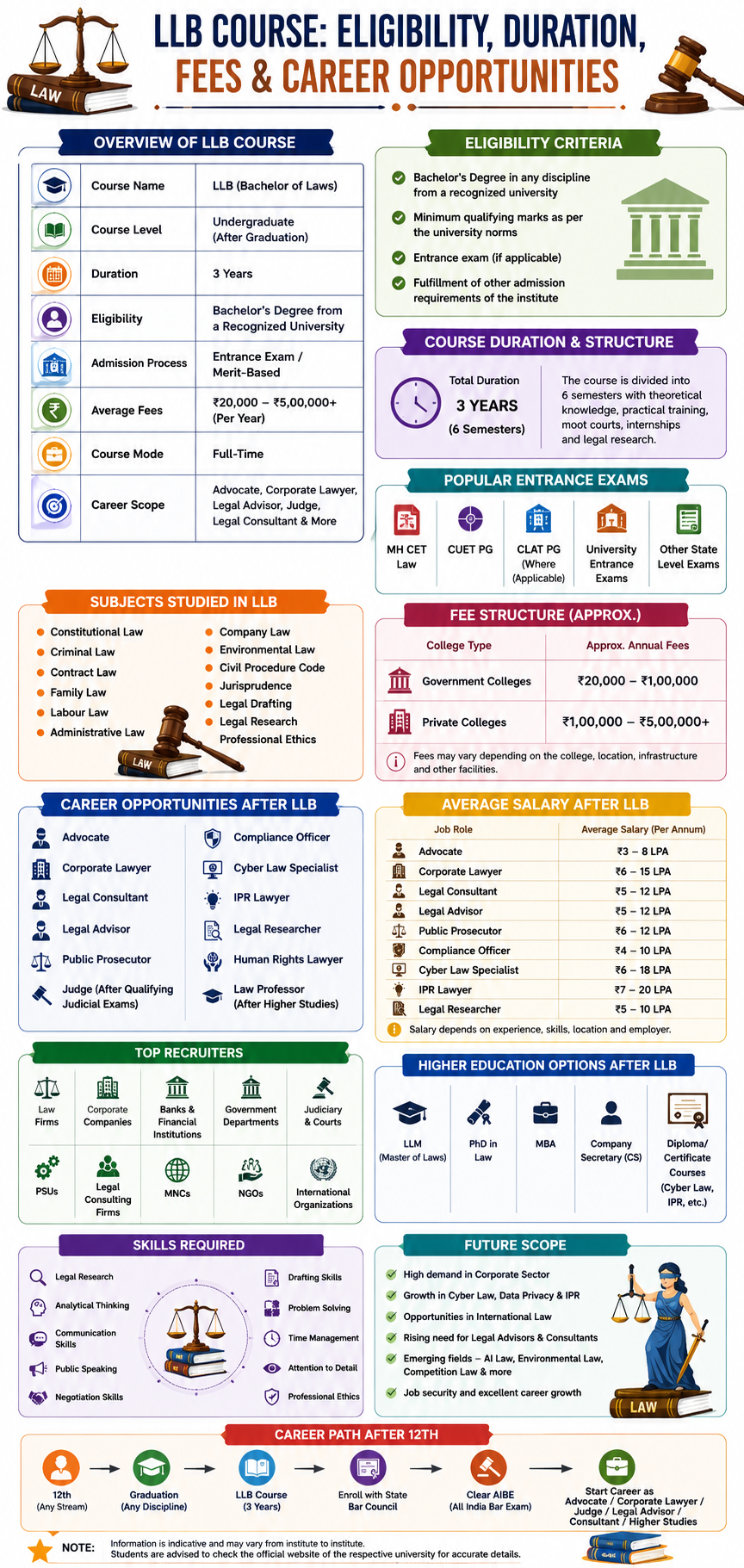
LLB (Bachelor of Laws) is a professional undergraduate law degree that equips students with the legal knowledge and practical skills required to practice law in India. It focuses on legal principles, constitutional law, criminal law, civil law, corporate law, and other important legal subjects.
Aerospace vs Aeronautical Engineering: Which Has Better Job Opportunities?
LLB Course Highlights
| Particulars | Details |
|---|---|
| Course Name | LLB (Bachelor of Laws) |
| Course Level | Undergraduate Professional Degree |
| Duration | 3 Years |
| Eligibility | Bachelor’s Degree from a Recognized University |
| Admission Process | Entrance Exam / Merit-Based |
| Popular Entrance Exams | CLAT PG (where applicable), MH CET Law, CUET PG, University Entrance Exams |
| Course Mode | Full-Time |
| Career Options | Advocate, Legal Advisor, Corporate Lawyer, Judge, Legal Consultant |
LLB Eligibility Criteria
To pursue an LLB course, candidates generally need:
- A bachelor’s degree from a recognized university
- Minimum qualifying marks as prescribed by the college or university
- Valid entrance exam score (where applicable)
- Fulfillment of institution-specific admission requirements Apply Now
LLB Course Duration Apply Now
LLB Admission Process
Admission usually follows these steps:
- Complete graduation from a recognized university.
- Apply for entrance examinations or direct admissions.
- Qualify the required entrance test.
- Participate in counselling or admission rounds.
- Complete document verification and fee payment.
Popular LLB Entrance Exams
Many universities accept scores from:
- MH CET Law
- CUET PG
- University-specific entrance examinations
- Other state-level law entrance exams
LLB Course Subjects
Students generally study the following subjects:
- Constitutional Law
- Criminal Law
- Civil Law
- Contract Law
- Family Law
- Administrative Law
- Company Law
- Labour Law
- Environmental Law
- Intellectual Property Law
- Taxation Law
- Human Rights Law
- Legal Drafting
- Legal Research
- Professional Ethics
LLB Course Fees
The fee structure varies depending on the institution.
| Institution Type | Approximate Annual Fees |
|---|---|
| Government Colleges | ₹10,000 – ₹80,000 |
| Private Colleges | ₹80,000 – ₹3,50,000 |
Fees may vary based on the college, facilities, and location.
Skills Required for LLB Students
To succeed in the legal profession, students should develop:
- Communication skills
- Critical thinking
- Analytical ability
- Legal research skills
- Public speaking
- Negotiation skills
- Problem-solving ability
- Legal drafting
- Professional ethics
- Time management

Career Opportunities After LLB
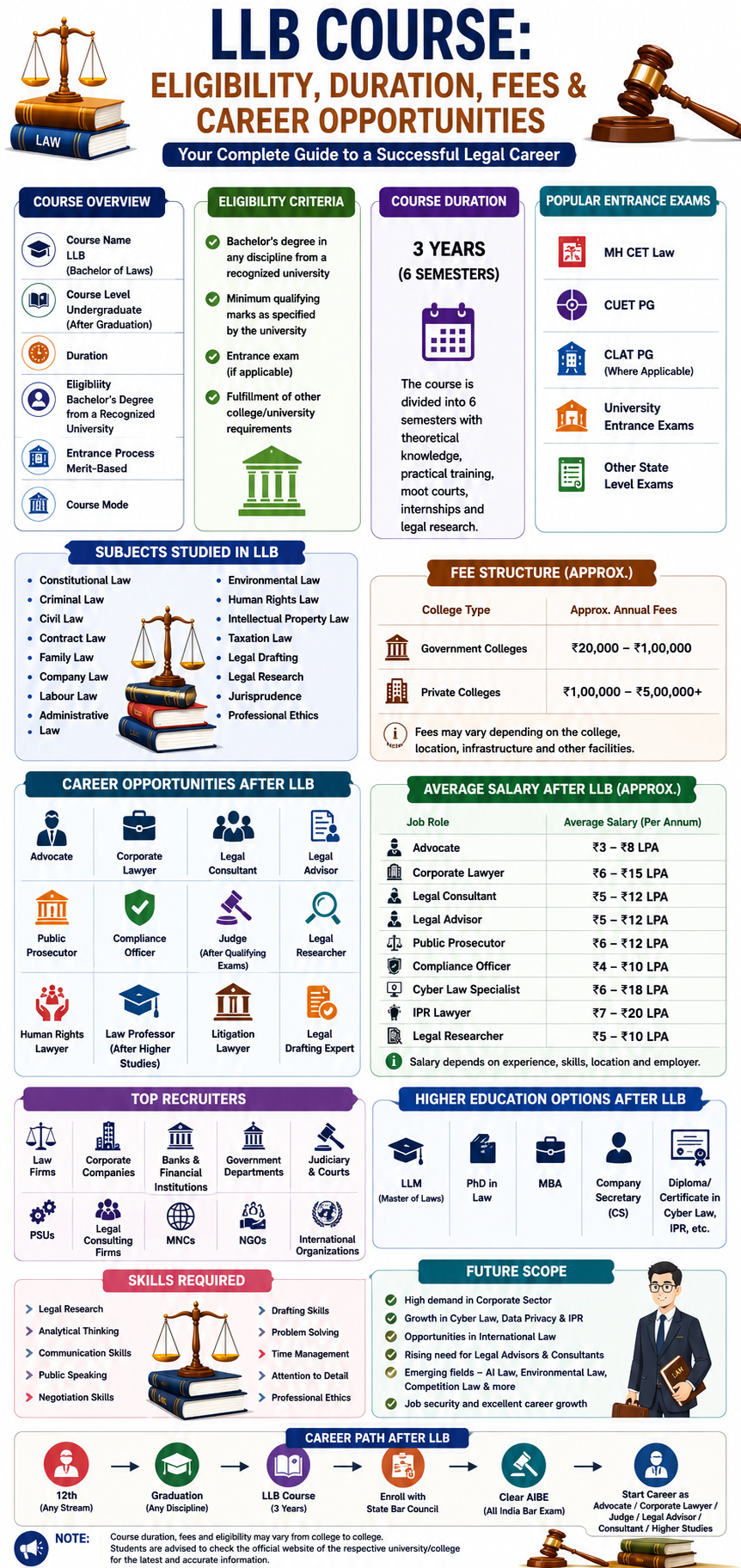
An LLB degree opens doors to multiple career options across various sectors.
Advocate
Represent clients before courts and tribunals after registering with the State Bar Council and clearing the All India Bar Examination (AIBE).
Corporate Lawyer
Handle legal matters related to contracts, mergers, acquisitions, compliance, and corporate governance.
Legal Consultant
Provide legal advice to businesses, startups, government organizations, and individuals.
Legal Advisor
Assist organizations in legal compliance, contracts, and regulatory matters.
Public Prosecutor
Represent the government in criminal cases.
Judge
Appear for Judicial Service Examinations to become a Civil Judge or Judicial Officer.
Compliance Officer
Ensure companies comply with legal and regulatory requirements.
Legal Researcher
Work with universities, research organizations, think tanks, and policy institutes.
Human Rights Lawyer
Advocate for civil liberties and human rights through NGOs and legal organizations.
Career Opportunities by Sector
| Sector | Career Roles |
|---|---|
| Litigation | Advocate, Trial Lawyer |
| Corporate Sector | Corporate Lawyer, Legal Advisor |
| Judiciary | Judge, Judicial Officer |
| Government | Public Prosecutor, Legal Officer |
| Banking & Finance | Compliance Officer |
| Education | Law Professor, Researcher |
| NGOs | Human Rights Lawyer |
| Consulting | Legal Consultant |
Salary After LLB
| Job Role | Average Salary |
|---|---|
| Advocate | ₹3–8 LPA |
| Corporate Lawyer | ₹6–15 LPA |
| Legal Consultant | ₹5–12 LPA |
| Legal Advisor | ₹5–12 LPA |
| Public Prosecutor | ₹6–12 LPA |
| Compliance Officer | ₹4–10 LPA |
| Legal Researcher | ₹5–10 LPA |
Salary depends on specialization, employer, location, and experience.
Top Recruiters
LLB graduates are recruited by:
- Law firms
- Corporate companies
- Banks and financial institutions
- Public Sector Undertakings (PSUs)
- Government departments
- Courts and tribunals
- Legal consulting firms
- NGOs
- Multinational companies (MNCs)
Higher Education Options After LLB
Students can pursue:
- LLM (Master of Laws)
- PhD in Law
- MBA
- Judicial Services Preparation
- Company Secretary (CS)
- Cyber Law Certification
- Intellectual Property Law Certification
- Arbitration and Mediation Courses
Future Scope of LLB
The legal profession continues to expand with the growth of business, technology, and international trade. Emerging fields such as Cyber Law, Artificial Intelligence Law, Data Privacy, Intellectual Property Rights, Environmental Law, Corporate Compliance, and International Trade Law are creating excellent career opportunities for law graduates.
With increasing demand across industries, an LLB degree offers long-term career stability and professional growth.
Why Choose an LLB Course?
- Prestigious profession
- Excellent career opportunities
- Attractive salary packages
- Diverse specialization options
- Opportunities in government and private sectors
- International career prospects
- Continuous learning and professional growth
Conclusion
Understanding LLB Course: Eligibility, Duration, Fees & Career Opportunities is essential for students planning a successful legal career. The course provides a strong foundation in legal principles, practical training, and diverse career opportunities across litigation, corporate law, judiciary, consulting, and public service. By exploring LLB Course: Eligibility, Duration, Fees & Career Opportunities, students can choose the right institution, prepare for admissions, and build a rewarding future in the legal profession. With dedication, practical experience, and continuous learning, an LLB degree can open the door to a respected and successful legal career.

About Puran Murti Vidyapeeth Apply Now
The institute is known for its focus on technical education, practical learning, laboratory exposure, and career-oriented training. Students can explore engineering programs in modern technology domains while benefiting from academic support, industry interaction, and campus facilities. The availability of hostel facilities, skill-development activities, and placement assistance also makes it a consideration for students looking for engineering education near Delhi NCR. Apply Now
Top Engineering Branches
BTech (Bachelor of Technology)
BTech is among the most popular courses after 12th Science (PCM).
Top Specializations:
- Aeronautical Engineering
- Aerospace Engineering
- Aircraft Maintenance Engineering (AME)
- Computer Science & Engineering (CSE)
- CSE with Artificial Intelligence and Machine Learning (AI & ML)
- Civil Engineering
- Electrical Engineering
- Electronics & Communication Engineering (ECE)
- Mechanical Engineering
Unique Aviation Programs (USP)
One of the biggest advantages of Puran Murti Vidyapeeth is its aviation-based courses, which are rare in India:
- B.Tech + AME (DGCA approved)
- B.Tech Mechanical Engineering + AME (DGCA)
- B.Tech ECE + AME (DGCA)
- B.Tech Computer Science
(AI & ML)+ AME (DGCA) - B.Tech Aeronautical Engineering
+ CPL (Ground Classes) - B.Tech Aerospace Engineering
+ CPL (Ground Classes)
Diploma Courses
Students can also choose job-oriented diploma courses: Apply Now
- Diploma in Automobile Engineering (AE)
- Diploma in AME (Aircraft Maintenance Engineering)
- Diploma in Aeronautical Engineering
- Diploma in Civil Engineering (CE)
- Diploma in Mechanical Engineering (ME)
- Diploma in Computer Science & Engineering (CSE)
- Diploma in Electronics & Communication Engineering (ECE)
- Diploma in Electrical Engineering (EE)
- Diploma in Fire Technology & Safety
- Diploma in Medical Lab Technology (MLT)
- Diploma in Hotel Management
- Diploma in CSE (AI & ML)
FAQs
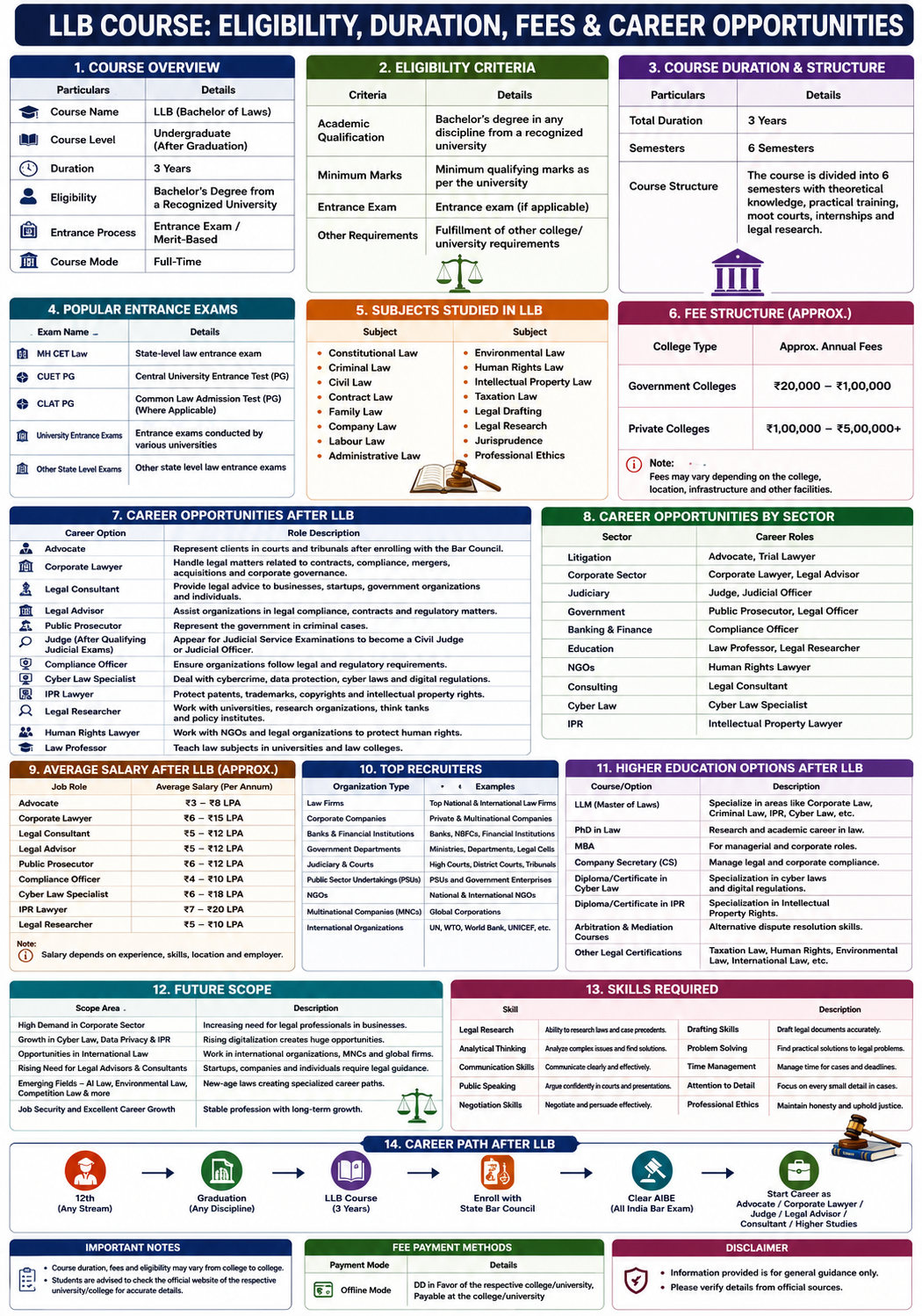
1. What is the eligibility for the LLB course?
Candidates must have a bachelor’s degree from a recognized university and meet the minimum eligibility criteria set by the institution.
2. What is the duration of the LLB course?
The LLB course is generally a 3-year undergraduate professional law program pursued after graduation.
3. What are the career opportunities after LLB?
Graduates can work as Advocates, Corporate Lawyers, Legal Consultants, Legal Advisors, Public Prosecutors, Compliance Officers, Legal Researchers, and Judicial Officers.
4. What is the average fee for an LLB course?
Government colleges usually charge ₹10,000–₹80,000 per year, while private colleges may charge ₹80,000–₹3,50,000 annually.
5. Can I pursue LLM after completing LLB?
Yes. After completing an LLB, students can pursue an LLM (Master of Laws) to specialize in areas such as Corporate Law, Criminal Law, Cyber Law, or Intellectual Property Law. Apply Now