MCA vs M.Tech: Which is Better for IT Careers?
Posted on : 18 June, 2026 12:00 pm
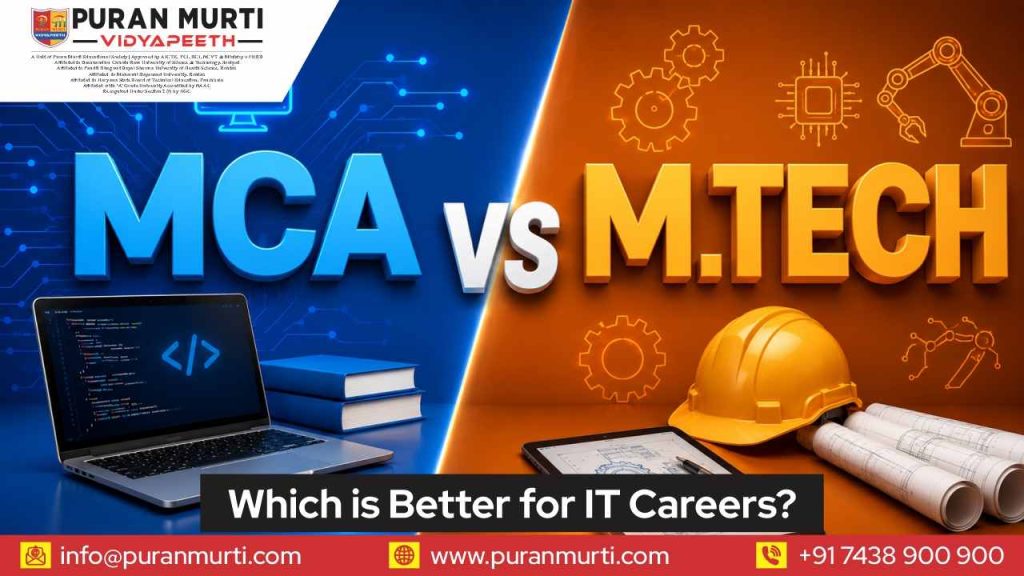
Choosing the right postgraduate program can significantly influence your future in the technology industry. MCA vs M.Tech: Which is Better for IT Careers? is a common question among students who want to build successful careers in software development, artificial intelligence, cybersecurity, data science, and other emerging technology fields. Understanding MCA vs M.Tech: Which is Better for IT Careers? helps candidates evaluate factors such as curriculum, career opportunities, salary potential, and future scope. Furthermore, exploring MCA vs M.Tech: Which is Better for IT Careers? allows students to identify which program aligns better with their interests, skills, and professional goals. This guide on MCA vs M.Tech: Which is Better for IT Careers? provides a detailed comparison to help aspiring IT professionals make an informed decision.
Both MCA (Master of Computer Applications) and M.Tech (Master of Technology) can lead to rewarding careers in the technology sector. However, these programs differ significantly in terms of curriculum, specialization, learning approach, and career outcomes. Therefore, understanding their key differences can help you make an informed decision.
In this article, we compare MCA and M.Tech based on eligibility, curriculum, career opportunities, salary prospects, and future scope.
What is MCA?
Master of Computer Applications (MCA) is a postgraduate degree that focuses on software development, programming, and computer applications. The course is designed to provide practical knowledge and industry-oriented skills that are widely used in the IT sector.
Subjects Covered in MCA
Students pursuing MCA typically study:
- Programming Languages
- Software Development
- Database Management Systems
- Web Development
- Mobile Application Development
- Cloud Computing
- Networking and Cybersecurity
- Data Structures and Algorithms
Because of its practical approach, MCA is often preferred by students who want to build careers in software development and IT services.

Career Opportunities After MCA
MCA graduates can pursue various roles, including:
- Software Developer
- Full-Stack Developer
- Web Developer
- Mobile Application Developer
- System Analyst
- Database Administrator
- IT Consultant
- Cloud Support Engineer
Furthermore, many software companies actively recruit MCA graduates for development and technology support positions.
What is M.Tech?
Master of Technology (M.Tech) is a postgraduate engineering degree that focuses on advanced technical knowledge, research, and specialization. The program is ideal for students who want to gain deeper expertise in a specific area of technology.
Popular M.Tech Specializations
Some of the most sought-after specializations include:
- Computer Science Engineering
- Artificial Intelligence
- Data Science
- Machine Learning
- Cybersecurity
- Cloud Computing
- Software Engineering
Subjects Covered in M.Tech
The curriculum generally includes:
- Advanced Computing Concepts
- Research Methodologies
- Specialized Technical Subjects
- System Design and Architecture
- Emerging Technologies
- Industry Projects and Dissertation Work
As a result, M.Tech is often chosen by students who are interested in innovation, research, and advanced technical domains.
Career Opportunities After M.Tech
M.Tech graduates often move into specialized roles such as:
- Data Scientist
- Artificial Intelligence Engineer
- Machine Learning Engineer
- Cloud Architect
- Cybersecurity Specialist
- Research Engineer
- Software Architect
- Technical Consultant
Additionally, opportunities are available in research organizations, universities, and technology-driven enterprises.
MCA vs M.Tech: Key Differences
| Feature | MCA | M.Tech |
|---|---|---|
| Focus Area | Software applications and programming | Advanced engineering and technology |
| Learning Style | Practical and industry-oriented | Research and specialization-focused |
| Eligibility | Bachelor’s degree with Mathematics background | B.Tech, BE, MCA, or related degree |
| Curriculum | Application development and IT skills | Advanced technical concepts and research |
| Career Path | Software development and IT services | Specialized technical and research roles |
| Research Opportunities | Limited | Extensive |
| Industry Focus | IT services and software development | Engineering, R&D, AI, Data Science, Cybersecurity |
Eligibility Criteria
MCA Eligibility
Candidates generally need:
- A bachelor’s degree from a recognized university
- Mathematics at the 10+2 or graduation level
- Minimum marks as specified by the institution
M.Tech Eligibility
Candidates generally require:
- B.Tech, BE, MCA, or an equivalent degree
- Entrance exam qualification (where applicable)
- Minimum academic requirements set by the institution
However, eligibility criteria may vary across universities and specializations.

Salary Comparison: MCA vs M.Tech
Salary packages depend on factors such as skills, specialization, certifications, employer reputation, and experience.
MCA Salary Prospects
MCA graduates often begin their careers in software development and IT services. With experience, they can progress into senior development and management roles.
M.Tech Salary Prospects
M.Tech graduates may secure specialized positions in AI, Data Science, Cybersecurity, and advanced engineering fields, which often offer competitive compensation.
Therefore, long-term salary growth is usually influenced more by skills, experience, and specialization than by the degree itself.
Future Scope of MCA and M.Tech
The future of both degrees looks promising due to rapid advancements in technology.
Emerging fields creating strong demand include:
- Artificial Intelligence
- Machine Learning
- Cybersecurity
- Cloud Computing
- Data Analytics
- Blockchain Technology
- Internet of Things (IoT)
Consequently, both MCA and M.Tech graduates can find excellent opportunities in startups, multinational companies, government organizations, and research institutions.
MCA or M.Tech: Which Should You Choose?
Choose MCA If:
- You enjoy programming and software development.
- You want practical exposure to IT technologies.
- You aim to work in software companies or IT services.
- You prefer application development over research.
Choose M.Tech If:
- You are interested in advanced technical concepts.
- You want to specialize in AI, Data Science, or Cybersecurity.
- You enjoy research and innovation.
- You are considering academic or R&D careers.
Ultimately, the best choice depends on your interests, strengths, and long-term career goals.
Conclusion
When comparing MCA and M.Tech, there is no universal winner. Both programs offer excellent career opportunities in the IT industry. MCA is ideal for students seeking practical software development skills, while M.Tech is better suited for those interested in advanced specialization and research.
Before making a decision, evaluate your career aspirations, learning preferences, and future goals. Choosing the right postgraduate program can provide a strong foundation for long-term success in the ever-evolving technology sector.
About Puran Murti Vidyapeeth
The institute is known for its focus on technical education, practical learning, laboratory exposure, and career-oriented training. Students can explore engineering programs in modern technology domains while benefiting from academic support, industry interaction, and campus facilities. The availability of hostel facilities, skill-development activities, and placement assistance also makes it a consideration for students looking for engineering education near Delhi NCR. Apply Now
Top Engineering Branches
BTech (Bachelor of Technology)
BTech is among the most popular courses after 12th Science (PCM).
Top Specializations:
- Aeronautical Engineering
- Aerospace Engineering
- Aircraft Maintenance Engineering (AME)
- Computer Science & Engineering (CSE)
- CSE with Artificial Intelligence and Machine Learning (AI & ML)
- Civil Engineering
- Electrical Engineering
- Electronics & Communication Engineering (ECE)
- Mechanical Engineering
Unique Aviation Programs (USP)
One of the biggest advantages of Puran Murti Vidyapeeth is its aviation-based courses, which are rare in India:
- B.Tech + AME (DGCA approved)
- B.Tech Mechanical Engineering + AME (DGCA)
- B.Tech ECE + AME (DGCA)
- B.Tech Computer Science
(AI & ML)+ AME (DGCA) - B.Tech Aeronautical Engineering
+ CPL (Ground Classes) - B.Tech Aerospace Engineering
+ CPL (Ground Classes)
Diploma Courses
Students can also choose job-oriented diploma courses: Apply Now
- Diploma in Automobile Engineering (AE)
- Diploma in AME (Aircraft Maintenance Engineering)
- Diploma in Aeronautical Engineering
- Diploma in Civil Engineering (CE)
- Diploma in Mechanical Engineering (ME)
- Diploma in Computer Science & Engineering (CSE)
- Diploma in Electronics & Communication Engineering (ECE)
- Diploma in Electrical Engineering (EE)
- Diploma in Fire Technology & Safety
- Diploma in Medical Lab Technology (MLT)
- Diploma in Hotel Management
- Diploma in CSE (AI & ML)
Frequently Asked Questions (FAQs)
1. Which is better for IT careers, MCA or M.Tech?
Both MCA and M.Tech offer excellent career opportunities in the IT industry. MCA is generally better for students interested in software development and IT services, whereas M.Tech is ideal for those seeking advanced technical specialization, research, or careers in emerging technologies such as AI and Data Science.
2. Does MCA have good career scope in the IT industry?
Yes, MCA graduates can pursue careers as software developers, web developers, system analysts, database administrators, cloud engineers, and IT consultants. The demand for skilled software professionals continues to grow across industries.
3. Is M.Tech better than MCA for higher salaries?
Salary depends on factors such as skills, specialization, certifications, employer, and experience. However, M.Tech graduates in specialized fields like Artificial Intelligence, Machine Learning, and Cybersecurity may have access to high-paying technical roles.
4. Can MCA graduates pursue M.Tech?
Eligibility requirements vary by institution. Some universities may allow MCA graduates to apply for certain M.Tech specializations, while others may require a B.Tech or BE degree.