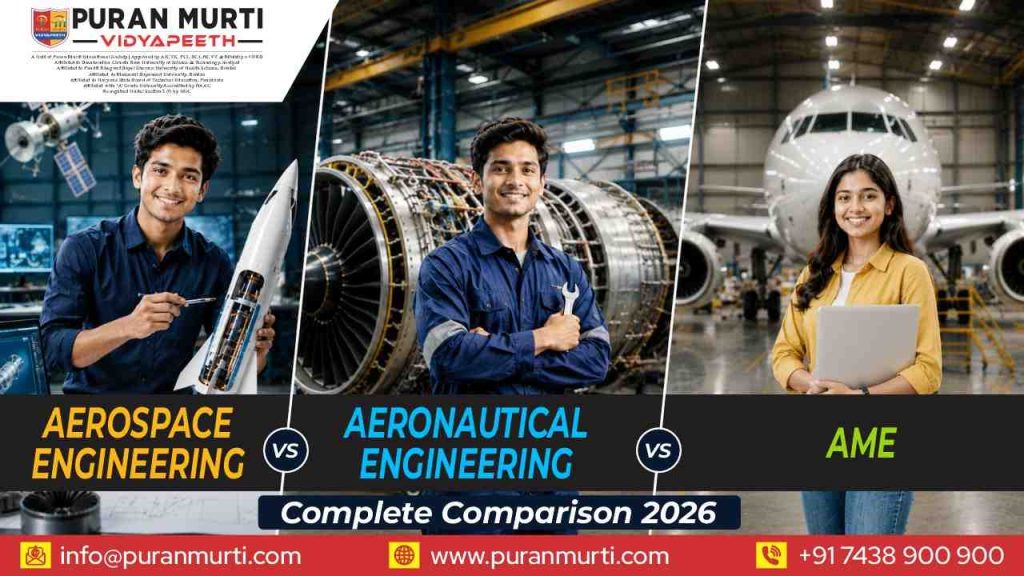
Aerospace Engineering vs Aeronautical Engineering vs AME: Complete Comparison 2027
Posted on : 7 June, 2026 12:36 pm
Aerospace Engineering vs Aeronautical Engineering vs AME is one of the most searched career comparisons among aviation aspirants in 2027. Students often struggle to understand the real differences between Aerospace Engineering vs Aeronautical Engineering vs AME because each field offers unique career opportunities in the aviation sector. While Aerospace Engineering vs Aeronautical Engineering vs AME may appear similar at first glance, they differ in curriculum, job responsibilities, industry exposure, and career growth. Therefore, understanding Aerospace Engineering vs Aeronautical Engineering vs AME is crucial for making the right educational and professional choice. As the aviation and aerospace industry continues to grow rapidly, students must carefully evaluate their interests, skills, and long-term goals before selecting the most suitable path.
Understanding Aerospace Engineering
Aerospace Engineering is a specialized branch of engineering that focuses on the design, development, testing, manufacturing, and maintenance of aircraft, spacecraft, satellites, missiles, and related systems.
Moreover, aerospace engineers work on technologies that operate both within Earth’s atmosphere and beyond it.
| Aspect | Details |
|---|---|
| Course Type | Engineering Degree |
| Duration | 4 Years |
| Eligibility | PCM in 12th |
| Main Focus | Aircraft and Spacecraft |
| Degree Awarded | B.Tech/B.E. |

What Is Aeronautical Engineering?
Aeronautical Engineering is a subset of Aerospace Engineering that deals specifically with aircraft operating within Earth’s atmosphere.
In addition, aeronautical engineers focus on aircraft structures, aerodynamics, propulsion systems, and flight mechanics.
| Aspect | Details |
|---|---|
| Course Type | Engineering Degree |
| Duration | 4 Years |
| Eligibility | PCM in 12th |
| Focus Area | Aircraft Only |
| Degree Awarded | B.Tech/B.E. |
What Is Aircraft Maintenance Engineering (AME)?
Aircraft Maintenance Engineering is a professional aviation program that trains students to inspect, maintain, repair, and certify aircraft for safe operation.
Unlike engineering degrees, AME is a licensing-based aviation program regulated by aviation authorities.
| Aspect | Details |
|---|---|
| Course Type | Licensing Program |
| Duration | 2–4 Years |
| Eligibility | PCM in 12th |
| Focus Area | Aircraft Maintenance |
| Certification | DGCA License |
Core Difference Between Aerospace Engineering and Aeronautical Engineering
Aerospace Engineering covers both aircraft and spacecraft, whereas Aeronautical Engineering focuses only on aircraft operating within the atmosphere.
| Aerospace Engineering | Aeronautical Engineering |
|---|---|
| Covers Aircraft | Covers Aircraft |
| Covers Spacecraft | Does Not Cover Spacecraft |
| Broader Scope | Specialized Scope |
| Space Research Opportunities | Aviation Industry Focus |
About Puran Murti Vidyapeeth
The institute is known for its focus on technical education, practical learning, laboratory exposure, and career-oriented training. Students can explore engineering programs in modern technology domains while benefiting from academic support, industry interaction, and campus facilities. The availability of hostel facilities, skill-development activities, and placement assistance also makes it a consideration for students looking for engineering education near Delhi NCR. Apply Now
Top Engineering Branches
BTech (Bachelor of Technology)
BTech is among the most popular courses after 12th Science (PCM).
Top Specializations:
- Aeronautical Engineering
- Aerospace Engineering
- Aircraft Maintenance Engineering (AME)
- Computer Science & Engineering (CSE)
- CSE with Artificial Intelligence and Machine Learning (AI & ML)
- Civil Engineering
- Electrical Engineering
- Electronics & Communication Engineering (ECE)
- Mechanical Engineering
Unique Aviation Programs (USP)
One of the biggest advantages of Puran Murti Vidyapeeth is its aviation-based courses, which are rare in India:
- B.Tech + AME (DGCA approved)
- B.Tech Mechanical Engineering + AME (DGCA)
- B.Tech ECE + AME (DGCA)
- B.Tech Computer Science
(AI & ML)+ AME (DGCA) - B.Tech Aeronautical Engineering
+ CPL (Ground Classes) - B.Tech Aerospace Engineering
+ CPL (Ground Classes)
Diploma Courses
Students can also choose job-oriented diploma courses: Apply Now
- Diploma in Automobile Engineering (AE)
- Diploma in AME (Aircraft Maintenance Engineering)
- Diploma in Aeronautical Engineering
- Diploma in Civil Engineering (CE)
- Diploma in Mechanical Engineering (ME)
- Diploma in Computer Science & Engineering (CSE)
- Diploma in Electronics & Communication Engineering (ECE)
- Diploma in Electrical Engineering (EE)
- Diploma in Fire Technology & Safety
- Diploma in Medical Lab Technology (MLT)
- Diploma in Hotel Management
- Diploma in CSE (AI & ML)
Core Difference Between Aerospace Engineering and AME
While Aerospace Engineering focuses on design and innovation, AME focuses on maintenance and airworthiness certification.
| Aerospace Engineering | AME |
|---|---|
| Design Aircraft | Maintain Aircraft |
| Engineering Degree | Aviation License |
| Research Focus | Technical Inspection |
| Development Role | Certification Role |
Core Difference Between Aeronautical Engineering and AME
Although both fields relate to aviation, their job responsibilities differ significantly.
| Aeronautical Engineering | AME |
|---|---|
| Aircraft Design | Aircraft Maintenance |
| Engineering Calculations | Aircraft Inspection |
| Development Work | Operational Safety |
| Manufacturing Sector | Airline Sector |
Course Structure of Aerospace Engineering
Students study advanced engineering concepts related to air and space systems.
| Major Subjects |
|---|
| Aerodynamics |
| Space Mechanics |
| Aircraft Structures |
| Flight Dynamics |
| Propulsion Systems |
Course Structure of Aeronautical Engineering
The curriculum primarily focuses on aircraft technologies.
| Major Subjects |
|---|
| Aircraft Design |
| Aerodynamics |
| Flight Mechanics |
| Aircraft Systems |
| Propulsion |
Course Structure of AME
AME students receive practical aircraft maintenance training.
| Major Subjects |
|---|
| Aircraft Systems |
| Maintenance Practices |
| Aviation Regulations |
| Avionics |
| Airframe Maintenance |
Eligibility Criteria
Before applying, students should understand admission requirements.
| Course | Eligibility |
|---|---|
| Aerospace Engineering | 10+2 PCM |
| Aeronautical Engineering | 10+2 PCM |
| AME | 10+2 PCM |
Admission Process
Admission procedures vary among institutions.
| Course | Admission Method |
|---|---|
| Aerospace Engineering | JEE/Main Entrance |
| Aeronautical Engineering | Entrance Exam |
| AME | Institute Admission Test |
Entrance Exams Accepted
Several entrance examinations are accepted nationwide.
| Course | Popular Exams |
|---|---|
| Aerospace Engineering | JEE Main, JEE Advanced |
| Aeronautical Engineering | JEE Main, State Exams |
| AME | AME CET, Institute Exams |
Duration Comparison
Course duration is an important factor for career planning.
| Program | Duration |
|---|---|
| Aerospace Engineering | 4 Years |
| Aeronautical Engineering | 4 Years |
| AME | 2–4 Years |
Practical Training Exposure
Practical learning plays a crucial role in aviation careers.
| Course | Practical Exposure |
|---|---|
| Aerospace Engineering | Moderate |
| Aeronautical Engineering | Moderate |
| AME | Very High |
Industry Orientation
Each program serves a different segment of the aviation ecosystem.
| Course | Industry Focus |
|---|---|
| Aerospace Engineering | Aviation and Space |
| Aeronautical Engineering | Aviation |
| AME | Airline Operations |
Skill Requirements for Aerospace Engineering
Students pursuing Aerospace Engineering generally require:
- Strong mathematics skills
- Analytical thinking
- Problem-solving ability
- Programming knowledge
- Research aptitude
Skill Requirements for Aeronautical Engineering
Furthermore, aeronautical engineers need:
- Engineering fundamentals
- Aircraft design understanding
- Technical analysis skills
- CAD proficiency
- Simulation expertise
Skill Requirements for AME
Meanwhile, AME professionals require:
- Technical accuracy
- Mechanical aptitude
- Inspection skills
- Safety awareness
- Attention to detail
Career Opportunities in Aerospace Engineering
Graduates can explore opportunities in:
- Space agencies
- Defense organizations
- Aircraft manufacturing companies
- Research institutions
- Satellite industries
Career Opportunities in Aeronautical Engineering
Career paths include:
- Aircraft design engineer
- Aerodynamics engineer
- Flight analyst
- Production engineer
- Aviation consultant
Career Opportunities in AME
Licensed AMEs can work as:
- Aircraft Maintenance Engineer
- Line Maintenance Engineer
- Base Maintenance Engineer
- Quality Assurance Engineer
- Technical Services Engineer
Top Recruiters for Aerospace Engineering
Leading employers include:
| Recruiters |
|---|
| ISRO |
| DRDO |
| Boeing |
| Airbus |
| HAL |
Top Recruiters for Aeronautical Engineering
Popular recruiters include:
| Recruiters |
|---|
| Airbus |
| Boeing |
| HAL |
| IndiGo |
| SpiceJet |
Top Recruiters for AME
Major aviation employers include:
| Recruiters |
|---|
| Air India |
| IndiGo |
| Akasa Air |
| SpiceJet |
| Air Works |
Salary Comparison in 2027
Salary varies according to skills, organization, and experience.
| Course | Entry-Level Salary |
|---|---|
| Aerospace Engineering | ₹5–10 LPA |
| Aeronautical Engineering | ₹4–8 LPA |
| AME | ₹4–9 LPA |
Higher Education Opportunities
Students can pursue advanced studies after graduation.
| Course | Higher Education Options |
|---|---|
| Aerospace Engineering | M.Tech, MS, PhD |
| Aeronautical Engineering | M.Tech, MS |
| AME | B.Tech, MBA, Aviation Management |
Government Sector Opportunities
Government organizations continue to recruit aviation professionals.
| Course | Government Opportunities |
|---|---|
| Aerospace Engineering | High |
| Aeronautical Engineering | Moderate |
| AME | Moderate |
International Career Scope
Global demand is increasing across aviation sectors.
| Course | International Scope |
|---|---|
| Aerospace Engineering | Excellent |
| Aeronautical Engineering | Very Good |
| AME | Excellent with License Conversion |
Future Demand in 2027 and Beyond
The aviation sector is expected to witness substantial growth due to expanding airline fleets, increasing air travel demand, and advancements in aerospace technology.
Consequently, all three career paths are likely to remain relevant for decades.
| Field | Future Demand |
|---|---|
| Aerospace Engineering | Very High |
| Aeronautical Engineering | High |
| AME | Very High |
Advantages of Aerospace Engineering
Some major advantages include:
- Broad career scope
- Space sector opportunities
- Research-oriented profile
- High innovation exposure
- Global demand
Advantages of Aeronautical Engineering
Similarly, this field offers:
- Aircraft specialization
- Strong engineering foundation
- Aviation industry relevance
- Diverse technical roles
- International opportunities
Advantages of AME
On the other hand, AME provides:
- Industry-focused training
- Licensing advantage
- Early employability
- High practical exposure
- Strong airline demand
Challenges in Aerospace Engineering
Students should also consider potential challenges:
- Complex curriculum
- Intensive mathematics
- Competitive job market
- Research-oriented learning

Challenges in Aeronautical Engineering
Likewise, some challenges include:
- Specialized industry dependence
- Technical complexity
- Limited space-sector exposure
Challenges in AME
Furthermore, AME professionals face:
- Regulatory examinations
- High responsibility levels
- Strict safety standards
- Shift-based operations
Which Course Is Best for Aircraft Design?
If your goal is aircraft design and development, Aerospace Engineering and Aeronautical Engineering are generally the strongest options.
However, Aerospace Engineering provides a broader perspective because it includes both aviation and space technologies.
Which Course Is Best for Aircraft Maintenance?
If you want to inspect, maintain, troubleshoot, and certify aircraft, AME is the most suitable choice.
Therefore, students interested in hands-on aviation operations often prefer this pathway.
Which Course Has Better Job Security?
All three fields offer promising career opportunities. Nevertheless, AME professionals often benefit from consistent demand because aircraft maintenance remains mandatory throughout an aircraft’s operational life.
Which Course Offers the Highest Growth Potential?
Aerospace Engineering often offers the widest growth potential due to opportunities in aviation, defense, satellite technology, and space exploration.
Meanwhile, AME provides strong career stability, and Aeronautical Engineering offers specialized expertise in aircraft technologies.
Final Verdict
Choosing between Aerospace Engineering, Aeronautical Engineering, and AME depends entirely on your career aspirations.
If you are passionate about spacecraft, satellites, advanced research, and next-generation technologies, Aerospace Engineering can be an excellent choice. Conversely, if your interest lies specifically in aircraft design and aviation engineering, Aeronautical Engineering may align better with your goals. However, if you prefer practical aviation operations, aircraft maintenance, inspections, and certification responsibilities, AME offers a highly rewarding and industry-focused career path.
Ultimately, understanding your interests, strengths, and long-term objectives will help you select the most suitable program and build a successful career in the rapidly evolving aviation industry.
Frequently Asked Questions (FAQs)
1 What is the difference between Aerospace Engineering, Aeronautical Engineering, and AME?
Aerospace Engineering covers aircraft and spacecraft, Aeronautical Engineering focuses on aircraft, while AME specializes in aircraft maintenance and certification.
2 Which field has better career opportunities in 2027?
All three fields offer strong career prospects. However, the best option depends on whether you prefer design, development, or aircraft maintenance.
3 Is AME a degree course?
No, AME is a licensing-based aviation program. It trains students to inspect, maintain, and certify aircraft for safe operation.
4 Which course is best for aircraft design?
Aerospace and Aeronautical Engineering are ideal for aircraft design. Aerospace offers broader exposure, while Aeronautical focuses only on aircraft.
5 Can AMEs and Aerospace Engineers work in the same industry?
Yes, both work in aviation. However, AMEs maintain and certify aircraft, whereas engineers focus on design, testing, and development.